Editor’s Notes
Total Results: 1697
Volume 111 : February 2026 Issue
Incongruent melting of garnet during garnet-spinel transition and its implication for lithospheric exhumation
https://doi.org/10.2138/am-2025-9809
Phase transitions with strong rock density influences play an important role in the vertical surface movement of the Earth. Garnet-spinel transition leads to a moderate decrease in the density of the lithospheric mantle, resulting in the syn-rift uplift in the extending lithosphere. The transition processes of garnet-spinel, however, remain unclear. Zou et al. analyzed the mineral chemistry of spinel-pyroxene symplectites around garnet from an olivine-websterite xenolith hosted by the Cenozoic Xilinhot basalts in northeast China. This work provides the first physical evidence of incongruent melting of garnet during the garnet-spinel transition and provides a rare case to connect the phase transition and lithospheric exhumation.
The optics of a possible new interference figure in mineralogy
https://doi.org/10.2138/am-2025-9824
Likely a new type of interference figure: grossular garnets collected in Quixeramobim city in Brazil exhibit a new interference figure, called the "mosaic," observed in seven samples of this garnet variety. The "mosaic" is formed by the agglutination of colors (blue, yellow, and purple) when viewed with the quartz-gypsum accessory plate, due to the different light vibration directions as it passes through these anisotropic garnets. The "mosaic" configuration occurs when the optic axes and acute and obtuse bisectrices align in such a way that both inclined (//) and perpendicular (⟂) directions are present simultaneously. So far, the "mosaic" has only been observed in garnets of the grossular group from Quixeramobim (Brazil) and occurs only in minerals that exhibit a high degree of optical disorder.
Fe2+/Fe3+ intervalence charge transfer and enhanced d-d absorption in mixed-valence iron minerals at elevated temperatures
https://doi.org/10.2138/am-2024-9724
A broad range of mixed valence Fe minerals are found to become much more optically transparent at elevated temperatures due to phenomena related to interactions between Fe2+ and Fe3+ cations: their Fe2+/Fe3+ intervalence charge transfer absorption bands lose significant intensity, as can their Fe2+ d-d absorption features, which are likely enhanced by Fe2+/Fe3+ exchange-coupled pairs. This behavior has potential implications for the importance of radiative conductivity in the Earth's mantle.
The first meteoritic ammonium mineral: Discovery of boussingaultite in the Orgueil CI1 carbonaceous chondrite
https://doi.org/10.2138/am-2025-9851
The paper reports the discovery of the first meteoritic ammonium mineral, nickeloan boussingaultite, (NH4)2(Mg,Ni)(SO4)2·6H2O. The mineral was found in Orgueil, a primitive carbonaceous chondrite closely related to the carbonaceous asteroids Ryugu and Bennu. It is demonstrated that boussingaultite (ammonium Tutton's salt) may serve as the likely carrier of bound ammonia in cometary and asteroidal bodies.
Volume 111 : January 2026 Issue
The structure and elasticity of hydrogrossular under high pressure: Implications for the origin of the low-velocity zone in the mantle
https://doi.org/10.2138/am-2025-9830
Garnet is recognized for its stability within the Earth's interior, constituting a significant portion of the Earth's crust and mantle with a modal abundance ranging from approximately 15% to 40%. Water has a strong effect on several key properties of the deep Earth. Hydrogrossular, the hydrous garnet, is considered an important water carrier in the mantle. Here, the density, elastic modulus, and seismic wave velocity of hydrogrossular with different water contents under high pressure (to 100 GPa) were calculated by first-principles. The results indicate that water significantly reduces seismic wave velocities of hydrogrossular. The presence of hydrogrossular, particularly at different water contents, could account for the lower-than-average seismic velocities compared to those predicted by the PREM. Therefore, Naren et al. propose that hydrogrossular might play a more important role in causing the mantle LVZs than previously imagined.
The partitioning of H between olivine and melt at low pressures (10—200 MPa)
https://doi.org/10.2138/am-2025-9738
Peterson et al. experimentally investigated the control(s) on H partitioning between olivine and melt at low pressures (10–200 MPa). Contrary to the pressure control found in high-pressure experiments, the study found that the speciation of H in the melt (i.e., molecular water or hydroxyl) is the primary control. In combination with prior work, the authors suggest that H speciation in the melt is a major control on H partitioning between all nominally anhydrous minerals (e.g., olivine, pyroxene, feldspar) and melts.
Spectroscopic and physicochemical study of the color grain-size effect in lazurite-type minerals
https://doi.org/10.2138/am-2024-9656
The color grain-size effect (CGSE) in lazurite-type minerals is an unexplained phenomenon of color dependence on grain size, and an important feature for studying the physicochemical conditions of particular chromophore stability. The model proposed for relatively large lazurite grains suggests calcite microinclusions and segregations along subgrain boundaries play the role of an internal buffer supporting the equilibrium coexistence of oxidized (SO42–, SO32–, possibly S2O32–) and reduced (S3–)sulfur . With the appropriate particle size, lapis lazuli pigment in paints is a stable phase and will not discolor over time in air in works of architecture and graphic art.
Pfaffenbergite, KNa3(Al4Si12)O32, a polymorph of sodic feldspar isostructural with kokchetavite and wodegongjieite, found in crystallized melt inclusions in metamorphic garnet
https://doi.org/10.2138/am-2025-9750
The feldspar family is the most common mineral group in the Earth's crust. Ferrero et al. found a new feldspar polymorph, pfaffenbergite, which crystallizes rapidly under metastable conditions from a silicate melt that originally was trapped as an inclusion. The authors propose that metastable minerals may be rather common in rapidly cooled/rapidly crystallized geological materials, such as lavas and ignimbrites, as well as experimental products. Their investigation may unravel the mechanisms of crystal formation under non-equilibrium conditions.
Identification of multiple orogenic cycles experienced by granulites from the Dabie orogen by multi-mineral dating
https://doi.org/10.2138/am-2024-9509
Accessory minerals in granulites from the Dabie orogen show different responses to different periods of granulite facies metamorphism produced by a Paleoproterozoic and a Cretaceous orogeny. Zircon records Paleoproterozoic granulite facies metamorphism, whereas rutile and apatite record Cretaceous metamorphic ages. The results suggest that zircon is a reliable recorder of early granulite facies metamorphism while rutile and apatite are robust recorders of later granulite facies metamorphism.
Alteration evolution of lightning fossils: Insights from natural fulgurite scars and hydrothermal experiments
https://doi.org/10.2138/am-2025-9815
The extreme energy dissipation during cloud-to-ground lightning strikes can result in high-temperature, high-pressure metamorphism of rocks on the surface, forming fulgurite. Recognition of ancient rock fulgurites and careful documentation of the associated alteration process are important because they represent a unique form of extreme metamorphism at the Earth's surface and can be used as indicators to reconstruct paleoecology, record paleoclimate events, lightning intensities, and energy dissipation. By integrating experimental results with field observations, Kuo et al. establish an alteration evolution of rock fulgurite with geological and approximate time constraints and provide insights into the alteration processes of rock fulgurite exposed on the surface. These findings also offer applications for recognizing rock fulgurite and the relevant remnants and, by extension, other rock-exposed regions with incomplete lightning catalogs.
Crystal structure of dehydrated ulexite, NaCaB5O6(OH)6á3H2O
https://doi.org/10.2138/am-2025-9820
This study investigates the crystal structure of the dehydrated ulexite phase, NaCaB5O6(OH)6·3H2O, using single-crystal X-ray diffraction. Yamaguchi et al. also investigate whether the thermal transformation from the three- to the one-hydrated phase occurs during the ulexite dehydration and dehydroxylation processes. This study makes a significant contribution to the literature because, to date, the dehydrated ulexite phases occurring in the temperature range of 60-260 °C have not been elucidated, and the crystal structure of the three-hydrated phase has not been determined. The results indicate the formation of a stable three-hydrated phase that retains the fundamental borate building block observed in ulexite. Importantly, the findings clarify the nature of the one-hydrated phase and suggest that dehydrated ulexite emerges naturally as a stable hydrated borate mineral.
Equation of state of Fe-bearing epidote-group minerals determined by X-ray diffraction
https://doi.org/10.2138/am-2024-9699
The epidote group are important hydrous minerals in Earth's interior. Since the decomposition of epidote group minerals in subducted basalts at elevated pressure and temperature could release water into the upper mantle, their physical properties under extreme conditions, including their stability, compressibility, and equations of state, are of great importance for understanding the circulation of water in the Earth's deep interior. In this study, Zhang et al. used the diamond anvil cells (DACs) combined with synchrotron X-ray diffraction (XRD) to study the equation of state of zoisite, clinozoisite, and epidote with different iron content. They found that elevating the Fe content increases the density of epidote group minerals but decreases the elastic modulus. For samples with the same Fe content, the orthorhombic zoisite has higher density and lower bulk modulus than the monoclinic clinozoisite.
Iron isotope fractionation between solid and liquid metal in the Fe-P±Ni system: Experimental constraints and implications for meteorites
https://doi.org/10.2138/am-2025-9765
Bennett et al. report Fe isotope fractionation between solid and liquid Fe-rich alloys as a function of P content. Increased P increases fractionation, with the liquid being isotopically lighter than the coexisting solid. The results suggest P has a negligible effect on Fe isotope distribution during fractional crystallization of planetesimal cores. The Fe isotope composition of schreibersite in iron and stony iron meteorites, however, can be useful in the analysis of its petrogenesis.
Elasticity of β-Mg2SiO4 containing 1.2 wt% H2O to 10 GPa and 600 K by ultrasonic interferometry with synchrotron X-radiation
https://doi.org/10.2138/am-2024-9664
This paper presents new sound velocities and elasticity for hydrous wadsleyite containing 1.2 wt% H2O. When fit to third-order finite strain equations, the elasticity data allow estimation of pressure and temperature derivatives for the bulk and shear moduli. Combining the new data with data from previous studies, Noda et al. suggest that a hydrous mantle transition zone with a pyrolite composition explains the 410 km seismic velocity jump.
The link between gold mineralization and fluid evolution in epithermal systems: A case study of the Dongyang gold deposit, China
https://doi.org/10.2138/am-2024-9390
Zhang et al. reconstructed the processes of fluid evolution for the Dongyang epithermal gold deposit based on the compositional, textural, and sulfur-isotopic signatures of sulfide minerals. The authors interpret a vertical zonation based on a distinct transition from an upper (surface to ~100 m) sulfide assemblage with negative-_34S to a lower (below ~100 m) zone where sulfides with near-zero-_34S coexist with ferric iron oxides and sulfosalts, indicative of an increase in the oxygen fugacity of the hydrothermal fluids with depth. Decreasing oxygen fugacity in hydrothermal fluids facilitated As partitioning into sulfides, thereby leading to the mineralization of "invisible" gold in this deposit.
A new trigonal (3T) polytype of chloritoid, Fe2+Al2(SiO4) O(OH)2, from the Kosoy Brod deposit, Middle Urals, Russia: Chemical composition, crystal structure, and complexity analysis
https://doi.org/10.2138/am-2025-9751
Zolotarev et al. describe a new polytype (3T) of the rock-forming mineral chloritoid, which may be widespread but was previously overlooked. The crystal structure of chloritoid-3T has been determined and refined using single-crystal X-ray diffraction (XRD). It has the highest symmetry and the highest structural complexity among the three modifications of chloritoid. Analysis of the powder XRD pattern of chloritoid-3T reveals its differences from those of previously known modifications (1A and 2M2). Analysis of the structural topology of different modifications of chloritoid indicates that they can be classified as polytypes, rather than polymorphs, as proposed in a number of previous works. The issue of polytype stability fields is debatable, but attempts to reconstruct the thermal history of rocks based on structural modifications of chloritoid have been made; any correlations between the presence of a structural modification and kinetic and/or thermodynamic parameters should be preceded by the determination of crystal structures and diagnostic features of all structural modifications of chloritoid.
High-pressure phase transitions in dalyite, a Zr-silicate
https://doi.org/10.2138/am-2024-9504
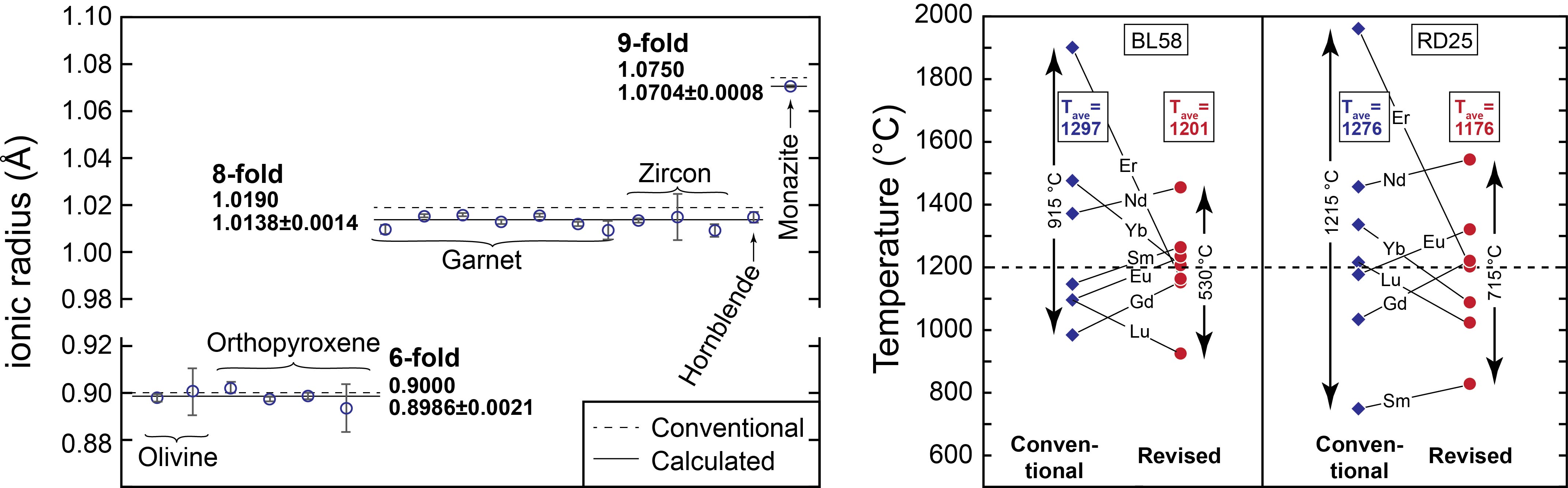
Dalyite is an indicator of melt fractionation and/or late-stage processes, forming only in conditions of high silica activity and high K2O chemical potential. Comboni et al. present the first high-pressure study on dalyite. Two phase transitions were observed, the structures of the high-pressure polymorphs were solved, and their structural evolution was described.
NEW MINERAL NAMES
https://doi.org/10.2138/am-2026-NMN111121
Complex carbonate ore mineralogy in the Mountain Pass carbonatite rare earth element deposit, U.S.A.
https://doi.org/10.2138/am-2025-9822
Economic concentrations of rare earth element (REE) minerals are uncommon in the Earth's crust, with most occurring in carbonatites. Carbonatites are dominated by carbonate minerals, some of which can incorporate significant concentrations of light REEs (LREEs; La, Ce, Pr, Nd). Technological applications of REEs are numerous, and they have been identified as some of the most critical mineral commodities to the global economy. The Mountain Pass carbonatite stock in the Mojave Desert of California is the most economically significant REE deposit in the U.S.A. and contains a few to tens of percent (by volume) of the carbonate REE ore mineral bastnäsite. Watts and Andersen present new data on the mineralogy of carbonate ores for a compositionally diverse suite of carbonatitic rocks from the Mountain Pass stock and related dikes, with implications for ore processing and magnet manufacture. Whole-rock geochemical data are integrated with mineral-scale textural and chemical data from scanning electron microscopy, electron probe microanalysis, and microRaman spectroscopy, important given the multiple compositional domains in individual crystals.
Volume 110 : December 2025 Issue
Formation and transformation of clay minerals influenced by biological weathering in a red soil profile in Yangtze River, China
https://doi.org/10.2138/am-2024-9412
Formation and transformation processes of clay minerals are influenced by both biotic and abiotic weathering, yet the specific mechanisms remain unclear. This investigation by Wang et al. reveals a profound association between biotic weathering involving organic acids and the formation and transformation of clay minerals. The findings underscore the significant influence of biotic weathering involving organic acids on the structure and composition of clay minerals, within the context of climate change, a phenomenon that is inadequately reported in natural systems, including soils and sediments.
« ‹ 1 2 3 4 … 85 › »ADDITIONAL RESOURCES