

Editor’s Notes
Total Results: 1697
Volume 109 : November 2024 Issue
Tetrahedral aluminum in tourmaline from a spinelpargasite-metamorphosed mafic-ultramafic rock
https://doi.org/10.2138/am-2023-9170
This paper focuses on tourmaline, which is up to 25% tetrahedral aluminum. Tourmaline occurs as dark blue crystals (with isometric external morphology) up to 3 mm in size and forms veinlets intersecting Mg-, Al-rich rock composed of spinel, pargasite, clinochlore, phlogopite, and hydroxylapatite. All tourmaline crystals investigated are characterized by chemical zoning and can be compositionally formed via Tschermak-like or plagioclase-like substitutions. Zones with a relatively high Si content have pronounced indications of dissolution, while silicon-depleted zones overgrow Si-rich zones and eventually create a visible replacement zone of the crystal. The tourmaline studied was formed at 600-750 °C and 0.10-0.20 GPa. The formation of tetrahedral Al-rich tourmalines requires several unusual factors: (1) desilication of primary rocks and (2) high temperatures and pressures.
Lorenz number and transport properties of Fe: Implications to the thermal conductivity at Earth's core-mantle boundary
https://doi.org/10.2138/am-2023-9246
Yin et al. measured the _ values of solid iron using the four-wire van der Pauw method in the multi-anvil press to measure the electrical resistivity of solid iron at 300 K and pressures to 26 GPa. The thermal conductivity of solid hcp iron is calculated as 129-9 W/m/K at 136 GPa and 300 K by the first-principles molecular dynamics methods. Electrical resistivity and thermal conductivity of solid hcp iron at Earth's CMB are estimated as ~76-83 _Ω·cm and 114-6 W/m/K, respectively.
Structure and equation of state of Ti-bearing davemaoite: New insights into the chemical heterogeneity in the lower mantle
https://doi.org/10.2138/am-2023-9104
Chao et al. investigated the density and equation of state of Ca(Si,Ti)O3 perovskite, finding that Ti-bearing perovskite is less dense than its pure CaSiO3 counterpart. This feature implies that the Ti-bearing perovskite may help slab stagnation and favor the formation of large, low-shear-velocity provinces.
Solfataric alteration at the South Sulfur Bank, Kilauea, Hawaii, as a mechanism for the formation of sulfates, phyllosilicates, and silica on Mars
https://doi.org/10.2138/am-2023-9153
The South Sulfur Bank region of the Kilauea volcano in Hawaii formed through solfataric alteration of glassy, volcanic Keanakako'i ash near fumaroles. Low-temperature hydrothermal alteration of the Keanakako'i ash produced assemblages of smectite clays, opal, gypsum, and jarosite, similar to outcrops on Mars in parts of Gale Crater, Noctis Labyrinthus, and Mawrth Vallis. Altered ash closer to vents is predominantly opal and anatase and serves as a potential analog for silica-rich regions of Gusev crater, Gale crater, and Nili Patera on Mars.
Plastic deformation and trace element mobility in sphalerite
https://doi.org/10.2138/am-2023-9215
Sphalerite (ZnS) is found in many ore deposits and is frequently hosted in metamorphic terranes that have undergone deformation and related recrystallization. However, deformation mechanisms of sphalerite are still poorly understood because evidence is barely visible under the optical microscope and may reflect complex and multistage mechanisms. Furthermore, sphalerite may host up to a few thousand ppm of critical metals such as gallium (Ga), germanium (Ge), and indium (In). Metamorphic conditions and dynamic recrystallization may have induced local or total redistribution of these elements. This study highlights the key importance of coupled textural (EBSD analyses) and in-situ chemical analyses (LIBS mapping) of diverse sphalerite types at a regional scale to indirectly unravel the origin of vein mineralization and the related critical metal distribution and mobility in sphalerite during mineral deformation and fluid circulation in the rocks.
Crystallographic insights into monovalent thallium incorporation: Exploring hydropyrochlore structure for environmental remediation
https://doi.org/10.2138/am-2023-9289
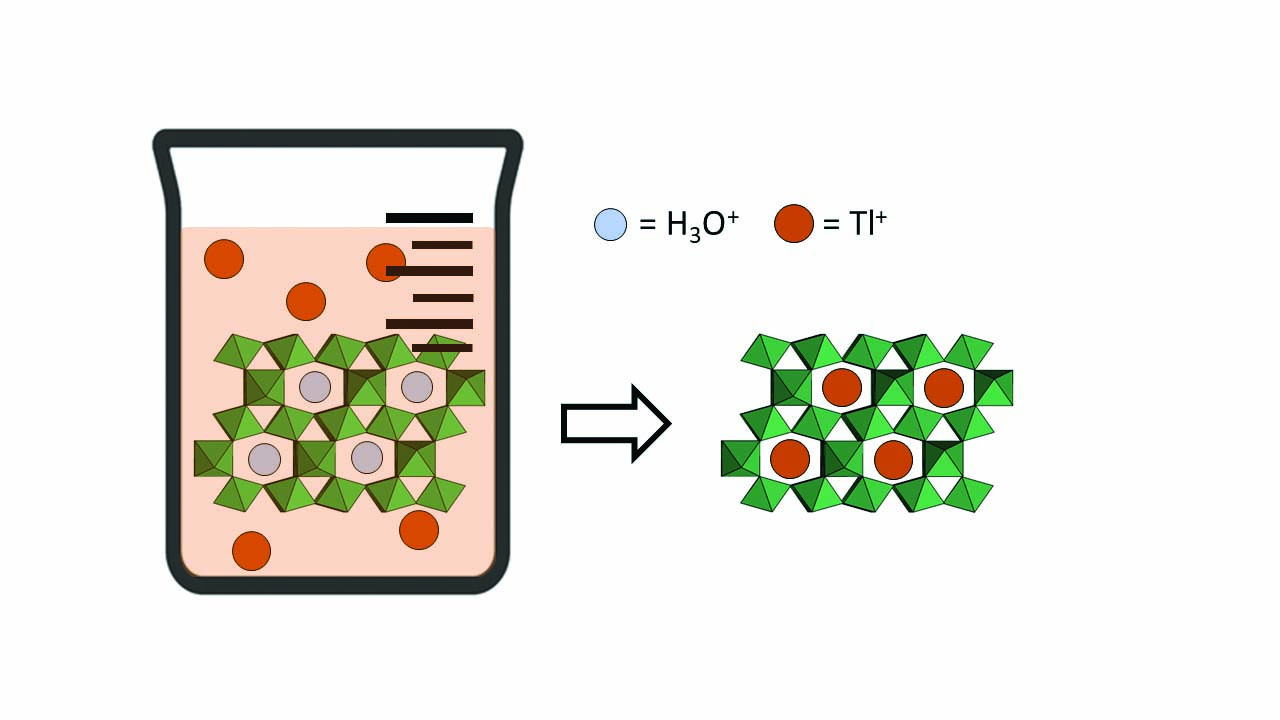
This study underlines the capabilities of the structure of hydropyrochlore to incorporate large amounts of Tl+ and, focusing on the structural variations subsequent to imbibition experiments in thallium-rich solutions, unequivocally demonstrates that this cation is not merely adsorbed on the surface of the crystal. As such, this research offers, although with some limitations, a versatile and promising solution for thallium sequestration and possibly the sequestration of other hazardous elements.
Distribution of REE between amphibole and pyroxenes in the lithospheric mantle: An assessment from the lattice strain model
https://doi.org/10.2138/am-2022-8831
Wang et al. developed predictive models for REE partition coefficients between pyroxenes and amphibole based on parameterized lattice strain models of mineral-melt REE partitioning for orthopyroxene, clinopyroxene, and amphibole and calibrated using mineral compositional data of natural amphibole-bearing mantle samples. The models demonstrate that amphibole generally crystallizes at a lower temperature than pyroxenes. Wang et al. quantified the amphibole temperature using major element compositions of amphibole. They show that a set of pyroxene-amphibole REE partition coefficients obtained from the models are especially useful for inferring REE contents in amphibole from those in pyroxenes when the grain size of amphibole in the mantle rock is too small for trace element analysis.
Elastic anomalies across the P21nm→Pnnm structural phase transition in δ-(Al,Fe)OOH
https://doi.org/10.2138/am-2023-9129
Oxyhydroxides like δ-(Al,Fe)OOH are the main carriers of hydrogen into the Earth's lower mantle. In these hydrous phases, hydrogen is bound through a typical O-H···O sequence that symmetrizes upon compression. Recent studies have shown proton disorder to be a precursor of the hydrogen bond symmetrization in δ-AlOOH. A structural phase transition from P21nm to Pnnm within the same pressure range occurs as pressure increases. The relation between elastic behavior, hydrogen bond disorder/symmetrization, and the structural phase transition in δ-(Al,Fe)OOH is still poorly constrained, limiting understanding of hydrogen recycling into the Earth's interior. In this study, δ-(Al,Fe)OOH single crystals were pressurized in a diamond-anvil cell and investigated by simultaneous X-ray diffraction and Brillouin spectroscopy measurements. The study results provide new insights into the relation between single-crystal elasticity at high pressures, structural transition, and proton disordering in δ-(Al0.97,Fe0.03)OOH, which may be applied to other O- H···O-bearing materials as well.
Hyper-enrichment of heavy rare earth elements in highly evolved granites through multiple hydrothermal mobilizations
https://doi.org/10.2138/am-2023-9117
Heavy rare earth elements (HREE) have become essential in modern society. The dominant source of the HREE is from regolith-hosted deposits, mostly developed from HREE-enriched, highly evolved granites. However, the HREE enrichment process of these granites is still poorly understood. Li and Zhou examined the Zudong HREE-rich granite from South China, which is the protolith of the world's largest regolith-hosted HREE deposit, to investigate the mineral record, especially of zircon, to illustrate the magmatic-hydrothermal process of HREE enrichment and the associated REE fractionation. Multiple hydrothermal re-mobilizations of the REE have been identified that progressively enrich the granite with HREE and remove other elements, including LREE, causing significant HREE enrichment.
In-situ zircon and cassiterite LA-ICP-MS geochronology and implications for granite-hosted Sn deposit models and exploration: Insights from the Cameroon Line
https://doi.org/10.2138/am-2023-9174
The widely accepted petrogenetic model of granite-hosted Sn deposits supports a genetic link between the host granite and the Sn mineralization event. However, U, Th, and Pb compositions from cassiterite and zircon from a granite host argue against contemporaneous formation of the granite and Sn mineralization. In fact, the Sn mineralization event is ca. 10 Ma younger than the host granite. This finding bears significant implications not only in terms of granite-related Sn deposit genetic models but also in terms of their exploration guidelines.
Compressibility, thermal expansion, and Raman spectroscopy of synthetic whitlockite Ca9Mg(PO3OH)(PO4)6 at high pressures and high temperatures
https://doi.org/10.2138/am-2023-9084
Temperature-induced dehydrogenation of whitlockite to merrillite was observed in situ above 973 K at ambient pressure, which indicates that some part of OH-bearing whitlockite may remain and could be discovered in meteorites if whitlockite undergoes a low-temperature process.
Experimental determination of tin partitioning between titanite, ilmenite, and granitic melts using improved capsule designs
https://doi.org/10.2138/am-2023-9232
Mineral/melt partition coefficients of Sn --D(Sn)--are important for understanding Sn behaviors in magmatic processes but remain lacking due to the notorious alloying effect of Sn with noble metal sample capsules. In this study, Huang et al. developed new capsule designs that prevent the alloying effect of Sn at a controlled oxygen fugacity (fO2). Using the new capsule designs D(Sn) between titanite, ilmenite, and granitic melt at P-T-fO2 conditions of 850-1000 °C, 0.5-1 GPa, and ~QFM-4-QFM+8 was determined. The results show that D(Sn) for both titanite and ilmenite are crucially dependent on fO2 and vary by 4 log units at the experimental conditions. The D(Sn) values for titanite and ilmenite provide a basis for determining Sn contents of primitive magmas, and Sn contents of the pre-mineralization granitic magmas in natural systems were estimated.
Low-temperature crystallization of kumdykolite, a polymorph of albite, during mineral carbonation within fluid inclusions in hornblendite from the Dabie orogen, central China
https://doi.org/10.2138/am-2023-9169
Kumdykolite is a polymorph of albite previously identified only within crystallized melt inclusions in high-temperature metamorphic rocks and porous silica patches in EH3 chondrite. This study reports a new occurrence of kumdykolite that precipitated during in-situ mineral carbonation within amphibole-hosted fluid inclusions in hornblendite. Kumdykolite within the fluid inclusions crystallized under conditions significantly different from previous reports. In particular, it crystallized at relatively low temperatures (greenschist facies), in contrast to previously reported high-temperature kumdykolite (granulite facies). Therefore, kumdykolite presented in this study may add to the knowledge of feldspar polymorphs, providing new insights into the petrogenesis of kumdykolite and related crustal processes.
Louisfuchsite, Ca2(Mg4Ti2)(Al4Si2)O20, a new rhšnite-type mineral from the NWA 4964 CK meteorite: A refractory phase from the solar nebula
https://doi.org/10.2138/am-2023-9283
Louisfuchsite is a new member of the rhönite subgroup under the sapphirine supergroup. It crystallized from an 16O-rich refractory melt under reduced conditions, among the first solid materials to occur in the solar nebula. It joins the 50+ refractory minerals identified in carbonaceous chondrites, marking the beginning of mineral evolution in the solar system.
Volume 109 : October 2024 Issue
Evidence for oceans pre-4300 Ma confirmed by preserved igneous compositions in Hadean zircon
https://doi.org/10.2138/am-2023-9180
Cameron et al. demonstrate that primary, well-preserved domains can be recognized using standard methodologies even in zircons older than 4000 Ma. The results refute the hypothesis that mildly elevated δ18O values in Hadean zircons result from alteration. The results show that pristine domains in Jack Hills zircons that preserve primary unaltered δ18O values representative of their growth in Hadean magmas can be identified if carefully selected based on objective criteria. This study supports the conclusion that the surface of early Earth cooled and had liquid-water oceans before 4300 Ma. Thus, conditions were habitable for life 800 myr before the oldest documented microfossils. This article is part of the “Isotopes, Minerals, and Petrology: Honoring John Valley” special collection.
Experimental vs. natural fulgurite: A comparison and implications for the formation process
https://doi.org/10.2138/am-2023-9192
Fulgurites, glassy formations from lightning strikes, offer insights into past environments and prebiotic chemistry. Çalışkanoğlu et al. compared a natural fulgurite in Eastern Turkey to one created in a lab, finding similar structures and, using Raman spectroscopy, estimated a formation temperature gradient. The authors also measured cloud-to-ground lightning discharge parameters, suggesting a current range for the natural fulgurite's formation. This research enhances the understanding of fulgurite formation and its implications for Earth's history.
Illitization of smectite influenced by chemical weathering and its potential control of anatase formation in altered volcanic ashes
https://doi.org/10.2138/am-2023-9125
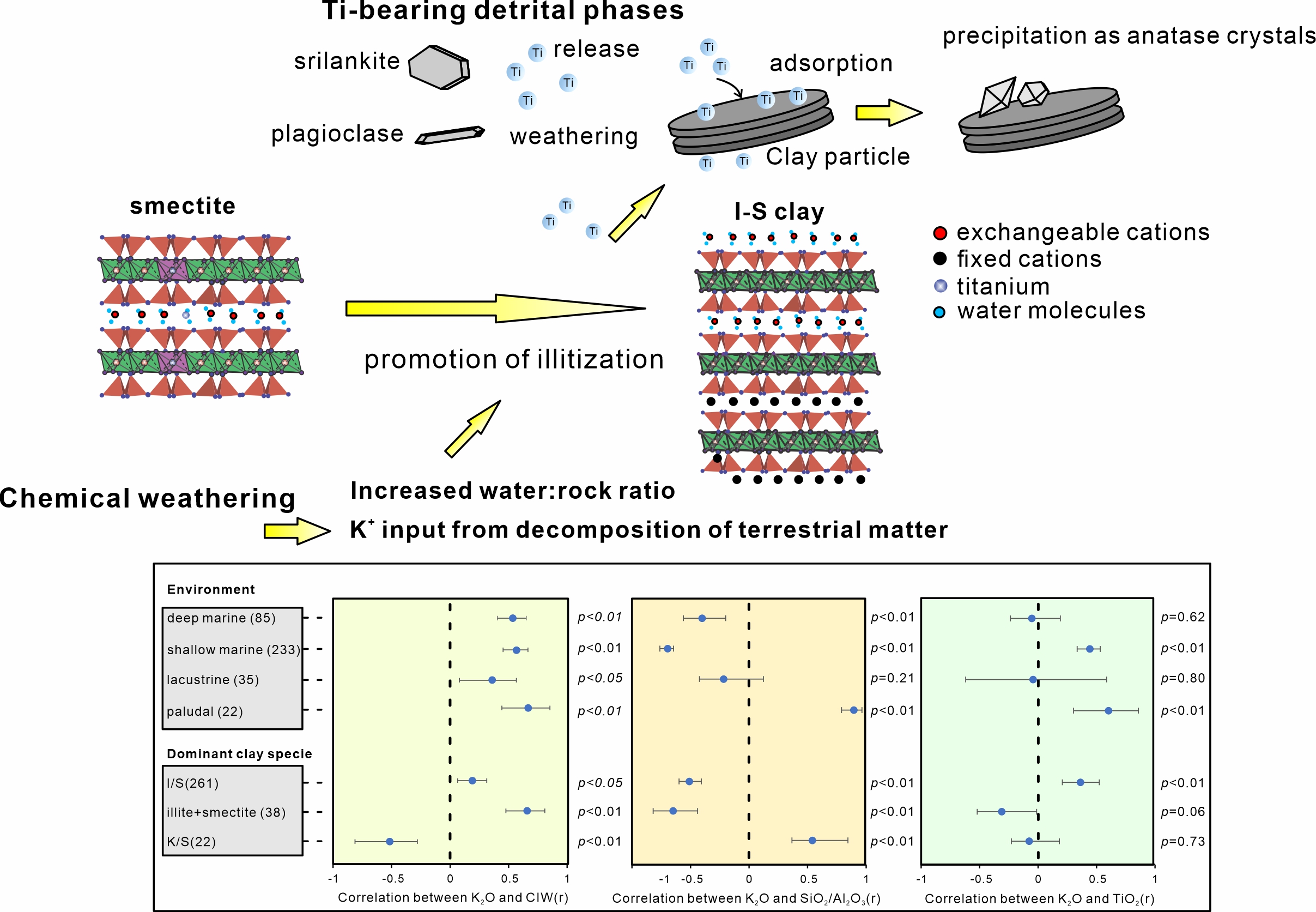
Through investigation of the fine structure of clay minerals and in-situ nano-mineralogy of Ti-bearing minerals from K-bentonite and meta-analysis of geochemical compositional data compilation of 384 K-bentonite layers with a global distribution, Liu et al. discovered that chemical weathering could promote the illitization reaction, which may jointly influence the formation of Ti oxides. Interstratified illite-smectite can adsorb Ti during the weathering and provide a suitable site for the nucleation of anatase and enrichment of titanium. This study unravels the role of chemical weathering in the illitization of smectite and its effect on the formation of Ti oxides. The comprehensive dataset advances our understanding on the formation of interstratified illite-smectite, illitization process, and related geochemical cycling in sedimentary systems. The coupling revealed in this study represents a linkage between sedimentary-basin evolution, environmental change, clay-mineral transformation, and nano-mineral neoformation.
A modified genetic model for multiple pulsed mineralized processes at the giant Qulong porphyry Cu-Mo mineralization system
https://doi.org/10.2138/am-2023-9145
To gain deeper insights into the processes that led to the formation of porphyry copper deposits (PCD), Zheng et al. obtained data from cathodoluminescence (CL) imaging, in-situ trace elements, and Sr isotopes of newly discovered scheelite (Sch 1, Sch 2, and Sch 3) found in three generations of vein types within the giant Qulong porphyry Cu-Mo mineralization system. These scheelite veins record at least three superimposed, episodic hydrothermal pulses. Volatiles originating from mafic rocks, injected into the porphyry metallogenic system, assume a pivotal role in shaping PCD formation. These findings shed light on the potential for identifying complementary metal endowments of W-Cu-Mo and extending the metallogenic scope of PCDs within collision zones.
Lead and noble gas isotopic constraints on the origin of Te-bearing adularia-sericite epithermal Au-Ag deposits in a calc-alkaline magmatic arc, NE China
https://doi.org/10.2138/am-2022-8552
Gao et al. present the in-situ study of Pb isotopes in tellurides (including altaite, petzite, and hessite) in epithermal systems conducted using a femtosecond laser ablation MC-ICP-MS. The authors combined in-situ Pb isotope analysis with He, Ne, and Ar isotope and microthermometric analysis of fluid inclusions in ore and gangue minerals from two Te-rich and two Te-poor epithermal Au-Ag deposits in an Early Cretaceous magmatic arc in northeastern China. The results were used to determine the proportions of mantle and crustal material as well as fluid evolution in Te-rich and Te-poor Au-Ag deposits. The isotopic results obtained on low Pb-content minerals are useful for tracing the source of metals in hydrothermal deposits.
Wenlanzhangite—(Y) from the Yushui deposit, South China: A potential proxy for tracing the redox state of ore formation
https://doi.org/10.2138/am-2023-9220
Liu et al. report a new V-HREE-bearing silicate mineral species, wenlanzhangite-(Y), which is a vanadiferous derivate of jingwenite-(Y) [Y2Al2V4+2(SiO4)2O4(OH)4] coexisting with jingwenite-(Y) in bedded/massive ores at Yushui, South China. The occurrence of wenlanzhangite-(Y) indicates a relatively more reducing hydrothermal environment, causing a reduction of V5+ in oxidized fluids to V3+ and thus represents a useful proxy for tracing the redox state of ore formation.
« ‹ 1 … 10 11 12 13 14 … 85 › »ADDITIONAL RESOURCES