
Editor’s Notes
Total Results: 1697
Volume 110 : January 2025 Issue
In-situ and ex-situ experimental investigation on the chalcopyrite replacement in saline solution at 310–365 °C and 15–25 MPa
https://doi.org/10.2138/am-2023-9136
The effects of temperature (310 to 365 °C) and pressure (15 to 25 MPa) on chalcopyrite replacement in NaCl solutions were investigated by combining ex situ surface characterization and in situ electrochemical techniques. Elevated temperature and pressure promote chalcopyrite dissolution by different oxidative pathways. At elevated temperature, copper ions are preferentially released from the chalcopyrite surface, resulting in further dissolution with less covellite and more hematite forming on the chalcopyrite surface. At elevated pressure, more iron ions diffuse through the passive covellite layer by point defects, favorably promoting chalcopyrite replacement by covellite. The pathway of chalcopyrite replacement can be applied in the hydrothermal brine-chalcopyrite reactions of the copper deposits, where covellite surrounds chalcopyrite and Fe oxides coexist with chalcopyrite, to explain the exchange of Fe/Cu ions between chalcopyrite and solution.
Cassiterite and Sn mineralization in the giant Bayan Obo Fe-Nb-REE deposit, Northern China
https://doi.org/10.2138/am-2023-9149
Xu et al. report extremely high Sn contents (up to 1500 ppm Sn) in the Bayan Obo, the world's largest REE deposit. The authors identified abundant cassiterite in the forms of nanoscale grains in magnetite and late granular grains in massive REE-Fe ores. These indicate that the Bayan Obo deposit has significant Sn mineralization in addition to vast amounts of REE and Nb. Multiple high-precision geochronological analyses on ore minerals (columbite, monazite, and parisite) coexisting with cassiterite reveal two separate stages of mineralization and confirm the co-generation of tin (Sn) and niobium (Nb) in the Bayan Obo deposit. The results support a possible model for Sn mineralization: Sn genetically originated from carbonatite magma, and the main early stage of Sn mineralization is coeval with massive magnetite mineralization. Subsequently, Early Paleozoic hydrothermal events facilitated the remobilization and further enrichment of Sn.
Enrichment and fractionation of rare earth elements (REEs) in ion-adsorption-type REE deposits: Constraints of an iron (hydr)oxide-clay mineral composite
https://doi.org/10.2138/am-2023-9217
Ion-adsorption-type rare earth element (REE) deposits are the source of more than 90% of global heavy REEs (HREEs). Thus, understanding the ore genesis of REEs, particularly the distribution characteristics and enrichment mechanisms of HREEs, is vital for efficient exploration and mining of ion-adsorption-type REE deposits worldwide. The characteristics and petrogenesis of bedrock and the aqueous mobility of REEs are important factors controlling REE accumulation and fractionation in the weathering crust of REE deposits. Since the effect of REE adsorption on secondary minerals, a crucial step in deposit formation, remains poorly understood, Liang et al. investigated the enrichment and fractionation of REEs relative to interface reaction on relevant clay minerals. Composites of ferrihydrite-kaolinite, goethite-kaolinite/halloysite, and hematite-kaolinite/halloysite were found to be distributed in the semi-weathered, completely weathered, and topsoil layers, respectively, with different sizes and shapes. Ion-exchangeable-REEs on clay minerals were enriched in the upper completely weathered layer. Fe (hydr)oxides scavenge REEs through complexation and oxidation, resulting in HREE enrichment and a positive cerium (Ce) anomaly. Compared with crystalline Fe (hydr)oxides, amorphous Fe (hydr)oxides immobilize more REEs but exhibit weaker preferential adsorption of HREEs. Furthermore, the distributions and stabilities of light REEs and HREEs were distinguished through simulated adsorption experiments and TEM energy-dispersive spectroscopy analyses.
Mineral precipitation sequence from multi-stage fluids released by eclogite during high-pressure metamorphism
https://doi.org/10.2138/am-2023-9218
Detailed petrological and phase equilibria modeling reveal an omphacite vein formed during deep subduction and early exhumation stages in southwestern Tianshan in China. The omphacite-rich vein has a mineral assemblage similar to that of the host eclogite. Precipitation sequences of vein minerals reveal the nature and evolution of multi-stage fluids. High-pressure fluids released by lawsonite breakdown during early exhumation can potentially modify the chemical compositions of arc magmas.
Miyake-jima anorthite: A lunar crustal material analog
https://doi.org/10.2138/am-2023-9122-a
Here, we report the major and trace elements along with infrared spectra of high calcium plagioclase grains from Miyake Island in Japan. The grains have compositional and spectral similarities to plagioclase from primary lunar highland crustal suites. We demonstrate the suitability of the Miyake Island plagioclase samples as excellent material analogs and also standard material for future studies on the geochemistry, experimental petrology, geophysics, and remote sensing of the lunar crust.
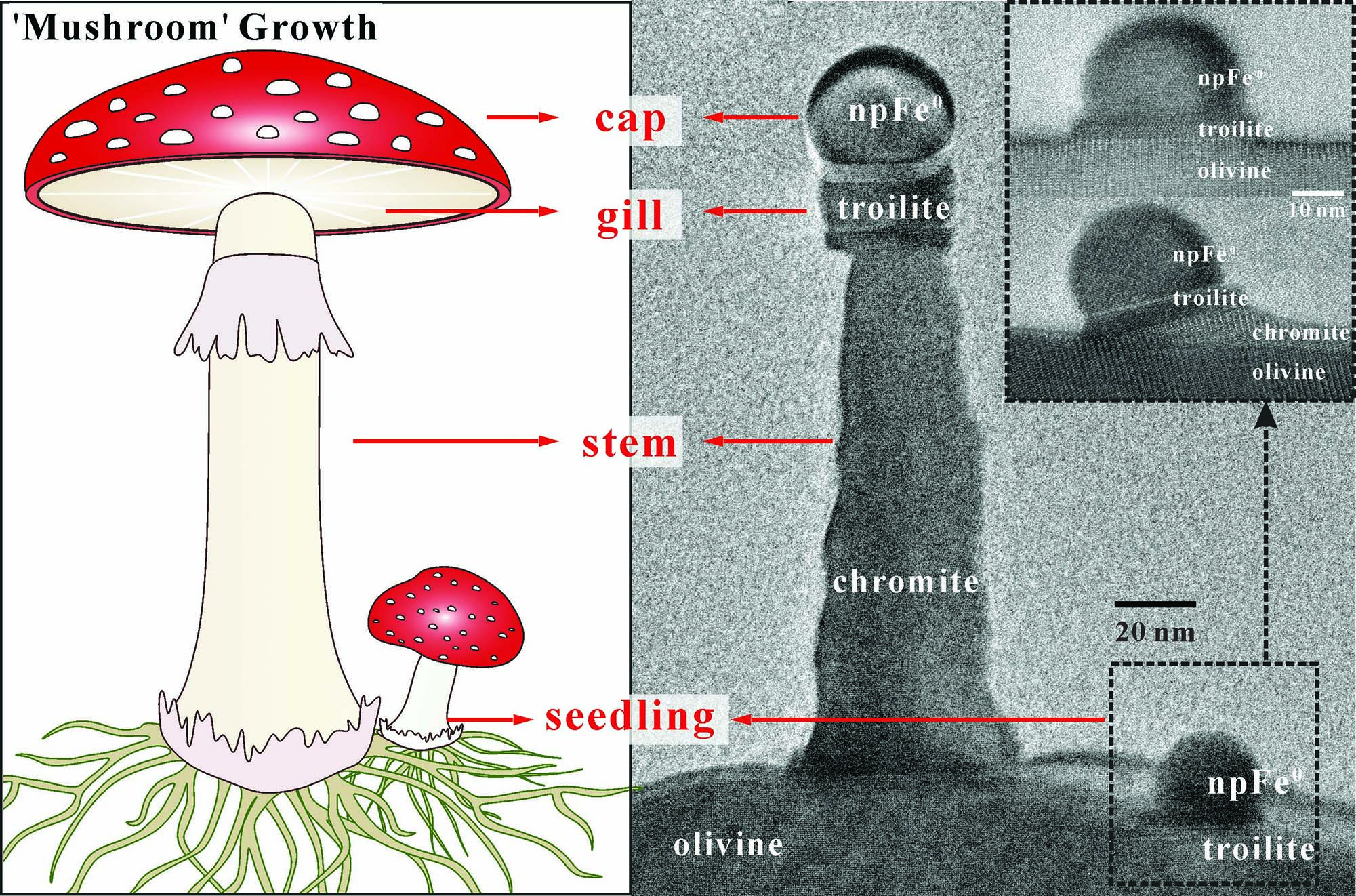
Mushroom-shaped growth of crystals on the Moon
https://doi.org/10.2138/am-2023-9214
Xi et al. report a novel mineral assemblage found in a lunar breccia clast recently returned by CNSA's Chang'e-5 mission. A careful characterization of the mineral samples revealed the presence of parallel olivine rods with a stripe-like pattern intricately entangled with nanospheres of troilite and metallic iron (npFe0). Based on the geometry and element depletions, olivine associated with troilite was likely the Cr source, and adjoining impact glass was the Fe source for chromite crystallization. Such process and the resultant structure have never been reported in Earth samples, though homogeneous whiskers and dendrites of mantle-derived minerals (e.g., pyroxene and olivine) are common in some volcanic glasses. Considering the frequent (micro)meteoroid impacts on the Moon, the conditions to form aggregates such as these may be very common in lunar regolith, significantly shaping the mineral composition and the geological evolution of the lunar surface. In addition, similar crystallization pathways may also occur in mantle-derived materials under conditions sufficiently far from equilibrium.
Volume 109 : December 2024 Issue
Fluids in the shallow mantle of southeastern Australia: Insights from phase equilibria
https://doi.org/10.2138/am-2022-8735
Small amounts of water (10s to 100s of ppm) are often present in samples derived from the Earth's mantle. Water can profoundly affect the properties of mantle peridotites, including viscosities, conductivities, and melting temperatures. Measuring the water content of nominally anhydrous minerals (NAMs) has provided insight into the amounts of water contained within mantle rocks. However, converting from NAM water contents to the activity of H2O, a(H2O), is non-trivial. Equilibria involving amphibole can be used to determine values of the a(H2O) at the time of mineral equilibration. This approach yields low values of a(H2O) (<0.3) for four peridotite xenoliths from Southeastern Australia. These four xenoliths also record oxygen fugacity values ranging from -0.2 to -1.2 (Log units relative to FMQ). All these values of oxygen fugacity are inconsistent with the presence of a CH4-rich fluid (too oxidizing), and the lowest value of oxygen fugacity, as recorded by one sample, is inconsistent with the presence of a CO2-rich fluid.
Compositional effects on the etching of fossil confined fission tracks in apatite
https://doi.org/10.2138/am-2024-9331
The authors establish an empirical equation giving the apatite etch rate as a function of orientation. This allows them to calculate the geometries, effective etch times, and etch rates of fission tracks across different chemistries. An etch-rate adapted protocol gives confined fission tracks with more comparable properties in apatites with different chemistries. Measuring the etch rates of fission tracks exhibits variation between apatites that could be related to their thermal histories.
Evaluation of the Rietveld method for determining content and chemical composition of inorganic X-ray amorphous materials in soils
https://doi.org/10.2138/am-2023-9240
Inorganic X-ray amorphous materials (iXAMs) are ubiquitous in soils but difficult to identify and quantify. Akinbodunse et al. evaluated the Rietveld method for quantifying iXAMs (ferrihydrite and opal-A) in crystalline mineral mixtures and determining their chemical composition based on Rietveld and chemical analysis data. The results provide a methodological framework for studying iXAM abundances and chemical compositions in soils and investigate their impact on soil physicochemical properties and biogeochemical element cycles.
High-pressure phase transition of olivine-type Mg2GeO4 to a metastable forsterite-III type structure and their equations of state
https://doi.org/10.2138/am-2023-9208
The authors studied the high-pressure behavior of Mg2GeO4 olivine, a commonly used analog of forsterite, Mg2SiO4. They show the presence of a high-pressure orthorhombic phase under room-temperature compression and a partial dissociation into bridgmanite and MgO or post-perovskite and MgO on laser heating. Using static and dynamic compression techniques, the high-pressure phase has now been reported in both silicates and germinates. This may have important implications in planetary interiors where it may persist as a metastable phase, thereby affecting the dynamics and structure of these planets.

The application of "transfer learning" in optical microscopy: The petrographic classification of opaque minerals
https://doi.org/10.2138/am-2023-9092
This study introduces “decision maps”, a novel visualization technique for machine learning, to classify mineral genetic types using pyrite trace elements. This method enhances the interpretability of complex geochemical data, bridging the gap between traditional discriminant diagrams and modern machine learning efficiency. The approach provides a more transparent and understandable classification of mineral genesis, aiding geoscientists in better understanding the relationship between geo-data and decision-making in mineral exploration. This advancement marks a significant shift in geochemistry classification towards a visually insightful methodology.
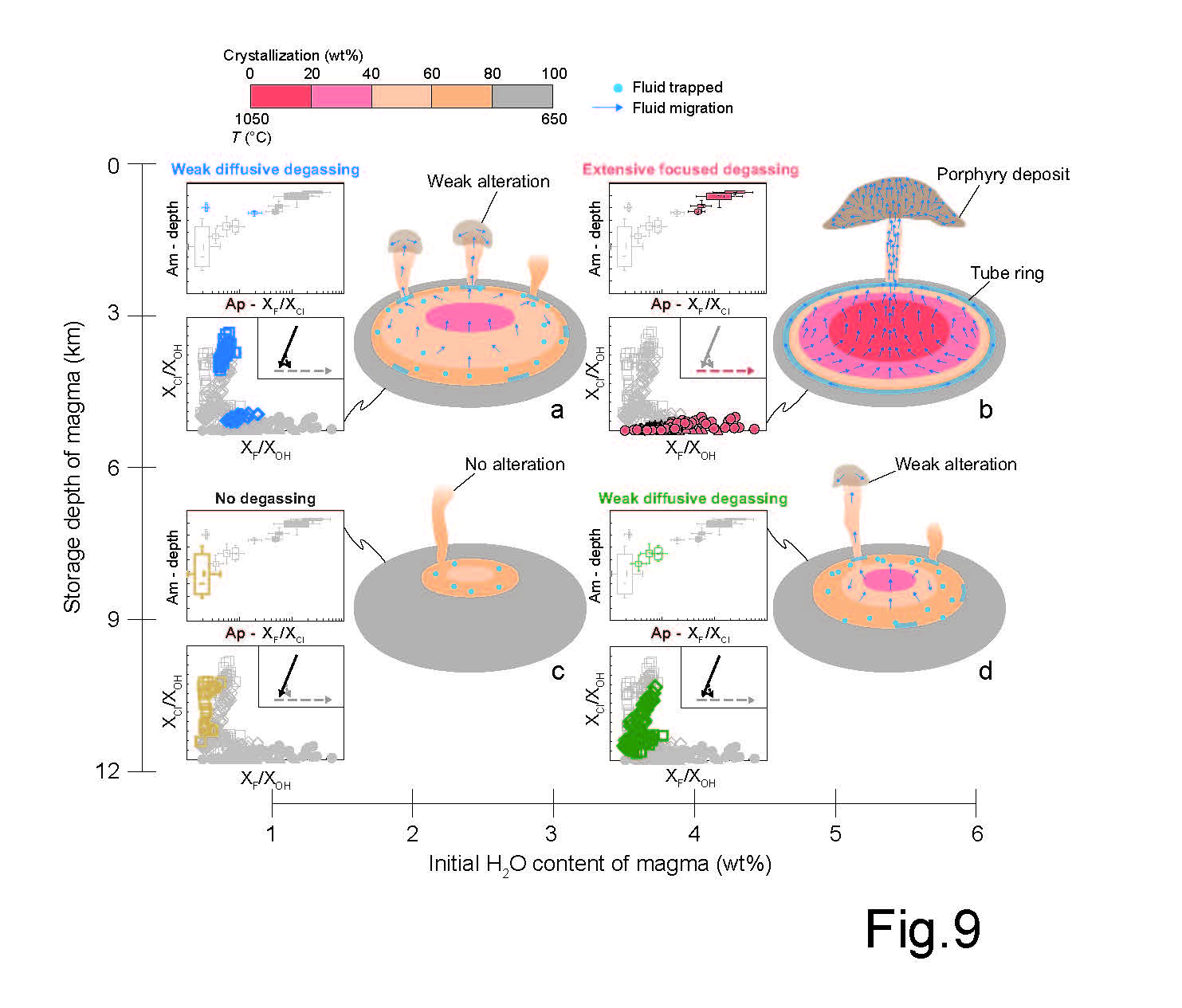
Mechanisms of fluid degassing in shallow magma chambers control the formation of porphyry deposits
https://doi.org/10.2138/am-2023-9091
Metals, such as copper and gold, play important roles in human life. However, they have relatively low contents within the Earth's interior and require focusing processes at shallow depths to form deposits (such as porphyry) before they can be exploited and utilized. In this study, porphyry deposits are taken as the research objects. The behaviors of magmatic fluid, closely related to the metal migration process at different depths in the shallow crust, are characterized by the comprehensive application of geochemistry, mineralogy, and thermodynamic modeling. Our results demonstrate that magma with shallower storage depth and higher initial H2O content is more likely to experience extensive focusing processes of magmatic fluid, leading to the generation of porphyry deposits.
The OH-stretching region in infrared spectra of the apatite OH-Cl binary system
https://doi.org/10.2138/am-2023-9059
The apatite mineral group contains anions of chlorine and OH, allowing insight into the behavior of geologic fluids. Recent crystal structural refinements found new anionic positions along the c-axis. Polarized infrared spectroscopy of single crystals found changes compared to the hydroxyapatite end-member. A pair of OH anions, spaced 2.9 Å apart, is the only contributor to the hydrogen-bonded spectra. In crystallographically similar positions, an OH-Cl pair appears to shift the OH stretching frequency to lower wavenumbers, indicative of hydrogen bonding. However, the interatomic distance is too great to allow hydrogen bonding. The structural changes that mimic hydrogen bonding are elucidated. Another peak in the infrared is shifted to higher wavenumbers in the OH stretching domain, the opposite of hydrogen bonding. This peak results from a chlorine atom interacting with the oxygen end of the OH dipole. The chlorine-oxygen distance for the pair is very short, and the means of accommodation are discussed.
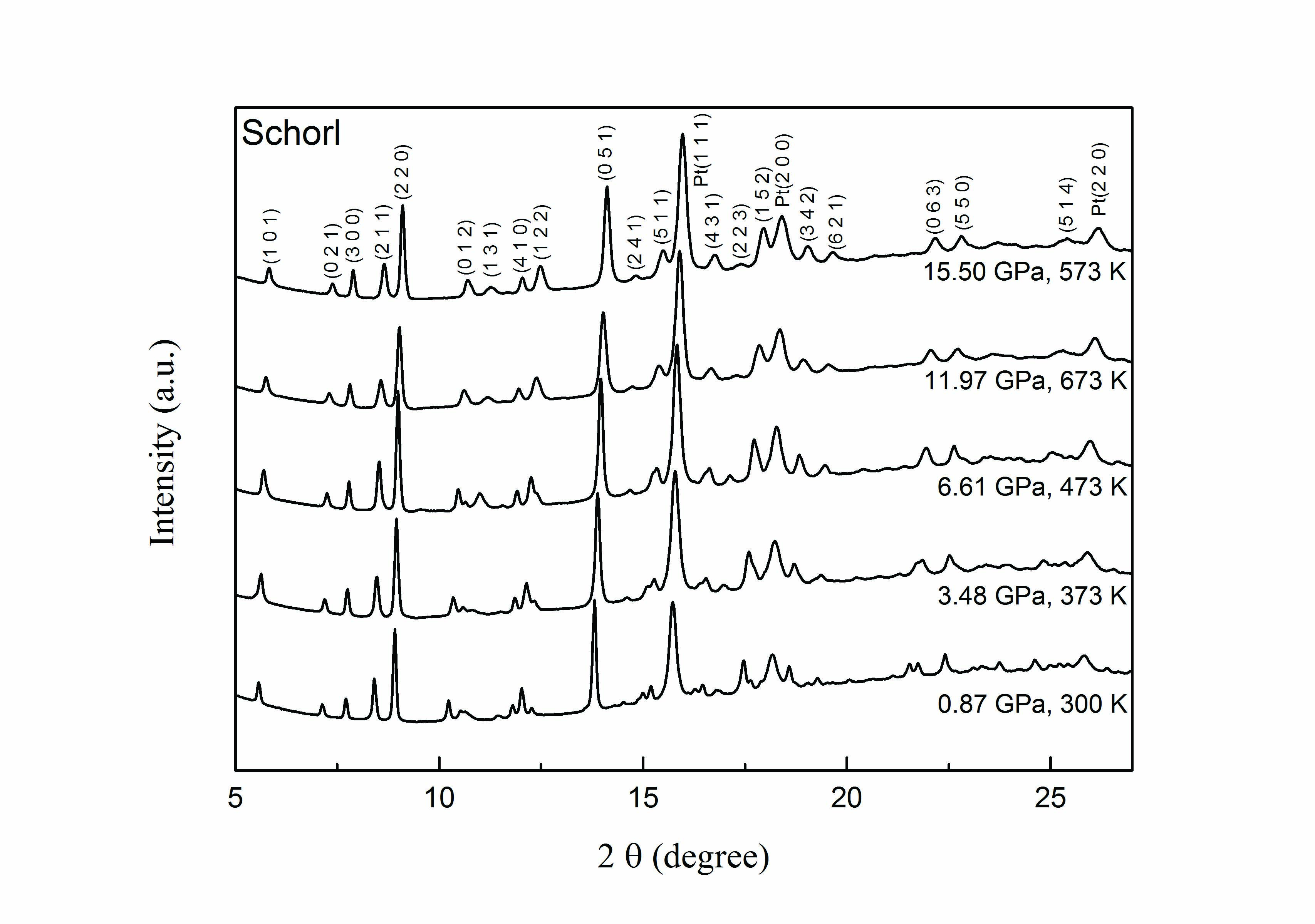
Thermal equation of state of Li-rich schorl up to 15.5 GPa and 673 K: Implications for lithium and boron transport in slab subduction
https://doi.org/10.2138/am-2023-9150
Tourmaline is the most widespread borosilicate mineral with a broad chemical composition. It occurs in a wide variety of granites, granitic pegmatites, and sedimentary and metamorphic rocks. As a dominant carrier of light elements, tourmaline plays a vital role in the lithium and boron cycle in the deep Earth, especially in the subduction zone. In subduction zones, as the pressure and temperature of the slab increase, the decomposition of lithium-bearing tourmaline will release fluxing elements like lithium and fluorine, which can induce partial melting and form lithium-rich magmatism. Thus, the thermal stability and equation of state (EoS) studies of lithium-bearing minerals such as tourmaline in the subduction slab help assess lithium cycle depth and explain the formation of lithium deposits. Pressure-volume EoS studies of tourmalines have been widely carried out using synchrotron X-ray diffraction combined with a diamond-anvil cell. In this study, Chen et al. investigated the pressure-volume-temperature relations of Li-rich schorl at high pressures up to 15.5 GPa and high temperatures up to 673 K. The compression property of schorl at room-temperature and high-pressure conditions was obtained. In addition, the authors compared the compressibility of schorl and elbaite and analyzed the possible factors influencing it. The anisotropic linear compressibility of schorl and elbaite was also discussed. Finally, the thermal EoS properties of schorl are obtained by fitting the pressure-volume-temperature data to the high-temperature Birch-Murnaghan EoS.
Raman scattering of omphacite at high pressure: Toward its possible application to elastic geothermobarometry
https://doi.org/10.2138/am-2023-9140
Raman elastic geothermobarometry is based on the determination of strain recorded by a mineral inclusion trapped in its host to estimate the entrapment pressure and temperature conditions of the inclusion. Determining the entrapment conditions of mineral host-inclusion systems in metamorphic rocks allows us to better understand the rock history and the geological processes. Raman elastic geobarometry has been successfully applied to anisotropic inclusions, such as quartz and zircon, entrapped in isotropic (i.e., garnets) and anisotropic hosts. Here, Baratelli et al. have extended the application of Raman elastic geobarometry to omphacite-in-garnet to develop a complementary system to the commonly used quartz or zircon inclusion in garnets. The authors report the pressure dependence of Raman spectra of omphacite crystals with the same composition but different symmetry because of the presence (P2/n) or absence (C2/c) of chemical order at the octahedral sites. They carried out ab initio Hartree-Fock/Density Functional Theory simulations on fully ordered omphacite to complement the experimental results. The results show that the changes in the position of the well-resolved Raman peak near 680 cm-1 with pressure are not affected by the presence or absence of chemical order, thus making it a good candidate for use in Raman geobarometry.
Interpreting mineral deposit genesis classification with decision maps: A case study using pyrite trace elements
https://doi.org/10.2138/am-2023-9254
The analysis of optical microscopic image data is crucial for the identification of mineral phases. As such images are typically very large and difficult to collect, their analysis has a high computational (and often manual) cost and a limited amount of automation. Here, Wang et al. adopt the "transfer learning" paradigm. By testing the Swin Transformer, a deep learning algorithm for different metallic mineral phases, they propose a well-behaved Swin Transformer metal mineral classifier with a high accuracy of 92% and a wide application potential. Moreover, the results demonstrate that pre-training weights can enhance learning and capture the relevant attributes in mineral classification. However, deep learning approaches are often considered a black box in that they may be too complex to be easily interpretable by humans. The authors use the Class Activation Map for the first time for mineral classification tasks, and observe that mineral edges are the most effective model classification features. The results demonstrate that boosting the learning processes with pre-trained weights can accurately capture relevant attributes in mineral classification, revealing the potential for application in mineralogy and petrology and enabling its use in resource explorations.
Geochemical characteristics of mineral inclusions in the Luobusa chromitite (Southern Tibet): Implications for an intricate geological setting
https://doi.org/10.2138/am-2023-9273
In unraveling the geological complexity of Luobusa Chromitite, this study investigates the features of Luobusa chromitite and ophiolites, revealing a multi-stage genesis involving mantle melting, melt-rock interactions, and shifts in oxygen and sulfur fugacity. Abundant platinum-group minerals, base-metal sulfides, and PGE-sulfides/alloys in chromitite signify intricate processes. Geochemical analysis and sulfur isotopes trace the Luobusa ophiolite's evolution from sub-ridge to supra-subduction zone settings. Variable _PGE values in chromitite suggest extensive melt fractionation. Well-crystalline Os-Ir alloys indicate early high-temperature stages, while sulfarsenide and pyrite inclusions show later stages with lower temperature and higher sulfur fugacity. Pyrite isotopes resonate with MORB and OIB characteristics, showcasing diverse magmatic sources.
Three new iron-phosphate minerals from the El Ali iron meteorite, Somalia: Elaliite Fe82+Fe3+(PO4)O8, elkinstantonite Fe4(PO4)2O, and olsenite KFe4(PO4)3
https://doi.org/10.2138/am-2023-9225
Inclusions of varying mineralogy are relatively common in certain types of iron meteorites. Herd et al. describe three new iron phosphate minerals from the 15-t El Ali iron meteorite found in Somalia. Discovered during the investigation and classification of the meteorite, the minerals are iron phosphates elaliite and elkinstantonite and K-bearing olsenite. Elkinstantonite is ferrous-iron dominant, whereas elaliite has mixed iron valency. Olsenite is the potassium analog of galileiite. The three minerals occur alongside wüstite, troilite, and sarcopside/graftonite in inclusions ranging from 20 to over 200 _m across; larger inclusions have more varied mineralogy. These mineral assemblages reflect local chemical and redox conditions of their micro-environments, distinct from those found in other iron meteorites, although the minerals likely exist in other meteorites and have yet to be identified.
Intervalence charge transfer in aluminum oxide and aluminosilicate minerals at elevated temperatures
https://doi.org/10.2138/am-2024-9343
Intervalence charge transfer is a dominant cause of color in many minerals containing iron in mixed oxidation states or Fe2+ with Ti4+. This work examines corundum and aluminosilicates with these cations and shows that the color is greatly reduced or disappears at elevated temperatures. This work raises the possibility that the optical transmission of minerals at elevated deep Earth temperatures can radically differ from the room-temperature properties, with implications for radiative thermal transport in the Earth.
Electron probe microanalysis of trace sulfur in experimental basaltic glasses and silicate minerals
https://doi.org/10.2138/am-2023-9157
Johnson et al. have developed a protocol to analyze trace amounts of sulfur down to 17 ppm on the electron probe microanalyzer (EPMA) by applying a beam current of 200 nA and a total counting time of 200 s to a suite of basaltic glasses. They used this protocol to analyze S in silicate minerals in experimental assemblages bearing silicate glass + clinopyroxene ± garnet ± sulfide and found that the nominally S-free minerals bear up to ~50 ppm S. This represents the first measurement of S in experimental garnets at sulfide-saturation. They calculated mineral-melt partition coefficients for S of up to 0.110, indicating that S partitions are incompatible with silicate minerals, which agrees with earlier work.
« ‹ 1 … 9 10 11 12 13 … 85 › »ADDITIONAL RESOURCES