
Editor’s Notes
Total Results: 1697
Volume 109 : July 2024 Issue
Magmatic degassing and fluid metasomatism promote compositional variation from I-type to peralkaline A-type granite in the late Cretaceous Fuzhou felsic complex, SE China
https://doi.org/10.2138/am-2023-8936
Zhang et al. show how magmatic degassing and fluid metasomatism promote compositional variation from I-type to peralkaline A-type granites. They found that apatite in both I- and A-type granites show large H2O and δD variations as a result of magmatic degassing, while F-rich alkaline fluid metasomatism promotes the compositional change from I-type to peralkaline A-type magmas. The relatively lower water content and stronger H isotope fractionation observed in A-type than I-type granite was likely due to more intense degassing in an open system.
The new mineral cuprozheshengite, Pb4CuZn2(AsO4)2(PO4)2(OH)2, from Yunnan, China, with site-selective As-P substitution
https://doi.org/10.2138/am-2023-8942
Sun et al. describe the properties of new mineral cuprozheshengited. It is a member of the dongchuanite group and is a rare example of P-As ordering in different structural sites. The structural geometric parameters and the DFT calculation study of cuprozheshengite reveal that the occupancy propensity of As at the X1 site benefits structural stability. The structure and stability studies of cuprozheshengite may have implications for environmental governance.
A neutron diffraction study of the hydrous borate inderborite, CaMg[B3O3(OH)5]2(H2O)4·2H2O
https://doi.org/10.2138/am-2023-9162
Gatta et al. reinvestigated the crystal chemistry of inderborite, a B-rich mineral (B2O3 ~ 41 wt%) with ideal formula CaMg[B3O3(OH)5]2(H2O)4∙2H2O by a multi-methodological approach (single-crystal X-ray and neutron diffraction, EPMA-WDS, LA-ICP-MS). The inderborite from the Inder deposit shows a positive δ11B value, within the range in which the source of boron is ascribable to marine reservoirs. In addition, the fraction of potential isomorphic substituents is substantially insignificant: B is, therefore, the only industrially relevant element occurring in this mineral. X-ray and neutron structure refinements show that ten over eleven independent oxygen sites in the structure of inderborite are involved in H-bonds as donors or acceptors, and this reflects the pervasive effect of the H-bonding network. The role played by the complex H-bond network is expected to be substantial on the stability of the crystalline edifice. The potential utilization of inderborite, as a B-bearing mineral, are also discussed.
Bobfinchite, Na[(UO2)8O3(OH)11]·10H2O, a new Na-bearing member of the schoepite family
https://doi.org/10.2138/am-2023-9031
Many competing mechanisms work to control the migration, precipitation, and speciation of uranium minerals formed in U-bearing systems. The description of bobfinchite by Olds et al. provides an essential foundation for defining crucial crystal-chemical and structure-property relationships in the schoepite family, which include some of the most frequently encountered alteration phases in uranium mines and the technogenic environments of the nuclear fuel cycle.
Kenorozhdestvenskayaite-(Fe), Ag6(Ag4Fe2)Sb4S12□: A new tetrahedrite group mineral containing a natural [Ag6]4+ cluster and its relationship to the synthetic ternary phosphide (Ag6M4P12)M'6
https://doi.org/10.2138/am-2023-9074
This manuscript by Qu et al. reports an extremely rare [Ag6]4+ cluster-containing tetrahedrite group mineral. In addition, the comparison to the isostructural ternary phosphides (Ag6M4P12) MÕ6 and the origin of the naturally occurring silver clusters are discussed. The work could represent a reference work for studies on the genesis of the natural subvalent hexasilver clusters, which in the future could represent an important source of information for both the mineralogical community and material science.
Compressibility and pressure-induced structural evolution of kokchetavite, hexagonal polymorph of KAlSi3O8, by single-crystal X-ray diffraction
https://doi.org/10.2138/am-2023-9120
Kokchetavite (KAlSi3O8, IMA-2004-011) was earlier identified as mineral inclusions in a wide range of crustal rocks and massifs, including those with an ultra-high pressure origin. However, their crystal structures were only guessed on the basis of powder X-ray diffraction patterns. The absence of data on the high-pressure stability and equation of state of this mineral was problematic for people involved in the study of metamorphic crustal complexes. In this work, Romanenko et al. present results of room-temperature compression and observations of pressure-induced structure transitions of kokchetavite up to 11.8 GPa by in situ, single-crystal, synchrotron X-ray diffraction. Observational data provide important information for the identification and interpretation of this phase in mineral inclusions. The authors demonstrate the high structural stability of kokchetavite, therefore, it can be taken into account in thermodynamic modeling of the composition of the fluid-saturated crust.
The glass transition temperature of anhydrous amorphous calcium carbonate
https://doi.org/10.2138/am-2023-9191
Bissbort et al. report the first observation and quantification of a glass transition in anhydrous amorphous calcium carbonate (ACC). ACC has been known to be an amorphous solid, which is produced by a precipitation and freeze-drying synthesis. However, it was not identified as a glass due to the absence of a glass transition in previous calorimetric analyses, which used conventional differential scanning calorimetry. Fast Differential Scanning Calorimetry with very fast heating and cooling rates allowed us to observe a glass transition at 339 °C. Hence, ACC is not only an amorphous solid but also a structural glass, although it was not produced in the classical way of glass formation, e.g., quenching from a melt. Further, this implies that a structural glass can also be formed from a simple single-component carbonate system and not only in more complex systems like ACMC or specific K-Mg-carbonates.
Reduced charge transfer in mixed-spin ferropericlase inferred from its high-pressure refractive index
https://doi.org/10.2138/am-2023-9100
The refractive index of a material is the macroscopic expression of its electronic structure; thus, it can provide valuable insights into related physical properties, such as electrical conductivity. Here, Schifferle et al. studied the refractive index of ferropericlase, Earth’s second most abundant mineral, across the pressure range of the mantle. Their results constrain the electronic structure of this mineral at high pressure with implications for the electrical conductivity of the lower mantle.
Stability of magnesite in the presence of hydrous fluids up to 12 GPa: Insights into subduction zone processes and carbon cycling in the Earth's mantle
https://doi.org/10.2138/am-2023-8982
CO2 is brought into the deep Earth in subduction zones. Transporting carbon from the Earth’s surface into the deep Earth is fundamental, as otherwise carbon would accumulate in the atmosphere, contributing to global warming. The fluxes and storage of carbon in the deep Earth are, however, controversial. By laboratory simulations of deep Earth conditions, Sieber et al. here report that magnesite (MgCO3), one of the main carriers of carbon (C), can be transported deep into the Earth without undergoing extensive melting even in the presence of water.
Local strain heterogeneity associated with Al/Si ordering in anorthite, CaAl2Si2O8, with implications for thermodynamic mixing behavior and trace element partitioning in plagioclase feldspars
https://doi.org/10.2138/am-2023-9197
Atkinson et al. used infrared spectroscopy to demonstrate that the most significant aspect of ordering of Al and Si in plagioclase feldspars relates to strain energies associated with local strain heterogeneity on a length scale of at least 1-5 unit cells. Using samples of synthetic anorthite, they establish the principle that there is a clear correlation between line width parameters extracted from primary IR spectra, macroscopic strain data determined from lattice parameter variations, and enthalpy data from solution calorimetry, with implications for trace element partitioning and thermodynamic mixing properties.
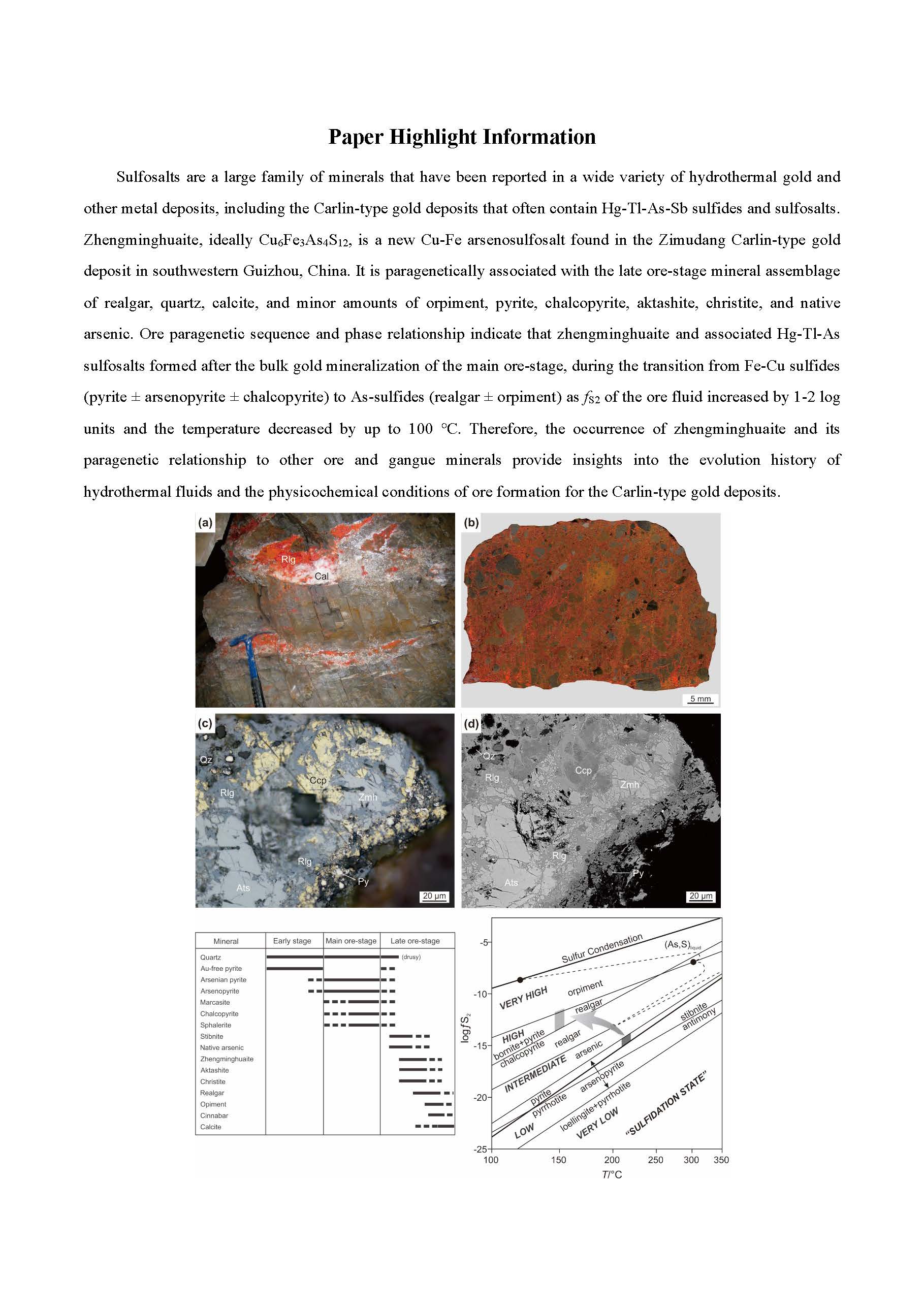
Zhengminghuaite, Cu6Fe3As4S12, a new sulfosalt mineral from the Zimudang Carlin-type gold deposit in southwestern Guizhou, China
https://doi.org/10.2138/am-2023-9078
Sulfosalts are a large family of minerals that have been reported in a wide variety of hydrothermal gold and other metal deposits, including Carlin-type gold deposits that often contain Hg-Tl-As-Sb sulfides and sulfosalts. Zhengminghuaite, ideally Cu6Fe3As4S12, is a new Cu-Fe arsenosulfosalt found in the Zimudang Carlin-type gold deposit in southwestern Guizhou, China, and reported here by Gu et al. Ore paragenetic sequence and phase relationship indicate that zhengminghuaite and associated Hg-Tl-As sulfosalts formed after the bulk gold mineralization of the main ore stage, during the transition from Fe-Cu sulfides (pyrite ± arsenopyrite ± chalcopyrite) to As-sulfides (realgar ± orpiment) as the fS2 of the ore fluid increased by 1-2 log units and the temperature decreased by up to 100 °C. The occurrence of zhengminghuaite and its paragenetic relationship to other ore and gangue minerals provide insights into the evolutionary history of hydrothermal fluids and the physicochemical conditions of ore formation for Carlin-type gold deposits.
Volume 109 : June 2024 Issue
Concerning tetrahedrites: How much to lump and how far to split?
https://doi.org/10.2138/am-2022-8923
The recent redefinition of the tetrahedrite group of minerals has resulted in descriptions of numerous new compositional variants, along with opportunities for many more, perhaps an extreme example of mineral definition splitting. The work by Hazen and co-authors developing a new mineral classification approach has led to questions about how and when to split or lump mineral definitions. This paper by Johnson explores some of the consequences of both threads, using the tetrahedrite group as a vehicle.
The space-time architecture variation of the shallow magmatic plumbing systems feeding the Campi Flegrei and Ischia volcanoes (Southern Italy) from halogen constraints
https://doi.org/10.2138/am-2022-8883
Balcone-Boissard et al. provide new constraints on the space-time architecture of the shallow magmatic systems of Campi Flegrei and Ischia volcanoes. First, the authors show that Cl acts as a geobarometer for alkaline magmas emitted at the volcanoes. Second, they highlight a contrasted architecture and dynamics of magma plumbing system of ignimbritic eruptions compared to Plinian eruptions. Finally, they suggest that the whole H-C-O-S-Cl-F system needs to be considered when discussing volatile behavior. The results have implications for volcanic hazard assessment.
Effect of chlorine substitution on the thermal stability of ferro-pargasite and thermochemical properties of ferrochloro- hornblende
https://doi.org/10.2138/am-2023-8981
Jenkins demonstrated that chloride substitution for hydroxyl in ferro-pargasite can produce a Cl-bearing amphibole that has ~150 ¡C lower thermal stability than ferro-pargasite at 2 kbar and at an oxygen fugacity 0.5 log(fO2) above Co-CoO. Thermochemical data for end-member ferro-chloro-hornblende (Ca2(Fe4Al)(AlSi7)O22Cl2) were derived from the thermal stability boundary, defined by reaction-reversal experiments, and then used to calculate the concentration of FeCl2 and CaCl2 in the metasomatizing fluids that formed the metagabbros at Lang¿y, Norway.
Ilmenite phase transformations in suevite from the Ries impact structure (Germany) record evolution in pressure, temperature, and oxygen fugacity conditions
https://doi.org/10.2138/am-2023-8985
Dellefant et al. analyzed microfabrics of ilmenite and associated further Fe-Ti-oxides in rocks from the Nšrdlinger Ries meteorite impact structure. A specific crystallographic relationship resulting from the back-transformation to ilmenite from high-pressure polymorphs can be used as an indicator of high shock pressures >16 GPa and the presence of associated Fe-Ti oxides as an indicator of temperature and oxygen fugacity conditions.
The 34S/32S homogeneity of Chemical Vapor Transport (CVT) Reaction-synthesized pyrites
https://doi.org/10.2138/am-2023-9029
Liu et al. investigated the homogeneity of sulfur isotopic composition (34S/32S) of Chemical Vapor Transport (CVT) Reaction-synthesized pure pyrite and nickel-doped pyrite crystals. The results show that the sulfur isotopic compositions (_34S) of these pyrites are relatively homogeneous, suggesting the potential to be applied as reference materials provided that the homogeneity can be improved further. In contrast, the nickel contents are heterogeneous. Using such pyrites with homogeneous _34S values but heterogeneous nickel contents, this study also assessed the matrix effects of nickel in measuring the 34S/32S of nickel-bearing pyrites by SIMS.
Hydrogen incorporation mechanism in the lower-mantle bridgmanite
https://doi.org/10.2138/am-2022-8680
Nature of hydrogen in deep-mantle minerals has been a significant topic. It was proposed that the geometry of chemical bonding around hydrogen in such minerals can be determined with high accuracy using TOF single-crystal neutron diffraction. Purevjav et al. demonstrate that such analysis indeed works even for the trace amount of hydrogen in bridgmanite, which is the most voluminous phase in the mantle. The analysis is also useful for hydrogen concentration determination as low as 0.09 wt% H2O. These results open a new window for future research.
Different structural behavior of MgSiO3 and CaSiO3 glasses at high pressures
https://doi.org/10.2138/am-2023-9060
Kondo et al. investigated the structures of MgSiO3 and CaSiO3 glasses up to 5.4 GPa using in situ pair distribution function measurements. The result revealed different high-pressure behavior in intermediate structures of MgSiO3 and CaSiO3 glasses. The structural difference results in the difference in the properties, such as viscosity, between MgSiO3 and CaSiO3 melts at high pressures, implying the importance of the different structural behavior due to different cation atoms to discuss the nature and properties of silicate magmas in the Earth's interior.
High-pressure phase transitions of Fe-bearing orthopyroxene revealed by Raman spectroscopy
https://doi.org/10.2138/am-2023-8998
Li et al. investigated the phase transition of orthopyroxene with four different compositions, up to 34 GPa and 300 K, using Raman spectroscopy. Their results indicate that the Raman modes at ambient conditions have a negative correlation with Fe content, except for modes at ~850 and 930 cm-1, which increase with Fe content. They observed a phase transition from metastable _- to _-phase at 12.9-15 GPa for orthopyroxene samples with less than 21 mol% Fe and a second phase transition from _- to _-phase at 29-30.1 GPa for all investigated samples. The latter transition occurs in Fe-bearing orthopyroxene but is caused by the coordination number change of Si from 4 to 6 for En100 or the presence of _-popx phase. The Raman shifts were used to constrain the GrŸneisen parameters of orthopyroxene at high pressures. This study provides important insights into the thermoelastic properties of orthopyroxene at high pressures.
High P-T phase relations of Al-bearing magnetite: Postspinel phases as indicators for P-T conditions of formation of natural samples
https://doi.org/10.2138/am-2023-8948
Since iron oxides (e.g., magnetite) with variable Al contents are found in extraterrestrial rocks or as inclusions in diamond, knowledge about their high P-T-fO2 stability should help unravel their formation conditions. Uenver-Thiele et al. have undertaken an experimental study to determine the phase relations of Al-bearing magnetite between 6-22 GPa and 1100-1550 ¡C. This work demonstrates that small amounts of Al change the phase relations compared to those of the magnetite end-member. Post-spinel assemblages such as Fe2(Al,Fe)2O5 + (Al,Fe)2O3, Fe3(Fe,Al)4O9 + (Al,Fe)2O3 or an orthorhombic hp-Fe(Fe,Al)2O4 + (Al,Fe)2O3 appear at high pressures and temperatures.
« ‹ 1 … 13 14 15 16 17 … 85 › »ADDITIONAL RESOURCES