Editor’s Notes
Total Results: 1697
Volume 111 : March 2026 Issue
Uncovering the mineral assemblages of six major gold deposit types: A machine learning approach to big data analytics of a global mineralogical database
https://doi.org/10.2138/am-2025-9777
This study developed a machine learning approach to defining the characteristic mineral assemblages of the six most economically significant gold deposit types [orogenic, epithermal, porphyry, Carlin, iron oxide-copper-gold (IOCG), and volcanogenic massive sulfide (VMS)]. Zuo et al. used association rule mining with an improved Apriori algorithm that constrains the rule consequent to deposit type, on a global database of 454 gold deposits. Visualization of the rule set through bipartite and unipartite networks revealed distinct mineral-to-gold deposit relationships. This study also showed that a machine learning approach to big data analytics of a global mineralogical database can detect both known and as-of-yet-unrecognized mineral associations. As such, this approach, which links geology and big data, offers new opportunities for mineral exploration targeting and gold deposit research.
Infrared spectroscopy of natural Type Ib diamond: Insights into the formation of Y-centers and the early aggregation of nitrogen
https://doi.org/10.2138/am-2024-9722
A new routine for deconvoluting the IR spectra of Type Ib + IaA diamonds is presented in which the spectrum of Y-centers is included. Using a database of 178 diamonds, Day et al. show that this new routine results in higher-quality fits of the IR N-region and that neglecting Y-centers during deconvolution may result in erroneous N-defect concentrations and mantle residence times or temperatures. These results shed light on the potential identity of Y-centers and their behavior during annealing and N-aggregation.
Microstructural and chemical responses of lunar pyroxene to shock shearing under low-to-moderate shock conditions
https://doi.org/10.2138/am-2025-9877
Shock shearing facilitates systematic plastic deformation, frictional melting, and pigeonite exsolution in lunar augite. The composition and structure of pyroxene are prone to being modified under low-to-moderate shock conditions. Localized melting and recrystallization processes in shocked pyroxene promote anomalous Raman peaks in spectra linked to tetrahedral cation substitutions which can be a diagnostic shock indicator.
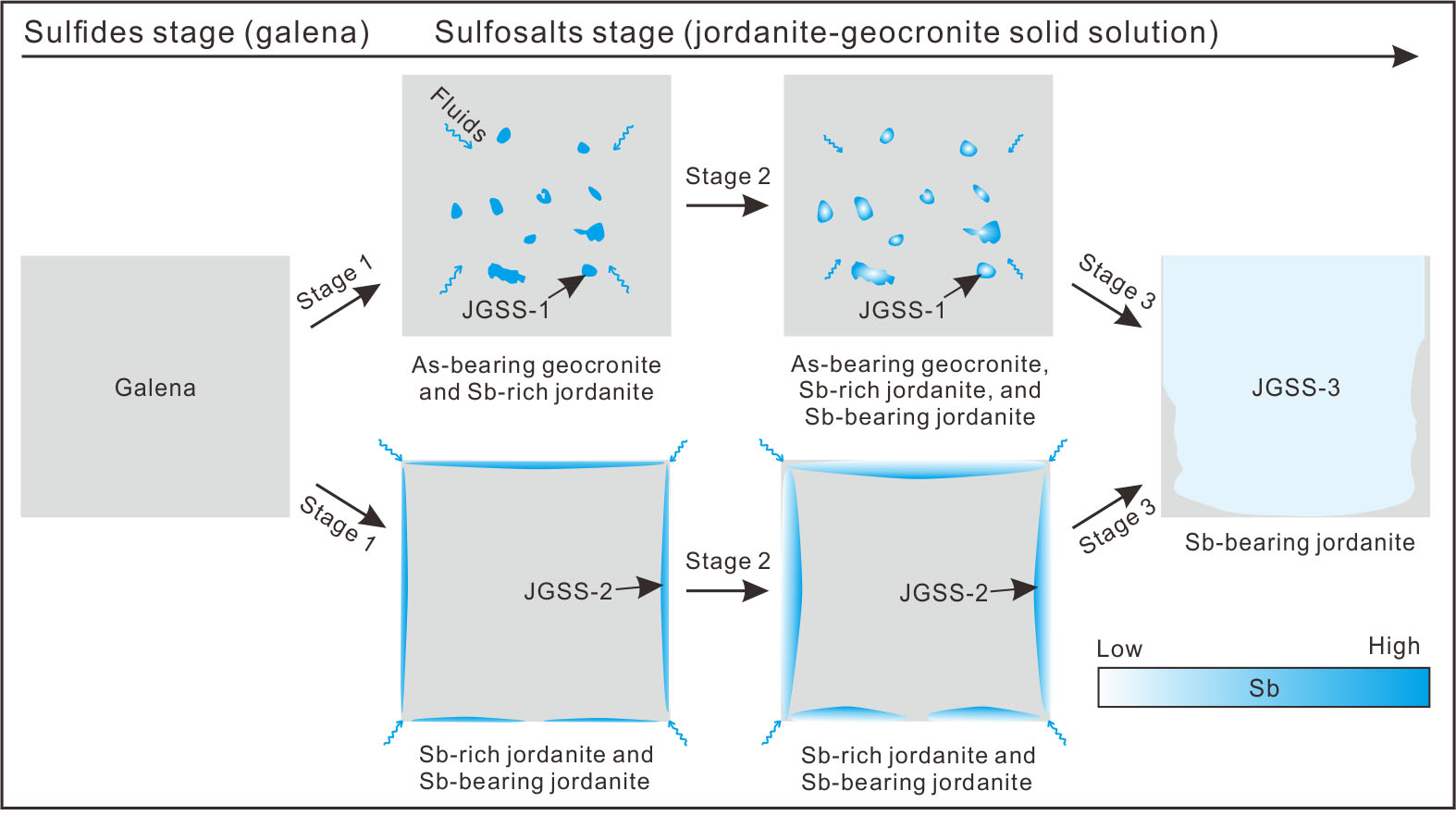
Genesis of jordanite-geocronite solid solution series in the Huize Pb-Zn deposit, SW China: Implications for fluid evolution in the late mineralization stage
https://doi.org/10.2138/am-2024-9708
This study presents the systematic mineralogical investigations of the newly identified jordanite-geocronite solid solution (JGSS) series in the Huize Pb-Zn deposit. The occurrence of JGSS indicates significant Sb- and As enrichment in the late-stage ore-forming fluids. The formation of JGSS involves multiple fluid-mineral interactions, which are primarily controlled by temperature, fO2, and fS2. The compositional variations of late-stage sulfosalts, particularly JGSS, offer valuable insights for mineral exploration in hydrothermal systems. Studies from various deposits such as Huize (China), Coranda-Hondol (Romania), and Huachocolpa (Peru) have demonstrated that As/Sb or As/(As+Sb) ratios in JGSS exhibit systematic spatial patterns, typically decreasing from the core of ore bodies outward or from depth to surface. These zonation trends reflect the upward migration of hydrothermal fluids and can be used to trace fluid pathways, highlighting the importance of sulfosalts in understanding ore genesis and assisting mineral exploration.
How fluids control beryllium mineralization in a magmatichydrothermal system: Evidence from mica geochemistry and quartz-beryl O isotopes
https://doi.org/10.2138/am-2024-9678
Wu et al. present mica geochemistry and quartz-beryl O isotopes, as well as zircon U-Pb ages and O-Hf isotopes, cassiterite U-Pb ages and whole-rock geochemistry for two distinct types of Be deposits (i.e., the Nasigatu greisen-type and the Zhujiayingzi quartz vein-type) in the southern Great Xing'an Range (SGXR), NE China. Nasigatu alkali feldspar granites (AG) and greisens (144–139 Ma) are nearly coeval with the Zhujiayingzi quartz veins (149–147 Ma). The collected data suggest that Be mineralization could hardly be achieved through partial melting, fractional crystallization, and/or fluid exsolution processes. Deep magmatic fluids exsolved from large deep silicic magmatic reservoirs not only provide heat and promote fluid-mineral interaction, but also efficiently extract and transport Be enriched in deep crystal mushes at varying depths. Elemental and isotopic compositions of muscovites track formation and breakdown of Be-F complexes, which served as the primary migration vehicle in the fluid system.
Toward the continuous series of HgS-ZnS solid solutions: Zn-rich metacinnabar assemblages in the Vorontsovskoe gold deposit, Northern Urals, Russia
https://doi.org/10.2138/am-2025-9783
Sandalov et al. reveal that a complete series of ZnS-HgS solid solutions with a sphalerite-type structure may be found, dispelling the potential for a miscibility gap in nature. Both strongly Zn-enriched metacinnabar and Hg-enriched sphalerite crystallize from high-temperature hydrothermal fluids (>250 ºC) enriched in Tl-Cu-Zn-Hg-As-Sb-S. These phases are particularly well-developed in sulfide-sulfosalts assemblages within gold-bearing breccias of the Vorontsovskoe deposit. Notably, the authors identify Mn as a potentially structure-stabilizing impurity in metacinnabar These results may provide crucial constraints for future experimental studies of the Hg-Zn-Mn-S cubic system, development of novel hydrothermal synthesis methods for Hg1-x-yZnxMnyS compounds, and design of materials with tailored electromagnetic properties for advanced technological applications.
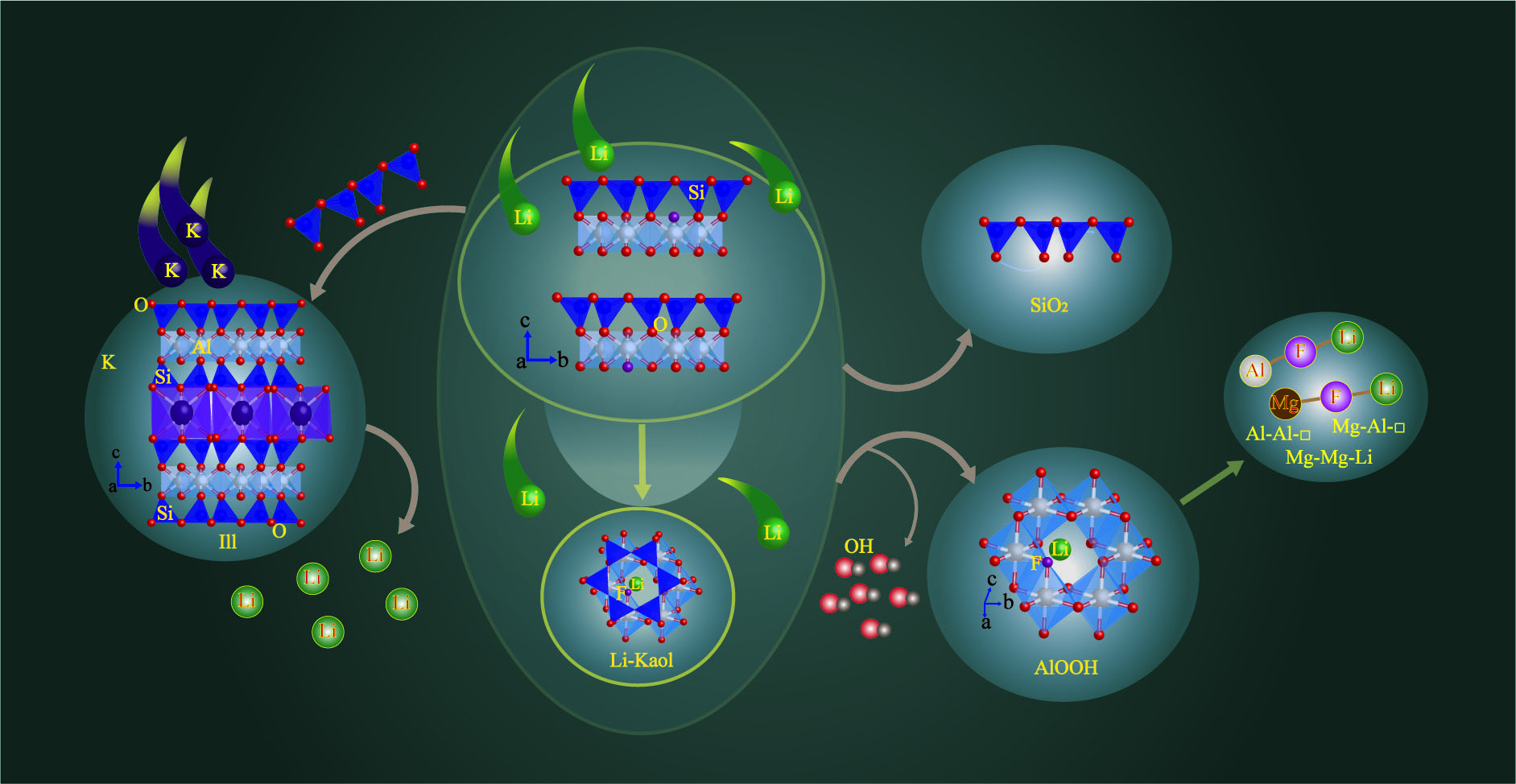
Molecular-level insights into mechanisms of Li enrichment and occurrence in natural clay-bauxite
https://doi.org/10.2138/am-2024-9683
This study is grounded in molecular-level insights and the inter-mineral lattice evolution of lithium (Li)-bearing minerals in Li-clay deposits. Yan et al. employ a combination of microscopic morphological observations and chemical analyses using scanning and transmission electron microscopy equipped with energy-dispersive X-ray spectroscopy, as well as time-of-flight secondary ion mass spectrometry and other spectroscopic techniques, to investigate the occurrence of Li. These findings reveal a hydroxyl-mediated structural response to Li enrichment, identify Li as occurring in six-coordinated and inner-sphere complexed forms, and indicate a transformation from di-octahedral to tri-octahedral configurations. The authors elucidate the mechanism of Li enrichment within pseudo-hexagonal cavities and clarify the inheritance relationships of Li-bearing structures among different minerals. Based on these findings, Yan et al. propose a roasting-free and more ecologically friendly solution for Li extraction.
Conversion of titanite to rutile during the albitization of granitoids from the Sakar Batholith, SE Bulgaria: Experimental studies
https://doi.org/10.2138/am-2024-9731
Titanite was converted to rutile during the albitization of granitoids in the Sakar Batholith, SE Bulgaria, and reproduced experimentally in this study. Four experiments involving fluid-aided alteration of titanite in a granitic system were conducted at 280 MPa and 600 °C. Four Na-bearing fluids (NaCl + H2O, NaF + H2O, Na2Si2O5 + H2O, and 2 M NaOH) were used; rutile was formed from titanite in experiments involving NaCl + H2O and NaF + H2O. The comparison between natural observation and the experimental results supports the premise that a NaCl + H2O fluid could have been responsible for the conversion of titanite to rutile during albitization, which further supports the role of NaCl-bearing fluids during the albitization of granitoids in general at mid- to upper-crustal pressures in the presence of alkali-bearing fluids. This implies that the geochemical relationship between rutile and titanite is more a function of the chemistry of the fluid and host rock, especially if they are Na-rich, rather than the P-T conditions.
Kimberlite emplacement conditions through experimentally produced reaction rims on ilmenite macrocrysts
https://doi.org/10.2138/am-2024-9608
This study explores mineral-melt reaction textures formed on mantle-derived ilmenite in kimberlite magmas, offering insights into kimberlite crystallization and magma evolution during ascent. By reproducing textures found in nature through experiments, Fairhurst et al. provide constraints on the conditions and processes shaping these reactions. These findings have broader implications for understanding similar textures in other igneous and metamorphic systems.
Raman spectroscopic investigation of ianthinite [U24+(UO2)4O6(OH)4(H2O)4]·5H2O, a rare mixed-valence uranium oxide hydrate
https://doi.org/10.2138/am-2025-9759
This work demonstrates that ianthinite has significant implications for identifying alteration phases of primary uranium ores in environmental settings via vibrational spectroscopy. Spano et al. provide new insights into the correlation between the structural features of mixed-valence U minerals and the resulting Raman spectra of these materials, which have important implications for assessment of the mineralogy of the nuclear fuel cycle.
A Zr-Hf geothermometer for magmatic zircon: New experiments and formulation
https://doi.org/10.2138/am-2024-9727
New experimental data on ZrO2 and HfO2 solubility in aluminosilicate melts of wide compositional range at temperature 900–1473 °C indicate nearly identical dependence of zircon and hafnon solubility on the melt composition. Based on this finding, a new Zr-Hf geothermometer equation for magmatic zircon is derived by thermodynamic processing of the experimental data. The thermometer does not rely on quantities used in other magmatic thermometers that may be difficult to constrain (e.g., melt composition). The commonly observed increase in Hf concentration from cores to margins of magmatic zircon crystals may be related to fractional crystallization of zircon.
(Li,Na)-P substitution in garnet: An indicator of ultrahighpressure conditions in subducted continental crust
https://doi.org/10.2138/am-2025-9836
This work demonstrates that Fe-rich garnet can incorporate minor amounts of Li, Na, and P in ultrahigh pressure rocks. The incorporation of Li follows a (Na,Li)1P1M2+-1Si-1 substitution. This observation, based on coesite-bearing metagranites from the Bohemian Massif, is valid for crustal quartzofeldspathic rocks involved in continental subduction. The results indicate that garnet is an important carrier of Li, with implications for its mantle cycle.
Volume 111 : February 2026 Issue
Controls on metal zonation in porphyry-skarn systems: Evidence from the Tonglushan Cu polymetallic deposit, Eastern China
https://doi.org/10.2138/am-2024-9726
Pyrite and sphalerite are the most widely distributed sulfides in the porphyry-skarn system, and their trace elements and sulfur isotopes record variations in spatio-temporal zoning and ore-forming environments. In the early stage, pyrite shows an increasing trend in Co, Ni, As, and Se concentrations with distance from the intrusion, but exhibits depletion in the most distal vein-type ore. This variation pattern contrasts with those observed in other similar porphyry-skarn deposits in the MLYRB and is recorded by the Se-Co/As ratio. This suggests that redox conditions are the primary controlling factor, with temperature playing a secondary role. In contrast, the spatial variations in sulfur isotopes in pyrite are primarily controlled by temperature. Late-stage sphalerite displays spatial trends, evolving from high Fe, Co, and Mn contents in skarn-type ores to higher Cd, Hg, and Sn concentrations in carbonate-replacement-type and distal vein-type ores. These trends are also influenced by redox and temperature differences, as recorded by the Mn/Sn-Fe/Cd ratios. These sulfide compositional characteristics may provide valuable insights into the mineralization processes of other similar porphyry-skarn deposits.
Anomalously high REE diaspore formed in bauxite overlying paleokarstic surface
https://doi.org/10.2138/am-2025-9748
pH conditions and leaching control the distribution and enrichment of REE in bauxite of the Benxi Formation (North China Craton). REE are enriched mainly by the substitution of Al3+ in the crystal lattice of diaspore, which is identified as the principal REE host. Variations in REE occurrence among diaspore, anatase, kaolinite, hematite, and goethite reflect the combined influence of mineral crystal structure and formation processes.
Arsenohauchecornite, ognitite, parkerite, and related minerals from Ona Preta orebody, Caraj‡s, Brazil: Fingerprinting PGE signatures in hydrothermal Ni ores
https://doi.org/10.2138/am-2024-9647
This study describes mineral assemblages in nickel-rich sulfide mineralization from the Onça Rosa orebody. Rare accessory Ni-Bi-minerals observed include arsenohauchecornite, ognitite (second world occurrence), and parkerite. Nanostructures in pentlandite reveal fluid pathways and host Pt-Ag-Bi-Te phases as nanoparticles. The presence of Pd and Pt extends the potential for PGE in hydrothermal Ni-sulfide ores in the Carajás Domain, a finding with implications for exploration in the region.
Quartz-petalite intergrowths in the Yichun pegmatite: Formation from late-stage Li-rich melts and implications for Li mineralization in rare-metal granites
https://doi.org/10.2138/am-2025-9818
Whether Li in peraluminous rare-metal granites was concentrated to economic grades solely by igneous processes or, in part, by metasomatic processes is still under debate. The Yichun deposit is a suitable locality to address this debate. Wu et al. concluded that more than half of the economic grades of Li in the topaz-lepidolite granite at Yichun were contributed through metasomatism after a magmatic concentration.
Investigating formation and enrichment processes of the super-large North Sanshandao gold deposit (Jiaodong Peninsula, Eastern China): An in-depth mineralogical perspective
https://doi.org/10.2138/am-2024-9701
This study investigates the mechanism of visible gold and high-grade ore zones of the large North Sanshandao gold deposit. Through in-depth analysis of in situ LA-ICP-MS trace element and LA-MC-ICP-MS sulfur isotope on various pyrite generations, these findings are of importance to the field of Jiaodong gold deposits. This study provides a new model for the widespread development of over 80% of the disseminated-type mineralization in the Jiaodong Peninsula, emphasizing Au remobilization (via coupled dissolution-reprecipitation process) as a key factor for the formation of high-grade and high-tonnage ore zones, and sheds new light on the multistage ore-material enrichment in large-scale gold mineralization (storage of sulfur may have been pre-enriched before mineralization).
Seismic signature of the upper continental crust: Implications from the thermoelastic properties of liebermannite and K-hollandite II
https://doi.org/10.2138/am-2024-9562
Wang et al. investigate what Upper Continental Crust (UCC) will be like in Earth's deep interior, focusing on two key minerals: liebermannite and K-hollandite II. The study used advanced calculations to understand their properties under extreme mantle conditions. Combining this information with mineral compositions of UCC, they created profiles showing the density and velocity of UCC within the Earth. Notably, UCC accumulates at the bottom of the mantle transition zone due to a density crossover with the surrounding mantle. At the top of the lower mantle, UCC undergoes a transition from high-velocity to low-velocity, marked by strong directional differences (anisotropy). The shift from liebermannite to K-hollandite II contributes to significant velocity changes. These variations may explain observed high-velocity anomalies beneath collision zones of continents and strong anisotropy around low-velocity anomalies in the upper lower mantle. Importantly, after garnet breaks down in UCC, it becomes challenging to distinguish UCC from oceanic crust due to similar velocities. The study provides insights into the intricate behaviors of UCC within Earth's interior, helping to understand phenomena like high-velocity anomalies and anisotropy observed in specific geological zones.
Scandio-fluoro-eckermannite, NaNa2(Mg4Sc)(Si8O22)F2, a new Sc-dominant amphibole-supergroup mineral from the Bayan Obo deposit, China
https://doi.org/10.2138/am-2024-9667
A new Sc-dominant amphibole-supergroup mineral has been discovered in the Bayan Obo REE-Nb-Fe polymetallic deposit, China. The ideal formula of the mineral is NaNa2(Mg4Sc)(Si8O22)F2, and it has been named scandio-fluoro-eckermannite. Both the mineral and its name have been approved by the IMA-CNMNC (2024-002). The discovery of scandio-fluoro-eckermannite highlights the importance of amphibole in controlling Sc in this type of ore-forming system. Scandio-fluoro-eckermannite might also be used as a potential recorder to investigate the enrichment process of Sc in the Bayan Obo deposit.
New minerals auropolybasite [Ag15AuSb2S11] and auropearceite [Ag15AuAs2S11]: Implications for the formation of bonanza ores in epithermal systems
https://doi.org/10.2138/am-2025-9806
Auropolybasite (IMA 2024-006) and auropearceite (IMA 2024-025), the new members of the polybasite-pearceite group are presented from the bonanza-type Ag-Au epithermal mineralization in Western Carpathians (Slovakia). Ore is significantly depleted in Cu, leading to an extraordinary Cu-free mineral assemblage. The main aspect of these minerals lies in the incorporation of gold into their structure, and the authors confront this finding with previous research on polybasite-pearceite group minerals. Besides a fundamental description of crystallography and crystal structure, the complicated problem of twinning in these minerals is interpreted, and the essential gold for silver substitution is explained. Moreover, the role of gold in known sulfides and sulfosalts is discussed. Finally, there are implications for the fluid properties responsible for the genesis of these minerals in epithermal deposits.
1 2 3 … 85 › »ADDITIONAL RESOURCES