

Editor’s Notes
Total Results: 1697
Volume 109 : October 2024 Issue
High-resolution SIMS U-Th-Pb geochronology of smallsize (<5 _m) monazite: Constraints on the timing of Qiuling sediment-hosted gold deposit, South Qinling Orogen, central China
https://doi.org/10.2138/am-2023-9210
This study presents an example of monazite compositional alteration and hydrothermal monazite growth of U-Th-Pb ages caused by coupled dissolution-reprecipitation reactions. It is crucial to examine the monazite textures and recognize alteration textures before carrying out isotopic dating of monazite collected from hydrothermal ore deposits. This study also demonstrates that monazite could record early hydrothermal events and not be affected by later hydrothermal alteration. Combined with textual and compositional characterization, the high-resolution SIMS U-Th-Pb dating technique on small-size monazite represents a powerful tool for determining the timing of mineralization, especially in the ore deposit without suitable geochronometers to record the hydrothermal process. This work is of interest to researchers studying metallic mineralization, major and trace elements of hydrothermal accessory minerals, and the geochronology of hydrothermal deposits.
An evolutionary system of mineralogy, Part VIII: The evolution of metamorphic minerals
https://doi.org/10.2138/am-2023-9004
The eighth installment of the "Evolutionary System of Mineralogy" explores relationships among 1220 species of metamorphic minerals. Metamorphic rocks display characteristics of an evolving chemical system, with significant increases in mineral diversity and chemical complexity over the first four billion years of Earth history. Earth's first metamorphic rocks were thermally altered xenoliths and contact zones (hornfels and sanidinite facies) associated with early Hadean igneous activity (>4.5 Ga). The appearance of new Hadean lithologies, including clay-rich sediments, arkosic sandstones, and carbonates, provided additional protoliths for thermal metamorphism prior to 4.0 Ga. Mountain building and erosion exposed extensive regional metamorphic terrains, with lithologies corresponding to a sequence of metamorphic facies. More recently, rapid subduction and rebound of crustal wedges, coupled with a shallowing geothermal gradient, has produced distinctive blueschist, eclogite, and ultrahigh-pressure metamorphic suites (<1.0 Ga). The evolution of metamorphic minerals thus exemplifies changes in physical and chemical processes in the crust and upper mantle that characterize Earth's first 4 billion years.
Gamma-enhancement of reflected light images as a routine method for assessment of compositional heterogeneity in common low-reflectance Fe-bearing minerals
https://doi.org/10.2138/am-2023-9114
Reflectance variations of Fe-bearing ore minerals (magnetite, wolframite, and tetrahedrite-tennantite) and transparent minerals (garnet) were revealed using the gamma correction method, which enhances optical digital signal differences obtained under reflected light using an optical microscope. Gamma-enhanced reflectance variation is either the same as the gray value change seen on backscatter electron (BSE) images or contrasting, yielding a convincing linkage between reflectance variation and compositional heterogeneity. This method can even assess the compositional heterogeneity of wolframite, which is nearly impossible to observe on BSE images. Fe-rich domains in these minerals are expected to have higher reflectance than Fe-poor domains. Gamma correction can be used as a routine method to assess compositional heterogeneity and textural variation for certain Fe-bearing minerals before quantitative analysis. Gamma correction is an alternative, optical-based technique that can be used instead of or complement BSE imaging.
Polysomatic intergrowths between amphiboles and nonclassical pyriboles in magnetite: Smallest-scale features recording a protracted geological history
https://doi.org/10.2138/am-2023-9188
Campo Rodriguez et al. report a nanoscale study of non-classical pyriboles (NCPs) within magnetite cores from the Jatobá Ni-bearing IOCG deposit, Carajás district, Brazil. The occurrence contains one of the widest ranges of chain silicates ever recorded, from simple intergrowths of single to triple Ibeam zippers, including pyroxene slabs, to longer NCP polysomes up to 15-Ibeam chains. Clinojimthompsonite (Cjim) is observed for the first time within magnetite. Co-crystallization of double- and triple-chain silicate structures with rhythmic intergrowths as larger blocks along b is often accompanied by rhythmic Ca-Fe zonation along a, supporting primary NCP crystallization via self-patterning during amphibole growth within magnetite in a close-to-equilibrium system. The multi-stage amphibole-NCPs generations in magnetite emphasize the interpretive value of magnetite for overprinting events in terranes with protracted geological histories. The discovery of Ce-rich hornblende provides new avenues to understand the early, alkali-calcic alteration stages of IOCG systems and models for REE incorporation into and subsequent release from chain silicates.
Mineralogical and geochemical facets of the massive deposition of stibnite-metastibnite at a seafloor hydrothermal field (Wakamiko Crater, Kagoshima Bay, Ryukyu Volcanic Arc)
https://doi.org/10.2138/am-2023-9096
Stibnite and metastibnite (described for the first time at the seafloor) precipitate as massive boulders in a submarine crater of the Ryukyu volcanic arc. The study shows that hydrothermal conditions of low temperatures (<50 °C) and low values of pH (<6) are favorable for the precipitation of stibnite on the seafloor. Metastibnite deposition appears to result from rapid quenching of hot hydrothermal fluid when mixed with cold seawater and rapid precipitation at the interface between stibnite and vent fluid. By investigating the mineralogy and geochemistry (including S isotope composition) of the hydrothermal deposits along with the geochemistry of the venting fluids, this work provides insight into the precipitation conditions of stibnite at seafloor hydrothermal sites.
High-pressure phase transition in clinochlore: IIa polytype stabilization
https://doi.org/10.2138/am-2023-9277
Soldavini et al. conducted in-situ single crystal X-ray diffraction on natural clinochlore under pressures up to 20 GPa at room temperature and 600 K. A phase transition at 9 GPa was observed, revealing a shift from the IIb-4 triclinic to the IIa-1 monoclinic polytype. This transition showed reversibility and led to a significant reduction in disorder. The bulk modulus decreased from 81.2(13) to 56.0(6) GPa, indicating stabilization of a more compressible structure. The same transition occurred at 7.8 GPa during high-temperature experiments at 600 K, suggesting a negative P/T slope. Therefore, stabilizing the IIa polytype could prevent chlorite's destabilization and dehydration during high P-T processes, such as impact events. In these contexts, the occurrence of metastable transformation has potential implications for volatile retention during planetary accretion.
Trace element fractionation in magnetite as a function of Fe depletion from ore fluids at the Baijian Fe-(Co) skarn deposit, eastern China: Implications for Co mineralization in Fe skarns
https://doi.org/10.2138/am-2023-9105
In-situ geochemical analyses of magnetite from the Baijian Fe-(Co) skarn deposit in eastern China, coupled with quantitative (Rayleigh and equilibrium) modeling, show that progressive precipitation of magnetite controls the trace element composition of both the fluid and magnetite during Fe skarn mineralization. This process significantly decreases the concentrations of compatible elements (Ni and V) and increases the concentrations of incompatible elements (Zn, Mn, and Co) in magnetite. The observed variations in the ratios of incompatible/compatible elements (e.g., Co/Ni, Zn/V, and Zn/Ni) in magnetite can be explained by Rayleigh fractionation. As magnetite continues to precipitate, the Co/Fe ratio in the fluid increases, causing Co to precipitate in late-stage sulfides. The findings further suggest that Fe skarn deposits with substantial Fe reserves (e.g., >50 Mt Fe) can potentially contain significant amounts of Co, thus offering new resources to meet the growing demand for this metal. This article is part of the “Critical Minerals for a Sustainable Future” special collection.
Volume 109 : September 2024 Issue
Characterization and potential toxicity of asbestiform erionite from Gawler Downs, New Zealand
https://doi.org/10.2138/am-2023-9184
Patel et al. describe the crystal chemistry of asbestiform erionite from Gawler Downs, New Zealand, for the first time. Complementary analytical methods were used to analyze the sample, including micro-Raman spectroscopy, thermogravimetric analysis, scanning electron microscopy, transmission electron microscopy, electron microprobe analysis, and X-ray powder diffraction with the Rietveld method. The potential toxicity of the Gawler Downs erionite was computed, and results were comparable to that of other carcinogenic fibers such as fibrous erionite from Karain, Turkey (2.33) and Nevada, U.S.A. (2.28).
First widespread occurrence of rare phosphate chladniite in a meteorite, winonaite Graves Nunataks (GRA) 12510: Implications for phosphide phosphate redox buffered genesis in meteorites
https://doi.org/10.2138/am-2023-9195
Anzures et al. describe the first widespread meteoritic occurrence of a rare Na-, Ca-, and Mg,Mn,Fe-bearing phosphate, chladniite, with numerous 1-500 µm chladniite grains found in winonaite GRA 12510, along with its first pure Raman spectrum. The calculated oxygen fugacity of this meteorite, along with other winonaites and IAB iron meteorites, falls along the P0-P5+ redox buffer. These results have implications for meteorite genesis, fast meteorite cooling rates, and new experimental techniques at oxygen fugacities between IW-2 and IW-4 that are important for primitive meteorite constituents (e.g., CAI's), partially differentiated planetesimals, planets including Mercury, and core formation on Earth.
K isotopic fractionation in K-feldspar: Effects of mineral chemistry
https://doi.org/10.2138/am-2023-9006
Liu et al. analyzed the stable K isotope compositions of 11 K-feldspar samples with varying degrees of Al/Si order, ranging from 0.22 to 0.94, and diverse lithological compositions. The δ41K values of these samples range from -0.710 to -0.075 ‰, which are trivially correlated with the degrees of Al/Si order. The correlations of δ41K with SiO2 and Al2O3 contents and the corresponding Al/Si mole ratios reveal that the K isotopic composition of K-feldspar is dependent on its Al and Si compositions. Its K isotopic fractionation may be insensitive to other factors, e.g., the source heterogeneity, which is further confirmed by comparing the δ41K values in this study with published δ41K values of K-feldspar from different sources.
Jarosite formation in Permian-Triassic strata at Xiakou (South China): Implications for jarosite precipitation from H2S upwelling on Mars
https://doi.org/10.2138/am-2023-9062
Hong et al. report the formation of sulfates, including jarosite, in K-bentonites within shallow-water facies of the Permian-Triassic (P-T) transition at Xiakou in South China. In these strata, jarosite is dispersed in the clay matrix or forms aggregates in pore spaces, has a euhedral morphology, and co-exists with variably 34S-depleted paragenetic gypsum and bassanite (δ34S = -37.23‰ to +3.20‰ VCDT). Subaqueous alteration of volcanic tuffs concurrently with oxidation of upwelled, biogenically sourced H2S is the process of jarosite formation in the Xiakou K-bentonites. This mechanism of jarosite precipitation and stability over geological time challenges the long-held view of acidic, water-limited conditions leading to iron(III) sulfate precipitation. It would be consistent with possible microbial or nanobial life on early Mars.
The effect of A-site cations on charge-carrier mobility in Fe-rich amphiboles
https://doi.org/10.2138/am-2023-9138
Bernardini et al. show that the A-site cations in Fe-rich amphiboles reduce the activation temperature of charge carriers, decrease the polaron dipole moment, slow down the process of re-localization of e-, and support the persistence of delocalized e- even at RT. The results have implications in Earth and materials sciences because they show that the A-site cations affect the depth of development of high conductivity in subducted amphibole-bearing rocks and demonstrate the potential of the amphibole-structure in designing functional materials with anisotropic-conductivity properties.
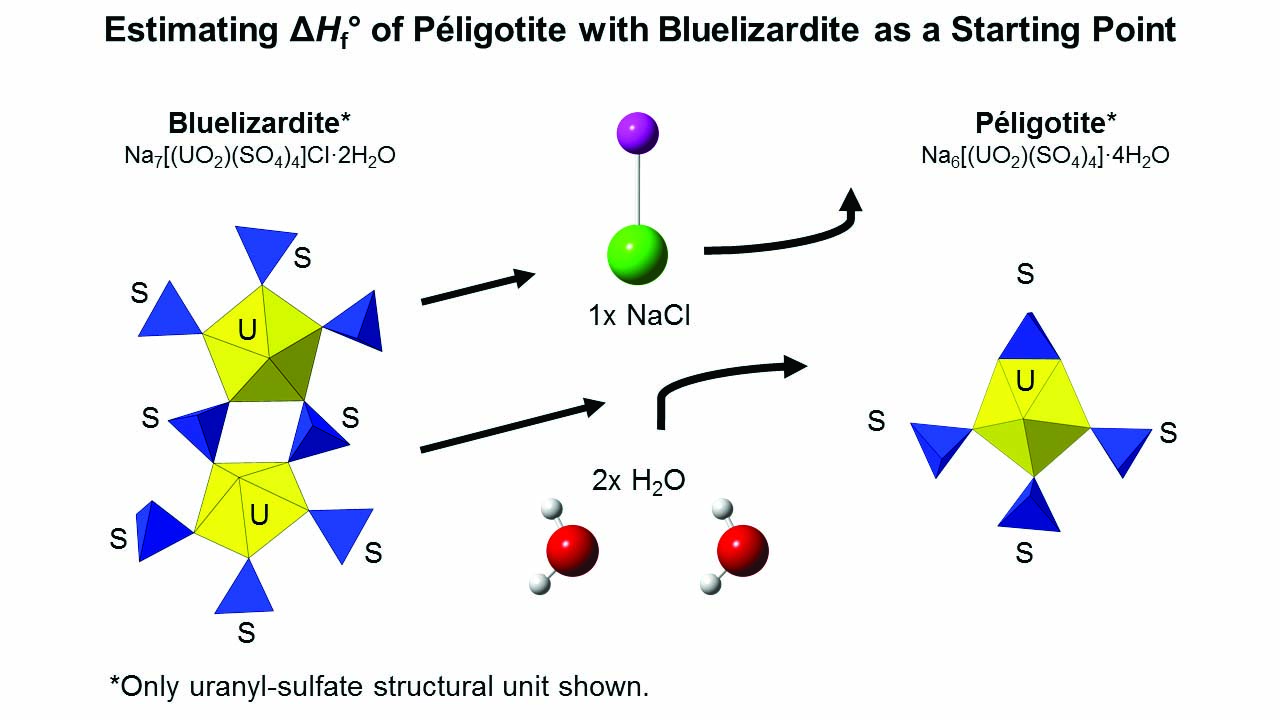
Calorimetry and structural analysis of uranyl sulfates with rare topologies
https://doi.org/10.2138/am-2023-9133
Five recently described uranyl sulfate minerals (lussierite, péligotite, shumwayite, geschieberite, and bluelizardite) were synthesized by Perry et al., their standard state enthalpy of formations determined with high-temperature calorimetry, and hydrogen positions found. The ΔHf° of péligotite was accurately estimated from the ΔHf° of lussierite and bluelizardite using literature ΔHf° values, suggesting the ΔHf° of other uranyl sulfate minerals can be accurately estimated.
Biological control of ultra-skeleton mineralization in coral
https://doi.org/10.2138/am-2023-9134
A combination of Raman spectral imaging and cross-polarized reflected light microscopy imaging was used by He et al. to reveal the three-dimensional spatial distribution, arrangement of skeletal ultrastructures and their associated mineral and organic compositions within coral, which has never been reported previously and will provide a new research paradigm for studies on biocarbonate microstructure and biomineralization process. These results will help to understand better the growth mechanisms of corals and their response and adaptation to global change.
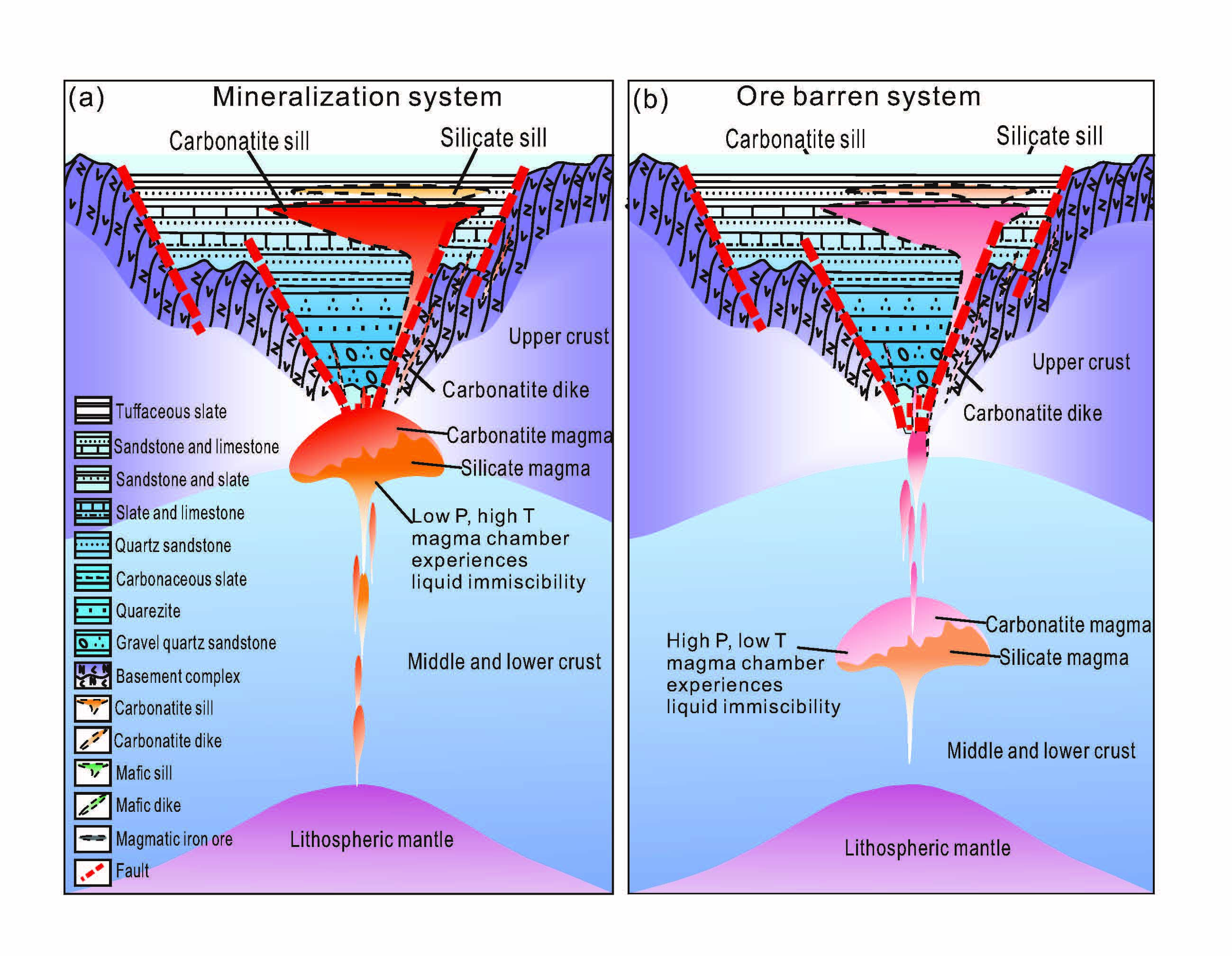
Systematic study of high field strength elements during liquid immiscibility between carbonatitic melt and silicate melt
https://doi.org/10.2138/am-2023-9093
Zhang et al. conducted liquid immiscibility experiments to understand the changes in partition coefficients of Nb, Ta, Zr, and Hf between carbonatitic and silicate melts. The results showed a positive correlation between the partition coefficients of these elements and Si, indicating that Si determines the differentiation of Nb-Ta and Zr-Hf. The partition coefficients of Si increase as temperature decreases and pressure increases, resulting in higher HFSE concentrations during the early stages of liquid immiscibility. The study provides insights into the association between super large carbonatite-related Nb deposits and Si-undersaturated silicate rocks.
Clustering and interfacial segregation of radiogenic Pb in a mineral host-inclusion system: Tracing two-stage Pb and trace element mobility in monazite inclusions in rutile
https://doi.org/10.2138/am-2023-9085
Verberne et al. combine nanoscale microstructural and chemical analyses to gain insight into the relationship between Pb and trace-element systematics in monazite inclusions found in ultrahigh-temperature metamorphic rutile, specifically targeting the mineral-host–inclusion interface. . . Using techniques such as atom probe tomography and transmission electron microscopy, Verberne et al. characterize the rutile host, the monazite inclusion, and their shared interface. This allows the authors to constrain trace element systematics and derive the timing of metamorphism within the established P-T history by analyzing the Pb isotopic signature at interface.
First application of scintillator-based photon-countingcomputed tomography to rock samples: Preliminary results and prospects
https://doi.org/10.2138/am-2023-9099
Ishiguro et al. report the first results of applying a laboratory-built Photon Counting-Computed Tomography (PC-CT hereafter) system using a scintillator-based photon counter to minerals such as quartz and calcite. PC-CT uses a new type of energy-resolved X-ray detector, which allows X-rays with a continuous energy spectrum to be detected separately in arbitrary energy regions. The preliminary results suggest that PC-CT can produce high-contrast images of minerals and may be able to distinguish mineral phases with different attenuation curves, even when their CT values are similar. Moreover, if prior knowledge of mineral phases is given from other methods, it may be possible to use PC-CT imaging to obtain their chemical compositions.

GCDkit.Mineral: A customizable, platform-independent R-language environment for recalculation, plotting, and classification of electron probe microanalyses of common rock-forming minerals
https://doi.org/10.2138/am-2023-9032
Janoušek et al. present GCDkit.Mineral, a platform-independent (Windows/Mac/Linux) freeware for recalculation, plotting, and statistical treatment of mineral data obtained by microbeam techniques, typically an electron microprobe. Raw compositional data (wt%) are recalculated to atoms per formula unit (apfu) based on a required number of O equivalents, atoms, or charges, with or without FeII/FeIII estimation by a variety of methods. Analyses may then be recast to structural formulas, i.e., the atoms are distributed into appropriate crystallographic sites. For minerals forming solid solutions, the molar percentages of end-members are computed. All data may be treated statistically, either by built-in functions for descriptive and multivariate statistics or by using the wealth of tools provided by the broad R community. The program is fully menu-driven for users unfamiliar with R and contains embedded default recalculation options for many common rock-forming minerals. Seasoned R users may invoke GCDkit.Mineral in command line mode, use batch scripts or Python-driven notebooks (e.g., of project Jupyter), or modify and develop new recalculations or plugins.
Apatite as an archive of pegmatite-forming processes: An example from the Berry-Havey pegmatite (Maine, U.S.A.)
https://doi.org/10.2138/am-2023-9097
Roda-Robles et al. report a detailed petrographic and chemical characterization of apatite associated with the different units of a highly fractionated, internally zoned pegmatite that help understand the crystallization history of pegmatitic melts. Apatite chemistry records variations in the fO2, elemental fractionation, interaction with competing mineral phases, fluid activity, and exsolution events. The main chemical elements in apatite that provide petrogenetic information in pegmatitic rocks include Mn, Sr, REE, and Y.
Re-examination of vesbine in vanadate-rich sublimaterelated associations of Vesuvius (Italy): Mineralogical features and origin
https://doi.org/10.2138/am-2023-9126
Pellino et al. give a detailed characterization of the V-bearing mineral assemblages on old vesbine samples from the Vesuvius volcano, kept in the Royal Mineralogical Museum of the University of Naples Federico II (Italy), a product of the fumarolic activity of Vesuvius volcano that is poorly understood. The purpose was to investigate the genesis of this peculiar assemblage.
« ‹ 1 … 11 12 13 14 15 … 85 › »ADDITIONAL RESOURCES