

Editor’s Notes
Total Results: 1697
Volume 109 : September 2024 Issue
Temperature and compositional dependences of H2O solubility in majorite
https://doi.org/10.2138/am-2023-9130
Liu et al. synthesized majorites with compositions, pressure, and temperature conditions relevant to the Earth's mantle and measured their H2O contents. They found that at the top lower mantle, where majorite persists beyond the stability of ringwoodite, majorite becomes the principal H2O reservoir. When a slab crosses the 660-km discontinuity, hydrous majorite transforms gradually into bridgmanite. This transformation may release water and contribute to a thick, hydrous melt-bearing layer below the 660-km discontinuity, up to ~800 km depth.
Raman spectroscopy of the ilmenite–geikielite solid solution
https://doi.org/10.2138/am-2023-9262
Ilmenite is an important mineral group for many planetary bodies, including the Earth, the Moon, and Mars. Breitenfeld et al. provide a model for estimating the Fe and Mg content of geologic samples within the ilmenite–geikielite solid solution series using Raman spectroscopy. This work is useful for laboratory analyses of terrestrial and extraterrestrial samples, real-time terrestrial fieldwork, or planetary surface exploration by astronauts.
Germanium distribution in Mississippi Valley-Type systems from sulfide deposition to oxidative weathering: A perspective from Fule Pb-Zn(-Ge) deposit, South China
https://doi.org/10.2138/am-2023-9106
Ge is crucial for high-tech industries, spurring considerable interest in studying its geochemical behavior in ore deposits. In this study, Wei et al. examine the Fule Pb-Zn(-Ge) MVT deposit in China as a typical case to reveal the partitioning of Ge between minerals and evaluate the mobility and redistribution of Ge during supergene weathering. A better understanding of Ge's distribution and mineral hosts in low-T hydrothermal systems have direct implications for Ge mobility and dictate metallurgical strategies for Ge recovery.
Volume 109 : August 2024 Issue
Fingerprinting the source and complex history of ore fluids of a giant lode gold deposit using quartz textures and in-situ oxygen isotopes
https://doi.org/10.2138/am-2023-9017
Fan et al. demonstrated that a visually single quartz vein may consist of multiple, isotopically distinct generations and thus record complex fluid processes. Such subtle information is highly likely to be obscured by bulk isotope analysis of quartz separates, which is commonly used in the studies of lode gold deposits because bulk compositions represent an average of different fluid events. Moreover, as recorded here, fluid mixing is a potentially unrecognized but perhaps common feature in many lode gold systems. Fluid source and subtle evolution in most lode gold deposits should be carefully re-examined. This can be achieved using in-situ oxygen isotope analysis of quartz closely coordinated with its detailed microtextures.
Cu isotope fractionation between Cu-bearing phases and hydrothermal fluids: Insights from ex situ and in situ experiments
https://doi.org/10.2138/am-2023-9155
Cu isotopes have been widely applied to fingerprinting metal source, to tracking fluid pathway, and to tracing mineralization processes, in which knowledge on isotope fractionation is a prerequisite. Qi et al. investigated the dissolution of Cu-bearing minerals (native Cu and cuprite) in hydrothermal fluids up to 800 °C and 200 MPa. Comparison using in situ and ex situ fluid sampling techniques show that rapid cooling of ore-forming fluids (200-300 °C) tends to form Cu phases with different oxidation states, consequently leading to significant Cu isotope fractionation up to ~1‰. In addition, temperature-dependent cuprite dissolution and non-redox-related solid precipitation processes can result in pronounced Cu isotope fractionation.
Barium mobility in a geothermal environment, Yellowstone National Park
https://doi.org/10.2138/am-2023-8996
Using Yellowstone as a modern analog of precious metal epithermal systems, Zimmerman and Larson examined Ba mobility from primary igneous feldspars under varying fluid conditions. Circumneutral fluids sequestered Ba in secondary feldspars, while acid-sulfate fluids liberated Ba from feldspars and sequestered it in sulfate minerals. One implication is that rhyolite formation at supervolcanoes may occur through the recycling of hydrothermally altered rock to generate a Ba-enriched, 18O-depleted magma after caldera collapse.
Single-crystal elasticity of humite-group minerals by Brillouin scattering
https://doi.org/10.2138/am-2023-9067
Humite-group minerals have long been recognized as important carriers of water and fluorine in subduction slabs. Zhang et al. determined the elasticity of four (F, OH)-humite group minerals (one chondrodite, one humite, and two clinohumite) using Brillouin scattering. The results show that adding fluorine increases the elasticity of clinohumite and chondrodite, which is in contrast to the effect of H2O. Meanwhile, iron has a negligible impact on the bulk modulus of humite-group minerals but significantly decreases the shear modulus of clinohumite. Together with previous experimental results, the authors also analyzed the influence of F, H2O, and Fe content on the density, elasticity, and sound velocities of minerals along the forsterite-brucite join in the MgO-SiO2-H2O system.
Sulfur speciation in dacitic melts using X-ray absorption near-edge structure spectroscopy of the S K-edge (S-XANES): Consideration of radiation-induced changes and the implications for sulfur in natural arc systems
https://doi.org/10.2138/am-2022-8833
Measuring the proportion of the different oxidation states of sulfur in quenched silicate glasses is important for understanding how redox conditions affect the behavior of sulfur and, therefore, the carrying capacity for metals that bond with S in the melt. Synchrotron micro-X-ray absorption near-edge structure spectroscopy at the S K-edge (S-XANES) is uniquely suited for these measurements. However, to date, no study has systematically investigated the threshold of incident photon flux density on beam damage, which alters the original proportion of S oxidation states in beam-sensitive glasses. Kleinsasser et al. present a comprehensive study using water-saturated dacitic glasses equilibrated at 1000 °C, 300 MPa, and a range of reducing to oxidizing conditions. Analyzing the glasses at three different photon flux densities, they describe the onset of beam damage at each radiation level and determine the maximum total exposure threshold before the original S oxidation states are significantly altered. The results demonstrate that S4+ is soluble in dacitic glasses, which contradicts what has been shown in basaltic-andesitic glasses. They also show that beam damage manifests as both photo-reduction (as observed in basaltic glasses) and as photo-oxidation, which is unique to dacitic glasses. Finally, this study provides beamline scientists with critical information on how to maximize the results of S-XANES on silicate glasses while minimizing the effects of beam damage.
Ab initio calculations and crystal structure simulations for mixed layer compounds from the tetradymite series
https://doi.org/10.2138/am-2023-9018
Yao et al. used density functional theory (DFT) calculations to obtain structural information on seven members of the tetradymite homologous series - four named members and three unnamed species. The results have implications for other mixed-layer compounds in that relationships between modulation vectors and interlayer distances can be mathematically defined to allow prediction of crystal parameters of any species in the series, including those well beyond the compositional range considered here. The findings are significant for mineral systematics and classification as they underpin structural models for all intermediate structures in the group, and analogous approaches can be equally applied to other mixed-layer series.
Machine learning applied to apatite compositions for determining mineralization potential
https://doi.org/10.2138/am-2023-9115
Zheng et al. identified mineralization potential by applying machine learning (ML) method to global scale of apatite compositional data. The developed XGBoost models exhibit superior accuracy in distinguishing between barren and fertile suites compared to traditional diagrams. Feature importance analysis of these models suggests that a hydrous magma enriched with Cl and S may play a pivotal role in metal enrichment and mineralization. The results of this study indicate that ML techniques have the potential to decode latent information in high-dimensional geochemical data and to be applied in the field of mineral exploration.
Reconstructing volatile exsolution in a porphyry ore-forming magma chamber: Perspectives from apatite inclusions
https://doi.org/10.2138/am-2023-8963
Magmatic water saturation in the magma chamber is essential for the formation of porphyry mineral deposits. However, a direct volatile record of the processes remains lacking. Huang et al. analyzed the volatile compositions of zircon-, biotite-, plagioclase-hosted apatite inclusions, and apatite groundmass crystals from the largest Cretaceous porphyry Cu-Mo deposit in South China to reconstruct the volatile history of the ore-forming magma. Through comparison with thermodynamic models, they show that the apatite crystals fully enclosed by zircons retain the volatile composition at the time of entrapment, which is consistent with isobaric water-saturated crystallization and volatile exsolution in the magma chamber. However, non-zircon host magmatic apatite inclusions do not preserve their original volatile records but have been over-written by later diffusional re-equilibration with the residual melt after significant volatile exsolution. Their data also indicate that most of the water and Cl (possibly Cu, Mo, and S) have been extracted by the fluids exsolved from the magma chamber and may have been critical in porphyry mineralization.
Incommensurate to normal phase transition in malayaite
https://doi.org/10.2138/am-2023-9063
Malcherek et al. report variable temperature X-ray diffraction (20 K < T < 295 K) and Raman scattering (90 K < T < 400 K) data of malayaite, the tin analog of the mineral titanite, aided by results from density functional perturbation theory. The authors observed a phase transition to an aperiodically ordered (one-dimensionally modulated) structure at 50 K. Approaching the phase transition from higher temperatures, frequency reduction (softening) of antiparallel temperature motion of the Ca atoms (which occupy voids within the framework structure) is observed, that freezes into the modulated phase at the transition temperature. Already 100 K above this temperature, softening of the Ca motion accelerates, while other phonon modes also start to soften. This temperature coincides with the onset of negative thermal expansion along the b-axis of malayaite. As indications for the occurrence of the phase transition in this mineral were initially obtained using computational methods, such methods may be used to predict similar transitions to yet undetected low-temperature crystal structures in other minerals.
Raman spectroscopic measurements on San Carlos olivine up to GPa and K: Implications for thermodynamic properties
https://doi.org/10.2138/am-2023-9052
Olivine is the most abundant mineral above the 410-km seismic discontinuity in the deep EarthÕs interior, and its thermodynamic properties play a dominant role in the physics and chemistry of the Earth and planetary mantles. Generally, the thermodynamic properties of minerals are modeled in harmonic approximation, like the heat capacities, equations of state, and equilibrium isotopic fractionation factors, etc. Nevertheless, such an approximation would deviate from reality, especially at high-pressure and high-temperature conditions. Hence, the intrinsic anharmonic correction becomes necessary and crucial to restore agreement between theoretical calculations and measurements at the P-T conditions of the mantle. Liu et al. selected San Carlos olivine as an example, and they conducted high-P-T Raman measurements simultaneously in an externally heated diamond anvil cell up to 14 GPa and 800 K. Temperature is more important in determining the anharmonic contribution to thermodynamic properties, as compared with pressure. Their calculation can be adopted as a useful tool for modeling the radial temperature distribution in planetary mantles and setting up connections between isothermal and adiabatic compressions of minerals. Besides, the modeled heat capacities of olivine can also be related to the heat transport properties of heat conductivity and heat diffusivity in the Earth and planetary interiors, which are important for many geodynamic processes.
Chemical and boron isotopic composition of tourmaline from the Yixingzhai gold deposit, North China Craton: Proxies for ore fluids evolution and mineral exploration
https://doi.org/10.2138/am-2023-9094
Tourmaline commonly occurs in magmatic-hydrothermal deposits, and its composition and boron isotope geochemistry have been widely used to fingerprint the source and evolution of the hydrothermal fluids and associated metals. However, whether these chemical and/or boron isotopic compositions can be used as vectors for mineral exploration has yet to be explored in detail. Zhao et al. document the major and trace element compositions and boron isotopic values of tourmaline along a vertical extension (i.e., 510, 830, 1230 m above sea level) of the newly discovered porphyry gold mineralization in the Hewan feldspar quartz porphyry of Yixingzhai deposit in the North China Craton to shed light on the evolution of the ore-forming fluid, the mechanisms of gold deposition, and potential indicators for gold exploration. The results show that the hydrothermal fluid responsible for the gold mineralization was initially exsolved from the Hewan porphyry, which migrated upward and gradually mixed with the circulating meteoric water. Such fluid mixing, in a suitable proportion, caused the formation of economic gold ores. The tourmaline _11B, Co/(Pb+Zn), and Sr/(Pb+Zn) values potentially could be used as proxies for gold exploration in other coeval plutons and cryptoexplosive breccia pipes in and around the mine area. This study highlights the feasibility of using tourmaline's chemical and isotopic compositions for mineral exploration.
Tourmaline chemical and boron isotopic constraints on the magmatic-hydrothermal transition and rare-metal mineralization in alkali granitic systems
https://doi.org/10.2138/am-2023-9131
Wu et al. applied tourmaline chemistry and B isotopes to unravel processes at the magmatic-hydrothermal transition that are responsible for rare-metal partitioning in the Huoshibulake and Tamu REE-Nb-mineralized intrusions in Southern Tianshan, SW Central Asian Orogenic Belt. Several key findings are: (1) The Huoshibulake and Tamu rare-metal alkali granites show multi-generation crystallization of tourmaline. (2) Tourmaline chemistry and boron isotopes can be used to reconstruct the magmatic-hydrothermal evolution. (3) Saturation of fluorite during the magmatic-hydrothermal transition is a critical factor in determining the rare-metal enrichment and deposition.
Volume 109 : July 2024 Issue
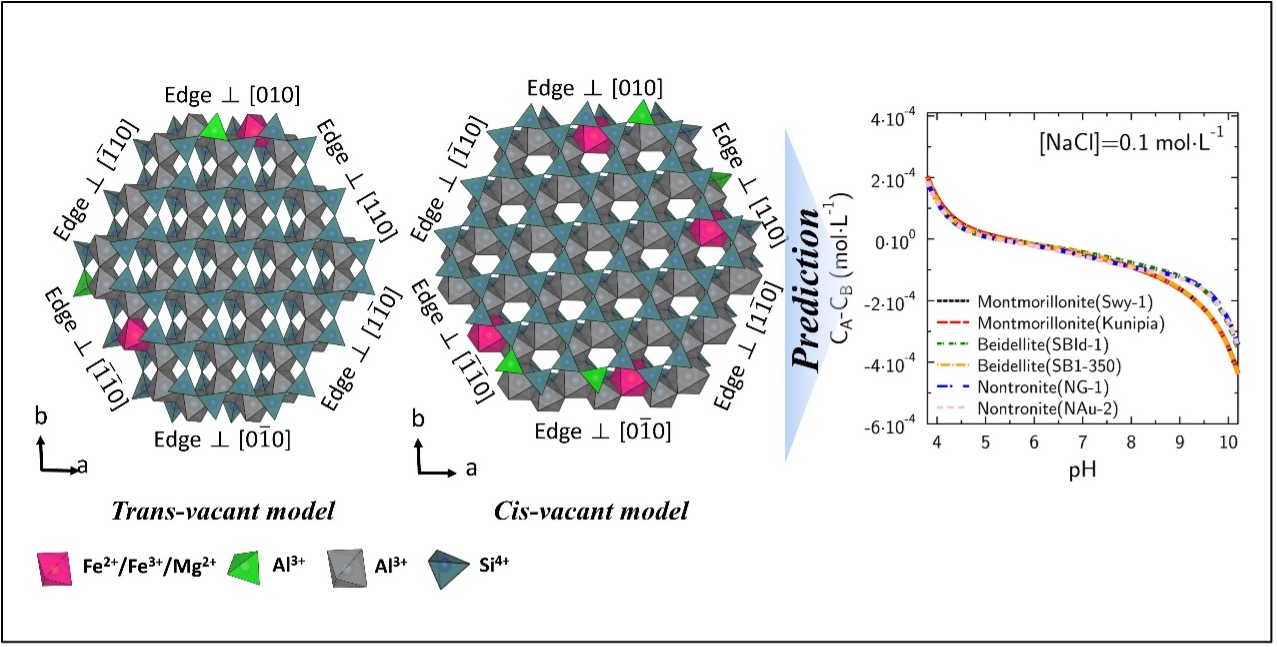
Influence of Fe(II), Fe(III), and Al(III) isomorphic substitutions on acid-base properties of edge surfaces of cis-vacant montmorillonite: Insights from first-principles molecular dynamics simulations and surface complexation modeling
https://doi.org/10.2138/am-2023-9057
In this contribution from Gao et al., the structure of smectitic clay mineral layers is shown to influence the acid-base properties of their edge surfaces. Molecular-level information makes it possible to predict these properties and build larger-scale surface reactivity models that take into account the presence of isomorphic substitutions and the position of structural vacancies in the layer.
The kinetic effect induced by variable cooling rate on the crystal-chemistry of spinel in basaltic systems revealed by EPMA mapping
https://doi.org/10.2138/am-2023-9014
The crystal chemistry of spinel is markedly affected by ΔT/Δt (1 to 180 °C/h), and it can be captured only by EPMA maps. At sluggish rates, the average spinel is relatively rich in Ti and the Fe2+ + Mg sum and close to equilibrium with its basaltic liquid, but at progressively higher ΔT/Δt, these values decrease, and the Fe3+ + Al sum increases. In this paper by Gennaro et al., this behavior indicates that only the amounts of Me4+, Me3+, and Me2+ cations record kinetics of solidification suffered by magmas and lavas on Earth.
Machine-learning oxybarometer developed using zircon trace-element chemistry and its applications
https://doi.org/10.2138/am-2023-8978
Zou et al. use trace elements in zircons and their independent fO2 constraints to train machine learning models to construct an oxybarometer. The machine-learning oxybarometer has higher accuracy than the traditional method and can be applied in a variety of geologic settings. Web-based software has been developed to make the machine-learning oxybarometer easily accessible to the research community.
Experimental determination of Si, Mg, and Ca isotope fractionation during enstatite melt evaporation
https://doi.org/10.2138/am-2023-9111
Lu et al. find that during high-T evaporation of enstatite melt, light Si and Mg isotopes favor vapor over melt, but Ca does not show evaporation or isotopic fractionation. Their modeling shows that if the Mg/Ca and Si/Ca ratios and isotopes in the bulk silicate Earth are attributed to the evaporation of enstatite chondrite-like precursors, evaporation temperatures > 5000 K are required.
Quartz texture and the chemical composition fingerprint of ore-forming fluid evolution at the Bilihe porphyry Au deposit, NE China
https://doi.org/10.2138/am-2022-8840
Porphyry Au-only deposits represent an important but understudied sub-type of porphyry deposits. However, this type of deposit is rarely developed globally and former studies mainly focused on porphyry Cu and Mo endmembers, indicating that the ore-forming and Au enrichment processes of porphyry Au-only deposits are poorly understood. In this contribution, Hong et al. report systematic SEM-CL textures and in-situ trace element concentrations of different quartz generations from the magmatic to hydrothermal stages in the Bilihe porphyry Au deposit. Their results suggest that different quartz generations could reveal different growth rates, temperatures, pH, and fluid compositions. This study advances the application of CL textures combined with quantitative trace element data of successive quartz generations to comprehend specific ore-forming, physiochemical environments, and mineralization processes, which helps to better understand the processes of porphyry Au ore formation.
« ‹ 1 … 12 13 14 15 16 … 85 › »ADDITIONAL RESOURCES