
Editor’s Notes
Total Results: 1697
Volume 109 : April 2024 Issue
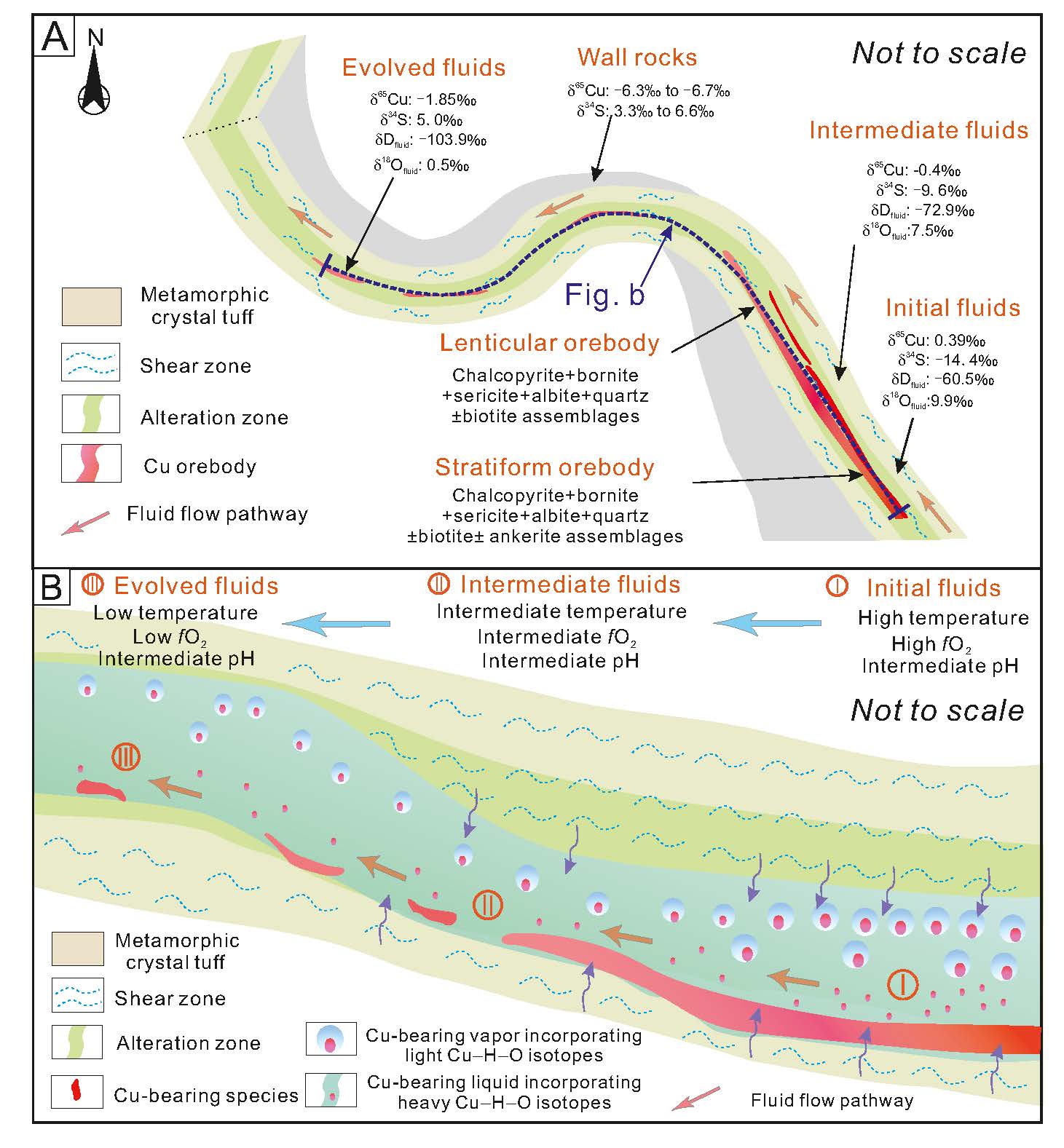
Vapor-phases as Cu transport agents for the shear-zonehosted mineralization system: A perspective from H-O-SCu isotopes
https://doi.org/10.2138/am-2022-8888
Elucidating metal transport agents is the key to understanding the genesis of deposits and tracking the locations of concealed orebodies. Zhao et al. demonstrate that integrating H-O-S-Cu isotopic analyses with geochemical modeling can reveal the vapor phase as the dominant metal transport agent in a metamorphic geological environment. From this perspective, metal precipitations can occur along the shear zone over a long distance because vapor phases can move outwards promptly. Their study provides a framework to track the locations of concealed orebodies for the shear-zone-hosted Cu deposits reliably.
Don Juan Basin, Antarctica: A chemically altering environment with martian analog potential
https://doi.org/10.2138/am-2022-8779
Foerder et al. present a coordinated geochemistry-, spectroscopy-, and mineralogy-based study of sediments from a basin in the McMurdo Dry Valleys of Antarctica with the purpose of investigating the type and degree of alteration occurring in and around a hypersaline and perennially liquid water pond found within. Sediment provenance, surface, and subsurface processes are also considered to provide information on alteration processes occurring in a cold, water-poor, Mars-like setting. The authors connect these geochemical and mineralogical observations to those detected at the martian surface to describe a possible analog setting (and process) for the formation of these ofttimes enigmatic aqueous, chemical alteration products on Mars. This work has important implications for the Hesperian to recent history of chemical alteration processes at and near the martian surface.�
High-pressure polymorphs of ferroan dolomite: Possible host structures for carbon in the lower mantle
https://doi.org/10.2138/am-2022-8737
Martirosyan et al. demonstrate a complex polymorphism of the dolomite-ankerite solid solutions at high pressure and a clear effect of cationic substitution on the phase behavior. Given the significant role of carbonates in the petrological and geochemical processes, such as carbonatitic melt formation, metasomatism, and red-ox reactions, the Dol-IIIc and IIIb polymorphs should be considered in the modeling of the lower mantle processes related to the deep carbon cycle.
Revisiting the genesis of the adakite-like granitoids in collisional zones: Water-fluxed melting of intermediate to felsic rocks with dilution by low Sr/Y phases
https://doi.org/10.2138/am-2022-8873
Xie et al. investigated the origin of adakitic plutonic rocks through geochemical and textural characterization of rock-forming minerals in the orthopyroxene-bearing, Zhuyuan granodiorite (West Qinling, China). The study proposes that high Sr/Y signal is primarily controlled by the late-stage orthocryst assemblages (non-sieve textured plagioclase+ biotite + K-feldspar + quartz). The addition of low Sr/Y non-orthocrysts and associated melt may have diluted the primary �adakitic signal� in the magma reservoir, driving the bulk composition to more mafic values. The study also highlights that the high Sr/Y signal, which can be formed under various pressure conditions, is often controlled by source compositions. In this regard, many high Sr/Y adakitic granites cannot be directly used to infer the thickness of the continental crust when the source is a felsic to intermediate protolith melted under water-fluxed conditions.
Pressure-induced phase transitions in Ni-bearing ferrosilite (Ni-En31Fs65)
https://doi.org/10.2138/am-2022-8879
Metastable orthopyroxene is considered to be related to the stagnation of slabs due to its low density compared with other major slab minerals. Xu et al. observed three metastable phase transitions in Ni-bearing ferrosilite (Ni-En31Fs65) at 12.1(6) GPa, 15.6(6) GPa, and 31.3(25) GPa. This study revealed the possible phase transition path of Fe-rich orthopyroxene in extremely cold subducting slabs in the deep Earth: _-opx (Pbca) _ _-opx (P21/c)� _ _-opx (Pbca)� _ _-popx (P21ca).
Thermoelastic properties of non-metamict zircon
https://doi.org/10.2138/am-2023-8986
M�nchhalfen and Schreuer determined the thermoelastic properties and thermal expansion of natural single-crystal zircon without detectable radiation damage were in the temperature range between 100 K and 1650 K on five samples from Cambodia, Sri Lanka, and Tanzania. Their results are highly reproducible, allowing for a reliable extrapolation to 0 K. Previously unknown irreversible elastic effects were observed in the high-temperature range above 1500 K.
Scheelite composition fingerprints pulsed flow of magmatic fluid in the Fujiashan W skarn deposit, eastern China
https://doi.org/10.2138/am-2022-8917
Skarn mineralization forms when magmatic fluids react with impure carbonate rocks. Scheelite is an important ore mineral in W skarns, and its chemical and isotopic composition reflects both the magmatic fluid and the reaction history of the fluid with the carbonate wall rocks. Ji et al. present cathodoluminescence images and in-situ trace element and Sr-O isotope data of scheelite from four stages of the hydrothermal skarn development in the Fujiashan W skarn deposit, i.e., scheelite in prograde and retrograde skarn, quartz-sulfide veins, and late calcite replacements. The results show that pulsed and restricted magmatic fluid flow produces zones with depletions in elements that partition strongly into scheelite and systematic changes of Sr and O isotope composition. Notably, chemical and isotopic variations in scheelite do not require the involvement of different fluids or changes in redox conditions.
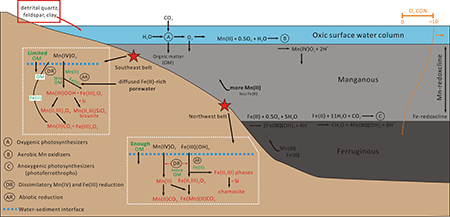
Mineralogy of the 1.45 Ga Wafangzi manganese deposit in North China: Implications for pulsed Mesoproterozoic oxygenation events
https://doi.org/10.2138/am-2022-8919
The traditional view suggests that the presence of Mn(II) carbonates in manganese deposits was formed by the diagenetic reduction of precursor Mn(IV) oxides. Therefore, Precambrian sedimentary Mn deposits have been used to indicate the evolution of oxygen in Earth�s surface environments. However, recent studies have shown that these Mn(II) carbonates can directly accumulate within anoxic water columns, casting uncertainty on the robustness of using ancient Mn deposits to constrain the redox fabric of the past marine water columns. Based on the comprehensive mineralogical investigation of the Mesoproterozoic Wafangzi Mn-Fe deposit, Yan et al. suggest that the Mn(II,III)- and Fe(II)-bearing mineral phases were formed through the diagenetic reduction of primary Mn(IV) and Fe(III) minerals, supporting the traditional oxygenation metallogenic model. Together with contemporaneous Mn mineralization in western Australia, their study supports a continent-scale transient pulsed oxygenation event in the mid-Proterozoic oceans. Their findings shed light on the interaction between Mn cycles and oceanic redox environment in the critical �boring billion� earth history.
Tourmaline growth in the border and wall zones of the Emmons pegmatite (Maine, U.S.A.): Evidence for disequilibrium crystallization and boundary layer formation
https://doi.org/10.2138/am-2023-8991
Van der Does et al. investigated unidirectional solidification textures and graphic intergrowths of tourmaline and quartz from the Emmons Pegmatite. Three textural groups were identified: comb-like tourmaline, quartz-tourmaline intergrowths (QTIs), and radiating tourmaline. Furthermore, five different morphologies were identified within these groups. Geochemical analyses show that the composition varies on three different scales: among the textural groups, intracrystalline, and within individual QTIs. The first two are explained by the progressive magmatic evolution of the dike and sector zoning, respectively. For the variations within the QTIs, the authors propose a model where the outer part of the QTI crystallizes from a water and flux-enriched boundary layer. The boundary layer forms as the central and first part of the QTI crystallizes. The skeletal part of the QTI then crystallizes from the boundary layer. These boundary layers have earlier only been observed in experimental studies, but this paper provides the first examples of boundary layers in natural samples. The fact that the geochemistry of the tourmaline varies on a millimeter to decimeter scale brings into question whether tourmaline in pegmatites can be used as a petrogenetic indicator for the bulk pegmatite melt.
NEW MINERAL NAMES
https://doi.org/10.2138/am-2024-NMN10949
New Mineral Names
Volume 109 : March 2024 Issue
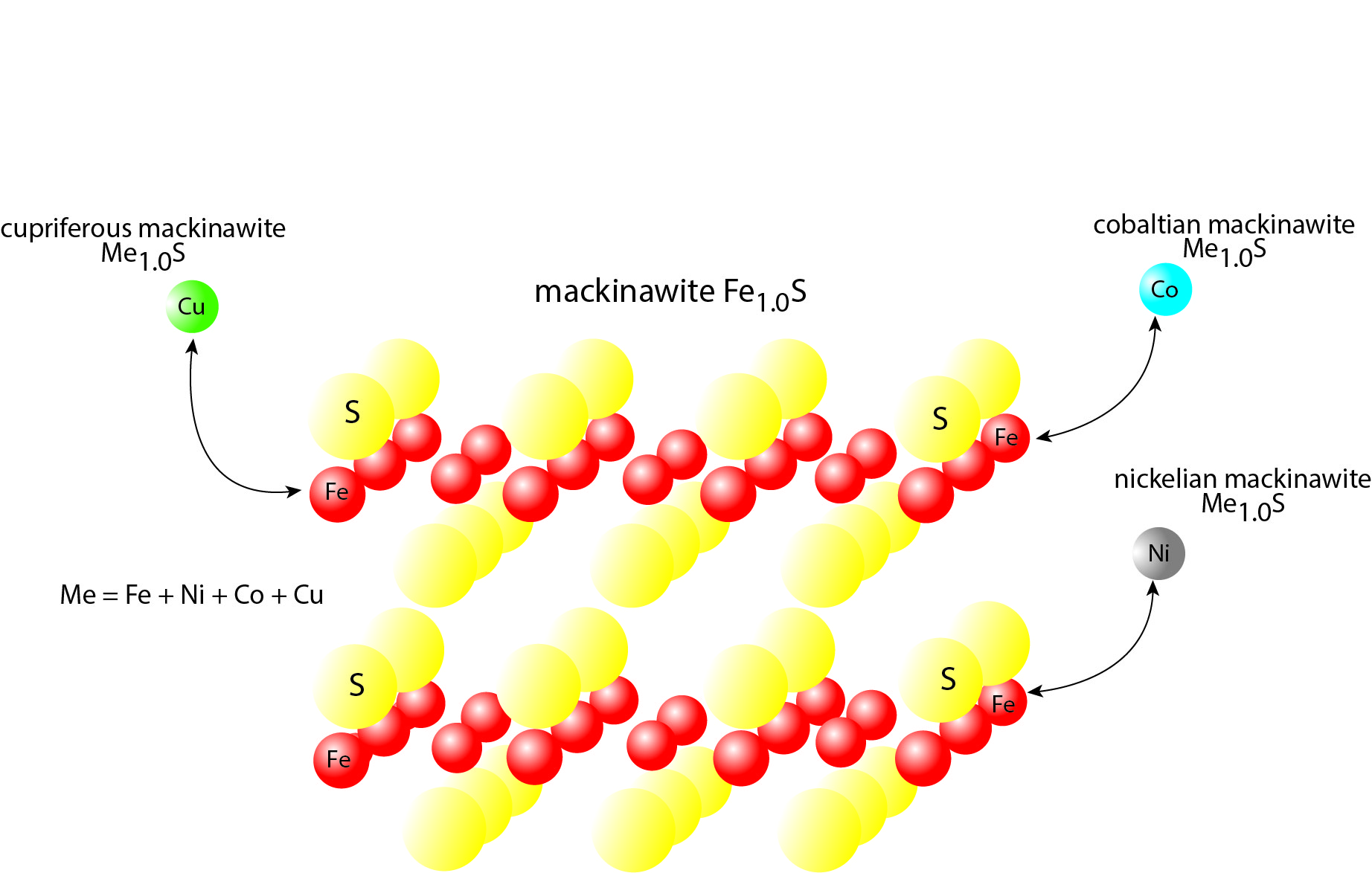
The composition of mackinawite
https://doi.org/10.2138/am-2023-8943
A critical statistical meta-analysis by Rickard shows that the composition of the tetragonal iron sulfide, mackinawite, is stoichiometric Fe1.0S. In the 60 years since its discovery, various formulations of mackinawite composition, such as Fe1+xS, have been listed in mineralogical databases and used by researchers. These formulations are wrong. Most mackinawites are simple FeS, but distinct cobaltian, nickelian, and (possibly) cupriferous varieties exist where minor elements substitute for Fe in the mackinawite structure. The result is fundamental to understanding the role of mackinawite in geologic, environmental, biologic, and industrial processes.
Halogen fractionation during vapor-brine phase separation revealed by in situ Cl, Br, and I analysis of scapolite from the Yixingzhai gold deposit, North China Craton
https://doi.org/10.2138/am-2022-8826
Gao et al. examine scapolite from the Yixingzhai deposit, which is formed from oxidized and high salinity magmatic-hydrothermal fluids under high temperature and low-pressure conditions. The extremely high Br/Cl and I/Cl values of the scapolite mainly result from halogen fractionation during vapor-brine phase separation where Br and I preferentially partition into the brine phase compared to Cl the separation.
The effects of oxygen fugacity and sulfur on the pressure of vapor-saturation of magma
https://doi.org/10.2138/am-2022-8739
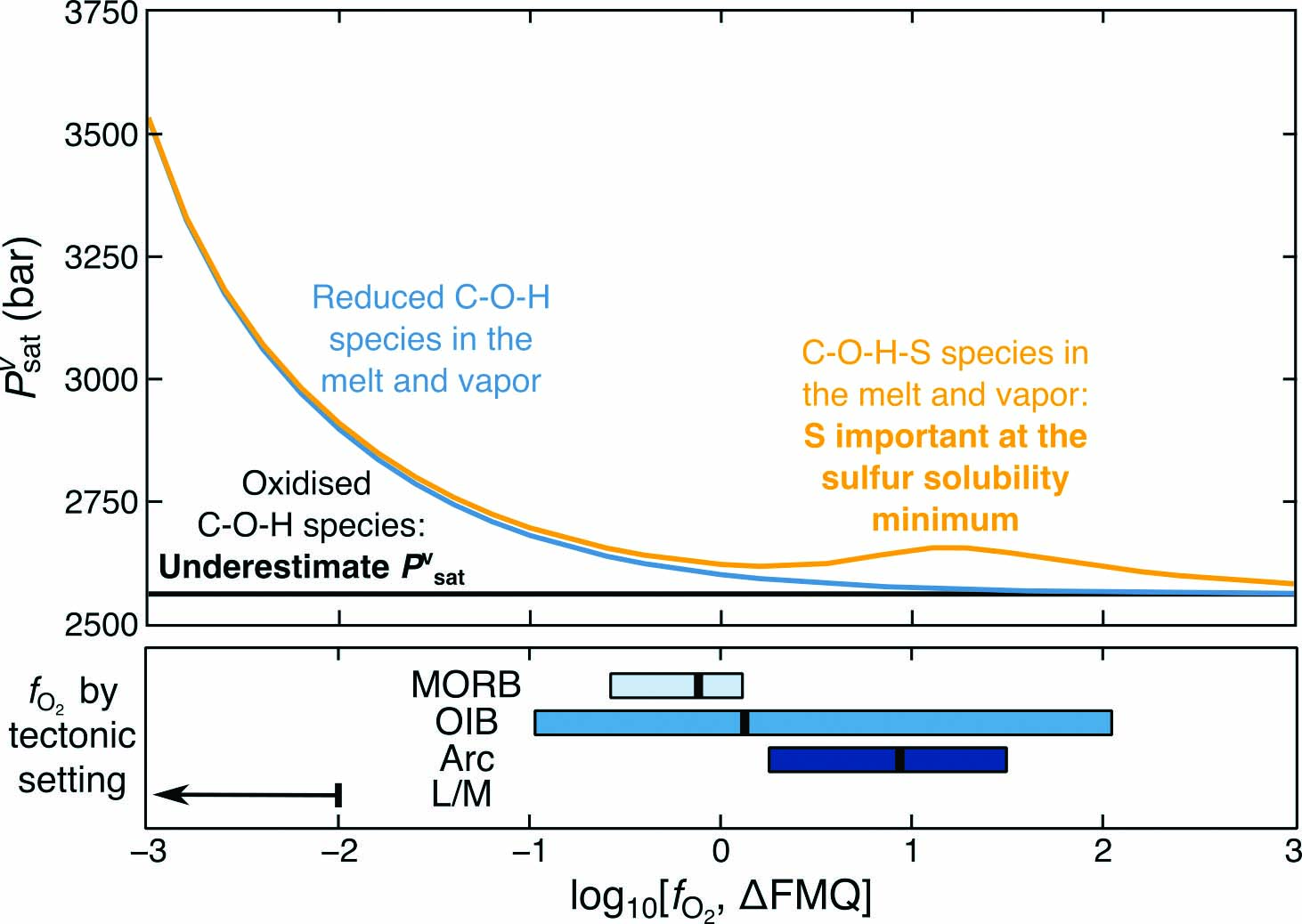
The volatile content of the melt can be used as a barometer if the melt is vapor-saturated (pressure of vapor-saturation: Pvsat). Most Pvsat calculations assume the melt and vapor contain only oxidized C-O-H species. Hughes et al. show that the exclusion of reduced C-O-H species results in large Pvsat underestimations at reduced conditions while excluding S causes underestimates of Pvsat at intermediate redox conditions. Hence, magma depths are deeper than previously calculated at these conditions.
A revisit to the phase transition behavior of K-feldspar at high-pressure and high-temperature: Implications on metastable K-feldspar in cold subduction
https://doi.org/10.2138/am-2022-8877
To better understand the phase relations of K-feldspar in cold subduction, He and Li carried out a series Raman measurements and quenching experiments to systematically study the effect of pressure and temperature on the phase behavior of K-feldspar and produced a more comprehensive P-T phase diagram of K-feldspar than previously known. K-feldspar undergoes a pressure-induced transition from C-1 to P-1 (metastable K-feldspar) symmetry at ~10.2 GPa. Metastable K-feldspar is an intermediate phase from K-feldspar to K-holl-I in extremely cold subduction slabs (<2 �C/km) or the center of some old and cold subducting slabs. Metastable K-feldspar is stable even at 11.4 GPa and 400�C in enriched hydroxyl group (OH) environments, and shows greater high P-T stability than K-feldspar. This study could help us to explore the possible formation paths and conditions of K-holl-I, the existing depth of K-feldspar stability, and have furthered the understanding of continental subduction.
Equation of state and structural evolution of manganese dolomite (kutnohorite) under high pressures
https://doi.org/10.2138/am-2023-8949
Xu et al. studied manganese dolomite at various high pressures. They report: (1) X-ray diffraction patterns of single-crystal manganese dolomite at pressures up to 51.2 GPa; (2) The equation of state of manganese dolomite from 1 bar to ~13.3 GPa; and (3) The split and disappearance of diffraction spots up to 51 GPa indicating the highly distorted rhombohedral structure of manganese dolomite.
A possible origin of the lunar spinel-bearing lithologies as told by the meteorite NWA 13191
https://doi.org/10.2138/am-2022-8728
Pink spinel anorthosite (PSA) and pink spinel troctolite (PST) are two lunar lithologies known to contain Mg-rich spinel. They are widely distributed on the Moon's near and far sides. The study of their petrogenesis is important to understand the evolution of the Lunar crust. Xie et al. report their study of NWA 13191, a recently approved lunar meteorite that contains a large amount of spinel-bearing clasts, and discuss its origin. The characteristics of its petrology and mineralogy indicate that the Mg-Al-rich melt may be produced by the impact melting of Mg-rich anorthosite precursors. The spinel is a metastable crystallization product along with plagioclase and vitric melt near the Moon's surface. This realization provides observational evidence for previous simulated crystallization experiments and theoretical speculations.
Vergasovaite to cupromolybdite topotactic transformation with crystal shape preservation
https://doi.org/10.2138/am-2022-8753
Whereas SC-SC transformations have been studied in detail to date, well-documented topotactic transitions in pure inorganic compounds and minerals with crystal shape preservation are as yet very rare. The thermal behavior of vergasovaite, Cu3O(SO4)(MoO4), and its synthetic analog was studied by Nazarchuk et al. by high-temperature single-crystal X-ray diffraction. The mineral is stable until 950; at 975 K, the topotactic transformation of vergasovaite into cupromolybdite, Cu3O(MoO4)2 occurs.
Thermal conductivity of aluminous garnets in Earth's deep interior
https://doi.org/10.2138/am-2023-8953
Hung et al. precisely determined the thermal conductivity of aluminous garnets under high pressure-temperature conditions, which significantly advances our understanding of the thermal properties of garnets and their impacts on the complex thermochemical evolution in Earth's deep interior. Their results also offer an important basis for future novel design and fabrication of laser optics and electronic devices based on a variety of synthetic non-silicate garnets.
Interaction of seawater with (ultra)mafic alkaline rocks— Alternative process for the formation of aegirine
https://doi.org/10.2138/am-2023-8928
Rapprich et al. present a new model for the origin of aegirine in (ultra)mafic and relatively Na-poor alkaline rocks from Central Europe, which did not experience significant magmatic differentiation. Their data suggest that the late- to post-emplacement alteration of a mafic alkaline rock due to its contact with seawater leads to the degradation of diopside, resulting in the growth of secondary aegirine. The observed transformation of diopside into aegirine does not lead to a significant enrichment of the rock in Na (sourced from the seawater), as the process is blocked by a lack of available ferric iron. This effect may explain the limited Na-enrichment of submarine alkaline rocks, which is negligible compared to large-scale sodic-metasomatism of MORB tholeiites acquired during spilitization.
Experimental study on the kinetics of magnesiohornblende dehydration and its implications
https://doi.org/10.2138/am-2022-8692
This experimental study by Han et al. provides a further understanding of seismic and high-electrical-conductivity anomalies in the subduction zone. This research will be of interest to colleagues who study the physical and chemical properties of hydrous minerals in subduction zones.
« ‹ 1 … 15 16 17 18 19 … 85 › »ADDITIONAL RESOURCES