
Editor’s Notes
Total Results: 1697
Volume 109 : February 2024 Issue
Reconstructing diagenetic mineral reactions from silicified horizons of the Paleoproterozoic Biwabik Iron Formation, Minnesota
https://doi.org/10.2138/am-2022-8776
Duncanson et al. present petrographic observations, SEM, EMPA, and Raman spectroscopy from iron mineral phases preserved within silica-cemented horizons of the ~1.9 Ga Biwabik Iron Formation (Minnesota, USA) to constrain texturally early iron formation mineralogy from this crucial post-GOE (Great Oxidation Event) interval. Based on textural relationships, the iron silicate greenalite is identified as the earliest-forming iron silicate mineral preserved within silica-cemented horizons. The Mg- and Al-rich iron silicates chamosite and stilpnomelane are preserved proximal to fine-grained, non-silicified horizons, suggesting local geochemical exchange during early diagenesis. The presence of well-preserved, early-forming silicates containing predominantly ferrous iron may indicate reducing conditions at the sediment-water interface during deposition of the Biwabik Iron Formation. Future studies using iron silicate mineralogy as seawater geochemistry proxies should consider preservation by silica cementation, in addition to the effects of local geochemical exchange during diagenesis.
Mannardite as the main vanadium-hosting mineral in black shale-hosted vanadium deposits, South China
https://doi.org/10.2138/am-2022-8903
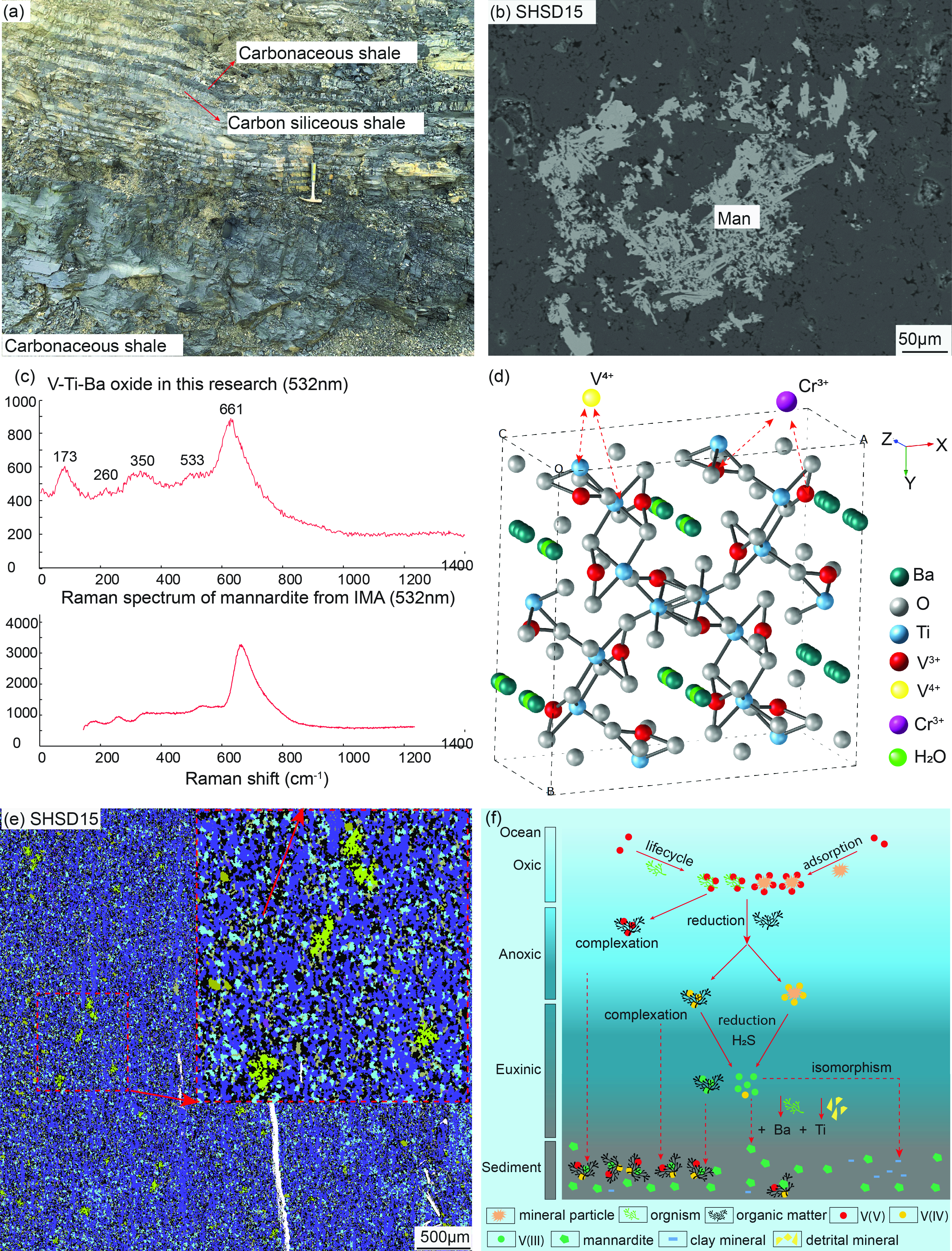
Yang et al. identified mannardite in the black shale-hosted vanadium deposits, which is the main vanadium-hosting mineral and provides 12.32% - 44.06% vanadium. The pentavalent vanadium species in seawater accumulated through organism activities may be reduced into quadrivalent vanadium by organic matter and then into trivalent vanadium species by H2S. Mannardite may be precipitated under the reductive condition with sufficient trivalent vanadium species, titanium (Ti) and biogenic barium (Ba). The results put forward new cognition on the occurrence states of vanadium, which shows mineralogical significance on understanding the metallogenic mechanism as well as beneficiation of vanadium in the black shale. Based on the proportion of vanadium from the mannardite (average of 24.95%), mannardite in the black shale-hosted vanadium deposits preserves a total of 19.6% vanadium in the world.
Molybdenite-bearing vugs in microgranite in the Preissac pluton, Québec, Canada: Relicts of aqueous fluid pockets?
https://doi.org/10.2138/am-2022-8770
Mulja and Williams-Jones demonstrated that (1) there exists rare occurrence of molybdenite-bearing miarolitic cavities in highly evolved fine-grained monzogranite dikes with ?REE of 17.2, EuCN of 0.27 and Eu/Eu* of 0.24; (2) field, mineral-chemical, whole-rock composition, and stable isotope (O and S) data indicate a magmatic-hydrothermal origin for the cavities, molybdenite and other associated phases; (3) the cavities represent relicts of vapors (gas-fluid mixtures) that exsolved from an ascending felsic magma through fractures where it quenched as fine-grained monzogranite dikes; and (4) molybdenum that partitioned into the vapor phase precipitated as molybdenite in the cavities, where, based on volumetric relationships and thermodynamic data, it attained a maximum concentration of 7800 ppm.
The equilibrium boundary of the reaction Mg3Al2Si3O12 + 3CO2 = Al2SiO5 + 2SiO2 + 3MgCO3 at 3–6 GPa
https://doi.org/10.2138/am-2022-8696
The reaction between garnet and CO2 fluid is of interest because it constrains the stability of CO2 fluid in eclogites, whose minerals were found in the CO2-bearing diamonds. Vinogradova et al. determined the equilibrium boundary for the reaction Mg3Al2Si3O12 (Prp) + 3CO2 (F) = 3MgCO3 (Mgs) + Al2SiO5 (Ky) + 2SiO2 (Coe/Qz) over the pressure interval 3-6 GPa using a multianvil press. The established boundary crosses the graphite-to-diamond transition curve at 4.4 GPa and 1060° C. Thus, the assemblage garnet + CO2 fluid is stable in the diamond stability field under P-T conditions of the continental geotherm with a heat flow of 40 mW/m2.
Comment on Lee et al. (2022) “Reexamination of the structure of opal-A: A combined study of synchrotron X-ray diffraction and pair distribution function analysis”— Concerning opal
https://doi.org/10.2138/am-2022-8863
Comment on Lee et al. (2022) �Reexamination of the structure of opal-A: A combined study of synchrotron X-ray diffraction and pair distribution function analysis� �Concerning opal
On “Reexamination of the structure of opal-A: A combined study of synchrotron X-ray diffraction and pair distribution function analysis”—Reply to de Jong
https://doi.org/10.2138/am-2023-9216
Reply: On "Reexamination of the structure of opal-A: A combined study of synchrotron X-ray diffraction and pair distribution function analysis"�Reply to de Jong
Volume 109 : January 2024 Issue
The search for a universal law of crystal growth: The law of proportionate effect?
https://doi.org/10.2138/am-2023-9182
Highlights and Breakthroughs: The search for a universal law of crystal growth: The law of proportionate effect?
Crystal growth according to the law of proportionate effect
https://doi.org/10.2138/am-2022-8851
Almost all solids are composed of crystals. Therefore, an investigation of the material world should include an understanding of how crystals grow. This paper by Eberl summarizes a theory of crystal growth based on the processes necessary to produce the shapes of crystal size distributions (CSDs). The most common shape for CSDs is lognormal, a shape that is produced mathematically by the Law of Proportionate Effect. Application of this law leads to the conclusions that crystal growth is a stochastic process that proceeds by the incorporation of crystal fragments (rather than single atoms) during growth cycles. The shapes of CSDs are set during and immediately after nucleation, and reflect the degree of supersaturation present in solution. Then these shapes are preserved by proportionate growth as crystals grow larger. Experimental evidence indicates that advection rather than diffusion is the most important process that supplies nutrients necessary for growth. The results of this theory can be applied to the determination of geologic history from mineralogy, and for the control of CSD shapes during industrial crystallization.
Melt-mediated re-equilibration of zircon produced during meltdown of the Chernobyl reactor
https://doi.org/10.2138/am-2022-8824
In this contribution, Fougerouse et al. determine a mechanism by which the composition of zircon crystals can be changed by interacting with a melt. The composition of zircon is without a doubt the most commonly used tool in the Earth sciences because zircons record the age when rocks formed and by which geological process. However, they show that zircon can be modified under conditions that were previously not considered.
Subsolidus breakdown of armalcolite: Constraints on thermal effects during shock lithification of lunar regolith
https://doi.org/10.2138/am-2022-8790
Lunar regolith breccias are precious samples that can be studied in the laboratory to unravel the formation and evolution history of the Moon. Properly obtaining scientific information from regolith breccias relies on the quantitative understanding of their thermal history. Strong shock lithification on the surface of the Moon is an important process that could have significant thermal effects. However, potential thermal effects of this process on lithic and mineral fragments have not yet been quantitatively constrained. Du et al. constrain the thermal effect during strong shock lithification by using the subsolidus breakdown reaction of armalcolite, which is an important temperature indicator. Their study indicates that the temperature rise in lithic clasts from strongly shock-lithified regolith breccias is heterogeneous, but could be high as at least 600 �C at the margin of lithic clasts close to the melt that formed during strong shock lithification. Such a temperature rise is also high enough to disturb the U-Pb systematics of apatite and paleomagnetic records of some magnetic minerals.
Melting and melt segregation processes controlling granitic melt composition
https://doi.org/10.2138/am-2022-8594
Rb, Sr, and Ba abundances of granites result from the melting reactions and feldspar fractionation during melt segregation in the source. Yu et al. find that the REE and Nd isotope signatures of granite are determined by complex accessory mineral reactions in the source. Thus, the granite composition is controlled by both melting and melt segregation processes in source.
Magmatic degassing controlled the metal budget of the Axi epithermal gold deposit, China
https://doi.org/10.2138/am-2022-8610
This contribution by Li et al., provides evidence for a linkage between mafic recharge, andesite formation, and epithermal gold mineralization. The bulk metal budget of an epithermal system is controlled primarily by nature of the magma. Gold mineralization is associated with repeated mafic magma injections. Silver-Cu-Pb-Zn-Sb enrichment is related to quiescent degassing of the felsic magma. The enrichment of fluid-immobile elements is caused in part by fluid-rock interaction.
Formation of mixed-layer sulfide-hydroxide minerals from the Tochilinite-Valleriite group during experimental serpentinization of olivine
https://doi.org/10.2138/am-2022-8625
Tochilinite-valleriite group (TVG) minerals are sparse components of serpentinites, but have the potential to provide useful constraints on the environmental conditions present when they formed (fluid composition, sulfur source, temperature, etc.). McCollom et al. report formation of the TVG minerals valleriite and haapalaite during experimental simulation of serpentinization, and discuss possible implications for natural serpentinites.
Two discrete gold mineralization events recorded by hydrothermal xenotime and monazite, Xiaoqinling gold district, central China
https://doi.org/10.2138/am-2022-8635
This study by Jian et al. implies that the large-scale Jurassic mineralization event in eastern China, known for its porphyry Mo deposits, has also caused widespread gold mineralization in the Qinling-Dabie Orogen. The fact that a few Jurassic gold mineralization ages have been reported so far is due to the lack of suitable geochronometers to record Jurassic hydrothermal processes, which have been overprinted by the Early Cretaceous gold mineralization event. This study also presents a rare example of xenotime compositional alterations and resetting of U-Pb ages induced by low to moderate salinity carbono-aqueous fluids at low temperatures. Since low-to-moderate salinity carbono-aqueous fluids are commonly involved in the formation of lode gold deposits, it's crucial to examine xenotime textures and recognize potential alteration textures before carrying out isotopic dating of xenotime collected from these deposits. Without prior chemical and textural characterization, attempts to date such composite crystals could yield mixed age information and meaningless ages.
Formation of amphibole lamellae in mantle pyroxene by fluid-mediated metasomatism: A focal plane array FTIR study from the Carpathian-Pannonian region
https://doi.org/10.2138/am-2022-8662
Amphibole, the most abundant hydrous mineral in the upper mantle, is considered to form by melt-rock interaction. However, its genesis may be ambiguous when present as lamellae in anhydrous mantle minerals (pyroxenes). Liptai et al. demonstrate that hyperspectral imaging facilitates calculating the volume proportion of the lamellae and the amount of water needed for its formation. This can be used to determine whether lamellae exsolution is a realistic scenario or if an external water source is needed.
Origin of gem-quality turquoise associated with quartzbarite veins in western Hubei Province, China: Constraints from mineralogical, fluid inclusion, and C-O-H isotopic data
https://doi.org/10.2138/am-2022-8643
It has long been thought that gemstone turquoise is formed by supergene processes via cool meteoric water leaching the wall rocks of common black shales or by the supergene oxidation of primary sulfides in porphyry deposits. In this study, Li et al. report the black-slate-hosted, gem-quality turquoise deposits found in Shanxi and Hubei provinces of China were not formed by supergene processes, instead, they may have been formed by non-magmatic, hydrothermal processes at temperatures up to 400 �C. The responsible hydrothermal fluids are characterized by the coexistence of two unmixed fluids, in which one resembles a high-to-moderate temperature and low salinity aqueous fluid produced by regional metamorphism, and the other is a CH4-N2 fluid formed by interaction with black slates. From the mineralogical point of view, the high-quality bluish-green gem turquoise tends to evolve to turquoise-planerite solid series as the fluid-rock interaction lessened and are characterized by textual and geochemical variations.
The 450 nm (2.8 eV) cathodoluminescence emission in quartz and its relation to structural defects and Ti contents
https://doi.org/10.2138/am-2022-8884
The present study by G�tze et al. was aimed to elucidate the origin of the common blue ~450 nm (2.8 eV) CL emission in quartz and to find possible quantitative relations to the structural incorporation of Ti. The investigation of quartz of different origin and containing different concentrations of Ti revealed that both structural defects not related to trace elements (self-trapped exciton, STE) and also incorporation of Ti4+ into the quartz structure can activate the blue CL emission at the same wavelength position. The common activation of the ~450 nm luminescence emission in quartz by an intrinsic defect (STE related to oxygen vacancy) and structurally incorporated Ti4+ as an additional activator prevents a serious quantitative evaluation of the CL signal. This finding is especially interesting with regard to correlations of trace-element contents and CL intensities, in particular with panchromatic SEM-CL investigations. Their results show that blue CL emission at ~450 nm can even appear in high-purity quartz with very low trace element contents.
Correlation between Hinckley index and stacking orderdisorder in kaolinite
https://doi.org/10.2138/am-2022-8830
Rao et al. employed a combination of experiments, first-principles simulation, and structure refinement analysis to prove that the Hi is directly related to the stacking order-disorder in kaolinite. They inferred that the stacking order-disorder in kaolinite will directly affect its lattice energy via experiments and this viewpoint was confirmed by first-principles simulations. Based on this, the stacking order-disorder in kaolinite is classified. Finally, a new crystallinity index was established, and it can be used independently or as a supplement to Hi-index.
Structure and titanium distribution of feiite characterized using synchrotron single-crystal X-ray diffraction techniques
https://doi.org/10.2138/am-2022-8750
In this study, Zurkowski et al. applied single-crystal X-ray diffraction techniques to assess the structure and titanium distribution in the recently discovered mineral, Feiite (Fe3TiO5). This Fe-, Ti-oxide is particularly interesting for its potential as an indicator of oxygen fugacity and high pressure-temperature processing of Martian crustal and mantle material. They report a convergent crystal-structure model for three grains of a feiite-Fe4O5 solid solution synthesized at 12 GPa and 1200 �C. Their structural refinements indicate a CaFe3O4 structure (Cmcm space group), and limited titanium solubility into the structure at these synthesis conditions. By comparing their measured average bond lengths to optimized Ti4+- O , Fe2+- O, and Fe3+- O bond lengths, they also estimate the ferric and ferrous iron contents of each site. The Ti and Fe3+ content constrained by their crystal-chemical analyses suggest that at least ~30% of the available iron must be ferric (i.e., Fe3+/Fetotal = 0.3) for the sample synthesized at 12 GPa and 1200 �C. Higher P-T conditions may be needed to from the endmember feiite (Fe2+3TiO5).
Enrichment of precious metals associated with chalcopyrite inclusions in sphalerite and pyrite
https://doi.org/10.2138/am-2022-8636
Zhang et al. investigated the distribution and occurrence of precious metals in sphalerite and pyrite from the Maluntou epithermal gold deposit, southeastern China. The key findings include: (1) the disseminated gold and silver bearing nanoparticles are closely associated with micro/nano chalcopyrite inclusions in sphalerite; (2) two origins of chalcopyrite inclusions involve recrystallization-driven phase separation from parent chalcopyrite-sphalerite solid-solutions, and replacement of pre-existing pyrite by Cu-bearing fluids; (3) mixing and boiling during the evolution of ore-forming fluids are key processes for the abnormal enrichment of precious metals in sphalerite. Such information is critical for understanding possible mechanisms of precious metal enrichment of in sulfides and industry processing of refractory ores.
« ‹ 1 … 17 18 19 20 21 … 85 › »ADDITIONAL RESOURCES