

Editor’s Notes
Total Results: 1697
Volume 108 : December 2023 Issue
Revision of the CaMgSi2O6-CO2 P-T phase diagram at 3–6 GPa
https://doi.org/10.2138/am-2022-8588
Reactions involving CO2 and carbonates are the key factors determining the magma generation in the upper mantle and the deep carbon cycle. The CaO-MgO-SiO2-CO2 system is important for studying these reactions. Shatskiy et al. investigated the impact of carbonatization on the mafic suit solidus (the system diopside-CO2) in the range of 3�6 GPa and 850�1500 �C. They found that above 4.5 GPa, the liquidus reaction involving clinopyroxene and CO2 sweeps down through 350 �C via a pressure maximum near 5.3 GPa to meet the invariant point at 4.5 GPa. The shape of the solidus resembles that of lherzolite�CO2 but shifted by 2 GPa to higher pressures.
Volume 108 : November 2023 Issue
Passive carbon sequestration associated with wollastonite mining, Adirondack Mountains, New York
https://doi.org/10.2138/am-2022-8622
Carbon sequestration has the potential to help lower atmospheric CO2, and carbon mineralization (locking C into minerals) could be used to capture carbon in many industrial materials, such as concrete, slag, and mine wastes. In this contribution from Peck et al., wollastonite mines in the Adirondack Mountains of New York show evidence for passive capture of atmospheric CO2, where weathering has caused the formation of calcite + opal cements, sequestering carbon and cementing crushed ore. Carbon isotopes provide evidence for a microbial role in carbon sequestration, which might be important in future engineered carbon capture projects.
Geochemical variation in biotite from the Devonian South Mountain Batholith, Nova Scotia: Constraints on emplacement pressure, temperature, magma redox state and the development of a magmatic vapor phase (MVP)
https://doi.org/10.2138/am-2022-8691
In this paper from Brenan et al., the composition of biotite from the South Mountain Batholith (SMB; Nova Scotia, Canada) is used to quantify intensive parameters during crystallization and to establish a baseline for variation to highlight anomalies associated with mineralization. MELTS thermodynamic modeling using biotite Fe/Fe+Mg-Ti relations implies reducing conditions during crystallization and suggests a role for graphitic sediments in SMB genesis. Biotite F-Cl-OH relations record a progressive decrease in Cl and OH, with increasing F, which can be modeled by SMB crystallization in the presence of a magmatic vapor phase (MVP). Results have implications for granophile element concentration processes in the SMB magmatic system, with the role of extensive crystallization as an important metal enrichment process. Biotite compositional variation in the context of quantitative modeling provides a powerful tool for unraveling the magmatic history and mineralization potential of felsic magmatic systems.
Nanostructural domains in martian apatites that record primary subsolidus exsolution of halogens: Insights into nakhlite petrogenesis
https://doi.org/10.2138/am-2022-8794
Apatite has been used in many geologic and biologic disciplines. Over the last decade, in planetary sciences, apatite has been widely used to investigate the nature of volatiles (F, Cl, H, and their isotope systems) associated with magmas and fluids from which they crystallized. However, little is known about natural apatite microstructures, which are critical for the interpretation of these volatile measurements. In this paper, Martinez et al. investigate the nanostructures of apatites in two martian nakhlites that have not been studied previously by FIB-TEM techniques, and they utilize the acquired information to gain additional insights into martian volatiles and the existing petrogenetic models for the chassignites-nakhlites system. Their work reveals novel information about the nanoscale structure of martian apatite, the most important one being 5-10 nm sized domains characterized by differences in contrast and undulosity of the lattice fringes that indicate localized strain. The lattice fringes maintain continuity across different domains, indicating that the strain is elastic. They argue that this is the result of the segregation of the halogens F and Cl into different domains in the apatite structure and conclude that vacancies were key in stabilizing these ternary apatites that otherwise would have been immiscible. The domains are a primary feature that represent exsolution during subsolidus cooling (<800 �C). In addition, Nakhla intercumulus apatites show zonation of REEs, Si, and Fe at fine scales, which is consistent with crystallization from a melt that was enriched in Cl. Finally, the differences in Nakhla apatite compositions between and within melt pockets may result from degassing of the intercumulus melts, which influenced the F-Cl-OH contents in apatites.
Magnetism and equation of states of fcc FeHx at high pressure
https://doi.org/10.2138/am-2022-8452
There is a core of iron alloy at the center of the Earth and Earth-like planets (e.g., Mercury and Ganymede). Gomi and Hirose performed theoretical calculations on iron alloyed with hydrogen. Their results suggest that the presence or absence of magnetism in the iron hydride affects the density and the speed of seismic wave propagation. Comparison between their prediction and previous observations of these quantities shows that the Earth�s core must contain elements other than hydrogen.
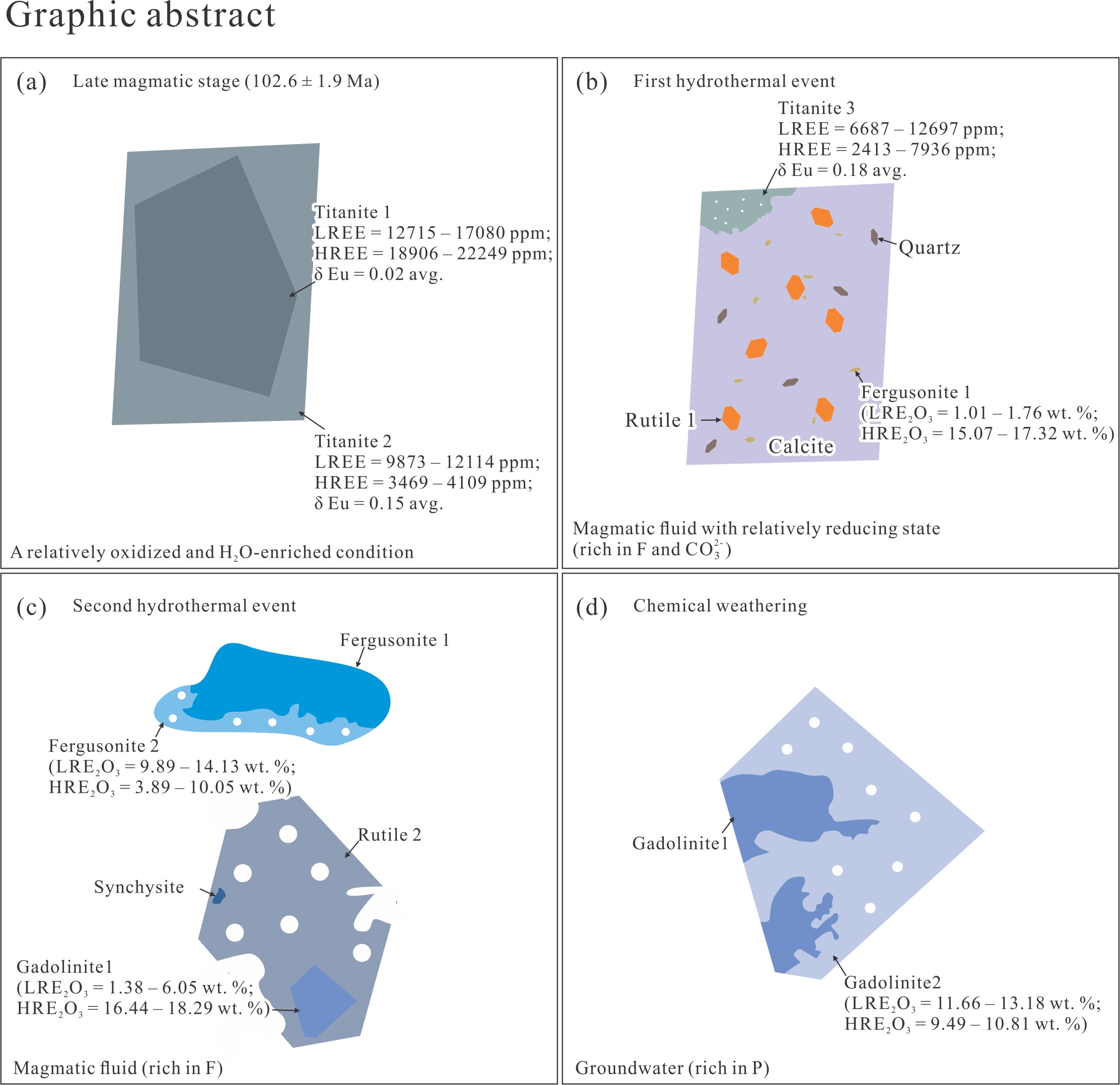
Hydrothermal alteration of magmatic titanite: Implications for REE remobilization and the formation of ion-adsorption HREE deposits, South China
https://doi.org/10.2138/am-2022-8644
Ion-adsorption rare earth element (REE) deposits in South China are currently the main source of heavy rare earth elements (HREE). The newly discovered Gucheng deposit is one good example of HREE mineralization hosted in weathered coarse-grained biotite granites (CGBG). A systematic study of REE-rich magmatic minerals in CGBG provides insight into the remobilization and enrichment of HREE. The results from this work by Feng et al. show that magmatic titanite is an important HREE-rich mineral and multiple stages of replacement processes havetransformed magmatic titanite to more weatherable HREE-bearing minerals, resulting in enrichment of HREE, fractionation of LREE and HREE, and contributed to the ion-adsorption HREE mineralization.
Effects of crystal chemistry on adsorption, ocuurrence and mobility of water in palygorskite tunnels
https://doi.org/10.2138/am-2022-8762
Zhou et al. performed Grand canonical Monte Carlo and molecular dynamics simulations to investigate multiple water distribution models in the tunnels of palygorskite. The presence of structural counterions lowers the amount of zeolitic water (~2 water molecules per counterion). Zeolitic water in palygorskite tunnels has a 2~3-order lower mobility than bulk water, and counterions further decrease their mobility. The zeolitic water confined in the tunnel has a very low mobility, and the appearance of Na+ ions in the charged palygorskite further reduces the mobility of zeolitic water. Compared with other clay minerals, the much lower water mobility implies that palygorskite could be a more efficient in fixing foreign molecules or ions in environmental applications.
Temperature-induced densification in compressed basaltic glass revealed by in-situ ultrasonic measurements
https://doi.org/10.2138/am-2022-8694
In this study, Xu et al. determined the acoustic velocity of a model basalt glass along different P-T paths, including cold compression, isothermal hot compression, and heating-cooling at high P. They found that temperature can facilitate the densification of the model basalt glass at high P, producing higher a acoustic velocity and a smoother pressure dependence of velocity than the cold-compressed glass. Their results clearly demonstrate that the glass acoustic properties are strongly dependent on its P-T path, and suggest that silicate glasses, especially cold-compressed ones, are not good analogs for studying the acoustic and elastic properties of their corresponding melts. This has significant implications for seismic detection of partial melts in the Earth's interior.
X-ray absorption records of Pd2+ on Ni site in pentlandite
https://doi.org/10.2138/am-2022-8704
Norilsk sulfide ores (Russia) are one of the largest sources of palladium (Pd) on Earth. Palladium occurs in platinum group minerals (PGM) and in base metal sulfides (BMS), especially in pentlandite. But the exact form of Pd in pentlandite is still unknown. Brovchenko et al. present the results of the first X-ray absorption measurements of Pd in pentlandite. They detected divalent Pd in pentlandite and Ni substitution of Pd in the pentlandite structure. These results are essential to understand incorporation of noble metals in natural minerals with important implications for ore deposit formation.
Twinning in hydrous wadsleyite: symmetry relations, origin, and consequences
https://doi.org/10.2138/am-2022-8596
Miyajima et al. report theirdiscovery of twinning in hydrous wadsleyite. The twins formed during crystal growth and may affect the physical properties of wadsleyite, as well as the phase transition to ringwoodite in the Earth's mantle transition zone. The twinning may reduce the mobility of dislocations in twinned wadsleyite grains and affect the deformation of wadsleyite-bearing rocks in the mantle transition zone. The twinning will also reduce the elastic anisotropy of wadsleyite and might enhance the kinetics of the phase transition from wadsleyite to ringwoodite.
AN EXPERIMENTAL CRYSTALLIZATION OF THE MACUSANI OBSIDIAN IN A THERMAL GRADIENT WITH APPLICATIONS TO LITHIUM-RICH GRANITIC PEGMATITES
https://doi.org/10.2138/am-2022-8674
London reports experiments with solid cores of the Macusani obsidian in a thermal gradient at 200 MPa pressure, which constitute the third experimental program with this glass, and the results are compared to the previous studies to elucidate the effects of the experimental methodology on the outcomes. This assessment is generally applicable to all experiments in which crystallization ensues from melt. The principal petrologic contributions of these experiments include a validation of the feldspar solvus algorithms to low, subsolidus temperatures, an experimentally determined solvus for the alkali feldspars attained through the crystallization of undercooled melt at low temperature, records of chemical gradients along and across the melt volumes, and documentation of the spatial zonation of crystalline assemblages and their textures. Oscillations in modal mineral proportions across the cores and along their lengths in the direction of the thermal gradients closely match similar patterns seen in natural pegmatites.
Amorphous Mn2SiO4: A potential manganese phase in the stagnant slab
https://doi.org/10.2138/am-2022-8606
Tephroite (Mn2SiO4) recently was discovered in ophiolite-hosted diamonds from deep Earth. Through high-pressure and high-temperature experiments, it is found that tephroite undergoes a pressure-induced amorphous transformation and this transformation is independent of temperature in the temperature and pressure range of this study. Manganese significantly reduces the amorphization pressure of olivine. This work by Ye et al. indicates that tephroite may exist in the slab in an amorphized form during subduction into the deep Earth, which provides insight into oceanic crustal recycling.
The Crystal Structure of Feitknechtite (β-MnOOH) and a new MnOOH Polymorph
https://doi.org/10.2138/am-2022-8729
Post et al. provide the complete structure description for ?-MnOOH (feitknechtite). Additionally, they identified and report the structure for a second MnOOH phase, similar to ?-MnOOH but with a different layer stacking, and as such seems to be a new MnOOH polymorph. Several researchers have described feitknechtite as a requisite intermediate phase during the synthesis of technologically important Mn (hydr)oxides. It is also assumed to play a critical role in abiotic and biotic processes that produce and alter Mn oxide phases in a variety of natural environments. The lack of knowledge of the atomic structure of feitknechtite has limited our understanding of its precise role and behavior in synthetic and natural redox reactions in manganiferous systems. This work provides the formal structure description required for model calculations that will provide a better understanding of this phase and make possible predictions about the behavior of ?-MnOOH (feitknechtite) under a range of conditions. It also provides an essential starting point for analyzing powder diffraction data to determine and monitor unit-cell parameters and other structure details, and for quantitative phase analyses of Mn oxide samples that contain feitknechtite. Feitknechite has been part of the Mn oxide conversation for more than seven decades, and it is satisfying to finally know what it is.
Yakubovichite, CaNi2Fe3+(PO4)3, a new nickel phosphate mineral of non-meteoritic origin
https://doi.org/10.2138/am-2022-8800
Yakubovichite, a new mineral containing up to 20 wt% NiO, represents a novel type of terrestrial phosphate mineral with extreme enrichment in Ni. The possible sources of Ni in the reported mineral assemblages are discussed by Britvin et al. The anomalous enrichment of pyrometamorphic assemblages in Ni may be related to metamorphic assimilation of Ni-rich minerals accumulated in the Cretaceous-Paleogene boundary layer, which was formed by the Chicxulub collision.
Volume 108 : October 2023 Issue
Heavy halogen compositions of lamprophyres derived from metasomatized lithospheric mantle beneath eastern North China Craton
https://doi.org/10.2138/am-2022-8693
Major findings by Zheng et al. include: (1) Lamprophyres derived from the metasomatized lithospheric mantle are enriched in water-bearing minerals and fluid-mobile large ion lithophile elements but strongly depleted in heavy halogens. (2) The mantle source of lamprophyres should be halogen-rich. (3) Volatile saturation and fluid exsolution lead to strong partitioning of the halogens into the exsolved fluid and, thus, noticeable halogen depletion. (4) Given the presence of Cl-poor amphibole, the halogen loss occurred before amphibole crystallization.
Compositional trends in Ba-, Ti-, and Cl-rich micas from metasomatized mantle rocks of the Gföhl Unit, Bohemian Massif, Austria
https://doi.org/10.2138/am-2022-8746
This study by Zelinkova et al. describes exotic Ba, Cl-rich phases in mantle pyroxenites and defines principal substitution mechanisms in Ba-, Cl-, and Ti-bearing micas. Data show that XFe exerts an important control on mica composition. Mica with 10.98 wt% Cl represents the most Cl-rich mica ever described. Association with Cl-rich phosphates and carbonates indicates metasomatism of mantle with fluid/melt with high activity of Cl and CO2 and low H2O activity.
Experimental determination of quartz solubility in H2O-CaCl2 solutions at 600–900 °C and 0.6–1.4 GPa
https://doi.org/10.2138/am-2022-8387
Makhluf et al. investigated the solubility of quartz in H2O-CaCl2 fluids at high pressure and temperature. They found that quartz grows less soluble as the salt content rises. The data were used to model the properties of CaCl2 brines, which can be important in a wide range of metasomatic environments.
The use of boron nitride to impose reduced redox conditions in experimental petrology
https://doi.org/10.2138/am-2022-8577
Li et al. demonstrate that BN can impose QIF-like redox conditions when used as a capsule sleeve in experimental assembly. The underlying mechanism is proposed to be 2BN+3H2O=B2O3+N2+3H2. Therefore, the redox-imposing potential of BN is a function of H2O activity. Oxygen fugacity control is a difficult task. The improved understanding of such a process in this study may lead to better recognition and exploration of the redox-imposing potential of BN in experimental petrology.
Structures and transport properties of supercritical SiO2-H2O and NaAlSi3O8-H2O fluids
https://doi.org/10.2138/am-2022-8724
Sun et al. demonstrate that the exponential decrease in the viscosity of silicate melt with increasing water content is due to a sharp decrease in the proportion of Q4 and increase in Si-O-H. They show that the supercritical fluids contain a large amount of partially polymerized or depolymerized silicate units bonded to hydrogen, which makes them rich in silicate while maintaining a low viscosity. This feature provides supercritical fluids the potential to transport elements that are hard to migrate in aqueous fluids or hydrous silicate melts, such as high field strength elements.
Hydrologic regulation of clay-mineral transformations in a redoximorphic soil of subtropical monsoonal China
https://doi.org/10.2138/am-2022-8706
A red soil profile with evident redoximorphic features was investigated by Zhao et al. with a focus on clay-mineral transformations. The study shows that hydrologic conditions (i.e., acidic cation concentration in soil solutions, waterlogging, and redox oscillations) are tightly coupled with the transformation pathways of secondary minerals, especially the expandable 2:1 clay minerals (i.e., vermiculite and smectite groups). The results advance the understanding on the transformation processes between different clay minerals and their environmental controls in natural soil systems.
« ‹ 1 … 19 20 21 22 23 … 85 › »ADDITIONAL RESOURCES