Editor’s Notes
Total Results: 1697
Volume 110 : November 2025 Issue
Contribution of Te-Bi melts in gold enrichment at the giant Jiaodong gold province, North China Craton: Insights from the Taishang deposit
https://doi.org/10.2138/am-2024-9597
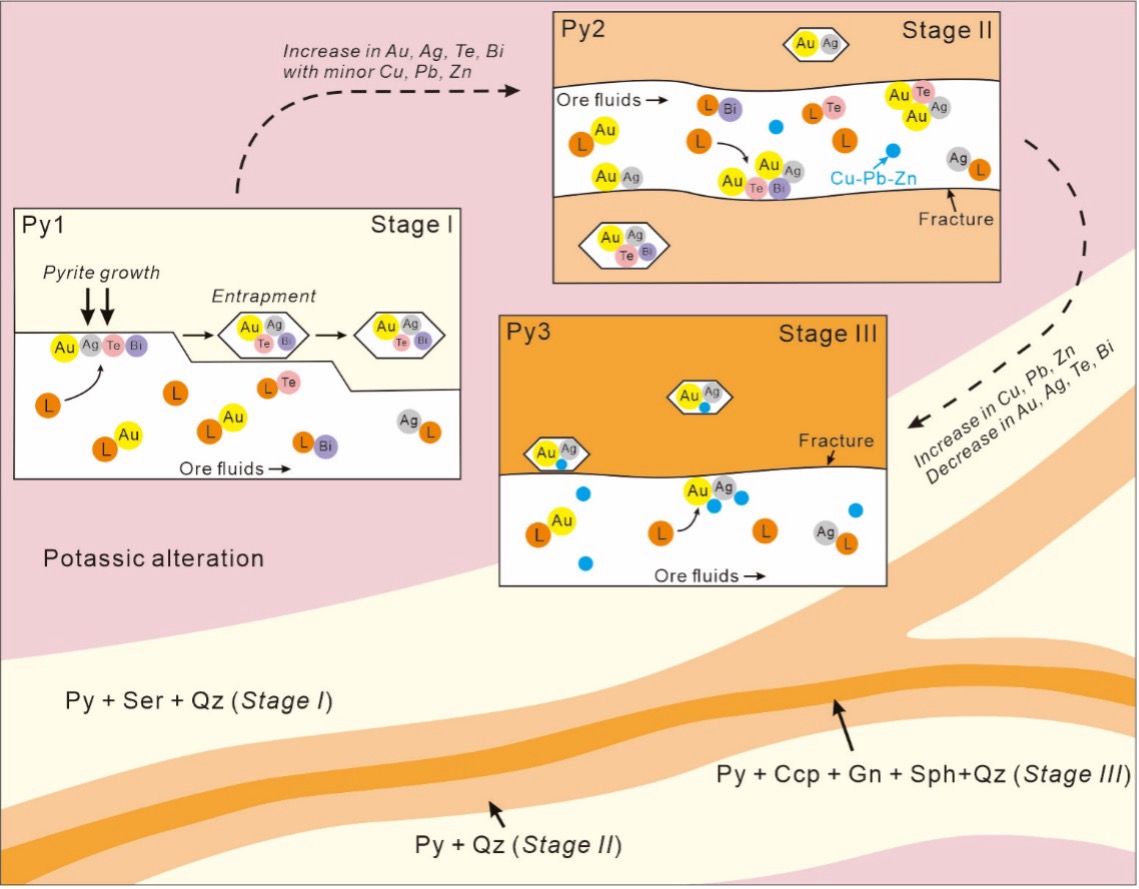
Yuan et al. explore in detail the mineralogy and geochemistry of Au-Ag-Te-(Bi)-bearing phases and pyrite at the Taishang gold deposit to better understand the influence of Te-Bi melts in the gold enrichment and to refine the ore genesis models for the giant Jiaodong gold province. Te-Bi melts have been recognized as crucial agents for scavenging gold in magmatism-related gold deposits globally, often characterized by a notable Au-Te-Bi association. This association is also recognized in gold deposits of the Jiaodong district, though the specific roles of Te and Bi in gold enrichment here have not been thoroughly evaluated until now. The mineralogical patterns reveal a strong relationship between Au, Ag, Te, and Bi, corroborated by trace element compositions of pyrite, which exhibit strong positive correlations among these elements. Furthermore, the texture of Au-Ag-Te-(Bi) assemblages in Stage I and II (i.e., unsharp and curvilinear boundaries) suggests crystallization from melts. Supported by relevant experimental evidence, the low melting points of Au-Ag-Te-Bi systems enable Te-Bi melts to effectively scavenge gold from fluids at the temperature conditions of Taishang. The presence of Au-Ag-Te-Bi association in both Taishang and other Jiaodong gold deposits underscores the importance of Te-Bi melts in enhancing gold enrichment.
Nb-Ta mineralization in a metaluminous-weakly peraluminous magmatic system: Constraints from the chemical compositions and Hf isotopes of columbite-group minerals in China
https://doi.org/10.2138/am-2024-9668
The sources of Nb-Ta deposits associated with metaluminous-weakly peraluminous (MWP) and strongly peraluminous systems exhibit differences. In the MWP system, Nb mineralization is primarily controlled by Nb-enriched sources. Despite relatively low degrees of magma evolution, this enrichment can effectively reduce the dependence on extreme fractional crystallization, allowing Nb to concentrate to saturation levels, ultimately leading to mineralization. The Nb-Ta mineralization in South China during the Early Cretaceous (~140–120 Ma), associated with MWP systems, is attributed to contributions from a deep material source within an extensional tectonic setting.
In situ observation of the subsolidus reactions between petalite and spodumene + quartz in a hydrothermal diamond-anvil cell
https://doi.org/10.2138/am-2024-9652
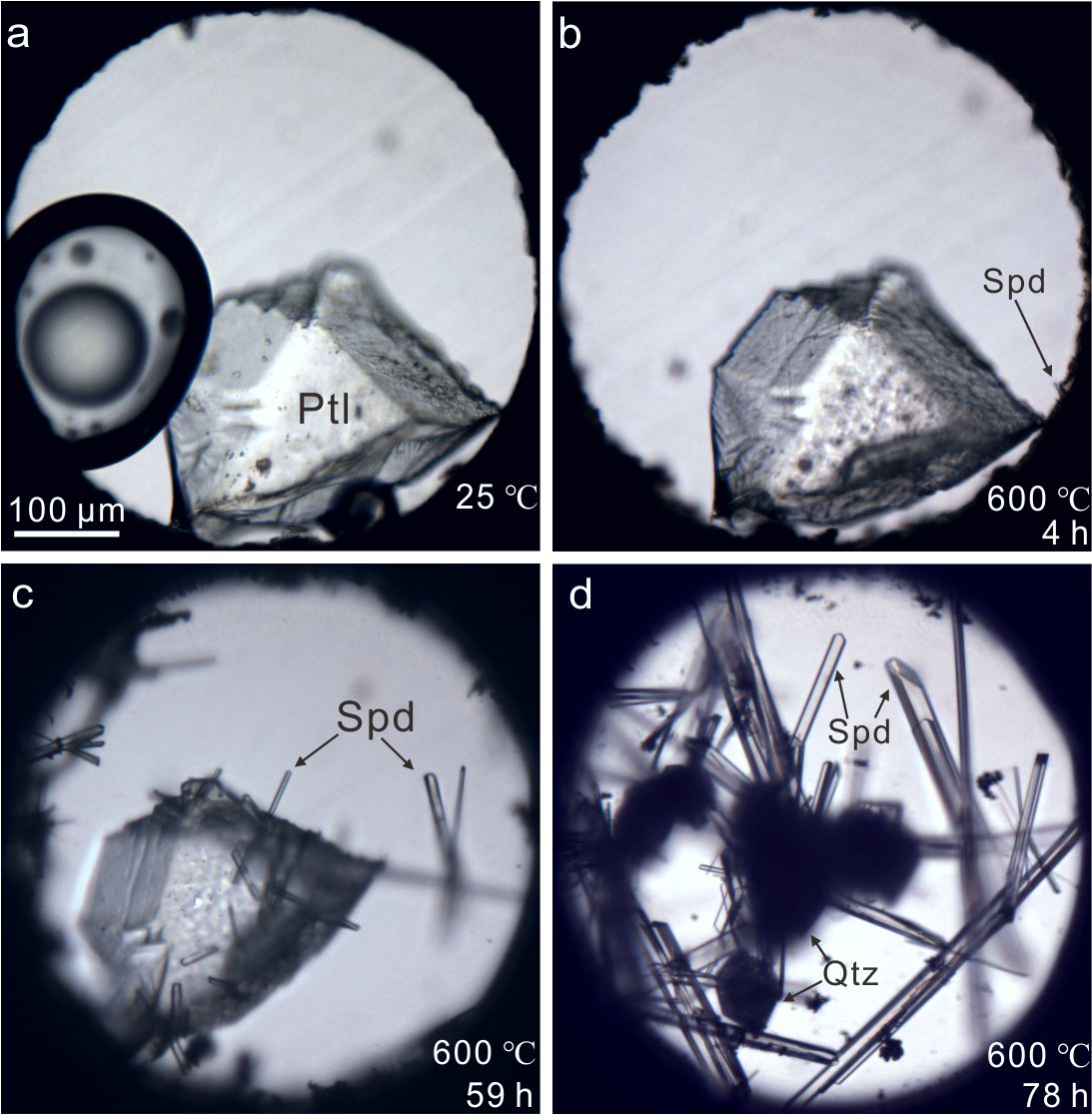
Spodumene and petalite are the primary minerals mined from pegmatites, the most important sources of hard-rock Li resources. In Li-mineralized pegmatites, the subsolidus reaction of petalite → spodumene + 2 quartz (reaction 1) and its reverse reaction, spodumene + 2 quartz → petalite (reaction 2), produce secondary spodumene, usually in the form of spodumene and quartz intergrowths (SQI), and secondary petalite, respectively. The experimental results of reaction 1, including reaction 2, can be applied to estimate reaction rates and corresponding growth rates under specific P-T conditions, aiding in the analysis of the morphology and origin of secondary spodumene and SQI in pegmatites. Combined with the P-T fields of Li-aluminosilicate minerals in the LiAlSiO4-SiO2-H2O system, these results can further constrain the P-T paths of pegmatite formation. Similarly, the reaction 2 parameters obtained in the experiments can be used to assess the origin of secondary petalite and constrain pegmatite P-T paths.
Structural behavior and magnetic properties of coquimbite AlFe33+(SO4)6(H2O)12á6H2O over a wide temperature range
https://doi.org/10.2138/am-2025-9776
Understanding the stability of hydrated sulfates and establishing their existence under a wide range of temperatures is crucial for various scientific and technological applications. Abdulina et al. present a comprehensive study of the thermal and magnetic behavior of coquimbite over a wide temperature range and low vacuum (600 Pa). The behavior of coquimbite with increasing temperature can be divided into two stages: (1) negative and strongly anisotropic thermal expansion; (2) positive thermal expansion. Magnetic properties are driven by antiferromagnetic interactions within its M3-M2-M3 trimeric clusters of Fe3+.
The transformation of magnesium phosphate minerals at atmospheric conditions: Mechanisms, kinetics, and environmental applications
https://doi.org/10.2138/am-2024-9578
Struvite (MgNH4PO4·6H2O) is a mineral that precipitates from wastewater streams and blocks pipes. It was found that it can be recovered and manufactured into a phosphorus- and nitrogen-containing fertilizer used in agriculture, contributing to a sustainable phosphorus economy. However, struvite is unstable in air and decomposes into other minerals and phases; the speed and mechanisms of struvite transformation in air were tracked. It was found that struvite transforms into either newberyite (MgHPO4·3H2O) and/or dittmarite (MgNH4PO4·H2O), depending on the reaction temperature. This transformation changes the chemistry and hence the properties of the struvite fertilizer.
Native tin as solidified molten-metal droplets in a hydrothermal fluid from the epithermal Pukanec deposit (Slovakia)
https://doi.org/10.2138/am-2024-9522
Metals are commonly transported as dissolved components in aqueous solutions. Majzlan et al. suggest that tin (Sn), as a metal with a low melting point, can also be transported as droplets of metallic melt and deposited with other, more common ore minerals. The findings, from metallic Sn droplets in a deeply weathered Au-Ag deposit, are supported by stable Sn isotope data and redox phase analysis.
Wangyanite, PdNi8S8, a new Pd end-member mineral of the pentlandite group from the J-M reef, Stillwater Complex, Montana, U.S.A.
https://doi.org/10.2138/am-2024-9640
The behavior of platinum-group elements (PGE) in magmatic processes is critical for understanding the formation of PGE-rich deposits in mafic-ultramafic intrusions. The classical theory indicated that pentlandite exsolved from monosulfide solid solution (MSS) contains only low concentrations (ppb-ppm) of Pd. However, the enrichment of Pd in pentlandite, ranging from hundreds ppm to a few wt%, is widely observed in nature and unexplained by the classical theory. In this contribution, Chen et al. found a new Pd-dominant mineral, wangyanite, PdNi8S8, having an average Pd content of 9.95 wt%, from the J-M reef of the Stillwater complex. The authors identify this mineral, which has been approved by the IMA-CNMNC, as the Pd-member of pentlandite group. Although wangyanite shares the same crystal structure with pentlandite, the octahedrally coordinated site in wangyanite is mainly occupied by Pd, but not the Ni and Fe. Based on textural features, wangyanite is suggested to be formed by peritectic reaction between braggite, pentlandite, and sulfide liquid, which matches experimental results from the Pd-Fe-Ni-S phase system. The authors believe that the discovery of wangyanite can push geologists into rethinking the formation mechanism of Pd-rich pentlandite and its relationship to PGE minerals and base metal sulfides during the cooling and evolution of sulfide melt.
Crystal chemistry and high-temperature behavior of Al-bearing stishovite and Al-rich phase D: Implications for water storage in the deep mantle
https://doi.org/10.2138/am-2024-9665
Water (hydrogen) plays a critical role in controlling the evolution and dynamics of the Earth's interior. It is widely believed that the subducting slab serves as an effective carrier for transporting both H and Al from surface environments to the lower mantle. However, the structural characteristics, water contents, and thermal stabilities of nominally hydrous and anhydrous phases in Al-rich regions of the deep mantle remain poorly constrained. Zhang et al. analyzed high-quality single-crystal samples of Al-bearing stishovite and Al-rich phase D by using X-ray diffraction, high-temperature Raman, and FTIR analyses. Crystals were synthesized at 25 GPa, 1350–1600 °C in the MgO-SiO2-Al2O3-H2O system. The experimental results demonstrate that Al-rich silicate glass and Al-bearing SiO2 glass, formed respectively by the temperature-induced amorphization of phase D and stishovite, can retain water in the form of hydroxyl groups. This implies that Al-rich silicate glasses and Al-bearing SiO2 glasses may serve as potential reservoirs of H in the lower mantle and participate in deep water cycling processes in the Earth's interior.
Volume 110 : October 2025 Issue
Theoretical studies of thermodynamic and elastic properties of diamond under Earth's mantle conditions
https://doi.org/10.2138/am-2024-9574
Zeng et al. report that diamonds exhibit pronounced elastic anisotropy and nonlinear responses to pressure and temperature. Diamonds can significantly alter seismic velocities due to their lower density and higher moduli compared to typical mantle materials, suggesting that their presence could be detectable via advanced seismic techniques. The distinctive seismic signatures of diamonds at high pressures and temperatures, as predicted by this study, offer a novel approach to probe deep Earth and potentially other planetary interiors. This could lead to better understanding and exploration of the mantle’s geological features, aiding in the study of planetary evolution under extreme conditions.
Natrojarosite formed in the Matanomadh Formation, Kutch, India: A Na analog of jarosite on Mars
https://doi.org/10.2138/am-2024-9360
Ray et al. discuss the mineralogy and spectroscopy of iron sulfates, abundant secondary minerals discovered on Mars using orbiter instruments and in situ rovers. The new terrestrial analog sites, similar to those in the Martian volcanic terrain, are important to validate the Mars orbiter data and to better understand the complexity of formation history until samples are returned from Mars. The Fe K-edge XANES and EXAFS analyses help to ascertain the Fe speciation and the past aqueous environment of Mars. This study could inform future landing sites on Mars.
Moxuanxueite, NaCa6Zr(Si2O7)2OF3, a new wöhlerite-group mineral from Gejiu alkaline complex, Yunnan Province, China
https://doi.org/10.2138/am-2024-9397
Qu et al. describe moxuanxueite, ideally NaCa6Zr(Si2O7)2OF3, a new Zr-disilicate that was discovered in the Gejiu alkaline complex. Moxuanxueite offers important insights into the chemical variability of wöhlerite-group minerals. Furthermore, moxuanxueite, as well as other wöhlerite group species, as the common accessory Zr-Nb-Ti-bearing minerals, are not only important in understanding the crust-mantle cycle of HFSE elements but are also of economic interest as a promising source of critical metals.
EBSD mapping of Cu-Fe-sulfides reveals microstructures enriched in critical/precious metals and resolves deformation histories
https://doi.org/10.2138/am-2024-9396
King et al. characterized chalcopyrite and bornite from the Olympic Dam Cu-U-Au-Ag deposit using EBSD to identify microstructures and their correlations with trace element concentrations measured by LA-ICP-MS. Natural chalcopyrite is shown to be a rich source of micro-structural and -textural information, preserving <110> and <001> crystallographic preferred orientations, {110} and {112} twin systems, grain boundary migration, foam textures, and subgrain boundaries. The oriented stress imposed by brecciation and/or fluid fluxes at Olympic Dam, alongside temperature, pressure, and strain rate, induce a variety of microstructures preserved in chalcopyrite. EBSD mapping reveals that what appears as single grains of chalcopyrite in reflected light is, in fact, aggregates composed of ~100 individual grains. In contrast, analyzed bornite displays overwhelming crystallographic homogeneity. These observations confirm the critical role played by microstructures in Cu-(Fe)-sulfides as traps for Pb, a non-target contaminant in copper concentrates, as well as new evidence for the physical state of Ag and potential value-add critical metals like Bi and Sb.
The sulfate-bearing associations of fumarolic environments of Somma-Vesuvius volcano (Italy): A review from historical samples (Royal Mineralogical Museum of Naples)
https://doi.org/10.2138/am-2024-9666
Pellino et al. investigated sulfate-bearing associations of fumarolic environments of Somma-Vesuvius volcano (southern Italy), reporting new mineralogical data. The study explores these complex associations using various analytical methods, including SEM-EDS, PXRD, SC-XRD, FTIR, and Raman spectroscopy. Sulfates (Cu-, alkali-Cu-, and Pb-bearing sulfates) are the most widespread group, closely followed by halides and then oxides, phosphates, and arsenates, often occurring as rare mineral associations. Unusual phases containing As, Cd, Tl, and N were also identified. This work enhances understanding of genetic environments involving sulfates and can be especially relevant in consideration of the occurrence of sulfates in planetary bodies.
Snowball quartz in highly fractionated peraluminous granites: An indicator of multiple magma degassing
https://doi.org/10.2138/am-2024-9649
Zhang et al. investigated two independent magma chambers that contributed to the formation of the Yashan peraluminous granite pluton. Snowball quartz formed as a result of moderate undercooling (ΔT = 50–100 °C) of the melt during multiple episodes of magma degassing. Multiple magma degassing events facilitate Ta-Nb mineralization during the late evolutionary stage of the Yashan pluton. Snowball quartz can serve as an effective exploration indicator for Ta-Nb deposits associated with highly fractionated peraluminous granites.
Oxybarometry of reduced silicate glasses: Using multivariate methods to constrain Cr oxidation states with application to lunar glasses
https://doi.org/10.2138/am-2024-9602
Iron valence is generally used to quantify magmatic oxidation state; however, under reducing conditions, such as those of the lunar interior, Fe valence becomes less sensitive to changing redox. McCanta et al. proposed a Cr oxybarometer that may be more sensitive for silicate melts equilibrated at low fO2 (around the iron-wüstite buffer) conditions.
Nigelcookite, PbFe22+V23+(PO4)3(OH)3, and plumbojohntomaite, PbFe22+Fe23+(PO4)3(OH)3, two new members of the bjarebyite group from the Yushui Cu deposit, South China
https://doi.org/10.2138/am-2024-9586
Yao et al. report two new members of the bjarebyite-group minerals, nigelcookite, PbFe2(2+)V2(3+)(PO4)3(OH)3, and plumbojohntomaite, PbFe2(2+)Fe2(3+)(PO4)3(OH)3, found in the Yushui Cu deposit, South China. Both of them have the general formula XM12M22(PO4)3(OH)3. Nigelcookite is the first member of the group to have V3+ as the dominant ion at the M2 site, while plumbojohntomaite is the Fe3+-analog of nigelcookite, albeit with V3+ instead of Fe3+.
Rare occurrence of jarosite-alunite solid solutions with intermediate Al-Fe contents in the Jurassic Aztec Sandstone, Nevada, U.S.A.
https://doi.org/10.2138/am-2024-9423
McCollom et al. report the discovery of Al-Fe solid solutions with compositions intermediate between alunite and jarosite in sandstones from Nevada, which constitutes only the third geologic setting where such solid solutions have been documented. The results provide further evidence that Al-Fe solid solutions in this mineral group can occur in natural environments and may lead to new insights into the conditions that allow precipitation as solid solutions rather than end-members.
Olgafrankite, Ni3Ge, a new mineral as the carrier of siderophile germanium in reduced systems
https://doi.org/10.2138/am-2024-9714
Vereshchagin et al. examined samples from the world-famous Norilsk ore region, and found a new mineral, nickel germanide (Ni3Ge), which had previously been found in meteorite material (Rumuruti chondrite, the prototype of the R-type chondrites). The new germanide can be an important germanium carrier in reduced assemblages, in particular in iron- and stony-iron meteorites, where the well-known significant correlations between nickel and germanium may be accounted for by the presence of finely dispersed precipitates of olgafrankite.
Fuyuanite [Mg7Nb6O18(OH)8], a new hydrous magnesicniobic oxide mineral from the Bayan Obo deposit, China
https://doi.org/10.2138/am-2024-9676
She et al. described a new magnesic-niobic mineral with hydroxyl from Bayan Obo, China. The mineral's ideal formula is Mg7Nb6O18(OH)8, and it is named fuyuanite. Both the mineral and its name were approved by the IMA-CNMNC (2024-059).
Laboratory synthesis, spectroscopic characteristics, and thermal behavior of phoxite
https://doi.org/10.2138/am-2024-9463
Chen et al. report the FTIR and VNIR spectra, and thermal behavior of phoxite. The formation of phoxite prefers high relative humidity conditions (RH >59%). Phoxite can be a new biomarker mineral and an indicator of habitable environments.
« ‹ 1 2 3 4 5 6 … 85 › »ADDITIONAL RESOURCES