
Editor’s Notes
Total Results: 1697
Volume 109 : January 2024 Issue
An UV/Vis/NIR optical absorption spectroscopic and color investigation of transition-metal-doped gahnite (ZnAl2O4 spinel) crystals grown by the flux method
https://doi.org/10.2138/am-2022-8708
Synthetic flux-grown, end-member gahnite, ZnAl2O4, and a number of different colored crystals doped with transition metals including Ni, Cr, Co, Mn, and Fe were studied by Taran et al. with electron microprobe methods and UV/Vis/NIR single-crystal optical absorption spectroscopy. The authors measured and assigned the different electronic absorption features and analyzed the crystal colors using the experimental spectra and described them with the CIE 1931 color-space-chromaticity diagram.
Understanding the unique geochemical behavior of Sc in the interaction with clay minerals
https://doi.org/10.2138/am-2023-8941
Scandium can be incorporated into the lattice of clay minerals, whereas other rare earth elements (REEs) cannot. The microscopic structures, free energies, and hydrolysis of Sc3+ surface complexes determined in this study by Zhang et al. show that such unique behavior of Sc3+ originates from its high affinity to the vacancies on clay edges. The findings in this study highlight the importance of clay edge surfaces in REE enrichment and provide a physical basis for understanding the formation mechanism of Sc-rich clays. The structural and thermodynamic information presented in this study can be used to investigate the enrichment of REEs and develop efficient extraction techniques.
Scandian actinolite from Jordanów Śląski, Lower Silesia, Poland: Compositional evolution, crystal structure, and genetic implications
https://doi.org/10.2138/am-2022-8786
The paper by Pieczka et al. on scandian actinolite from contact zones of a granitic pegmatite intruded into serpentinite in a quarry at Jordan�w ?laski in Lower Silesia, Poland, characterizes the second occurrence of the amphibole-supergroup mineral enriched in Sc. The occurrence is not connected with the presence of fluorine, considered as the strongest agent complexing Sc, because F is only detected in traces in titanite. It seems that in the case of Jordan�w ?laski, we may have a new type of geologic environment leading to the Sc enrichment, in addition to clinopyroxene-bearing, basic alkaline rocks, carbonatites, and laterite deposits. The authors discuss differences observed in the geologic environments mainly in relation to basic clinopyroxene-bearing rocks based on the avaiable geologic information related to rocks of the serpentinite Gogolow-Jordan�w massif and ?leza ophiolite.
Characterizing a new type of nelsonite recognized in the Damiao anorthosite complex, North China Craton, with implications for the genesis of giant magmatic Fe-Ti oxide deposits
https://doi.org/10.2138/am-2022-8501
Li et al. recognized a new type of nelsonite in the Proterozoic Damiao anorthosite complex, which is distinct from the two known types of nelsonite from the same complex. Through the comprehensive comparative study taking into consideration of all three types of nelsonites found in the Damiao anorthosite complex, they show that giant magmatic Fe-Ti oxide orebodies can form by the combined processes of liquid immiscibility and fractional crystallization.
Genesis of Mesozoic high-Mg dioritic rocks from the eastern North China Craton: Implications for the evolution of continental lithosphere
https://doi.org/10.2138/am-2022-8755
Jinling high-Mg diorites (HMDs), a Mesozoic intra-plate intrusion of the eastern North China Craton, were derived from partial melting of hydrous mantle peridotites, but are not associated with the interaction of slab-derived melt with mantle peridotite. This study by Guo et al. highlights that Pre-Cenozoic HMAs/HMDs, such as Archean TTG and sanukitoids, could be derived from partial melting of hydrous mantle peridotites in continental interiors, and thus might not always be related with the onset of plate subduction.
SEM and FIB-TEM analyses on nanoparticulate arsenian pyrite: Implications for Au enrichment in the Carlin-type giant Lannigou gold deposit, SW China
https://doi.org/10.2138/am-2022-8550
A significant difference in Au concentration between the ore fluid and the coexisting arsenian gold-bearing pyrite in Carlin-type gold deposits requires incorporation of Au into arsenian pyrite during mineralization. Based on previous NanoSIMS Au mapping, nano-phase pyrites in a Au-bearing pyrite rim were revealed by in-situ FIB-TEM and SEI analysis. Yan et al. proposed a model for attaching and aggregating growth process of arsenian pyrite rims and conclude that the numerous nano-particulate pyrites are a key constraint on effective Au chemisorption to form a giant Carlin-type gold deposit. In addition, the mechanisms of nano-particulate pyrites and nano-gold formation might provide new insights into mineralization process of other gold deposits and Au metallurgical recovery from refractory ores.
Volume 108 : December 2023 Issue
Gas-mediated trace element incorporation into rhyolitehosted topaz: A synchrotron microbeam XAS study
https://doi.org/10.2138/am-2022-8417
Schaub et al. conducted synchrotron microbeam XAS analysis on picogram quantities of As, Mn, Ga, Ge, Fe, and Ti in topaz crystals from vesicular topaz rhyolite (Thomas Range, Utah) and obtained information on valence state, site assignments, and structural accommodation of these substituents. This information, coupled with trace-element abundances, provides new insights into the nature of the high-temperature magmatic gas involved in topaz formation.
Evidence for abundant organic matter in a Neoarchean banded iron formation
https://doi.org/10.2138/am-2023-8927
Peng et al. investigated the mineral associations, major element concentrations, total carbon contents and carbon isotope compositions of a set of BIF samples with highly variable iron and TOC contents from the late Neoarchean Zhalanzhangzi BIF, China. The results show that graphite grains with crystallization temperatures comparable to that predicted for the regional metamorphic grade are widely distributed despite highly variable iron and total organic carbon contents. The graphite is interpreted to represent the metamorphosed product of syngenetic biomass based on its co-occurrence with apatite rosettes and negative bulk rock ?13C organic values. The close association of graphite with iron-bearing phases indicates that ferric (oxyhydr)oxides may have exerted a first-order control on the abundance of OM.
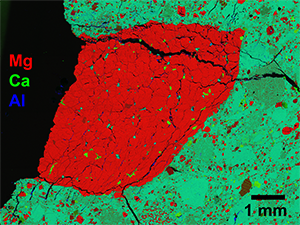
A dunite fragment in meteorite Northwest Africa (NWA) 11421: A piece of the Moon’s mantle
https://doi.org/10.2138/am-2022-8911
Treiman and Semprich describe a centimeter-sized fragment of dunite, the first recognized fragment of Moon mantle material, in the lunar highlands breccia meteorite Northwest Africa. From electron microscope data on dunite, they derive inferences about the bulk composition of the lunar mantle, processes related to the Lunar Magma Ocean and gravitational overturn of its cumulate rocks, and the present-day thermal structure of the Moon's mantle.
Electrical properties of iron sulfide-bearing dunite under pressure: Effect of temperature, composition, and annealing time
https://doi.org/10.2138/am-2023-9054
Tauber et al. report electrical measurements of a mantle xenolith with varying amounts of metal sulfide compounds over a wide frequency range while under high pressure and temperature. Samples annealing at 1023 K is found to significantly affect the electrical response at temperatures up to ~1100 K. Iron-sulfur compounds strongly increase bulk conductivity at or above 6.5%. At this threshold, the molten iron-sulfur network is fragile. Samples with added Ni or Fe metal show lowered conductivities relative to the dunite host. This surprising behavior is likely caused by a lowered oxygen fugacity.
Hydrogen bond symmetrization and high-spin to low-spin transition of ε-FeOOH at the pressure of Earth’s lower mantle
https://doi.org/10.2138/am-2022-8839
Insixiengmay and Stixrude conducted density functional theory (DFT) calculations to study ?-FeOOH, the iron-bearing end-member of phase H, which is the dominant hydrous phase at lower mantle conditions. This phase exhibits rich behavior and serves as a model system for understanding two transitions that occur in a variety of Earth materials at high pressure: hydrogen bond symmetrization and a high-spin to low-spin transition. The authors examine the change in physical properties across each transition and explore implications for their possible effects on geophysical probes by looking at changes in seismic wave velocity and electrical conductivity.
CURIES: Compendium of uranium Raman and infrared experimental spectra
https://doi.org/10.2138/am-2022-8738
No single database of Raman and IR spectra exists for uranium materials exclusively, and no large-scale summary of other important signatures originating from structural features beyond the axial U-O bond and other U-O moieties has been tabulated. Spano et al. provide new insights into Raman and infrared spectral features that are indicative of the underlying structural attributes from which they originate. The authors perform an extensive survey of all available experimental Raman and infrared spectra for supergene uranium minerals and employ multivariate statistical analyses to determine spectroscopic features that are common to groups of uranyl minerals based on secondary chemistry.
S2– and S3– radicals and the S42– polysulfide ion in lazurite, haüyne, and synthetic ultramarine blue revealed by resonance Raman spectroscopy
https://doi.org/10.2138/am-2022-8655
Farsang et al. demonstrated the power of resonance Raman spectroscopy in search for sulfur species trapped in the cages of feldspathoids. The S42- polysulfide ion is reported in lazurite and ha�yne for the first time. The results have implications in a broad range of fields, e.g., chemistry (identifying trace amounts of S-species), optoelectronics (entrapping S42- into sodalites/zeolites), and arts (identifying the provenance of natural ultramarines).
Effect of faceting on olivine wetting properties
https://doi.org/10.2138/am-2022-8808
Huang et al. evaluated facet-bearing dihedral angles and their proportions in olivine�multicomponent aqueous fluid systems. The results show that: (1) faceting produces larger dihedral angles than those with curved interfaces in the olivine-fluid system; (2) grain boundary planes are frequently composed of low-index planes, and the facet-facet angles are explained by olivine crystallography; and (3) the facet proportion is consistent with electrical conductivity data; faceting effects could be magnified under sheared mantle.
The obscuring effect of magma recharge on the connection of volcanic-plutonic rocks
https://doi.org/10.2138/am-2022-8642
The plutonic and volcanic realms are connected through the extraction of crystal-poor rhyolites from batholithic crystal mushes, whereas big data analyses of global volcanic and plutonic rocks reveal little evidence for significant segregation of liquids from plutons. Zhao et al. explore the possibility that magma recharge obscures the records of liquid-crystal segregation and remind us that big data analysis should be done with caution to avoid biased results.
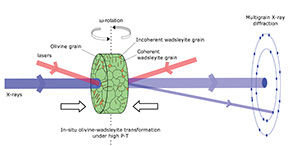
In-situ study of microstructures induced by the olivine to wadsleyite transformation at conditions of the 410 km depth discontinuity
https://doi.org/10.2138/am-2022-8731
Olivine transforms to wadsleyite at the conditions of 410 km depth in the Earth's mantle. How does this transformation affect microstructures and grain orientations? Ledoux et al. used in-situ experiments and followed the orientations of individual crystallites as the transformation proceeded. They do not observe relationships between the parent olivine and daughter wadsleyite phases and hence conclude that, in the Earth's mantle, microstructures should be reset below the 410 km depth discontinuity.
Effect of pre-existing crystals and melt homogeneity on the decompression-induced crystallization of hydrous rhyodacite magma
https://doi.org/10.2138/am-2022-8723
Magma crystallization controls its rheology and volcanic eruption. Matsumoto et al. investigated the effect of pre-existing crystals and melt homogeneity on magma crystallization during decompression. The results indicate that the injection of high-temperature magma into the reservoir that changes pre-existing crystals and melt homogeneity may control crystal texture formed during magma ascent and volcanic eruption.
Origin of clinopyroxene-ilmenite symplectites in mafic granulites from eastern parts of the Chotanagpur granite gneissic complex, East Indian shield
https://doi.org/10.2138/am-2022-8715
Chatterjee et al. report a rare occurrence of rod-like intergrowths of clinopyroxene-ilmenite that variably replace titanite in a suite of high-pressure mafic granulites from the Chotanagpur Granite Gneissic Complex, Eastern Indian Shield. The authors have modeled the reaction texture of clinopyroxene-ilmenite symplectite and deduced the physical condition of metamorphism. The clinopyroxene-ilmenite symplectites formed at the expense of garnet and titanite during steep near isothermal decompression (from ~13 kbar to ~7 kbar, at ~800�C), in the presence of fluid phase. It is also demonstrated that relative to Fe, Mg, and Ca, Ti was less mobile and that the mobility of Ti was restricted within the confines of the titanite being replaced by the clinopyroxene-ilmenite symplectite. Limited mobility of Ti even in the presence of presumed F-Cl bearing fluids or melt has important implications on the Ti mobility in the deep continental crust.
Single-crystal analysis of La-doped pyromorphite [Pb5(PO4)3Cl]
https://doi.org/10.2138/am-2022-8664
Sordyl et al. synthesized two La-doped pyromorphite analogs (Pb5(PO4)3Cl) and two control samples (with the absence of La) from aqueous solutions at 25�C. Na+ and K+ were used as charge compensating ions to facilitate the incorporation of trivalent REE cations (La3+ + Na+ ? 2Pb2+ and La3+ + K+ ??2Pb2+). The extent of La substitution, the position of La in the structure and the induced structural changes were determined using single-crystal X-ray diffraction. The results have applications in both fundamental understanding of apatite structure and environmental mineralogy (mineral-water interactions). Moreover, the results extend our knowledge of geofunctional materials that may be useful in future applications of Pb-apatite in REE recovery.
Crystal structure of calcium-ferrite type NaAlSiO4 up to 45 GPa
https://doi.org/10.2138/am-2022-8432
Alkali-rich aluminous high-pressure phases including calcium-ferrite (CF) type NaAlSiO4 in MORB composition are thought to constitute ~20% by volume in the lower mantle. Qin et al. investigated the Fe-free and Fe-bearing CF phases using single-crystal synchrotron X-ray diffraction and Raman spectroscopy coupled with diamond anvil cells up to 45 GPa. The Fe-free and Fe-bearing CF samples display similar compressibility and roughly 2% more compressible than the CF-type MgAl2O4. Compared to jadeite, the ability of CF-type phases to contain incompatible elements such as Na up to lower mantle pressures requires the larger and less compressible NaO8 polyhedra. These data provide new knowledge on how large alkali metals can be hosted in aluminosilicate framework structures with stability well into the lowermost mantle.
« ‹ 1 … 18 19 20 21 22 … 85 › »ADDITIONAL RESOURCES