

Editor’s Notes
Total Results: 1697
Volume 108 : May 2023 Issue
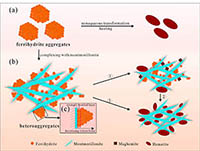
Heterogeneous and retarded phase transformation of ferrihydrite on montmorillonite surface: The important role of surface interactions
https://doi.org/10.2138/am-2022-8520
These novel findings enrich our knowledge of the phase transformation characteristics of ferrihydrite under various environmental conditions and advance the understanding of the importance of mineral surface interactions in stabilizing nanominerals and mineral nanoparticles in nature. The findings by Wei et al. also have important implications for assessing mineral composition and the associated ecological environment in wildfire-affected regions. The occurrence of maghemite as an intermediate during the transformation of ferrihydrite in the heteroaggregates also provides an explanation of the origin of magnetism in soils.
Atomic-scale characterization of the oxidation state of Ti in meteoritic hibonite: Implications for early solar system thermodynamics
https://doi.org/10.2138/am-2022-8311
Calcium-aluminum-rich inclusions (CAIs) in meteorites are the oldest solar system solids. Among the CAI phases, hibonite, nominally CaAl12O19, holds particular interest because it is among the first few phases to form from the solar gas and it can incorporate significant amounts of Ti in both Ti3+ and Ti4+. The relative amounts of these cations can reflect the redox conditions under which the grain formed or last equilibrated. Here Zanetta et al. develop a new method for the quantification of Ti oxidation states using electron energy-loss spectroscopy (EELS) in order to apply it to a hibonite grain sampled in the NWA 5028 CR2 chondrite. The aim is to constrain the conditions under which the hibonite grain formed and demonstrate viability of the EELS technique.
Structural behavior of C2/m tremolite to 40 GPa: A highpressure single-crystal X-ray diffraction study
https://doi.org/10.2138/am-2022-8278
The metastability/compression behavior of tremolite is studied by Ott et al. up to ~40 GPa. The metastable persistence of C2/m tremolite implies that chemically bound water may be carried much deeper than 90 km in steeply subducting cold slabs. This broad metastability range and an increasingly isotropic high-P compressibility contrasts with other clinoamphibole observations, implying that the size of cations interconnecting the I-beams of the clinoamphibole structure exerts a strong control on metastability.
Optimizing Raman spectral collection for quartz and zircon crystals for elastic thermobarometry
https://doi.org/10.2138/am-2022-8423
This study systematically assesses the reproducibility of Raman spectra collected on quartz and zircon crystals and quantifies uncertainties in calculations of entrapment pressures and temperatures as determined using elastic thermobarometry. Three key new contributions include identifying different types of peak drift that operate on different time scales, assessing the reproducibility of different methods for calculating entrapment pressures, and proposing a new method for monitoring peak drift using an external light source. Some methods are resistant to peak drift errors (propagated errors much less than ~1 kbar), while others are highly sensitive (up to several kbar). Ultimately, comprehensive recommendations are provided for analysis that should improve intralaboratory reproducibility and interlaboratory comparisons.
Measuring H2O concentrations in olivine by secondary ion mass spectrometry: Challenges and paths forward
https://doi.org/10.2138/am-2022-8247
Trace concentrations of water in olivine strongly affect diverse mantle and magmatic processes. Accurate measurements of these low concentrations are challenging and even more so due to a ~40% disagreement between the two main studies that have produced independent water calibrations. In this study, Towbin et al. resolved the differences between these calibrations and offer recommendations for an improved ion microprobe calibration using a readily available set of standards. In light of their finding, they reevaluate published partition coefficients for water between olivine and melt. By revising the measured olivine concentrations, they improve agreement between experimentally determined partition coefficients and those determined from olivine-hosted melt inclusions.
Arsenic clustering in arsenian pyrite: A combined photoemission and theoretical modeling study
https://doi.org/10.2138/am-2022-8415
The photoemission spectra from samples of arsenian pyrite collected by Mahjoub et al. using synchrotron soft X-ray spectroscopy are compared to a series of first principles simulations of the four experimentally observed surfaces of pyrite in the presence of As atoms on the top layers that substitute for superficial S. A comparison between the spectrum of bulk As-3d in the samples with its bulk counterpart in arsenopyrite revealed a 0.6 eV shift towards lower binding energies. The calculated partial charges of atoms located at the surface of arsenian pyrite indicated that while the electron density on the As atom of As-S dimers in arsenian pyrite is less negative than the As in bulk arsenopyrite, it is more negative than the As atom of As-As dimers, which were only seen in the superficial As clusters. This firmly validated the description of As presence in arsenian pyrite as local clusters inducing localized lattice strain due to increased bond distances.
High-pressure electrical conductivity and elasticity of ironbearing δ-AlOOH
https://doi.org/10.2138/am-2022-8393
In this contribution by Su et al., the electrical conductivity and elasticity were determined for δ-(Al,Fe)OOH with 5 and 48 mol.% FeOOH at pressures up to 75 GPa. They found that conductivity of δ-(Al,Fe)OOH may be slightly affected by high iron content and spin transition at high pressure, and concluded that subduction of Fe-bearing δ-AlOOH may account for some high conductivity regions in the lower mantle, e.g., the North Philippine Sea slab.
Nudged elastic band calculations of the (4H)X Si hydrogarnet type defect in Mg2SiO4 forsterite
https://doi.org/10.2138/am-2022-8449
The Nudged Elastic Band (NEB) method is used by Poe and Perna to investigate configurational transformations of the hydrogarnet defect in forsterite. Reactions involve rotational or torsional movements of OH bonds without breaking any strong chemical bonds, and activation energies do not exceed 0.6 eV. In some cases, reactions are accompanied by significant displacement of the (4H) center of mass to suggest a low-temperature means of promoting charge transport without requiring chemical dissociation of the hydrogarnet defect species.
Mn substitution and distribution in goethite and influences on its photocatalytic properties: A combined study using first-principles calculations and photocatalytic experiments
https://doi.org/10.2138/am-2022-8182
This study by Liu et al. provides one simulation frame and reveals the distribution pattern of Mn impurities in goethite, i.e., the Mn cations prefer to distribute within the cation layer approximately parallel to the (001) plane. They also predict that there may be Mn-rich nano-scale clusters or lamellae in Mn-substituted goethite even with as low Mn content as 3-4 mol% based on the phase diagram and band gap analysis. The incorporation of impurity ions can significantly decrease the band gap of goethite because of the involvement of impurity bands, here, Mn substitution enlarges the potential photocatalytic range of goethite to the whole visible and partial near-infrared light. Because visible light is the main solar radiation reaching the Earth, the enlargement of photocatalytic range provides more solar energy for photocatalyze. Doped goethite may be involved in various photochemical processes, for instance, solar-induced generation of reactive oxygen species (ROSs). ROSs can initiate subsequent degradation of organic compounds, which may be one possible reason to explain abiotic oxidation of organic compounds in desert on Earth and the absence of organics on Mars. Such photocatalytic ability probably can affect the element cycling to a non-negligible extent on both early and modern terrestrial planets.
Incorporating previously neglected excess oxygen associated with ferric iron in matrix corrections of microprobe data from cubic and rhombohedral Fe-Ti oxides
https://doi.org/10.2138/am-2022-8447
Dungan et al. address a long-term error in the application of 'ZAF' matrix corrections to iron-rich minerals, particularly those with high ferric iron. This mistake has prevented up to ~7 wt% oxygen from being considered as an absorbing element for Fe. Redressing this omission leads to increases in reported FeO+Fe2O3 up to 1.1 wt% for end-member Fe3O4. The routine for accomplishing this as a part of microprobe data collection is now available to users of Probe for EPMA software. Old or new data not collected with this version of the program may be recalculated with CalcZAF, an app which is available on-line.
Recycled carbonates in the mantle sources of natural kamafugites: A zinc isotope perspective
https://doi.org/10.2138/am-2022-8382
Kamafugites are extremely silica-undersaturated melts that are difficult to produce by partial melting of volatile-free peridotites, but can be experimentally yielded with CO2 being added. Nevertheless, there is still rare evidence for a CO2-rich mantle source and possible recycled carbonates in the source of natural kamafugites. Here Ma et al. take Cenozoic kamafugites from the West Qinling orogen, China, as an example to address the origin of this rare volcanic rock. Their results indicate that the West Qinling kamafugites represent the products of low-degree partial melting of a carbonated (CO2-rich) peridotite source, which provides evidence for an important role of recycled carbonates in the origin of natural kamafugite suites.
Raman analysis of octocoral carbonate ion structural disorder along a natural depth gradient, Kona coast, Hawai‘i
https://doi.org/10.2138/am-2022-8406
Calcitic octocorals collected along a natural depth gradient were analyzed by Conner et al. using Raman spectroscopy to better understand the individual effects of environmental and growth rate kinetic factors on carbonate ion structural disorder. Structural disorder displayed unique trends across the environmental gradient and across varying skeletal growth rates, respectively. The results of this study have implications for Mg paleo-proxies and potentially quantifying biogenic calcite solubility using Raman.
ERRATUM
https://doi.org/10.2138/am-2023-E10854
Erratum
Volume 108 : April 2023 Issue
Mineralogy and geochemistry of hot spring deposits at Námafjall, Iceland: Analog for sulfate soils at Gusev crater, Mars
https://doi.org/10.2138/am-2022-8364
Carson et al. report on the mineralogy and geochemistry of hot spring deposits at Namafjall in northern Iceland. The acidic hot springs produce patterns of mineralization in zones from most reducing (Fe-sulfide bearing) to most oxidized (Fe3+-sulfate and oxide bearing), with intermediately oxidized phases (elemental sulfur, Fe2+-sulfates) found in between. The Fe-sulfate assemblage is similar to that interpreted for the Paso Robles soils at the Mars Exploration Rover (MER) Spirit landing site, which could have undergone a similar process.
The iron spin transition of deep nitrogen-bearing mineral Fe3N1.2 at high pressure
https://doi.org/10.2138/am-2022-8434
Lv and Liu performed in-situ X-ray emission spectroscopy measurements on Fe3N up to 45.8 GPa at room temperature. The results show that 1) pressure-induced spin transition of iron in Fe3N starts at relatively low pressures and completes at ~28.7 GPa; (2) the iron spin transition pressure is highly related to the nitrogen concentration of hexagonal iron nitrides; and (3) the identity and concentration of light elements, together with crystal structure, take charge of the spin transition pressure of iron-rich alloys.
Hydrogen occupation and hydrogen-induced volume expansion in Fe0.9Ni0.1Dx at high P-T conditions
https://doi.org/10.2138/am-2022-8348
The density of the Earth's core is notably lower than that of iron-nickel alloy; hydrogen (H) is one of the most promising elements accounting for the density deficit. This study by Shito et al. first clarified the hydrogenation mechanism of FeNi alloy at high pressures and temperatures up to 12 GPa and 1000 K by in-situ X-ray diffraction and neutron diffraction measurements. Their results suggest that only 10% of nickel in iron drastically changes the behaviors of H. The maximum H content in the Earth's inner core is estimated to be one to two times the amount of H in the oceans.
Volumes and spin states of FeHx: Implication for the density and temperature of the Earth’s core
https://doi.org/10.2138/am-2022-8237
This study by Yang et al. show that: (1) Hhdrogen stabilizes the magnetic properties of fcc Fe to higher pressure; (2) spin transition and volume collapse of fcc FeH are predicted at ~40 GPa; (3) the HS to LS transition in fcc FeH dramatically increases its elastic modulus and sound velocities.; and (4) the presence of hydrogen induces a relatively low core temperature.
Thermodynamic characterization of synthetic lead-arsenate apatites with different halogen substitutions
https://doi.org/10.2138/am-2020-7452
Puzio et al. determined the enthalpies of formation (ΔH°f,el) of lead arsenate apatites (synthetic analogs of mimetites: Pb5(AsO4)3X, X= OH, Cl, Br, I) using high-temperature oxide melt calorimetry. The values of ΔH°f,el exhibit a linear increase with the molar mass of the apatite and show a strong linear correlation with the electronegativity of the halogen anion. On the basis of this observation, the values of ΔH°f,el for F-mimetite Pb5(AsO4)3F and I-pyromorphite Pb5(PO4)3I, which were previously unknown, were calculated from regression. The theoretically predicted values agree well with the observed systematic trends and can be used with confidence in thermodynamic calculations pending experimental confirmation.
Structural changes in shocked tektite and their implications to impact-induced glass formation
https://doi.org/10.2138/am-2022-8149
Sekine et al. investigated shock-recovered tektites using XRD, Raman, and Ti K-edge XAFS methods. Tektite holds the local structures around Ti in melt even after annealing in the release process. Some tektites with Ti3+ indicate intensive impact heating over 3000 K and reduction. Impact glasses observed near impact craters suggest mild or oxidizing impact conditions.
Characterization of vandenbrandeite: A potential alteration product of spent nuclear fuel
https://doi.org/10.2138/am-2022-8272
Frankland et al. discuss the potential of using laser-based spectroscopic techniques to characterize the alteration products of spent nuclear fuel in settings where the use of more traditional analytical methods is impracticable. This is demonstrated through the investigation of two copper-bearing uranyl oxy-hydroxide phases, which may form on the surface of the spent fuel should a KBS-3 type copper canister fail or suffer from initial defects. In this study, two vandenbrandeite samples were characterized using multiple-wavelength laser Raman and luminescence spectroscopy, with the results interpreted using ab initio modeling. As alteration phases may be poorly crystalline or amorphous, the two vandenbrandeite specimens were chosen to exhibit varying degrees of crystallinity. Good agreement was obtained between experimental and simulated Raman spectra.
« ‹ 1 … 24 25 26 27 28 … 85 › »ADDITIONAL RESOURCES