

Editor’s Notes
Total Results: 1697
Volume 108 : March 2023 Issue
Cation ordering, twinning, and pseudo-symmetry in silicate garnet: The study of a birefringent garnet with orthorhombic structure
https://doi.org/10.2138/am-2022-8455
Silicate garnets are common rock-forming minerals that occur in Earth's crust and mantle. In general, silicate garnets have cubic (Ia3(bar)d) symmetry. Many studies on rare birefringent garnet structures are performed with powder XRD. However, the lattice parameters of birefringent garnets are very close to a cubic structure, which would result in significant overlap between symmetrically non-equivalent reflections in the powder XRD pattern. Information regarding the extinction conditions and slight deviation from the cubic lattice would be completely lost, and many unsupported assumptions have to be made in those studies, resulting in questionable conclusions. It is only with single crystal-XRD and high-resolution TEM can we extract the details in the cation ordering and twin domain structures. The results from Huifang Xu et al. imply that Fe-Al ordering states in the grandite garnets are related to their crystallization temperatures. Well-ordered grandite garnet with compositions close to Adr0.5Grs0.5 was crystallized at low-temperature. Possible lower symmetries in reported grandite garnets can be explained with the determined structure and twins in different proportions. Coexisting grandite garnets and Al-Fe ordering states in the orthorhombic structure can be used as an indicator of their crystallization temperature.
The occurrence of monoclinic jarosite in natural environments
https://doi.org/10.2138/am-2022-8276
Jarosite and related subgroup minerals are of high importance in mineral processing, as sources and sinks for metals and acidity in the environment, and they have the potential to preserve elemental and isotopic biomarkers relevant to the search for life in the solar system. The crystal structures and chemistry of jarosite minerals influences their stability and reactivity and thus the roles they play in natural and engineered systems. Whitworth et al. report the occurrence of monoclinic symmetry in a natural natrojarosite sample investigated using synchrotron powder X-ray diffraction (PXRD), thermogravimetric analysis (TGA), and electron backscatter diffraction (EBSD). The results of this study suggest that monoclinic symmetry in natural jarosites may be more prevalent than previous studies suggest. The splitting of peaks in monoclinic jarosites can be subtle so it is recommended that high-resolution XRD data is collected when studying the crystal structure of jarosites.
Niobium speciation in minerals revealed by L2,3-edges XANES spectroscopy
https://doi.org/10.2138/am-2022-8293
This paper from Bollaert et al. provides the first Nb L2,3-edges XANES spectroscopy study on a selected set of Nb minerals and synthetic oxides. Spectral features mirror the sensitivity to the average Nb–O distance, local site symmetry, and bond covalence, which are used to constrain Nb speciation in minerals. Deciphering Nb speciation will improve our understanding of Nb enrichment in primary and lateritic deposits and may help to diversify the range of primary sources and to upgrade the efficiency of ore processing of this critical metal.
The first occurrence of the carbide anion, C4–, in an oxide mineral: Mikecoxite, ideally (CHg4)OCl2, from the McDermitt open-pit mine, Humboldt County, Nevada, U.S.A.
https://doi.org/10.2138/am-2022-8408
Cooper et al. describe mikecoxite, ideally (CHg4)OCl2, the first oxide-chloride mineral to be discovered that also contains the carbide ion: C4-, a rather unexpected discovery that extends the range of anions in oxide-halogen-oxysalt minerals to (F, Cl, Br, I)-, (O, S)2-, N3-, and C4-. The source of carbon for mikecoxite in the volcanic, high-desert environment of the type locality seems to be methane, with the reaction catalyzed by microbiota through full mercuration of carbon atoms, beyond the first stage that produces the volatile and highly mobile methylmercury, [CH3Hg]+.
Hydrothermal alteration of Ni-rich sulfides in peridotites of Abu Dahr, Eastern Desert, Egypt: Relationships among minerals in the Fe-Ni-Co-O-S system, fO2 and fS2
https://doi.org/10.2138/am-2022-8217
Abdel-Halim demonstrate that the sulfide mineralogy reflects the magmatic and post-magmatic evolution of Abu Dahr complex and that serpentinization-related Ni released from magmatic olivine upgraded the tenor of Ni in disseminated magmatic ore and the Ni-abundance in rocks. They also found that the hydrothermal alteration processes change the mineralogy of the Ni-bearing minerals and compare the high-Ni sulfide and metallic phases of Abu Dahr serpentinites to global Ni-rich serpentinites.
NEW MINERAL NAMES
https://doi.org/10.2138/am-2023-NMN10831
New Mineral Names
Volume 108 : February 2023 Issue
Analyses under the curve, identifying how invisible gold is held in pyrite
https://doi.org/10.2138/am-2022-8791
This Highlight and Breakthrough paper by Daniel Gregory shows how the paper by Ehrig et al. (see below) traces how amounts of gold are held in the mineral pyrite. It has long been debated whether gold occurs dissolved in the pyrite or occurs as inclusions of other mineral species. This paper shows that even when traditional techniques would indicate gold is held within the crystal structure, it is actually held within nanoinclusions of other minerals.
Titanite geochemistry and textures: Implications for magmatic and post-magmatic processes in the Notch Peak and Little Cottonwood granitic intrusions, Utah
https://doi.org/10.2138/am-2022-8241
Henze et al. demonstrate that titanite compositions and textures provide important insights into the origins of granitic rocks and can be used to distinguish separate batches of magma, gauge the evolution of magmatic rocks, assess mixing processes, and infer compositions of mixing components. Because titanite also forms hydrothermally, it retains hints about the composition, temperature, and oxygen fugacity of the hydrothermal fluids and reveals details about titanite-forming reactions.
Gismondine-Sr, Sr4(Al8Si8O32)·9H2O, a new strontium dominant, orthorhombic zeolite of the gismondine series from the Hatrurim Complex, Israel
https://doi.org/10.2138/am-2022-8376
Skrzynska et al. show that, in addition to high pressure and dehydration, the elliptical deformation of the channels in GIS also arises as a consequence of the extraframework cations and H2O content. The extraframework content, i.e., the type of extraframework cations in t-gsm cages of gismondine-Sr, influences the aluminosilicate framework leading to the orthorhombic symmetry.
Lifting the cloak of invisibility: Gold in pyrite from the Olympic Dam Cu-U-Au-Ag deposit, South Australia
https://doi.org/10.2138/am-2022-8395
Ehrig et al. employed a combination of micrometer- and nanoscale analysis to define the location and physical form of so-called “invisible gold” in pyrite from one of the Earth’s largest ore systems, Olympic Dam, South Australia. They recognize nanostructures associated with local enrichment in Te, Bi, and Pb and the presence of Au-Ag-telluride nanoparticles. The data reveal new layers of complexity with respect to the trace/minor element incorporation in mineral matrices and their subsequent release during overprinting.
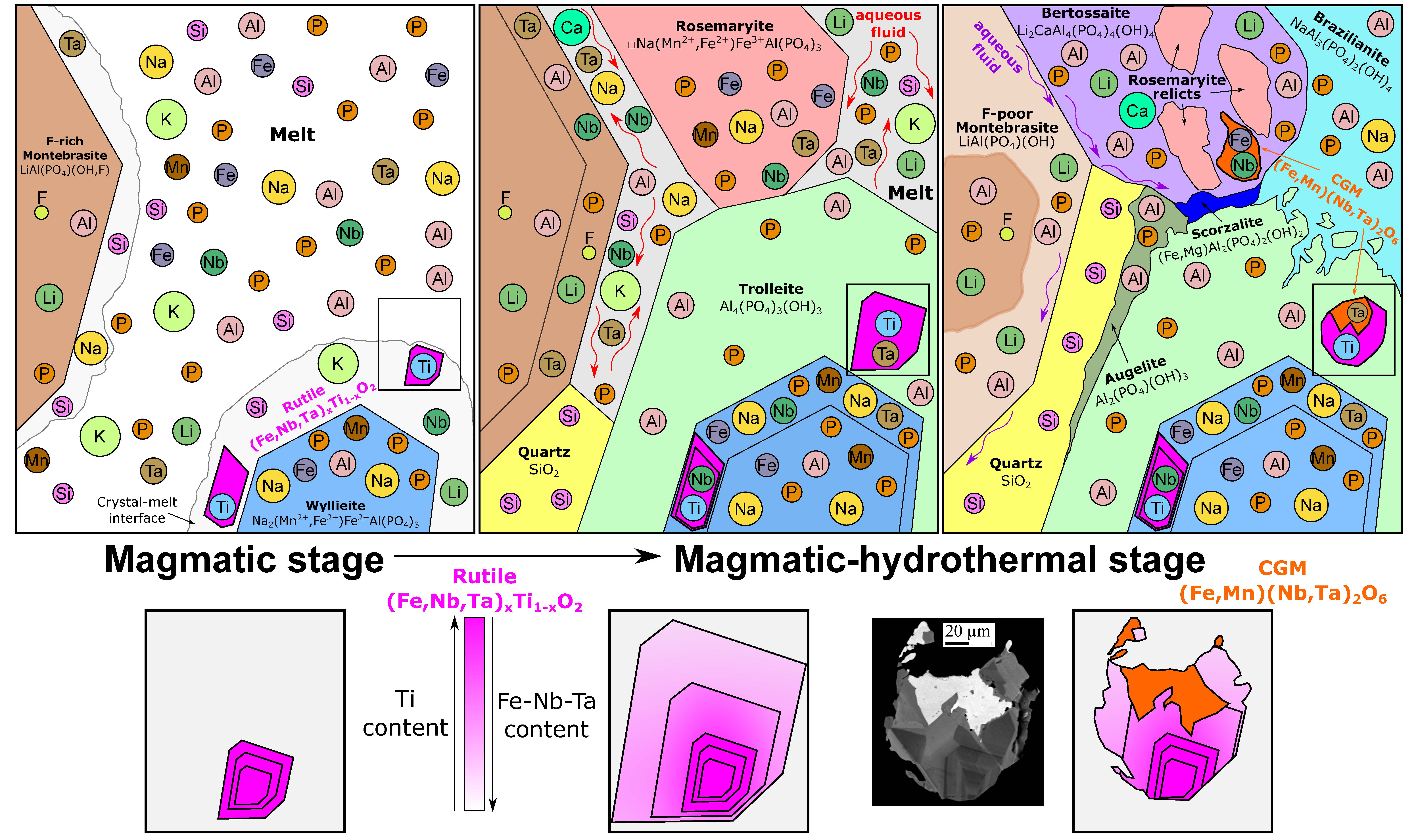
Paragenesis and precipitation stages of Nb-Ta-oxide minerals in phosphorus-rich rare-element pegmatites (Buranga dike, Rwanda)
https://doi.org/10.2138/am-2022-8201
Araujo et al. present the application of high-resolution Raman imaging techniques, coupled with petrography and EPMA analyses, to define the paragenesis and crystallization stages of Nb-Ta-oxide minerals (NTO) in the phosphorus-rich Buranga pegmatite. The results show that NTO precipitates as (1) the Fe-Nb-Ta-rich rutile in the magmatic stage; and (2) columbite group minerals (CGM) in the magmatic-hydrothermal stage. Additionally, the CGM precipitation is linked with the destabilization of primary minerals after crystal-fluid-melt interactions and depends on the availability of Fe and Mn in the system, which in turn is controlled by the crystallization of phosphate minerals in these flux-rich pegmatites.
3D zoning of barium in alkali feldspar
https://doi.org/10.2138/am-2022-8139
Lubbers et al. used computed X-ray microtomography (microCT) to observe 3D chemical zoning in natural sanidine minerals. The results allow us to better quantify mineral zoning geometries and volumes while mitigating sectioning effects related to looking at minerals in 2D. These results have implications for petrological tools that interpret mineral zoning (e.g., diffusion chronometry, mineral growth/dissolution).
In situ Raman vibrational spectra of siderite (FeCO3) and rhodochrosite (MnCO3) up to 47 GPa and 1100 K
https://doi.org/10.2138/am-2022-8343
Wang et al. report the Raman vibrational spectra of siderite and rhodochrosite at simultaneously high-P and high-T conditions for the first time. They found that the frequency shifts of the carbonate modes are a coupled function of both P and T, and the effect of the P-T cross-derivative term cannot be neglected. A method of using high P-T Raman scattering data to calculate the mode (macroscopic) Gruneisen parameters (γi) and the bulk modulus parameter (K(T)) is established.
Isotopic responses of magnesium to two types of dissolutionreprecipitation processes for the growth of the double-carbonate mineral norsethite
https://doi.org/10.2138/am-2022-8386
Liu et al. used Mg isotopes to probe the trace element behavior during the formation and growth of norsethite ['BaMg(CO3)2]. They observed two different types of dissolution-reprecipitation process during carbonate growth, including the transformation of amorphous carbonate to crystalline carbonate (fast dissolution-reprecipitation) and recrystallization of crystalline carbonate (slow dissolution-reprecipitation). The study finds significantly different Mg isotope fractionation behaviors during these two processes and highlights the importance of understanding the formation mechanism and post-depositional history of carbonate for interpreting the isotopic data in carbonate minerals.
Fluid-rock interaction and fluid mixing in the large Furong tin deposit, South China: New insights from tourmaline and apatite chemistry and in situ B-Nd-Sr isotope composition
https://doi.org/10.2138/am-2022-8310
Chen et al. show that the in situ elemental and B-Sr-Nd isotopic compositions of tourmaline and apatite at the Furong Sn deposit define the greisen-type mineralization to a dominantly magmatic-hydrothermal environment and the skarn-type mineralization to an open system with fluid mixing and fluid-rock reactions. This work highlights that coupled hydrothermal minerals such as tourmaline and apatite have great potential to fingerprint the nature, source, and evolution of fluids in granite-related ore systems.
A neutron diffraction study of boussingaultite, (NH4)2[Mg(H2O)6] (SO4)2
https://doi.org/10.2138/am-2022-8385
Boussingaultite is a magnesium ammonium sulfate hexahydrate with the ideal formula (NH4)2&91;Mg(H2O)6](SO4)2. It occurs as a sublimate formed under fumarolic conditions, geysers, or from coal gas at burning coal dumps. There is an increasing interest in boussingaultite, or its synthetic counterpart, generated by some potential industrial and agricultural utilization of this material. Using a multi-methodological approach, this study by Gatta et al. sheds new light on the mechanisms that promote solid solution with substitutions in the crystalline edifice A+2B2+(SO4)2(H2O)6 at the A (e.g., K+ vs. NH4+) and at the B (e.g., Mn2+ vs. Mg2+) sites.
Zn-clays in the Kihabe and Nxuu prospects (Aha Hills, Botswana): A XRD and TEM study
https://doi.org/10.2138/am-2022-8439
Putzolu et al. conducted powder XRD and TEM-AEM experiments of Zn-rich clays in the Kihabe and Nxuu prospects. The obtained data allowed describing fraipontite and sauconite as the main Zn carriers. The study of the paragenetic evolution of the ore showed that Zn-clays formed at the expense of early precipitated barren phyllosilicates (i.e., kaolinite and beidellite) of hydrothermal origin that were fertilized by Zn2+ and Al3+-rich fluids of mixed meteoric and low-T hydrothermal nature. The nanoscale TEM analyses revealed the alteration of previously formed willemite and sphalerite sourced Zn during the clay formation process. Furthermore, the detection of low tetrahedral charge sauconite, with a stoichiometry close to synthetic Zn-stevensite, is valuable to future studies on metals enrichment in 2:1 clays and also has implications on the clay systematics.
Finchite, Sr(UO2)2(V2O8)·5H2O, a new uranyl sorovanadate with the francevillite anion topology
https://doi.org/10.2138/am-2022-8365
Spano et al. describe a new mineral, finchite, Sr(UO2)2(V2O8)·5H2O. This is the first uranium mineral known to contain essential Sr and represents a possible immobilization species for both uranium and the hazardous radionuclide 90Sr because of the relative insolubility of uranyl vanadate minerals in water.
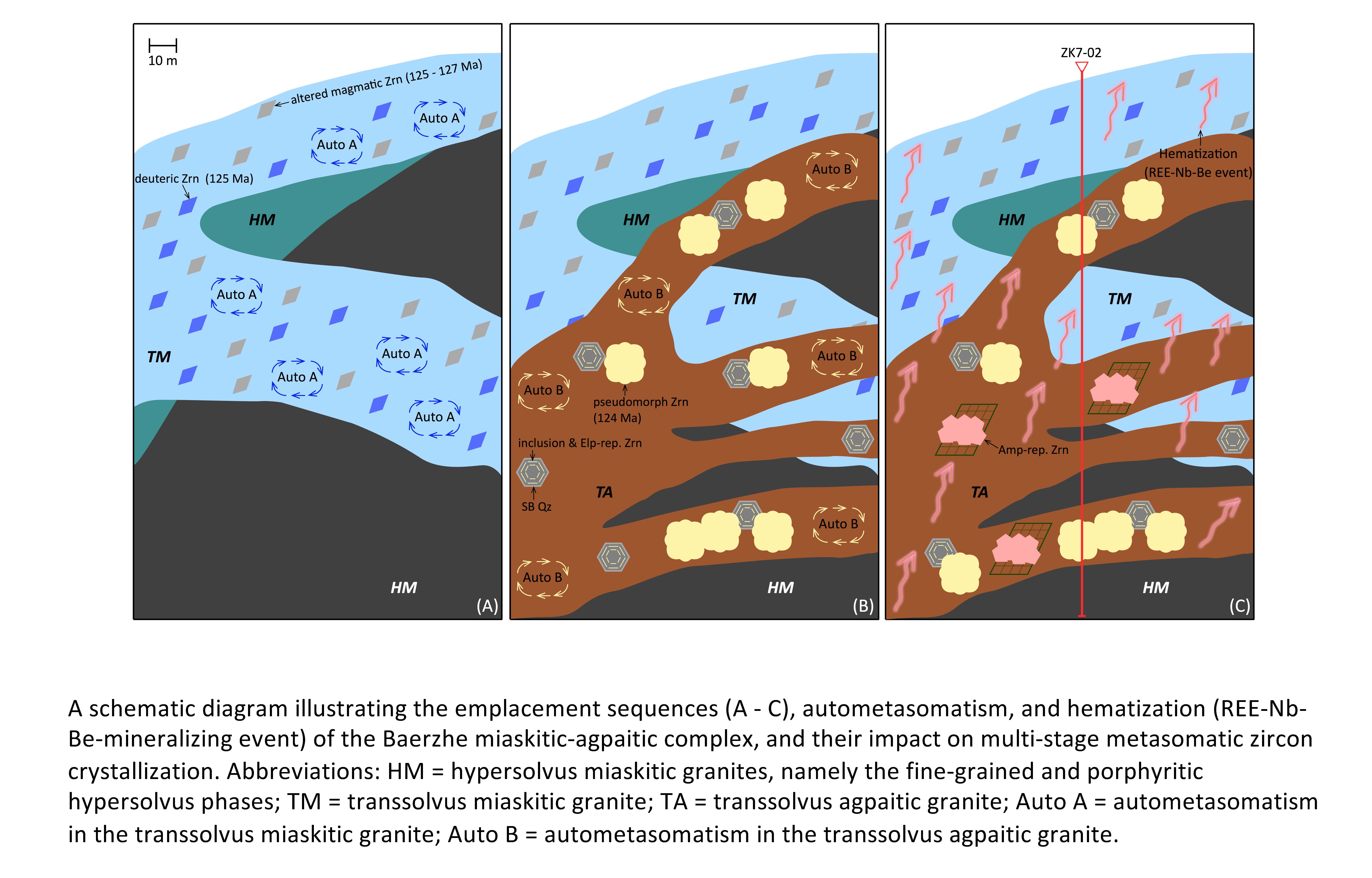
Multi-stage metasomatic Zr mineralization in the world-class Baerzhe rare earth element Nb-Zr-Be deposit, China
https://doi.org/10.2138/am-2022-8336
Wu et al. show that metasomatic zircon in the agpaitic granite was not subjected to metamictization or intense alteration, with trace elements accommodation largely following a xenotime substitution mechanism. Most zircon in the miaskitic-agpaitic complex at Baerzhe was the product of autometasomatism that was constrained to their parental granites. Some REE- and Be-rich zircon that replaced magmatic amphibole crystallized as a result of a reaction with an REE- and Be-rich fluid that most likely was responsible for REE-Nb-Be mineralization that affected both the miaskitic and agpaitic granites. The multi-stage metasomatic zircon-forming events present at Baerzhe reveal a more complex history of zircon formation in alkaline complexes than previously thought. Such complexity in the formation of metasomatic zircon could apply to similar alkaline settings that contain high Zr endowments.
Volume 108 : January 2023 Issue
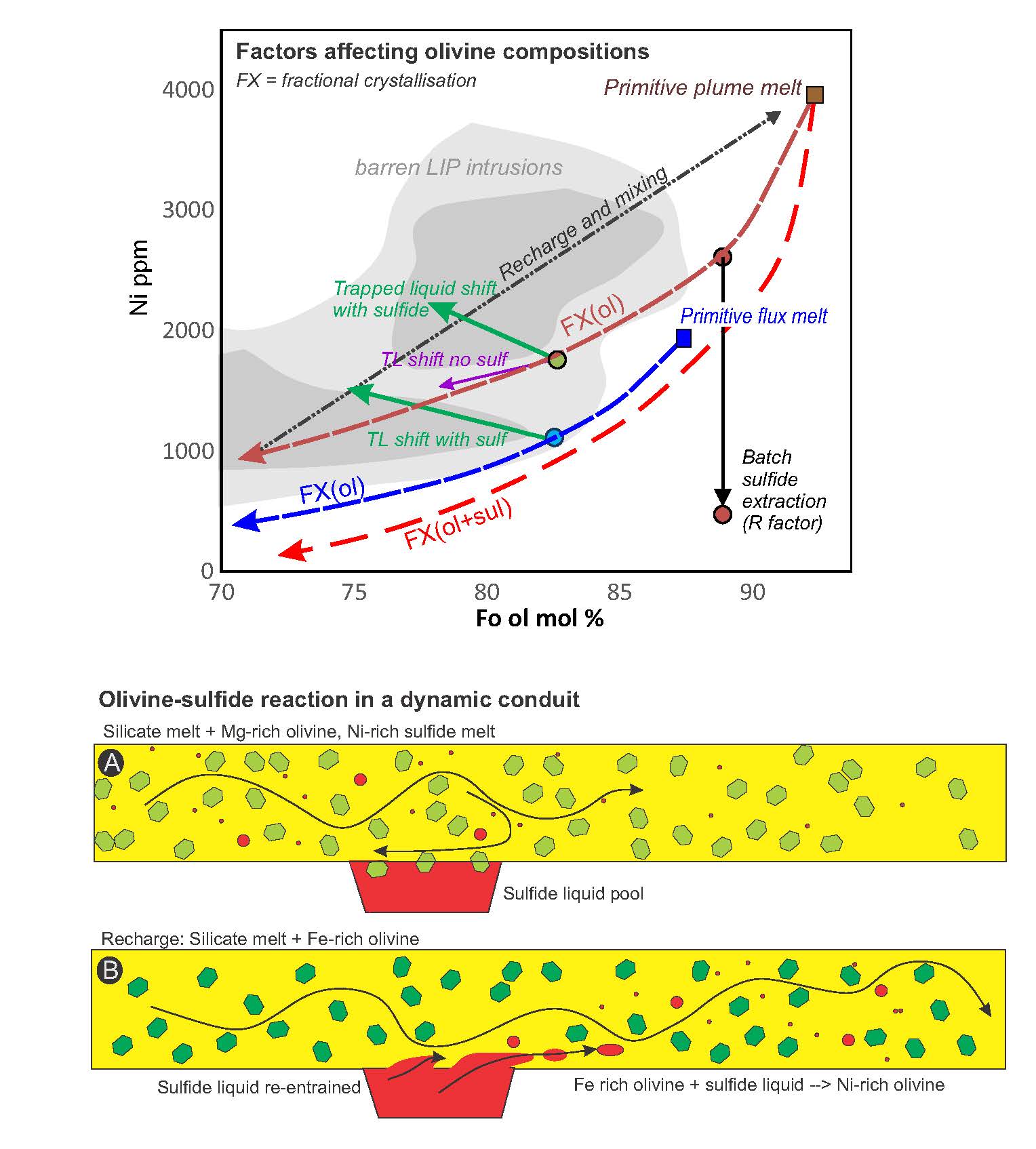
Nickel in olivine as an exploration indicator for magmatic Ni-Cu sulfide deposits: A data review and re-evaluation
https://doi.org/10.2138/am-2022-8327
Nickel and cobalt are essential battery metals, increasingly in demand as the world moves away from fossil fuels. We need to find new deposits, but exploration is becoming increasingly difficult. One of the techniques that have been applied for decades to identify possible target bodies of igneous rock (intrusions) is to look at the nickel contents of the common silicate minerals, particularly olivine, on the assumption that ore-forming processes will leave a signal of nickel depletion that extends beyond the ore deposits themselves. A large body of data has been collected worldwide over several decades, including thousands of analyses of olivines in volcanic rock as well as in intrusions, but the multiple factors that control the variability of nickel in olivine have not been systematically considered and evaluated to test whether the signals of magmatic sulfide formation can be reliably identified. Barnes et al. begin by defining the “baseline” of olivine compositions in non-ore-bearing rocks in different settings, then show that the natural variation in ore-bearing rocks shows complex signals, including enrichment as well as depletion in nickel relative to these baselines. Through empirical investigation and quantitative modeling, they attempt to unravel the multiple factors that lead to these observations. Nickel in olivine can indeed be a useful ore deposit indicator in some circumstances, but many confounding factors need to be considered. Nevertheless, useful information about ore-forming processes can certainly be derived.
« ‹ 1 … 26 27 28 29 30 … 85 › »ADDITIONAL RESOURCES