

Editor’s Notes
Total Results: 1697
Volume 107 : November 2022 Issue
Complexions and stoichiometry of the 60.8°//[100](011) symmetrical tilt grain boundary in Mg2SiO4 forsterite: A combined empirical potential and first-principles study
https://doi.org/10.2138/am-2022-8420
Furstoss et al. show that multiple stoichiometric and non-stoichiometric grain boundary (GB) structures are stable for one particular GB in forsterite. Vacancies are, in most cases, attracted by the GBs. The atomic structures found here have never been described before and could explain the high diffusivity of oxygen at GB as well as part of the water storage in forsterite.
Effects of electronegativities and charge delocalization on Q2 Raman shifts of alkaline- and alkaline earth-bearing glasses and metasilicate crystals
https://doi.org/10.2138/am-2022-8172
Nesbitt et al. investigate Raman shifts of the A1 symmetric stretch of silicate Q2 species vary over a range of ~90 cm-1 in crystals and glasses containing alkali and alkaline earth oxides. The shifts display a striking, sympathetic relationship with the electronegativity of the alkali and alkaline earth metals (M), with the highest frequency observed for Mg-silicate glasses and crystals and the lowest frequency for Cs-bearing glasses.
Crystal structure of nyerereite: A possible messenger from the deep Earth
https://doi.org/10.2138/am-2022-8106
Zucchini et al. studied the crystal structure of synthetic nyerereite [Na2Ca(CO3)2]. Na2Ca(CO3)2 likely has a wide stability field at pressure conditions higher than those of the synthesis experiments (100 MPa). New scenarios, where nyerereite would have a wide stability field at high-pressure conditions, strongly influence the mobility of carbonate melts in the deep upper mantle/transition zone and have significant implications for the deep carbon cycle associated with carbonatites.
Crystal structures and high-temperature and high-pressure vibrational spectra of synthetic fluorine-bearing brucites
https://doi.org/10.2138/am-2022-8215
Miao et al. synthesized two F-bearing brucite samples, Mg(OH)1.78F0.22 and Mg(OH)1.16F0.84, at 9.5 GPa and 1373 K. Single-crystal X-ray diffraction measurements indicate that both the phases still crystallize in the symmetry of P3m1, and the fluorine effect on the crystal structure has been carefully characterized. Additional IR-active OH-stretching bands are observed at 3660, 3644, and 3513 cm-1 for the F-bearing samples, besides the original one at 3695 cm-1. In situ high-temperature and high-pressure Raman and Fourier transform infrared (FTIR) spectra were systematically collected on both the F-bearing samples and a natural one with 0.7 mol% F-. Miao et al. observed that the dehydration points of the synthetic F-bearing brucite samples are 800–850 K at the ambient pressure, which is 100–150 K higher than that for F-free samples in the atmosphere. In the presence of fluorine, hydrous minerals, including brucite, could be stable at higher P-T conditions in subduction zones, which will provide us new insight into the combination of hydrogen and fluorine cycling in the subduction slabs. Fluorine substitution generates new H positions at lower energies (frequencies) and stabilizes the lattice structure, which has a pronounced impact on the thermoelastic properties, and fluorine could promote hydrogen bond symmetrization in hydrous minerals at high pressures. And, fluorine incorporation will affect the hydrogen isotopic fractionation between hydrous minerals and water.
The influence of OH content on elastic constants of topaz [Al2SiO4(F,OH)2]
https://doi.org/10.2138/am-2022-8159
Topaz might play a significant role in transporting water and fluorine into the Earth's interior in subduction zones. Seismological detection of topaz gives us insights into the transport of water and fluorine and requires a thorough understanding of its elastic properties. The influence of OH content on elastic constants of topaz has not been fully understood, though experimental and theoretical studies have been done on topaz with various OH contents. Aradachi et al. determined elastic constants of topaz for five natural single-crystal specimens with different OH content (x=0.28~0.72) via the sphere resonance method at ambient conditions. Their measured elastic constants are significantly higher (>3%) than theoretically determined values, especially in diagonal components (Cii). The theoretical lower values must be related to the lattice parameters used in the theoretical studies, which are systematically larger than measured lattice parameters. The theoretical approach should be modified to reproduce measured lattice parameters and lead to agreement of theoretical and experimental elastic constants. These results provide a clue to a better understanding of elasticity of topaz and a basis for the seismological detection of subducted oceanic sediments.
Experimental calibration of an Fe3+/Fe2+-in-amphibole oxybarometer and its application to shallow magmatic processes at Shiveluch Volcano, Kamchatka
https://doi.org/10.2138/am-2022-8031
Goltz et al. present an experimentally calibrated amphibole-melt oxybarometer applicable to mafic and felsic systems with no coexisting oxides. Using the partitioning of Fe3+ and Fe2+, the oxygen fugacities of magmas at Shiveluch Volcano are calculated. Some samples with oxidized amphibole reflect pre-eruptive dehydrogenation; diffusion modeling of H is used to determine the timing of mafic recharge events. Not all recharge events are directly linked to eruption.

The crystal structure of mineral magadiite, Na2Si14O28(OH)2∙8H2O
https://doi.org/10.2138/am-2022-8156
Marler et al. describe the complex structure of mineral magadiite, a mineral known for 54 years and discovered at Lake Magadi, Kenya. Magadiite has also frequently been synthesized in the lab to act as a precursor material for a subsequent transformation into porous silicates. Its structure, however, remained obscure until now due to a limited crystallinity, small particle size, and complex structure. Magadiite is a layered silicate containing thick silicate layers with intercalated bands of hydrated sodium cations.
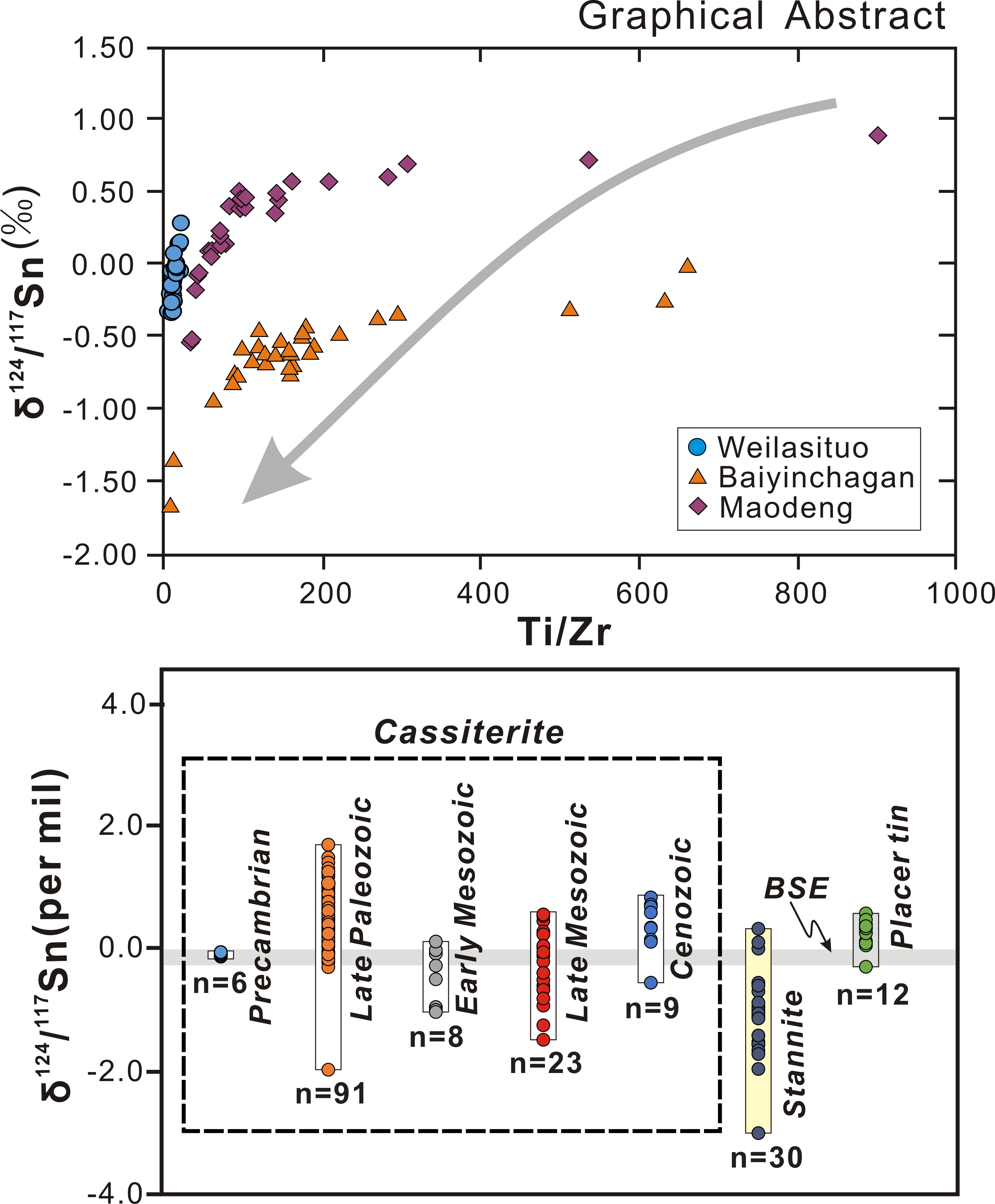
Tin isotopes as geochemical tracers of ore-forming processes with Sn mineralization
https://doi.org/10.2138/am-2022-8200
Zhou et al. show that kinetic Rayleigh fractionation is likely to lead to isotope fractionation of tin during the formation of the ores, that liquid-vapor partitioning or vaporization, and fluid-rock interaction have strong effect on Sn isotope fractionation, and that Sn isotopes can be a robust tool for tracing mineralization centers, fluid pathways, migration mechanisms of tin, and a powerful probe of redox processes.
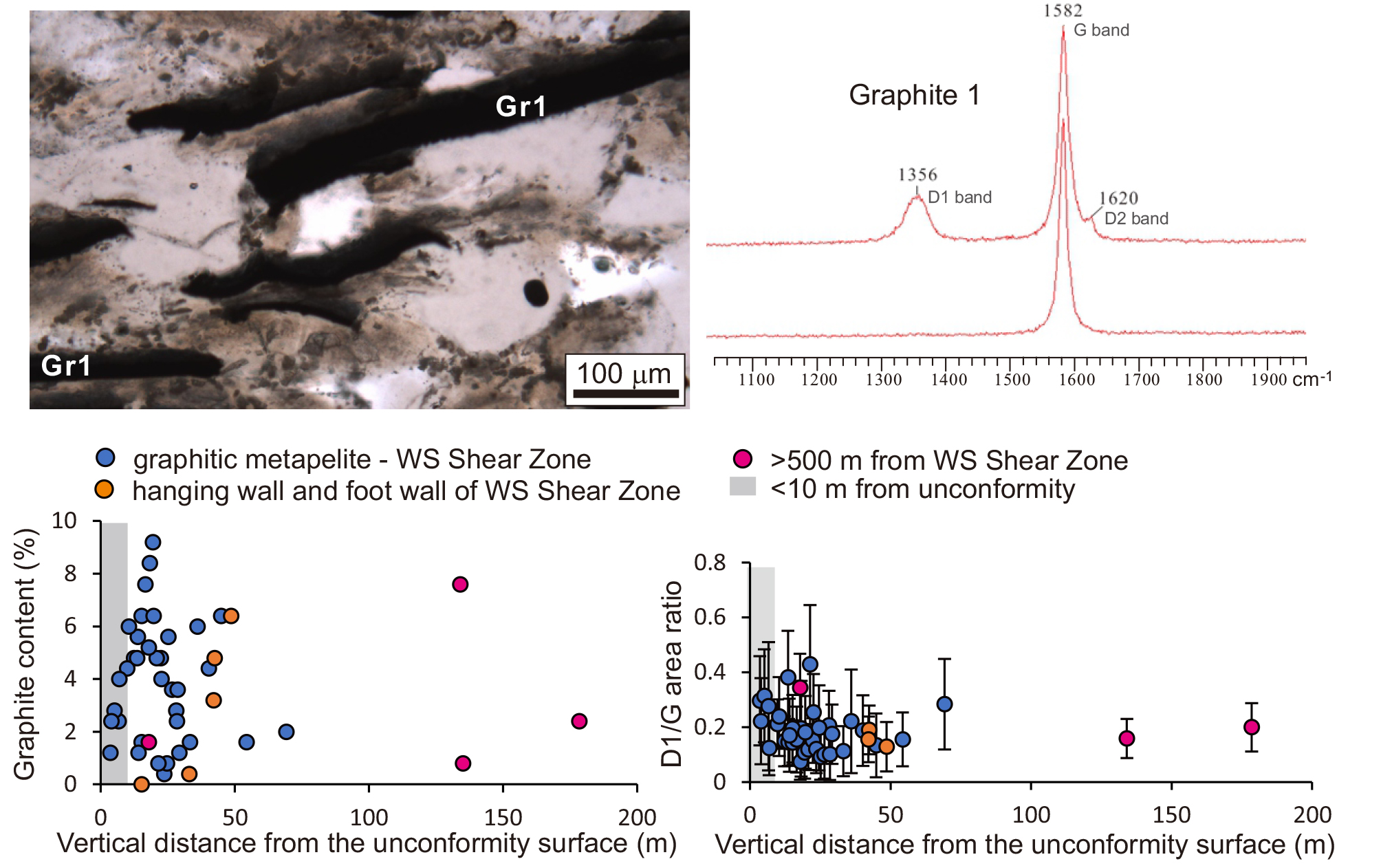
The role of graphite in the formation of unconformity-related uranium deposits of the Athabasca Basin, Canada: A case study of Raman spectroscopy of graphite from the world-class Phoenix uranium deposit
https://doi.org/10.2138/am-2022-8158
Unconformity-related uranium (URU) deposits in the Proterozoic Athabasca Basin (Canada) represent the richest and one of the most important uranium endowments in the world. Song et al. use the Phoenix uranium deposit in the southeastern Athabasca Basin as a case study to address the association of URUs with graphitic basement faults. Petrographic studies indicate that there is no direct contact between graphite and uraninite at microscopic scales, and the content of graphite in the graphitic metapelite along the ore-controlling WS Shear Zone does not show a systematic change with the distance from the unconformity surface. Raman spectroscopic studies of graphite suggest that the degree of structural disorder of graphite does not change systematically with the distance from the unconformity surface either. The minor irregularities in these parameters near the unconformity are better explained by paleo-weathering related to the unconformity and/or diagenetic processes than by hydrothermal activity related to uranium mineralization. Based on these observations and interpretations, the role of graphite as an in situ reducing agent, either directly or as a provider of hydrocarbons, is discounted. It is proposed that hydrocarbons derived from graphite at depth, tapped by episodic reactivation or seismicity of the basement faults that were facilitated by graphite as a lubricant, were responsible for URU mineralization.
Pomite and pseudopomite, two new carbonate-encapsulating mixed-valence polyoxovanadate minerals
https://doi.org/10.2138/am-2022-8335
The discovery of POM minerals is one of the specific landmarks of descriptive mineralogy and mineralogical crystallography of our time. In this paper by Kampf et al., the most recently discovered POM minerals, pomite and pseudopomite, are the first to incorporate carbonate as the central heteropolyhedral group of the POM. Synthetic carbonate-bearing POMs have been suggested as useful for the capture of atmospheric carbon, and naturally occurring phases, such as pomite and pseudopomite, may prove to be important guides in that respect.
BOOK REVIEW
https://doi.org/10.2138/am-2022-B1071117
Book Review: Triple Oxygen Isotope Geochemistry
Volume 107 : October 2022 Issue
Experimentally derived F, Cl, and Br fluid/melt partitioning of intermediate to silicic melts in shallow magmatic systems
https://doi.org/10.2138/am-2022-8109
Understanding the behavior of halogens in magmas is of importance for a range of crustal processes, including magma evolution and degassing and ore mineralization, by influencing the physical and chemical properties of melts, fluids, and minerals. To this end, the study by Cassidy et al. uses experiments and chemical analyses to define under what conditions these halogens prefer the fluid (or gas phase) relative to the melt. These data provide a framework for interpreting halogens gases measured within volcanic plumes.
Spectroscopic study on the local structure of sulfate (SO42–) incorporated in scorodite (FeAsO4·2H2O) lattice: Implications for understanding the Fe(III)-As(V)-SO42–- bearing minerals formation
https://doi.org/10.2138/am-2022-8184
Incorporation of SO42- in the scorodite structure is an important process during its formation in mining-related settings such as acid mine drainage and hydrometallurgical tailings. In addition, the incorporation of SO42- in scorodite is also an important mechanism during the immobilization of arsenic in waste sulfuric acid streams that use scorodite as an As-carrier. The incorporated structural SO42- can reduce the scorodite stability and then affect the mobility and fate of arsenic. The study by Ma et al. indicates that the SO42- may form Fe2(SO4)3-like local structure in scorodite. Hence, higher solubility of local Fe2(SO4)3 (vs. FeAsO4∙2H2O) trapped in scorodite may be the main reason for the higher solubility of SO4-scorodite. Furthermore, the structure of SO4-scorodite solid solution can also help understand the evolution and crystallization processes of its precursors, i.e., amorphous ferric arsenate.
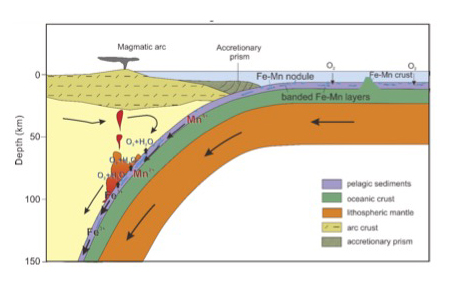
Oxidation of arcs and mantle wedges by reduction of manganese in pelagic sediments during seafloor subduction
https://doi.org/10.2138/am-2022-8171
Song et al. investigated high-pressure metamorphosed Mn-rich cherts in ancient seafloors in the Qilian subduction zone, and demonstrated that reductive reactions of Mn-rich cherts in the subduction zone are an important factor for mantle wedge oxidization and oxygen recirculation. They propose that the oxygen flux generated by progressive metamorphism of Mn-rich pelagic sediments is high enough for oxidizing the sub-arc mantle, while the ferric iron plays very little role in the oxidization of the sub-arc mantle wedge.
Raman scattering and Cr3+ luminescence study on the structural behavior of δ-AlOOH at high pressures
https://doi.org/10.2138/am-2022-8005
Wang et al. conducted Raman scattering and luminescence spectroscopic measurements on δ-AlOOH at pressures up to 34.6 GP and 22.1 GPa, respectively. From the Raman spectra, the Raman-active B2 modes at 390 cm-1 and 416 cm-1 show a continuous hardening behavior but become abnormally stiffened at ~8 GPa, in agreement with the structural transition from P21nm to Pnnm. These two modes are highly sensitive to pressure in the P21nm phase but less so in the Pnnm phase, which are consistent with the different compressibilities of two phases. Additionally, several softening modes were observed in the P21nm phase, which show a gradual decrease in intensity and finally disappear before the P21nm-to-Pnnm phase transition. The luminescence data also show systematic abrupt changes in the slopes or pressure dependences of the R-lines and sidebands across the phase transition. The evolution of R2-R1 splitting with pressure indicates continuously suppressed distortion of AlO6 octahedron under high pressure.
Jadeite and related species in shocked meteorites: Limitations on inference of shock conditions
https://doi.org/10.2138/am-2022-8220
Jadeite has been frequently reported in heavily shocked meteorites. It displays a variety of textures and grain sizes, and many researchers identified it solely on the basis of its Raman spectra. Here Baziotis et al. show that additional techniques are required in order to confidently identify jadeite and distinguish it from related species. A reassessment of reported jadeite occurrences puts in a new light on many previous conclusions about the shock histories preserved in particular meteorites.
Pressure-induced C23–C37 transition and compression behavior of orthorhombic Fe2S to Earth’s core pressures and high temperatures
https://doi.org/10.2138/am-2022-8187
Fe2S was recently identified as a plausible iron-rich sulfide stable at Earth's inner core boundary conditions. Zurkowski et al. present the mechanism for a pressure-induced phase transition in Fe2S around Earth's core-mantle-boundary pressures. Up to 120 GPa, Fe2S exhibits the Co2P structure type (C23), and a highly compressible a axis compared to the b and c axes. In the 120 to 150 GPa pressure range, a change in compressibility is observed, such that the C23 Fe2S structure evolves towards a more Co2Si-like structure (C37). Above 150 GPa, this transition is complete and C37 Fe2S is observed to at least 306 GPa based on previous studies. An equation of state of the C37 Fe2S phase is presented and compared to the density of Earth's Fe-rich outer core. Based on these results, an Fe-S alloy alone cannot match the geophysical constraints of Earth's core and likely S plus other light elements such as Si, O, C, and H are present.
Estimating ferric iron content in clinopyroxene using machine learning models
https://doi.org/10.2138/am-2022-8189
Huang et al. demonstrate that: (1) machine learning models provide reliable predictions of clinopyroxene ferric iron content; (2) supervised training models can significantly minimize temperature uncertainties of clinopyroxene-garnet geothermometers; and (3) the distribution of Fe3+/ΣFe values differs slightly between dehydrogenated and non-dehydrogenated clinopyroxenes.
Pyradoketosite, a new, unexpected, polymorph of Ag3SbS3 from the Monte Arsiccio mine (Apuan Alps, Tuscany, Italy)
https://doi.org/10.2138/am-2022-8136
Biagioni et al. describe the new mineral pyradoketosite, a new polymorph of the well-known compound Ag3SbS3. This compound has been known for two centuries as the trigonal and monoclinic polymorphs pyrargyrite and pyrostilpnite, respectively, that represent important Ag ore minerals and, more recently, are used for their thermoelectric and optical properties. It is worth noting that previous synthesis experiments in the Ag-Sb-S system were not able to obtain the synthetic analogue of pyradoketosite. The study of natural occurrences of Ag-sulfosalts can not only contribute to the knowledge of Ag crystal chemistry, but also may have interesting technological implications.
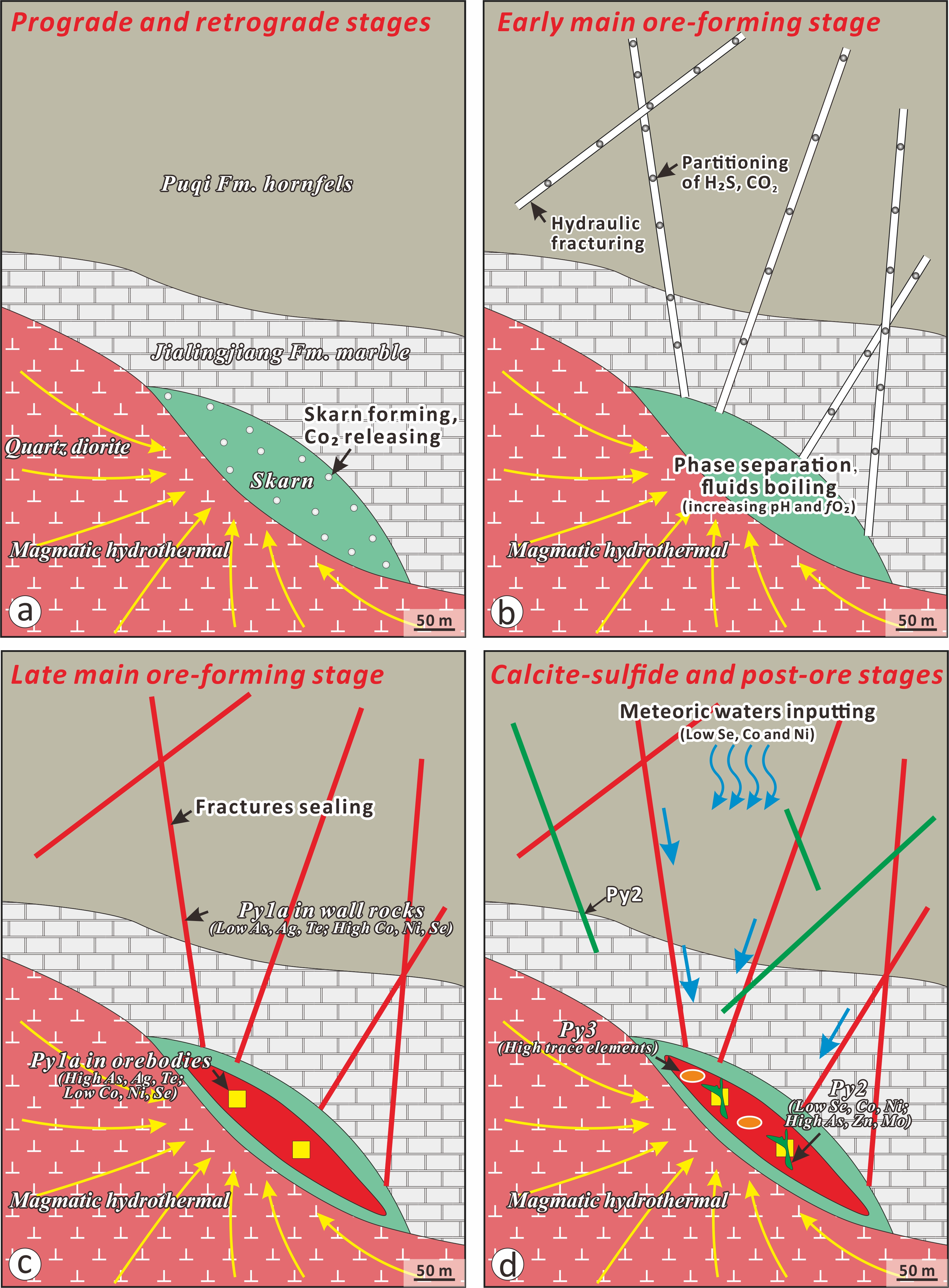
Pyrite geochemistry and its implications on Au-Cu skarn metallogeny: An example from the Jiguanzui deposit, Eastern China
https://doi.org/10.2138/am-2022-8118
This study by Zhang et al. highlights the significance of wallrock hydraulic fracturing, fluid-rock reaction, and the fluid physicochemical evolution in the skarn ore-forming process, and suggests the potential use of pyrite trace element geochemistry for exploring Au-Cu skarn mineral systems.
« ‹ 1 … 29 30 31 32 33 … 85 › »ADDITIONAL RESOURCES