

Editor’s Notes
Total Results: 1697
Volume 107 : October 2022 Issue
Synthesis of ferrian and ferro-saponites: Implications for the structure of (Fe,Mg)-smectites formed under reduced conditions
https://doi.org/10.2138/am-2022-8231
The smectite found at the Yellowknife Bay of Mars, surprisingly, may be characterized as a ferrian saponite, which has unique octahedral sheets based on the traditional clay mineralogy. Here, Sakuma et al. synthesized ferrian saponites using a hydrothermal method under reduced conditions. The stability of ferrian saponite can be explained by the desorption of hydrogen in the structure to neutralize the charge. The valence state of part of the iron cations in the octahedral sheets is reversible. These results provide a basis for estimating the paleoenvironments of Mars and Ceres using iron smectites.
Natural cubic perovskite, Ca(Ti,Si,Cr)O3–δ, a versatile potential host for rock-forming and less-common elements up to Earth’s mantle pressure
https://doi.org/10.2138/am-2022-8186
Britvin et al. report the discovery of a natural cubic perovskite. This is the first example of natural ABO3 perovskite bearing disordered oxygen vacancies. The mineral contains more than 20 mol% of davemaoite component (cubic perovskite-type CaSiO3) and is abnormally enriched in Cr. It remains stable upon compression to at least 50 GPa. Cubic perovskite can serve as a structural host for incorporation of different elements up to a pressure corresponding to the Earth's mantle conditions.
Nazarovite, Ni12P5, a new terrestrial and meteoritic mineral structurally related to nickelphosphide, Ni3P
https://doi.org/10.2138/am-2022-8219
Britvin et al. describe Nazarovite, Ni12P5, a new natural phosphide belonging to the system Fe-Ni-P that is the main reservoir of reduced (non-phosphate) phosphorus in the Solar System. Due to the crystal-chemical features, the mineral may serve as a chemical discriminator, selectively extracting Ni from phosphide-bearing Fe-Ni metal systems.
Zinconigerite-2N1S ZnSn2Al12O22(OH)2 and zinconigerite-6N6S Zn3Sn2Al16O30(OH)2, two new minerals of the nolanite-spinel polysomatic series from the Xianghualing skarn, Hunan Province, China
https://doi.org/10.2138/am-2022-7983
Rao et al. report the occurrence of two new polysomes of the N-S type polysomatic series. They describe the detail chemical and structural information of zinconigerite-2N1S and -6N6S. This discovery provides new insights into the crystal chemistry of N-S polysomatic series and their origin.
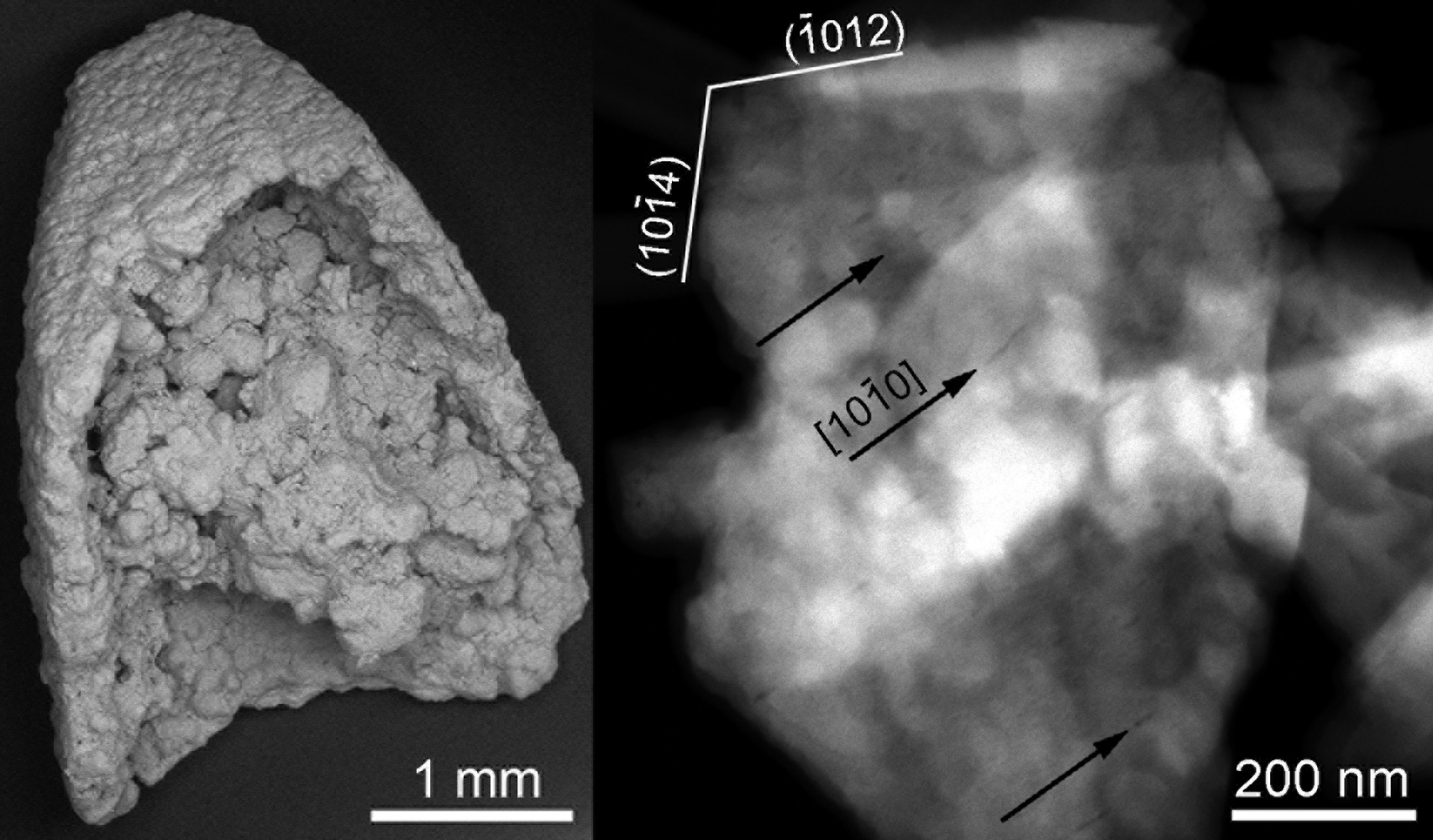
Tracing structural relicts of the ikaite-to-calcite transformation in cryogenic cave glendonite
https://doi.org/10.2138/am-2022-8162
Nemeth et al. show that glendonite, a calcite pseudomorph after ikaite (CaCO3∙6H2O) and commonly interpreted as an indicator of low paleotemperature, is characterized by high intergranular micrometer-size porosity, whereas calcite crystals, the constituent of glendonite, are consistent with a relatively low-porosity material. Although the aligned mesopores, frequently occurring twins, small grain size, presence of aqueous inclusions and the observed porosity arise from the ikaite-calcite transformation, the glendonite morphology remains the most reliable feature to identify calcite derived via transformation of ikaite and thus to infer past cryogenic temperatures. These findings have implications for the emerging research field of cryogenic caves carbonates, which are commonly associated with the presence of permafrost.
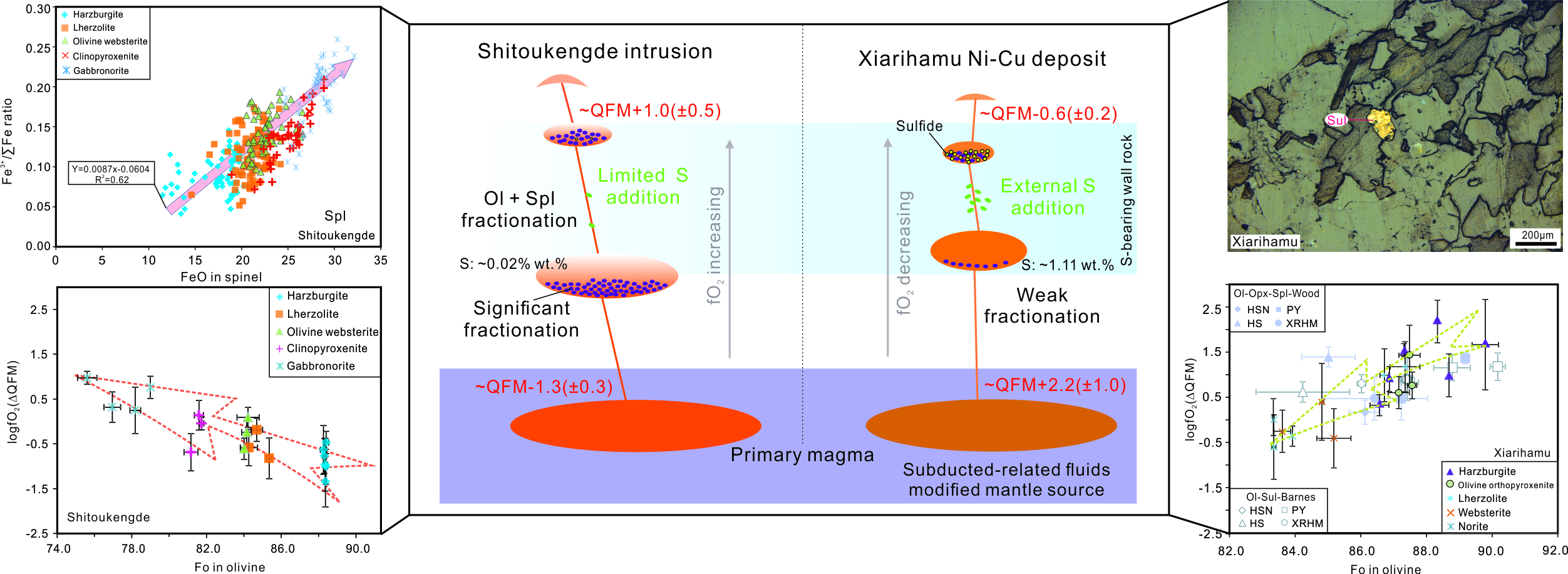
Oxygen-fugacity evolution of magmatic Ni-Cu sulfide deposits in East Kunlun: Insights from Cr-spinel composition
https://doi.org/10.2138/am-2022-8050
Jia et al. provide the first comparison of the magma fO2 for the Xiarihamu Ni-Cu sulfide deposit and Shitoukengde mafic-ultramafic intrusion based on olivine-spinel oxybarometry. The authors propose that the temporal evolution of oxygen fugacity of mantle-derived magma can be a key indicator for evaluating metallogenic potential of Ni-Cu sulfide deposits and that reduction processes from mantle source to shallow crust play an important role in the genesis of magmatic Ni-Cu sulfide deposits.
NEW MINERAL NAMES
https://doi.org/10.2138/am-2022-NMN1071016
New Mineral Names
Volume 107 : September 2022 Issue
Apollo 15 regolith breccia provides first natural evidence for olivine incongruent melting
https://doi.org/10.2138/am-2022-8121
The present-day architecture of the solar system is the result of countless collisions between astronomical objects. During impacts, the energy released by shock waves triggers pressures and temperatures comparable to those of planetary interiors. Minerals can form during impacts, and through their identification, it is possible to establish impact pressure and temperature conditions. In this study, Satta et al. describe for the first time the presence of ferropericlase — a mineral typically confined to depths about 660 km in the Earth — found in a lunar rock collected during the Apollo 15 mission. Their observations suggest that the lunar ferropericlase formed as a result of a shock-induced process never observed before in natural samples. This study provides a new understanding of impacts on the Moon's surface.
Enhanced weathering in the seabed: Rapid olivine dissolution and iron sulfide formation in submarine volcanic ash
https://doi.org/10.2138/am-2022-8057
Within volcanic ash particles recovered from a seamount in 3000 m water depth, olivine dissolution and related iron sulfide formation have been observed by Kahl et al. The FeS2 precipitates are found to be conjoined and planar aggregates, occurring in the center of cavities that formed by partial to complete dissolution of olivine. Almost all occurrences of FeS2 precipitation are related to Cr-spinel inclusions in the former olivine. Iron sulfide formation involves initial heterogeneous nucleation of FeS2 on spinel surfaces and subsequent pyrite and/or marcasite precipitation as overgrowths on existing FeS2 aggregates. Rapid olivine dissolution is facilitated by sulfide-bearing fluids, which prevent the formation of hydrous ferric oxide layers and promote sequestration of iron as FeS2. These delicate structures of FeS2 within voids created by olivine dissolution may represent a transient in-seafloor alteration, as progressive dissolution of volcanic glass causes the formation of Fe-oxyhydroxides and clay minerals, which are the commonly observed alteration features in seafloor basalts.
The efficiency of copper extraction from magma bodies: Implications for mineralization potential and fluid-silicate melt partitioning of copper
https://doi.org/10.2138/am-2021-7951
This study by Zhou et al. indicates that the efficiency of copper extraction from magmas plays a critical role in determining Cu mineralization potential. Their results indicate that a variety of igneous minerals with anomalously low Cu contents could potentially be used as a tool to identify a Cu-mineralizing magma body in a deposit with multiphase intrusions; nevertheless, a suite of igneous mineral compositions from a region should be analyzed for comparison. The results suggest that the inefficient copper extraction from plutons may be ascribed to the lack of reduced S species during fluid exsolution or different evolution paths of Cu and Cl during magma crystallization.
Validation of clinopyroxene-garnet magnesium isotope geothermometer to constrain the peak metamorphic temperature in ultrahigh-temperature ultramafic-mafic granulites
https://doi.org/10.2138/am-2022-8058
In this study by Gou et al., on the basis of evidence from phase equilibrium modeling, mineral chemical analysis, and conventional clinopyroxene-garnet Fe-Mg exchange geothermometry and clinopyroxene-garnet Mg isotope geothermometry, they evaluate the feasibility of a clinopyroxene-garnet Mg isotope geothermometer in the Neoarchean ultramafic-mafic granulites from the Namakkal Block of the Southern Granulite Terrane, India, which underwent ultrahigh-temperature (UHT) metamorphism, and the effect of the retrograde cooling on equilibrium Mg isotope fractionation between clinopyroxene and garnet during the UHT metamorphism. They demonstrate that the inter-mineral Fe-Mg exchange between clinopyroxene and garnet during the retrograde cooling of the ultrahigh-temperature (>900 °C) did not disturb their Mg isotope fractionation equilibrium attained during the ultrahigh-temperature metamorphic condition. Therefore, clinopyroxene-garnet Mg isotope thermometry is a valid tool to constrain the peak metamorphic temperature conditions even for ultramafic-mafic granulites that have undergone ultrahigh-temperature metamorphism.
Uranotungstite, the only natural uranyl tungstate: Crystal structure revealed from 3D electron diffraction
https://doi.org/10.2138/am-2022-8112
The structure of the only U(VI) tungstate known from nature has been characterized from a nano-size crystal by means of the 3D electron diffraction techniques. This work by Steciuk et al. is the first structural description of a natural uranyl-tungstate mineral and confirms the great structural and chemical flexibility of the beta-U3O8 type of sheets.
Carbon flux and alkaline volcanism: Evidence from carbonatite-like carbonate minerals in trachytes, Ulleung Island, South Korea
https://doi.org/10.2138/am-2022-8007
This paper by Chen et al. presents a detailed mineral chemical study of the trachyte and trachyandesite of Ulleung Island. Petrographic and chemical properties of different types of carbonate and silicate melt products in the rocks have been thoroughly analyzed. The carbonate phases include the following types, (1) euhedral pseudomorphic ankerite grains, (2) spherical and dumbbell shape globules in a trachyte matrix, (3) irregular-shaped inclusions in biotite and ulvospinel, and (4) hexagonal shaped inclusions in biotite. The C-O isotopes have δ13C (VPDB, ‰) ranging from -3.98 to -5.76, δ18O (SMOW, ‰) from 4.43 to 11.49, and exhibit igneous characteristics. Based on their appearances, the carbonate phases were formed from carbonate melt generated by carbon flux from the subducted oceanic slab. The pseudomorph carbonate grains were altered from pyroxene in the lower crust or the bottom of the fractionated magma chamber. The volcanic system of Ulleung Island preserves extraordinary evidence of carbon activity within the lower crust. The recycled carbon from the subducted slab can be stored within the lower crust through the replacement of silicate minerals. The calculation of carbon circulation in the earth system may need to consider adding this parameter in the modeling.
Controls on the formation of porphyry Mo deposits: Insights from porphyry (-skarn) Mo deposits in northeastern China
https://doi.org/10.2138/am-2021-7665
The results presented in this study by Ouyang et al. suggest that unique magma sources are not required for the formation of porphyry Mo deposits of both arc-related and Climax-type. Although the two classes of porphyry Mo deposits were formed in distinct tectonic settings and are associated with different kinds of intrusions, their formation is fundamentally controlled by similar geological processes and/or factors. A prerequisite for the formation of porphyry Mo deposits of both arc-related and Climax-type is the emplacement of oxidized, water-saturated magmas at 1.5 to 6.0 km palaeodepth. However, the actual ore-forming event itself is considered to relate to a sudden depressurization of the magma chamber and consequent venting of voluminous fluids along focusing structures, such as small stocks or dike swarms. These results, in combination with an examination of other porphyry Mo systems, suggest that sudden depressurization of magma chambers and subsequent venting of voluminous fluids along focusing structures most likely plays a critical role in the formation of porphyry Mo deposits of both arc-related and Climax-type. The findings of this study indicate that fluid processes in the shallow crust are pivotal for the formation of porphyry Mo deposits and that settings with ideal magmatic-hydrothermal architectures are most likely to develop into productive porphyry Mo systems.
High-pressure single-crystal synchrotron X-ray diffraction study of lillianite
https://doi.org/10.2138/am-2021-7765
In this paper by Zucchini et al., the high-pressure (HP) synchrotron X-ray diffraction study of lillianite up to approximately 21 GPa allowed them to (1) confirm the reversible first-order phase transition to beta-Pb3Bi2S6 that was bracketed between 4.90 and 4.92 GPa; (2) analyze the phase transition mechanism, as well as the compressibility of both lillianite and beta-Pb3Bi2S6; (3), observe a pseudomerohedral twinning that disappeared on decompression making lillianite an interesting shape-memory material; and (4) conclude that the stronger the stereochemical activity of the LEP, the higher the stability of the crystal structures at HP.
Thermoelastic parameters of Mg-sursassite and its relevance as a water carrier in subducting slabs
https://doi.org/10.2138/am-2022-8034
This work by Sula et al. presents new thermoelastic parameters and the structural evolution of Mg-sursassite at high-pressure and high-temperature, obtained by in-situ, synchrotron-radiation, single-crystal diffraction measurements, in relation with its mineral chemistry. Mg-sursassite is a hydrous mineral that potentially takes part, together with other hydrous minerals (e.g., Dense Hydrous Magnesium Silicates), in the mechanism of sequestration and release of water in the Earth's interior from subducted slabs.
3D crystal size distributions of pyroxene nanolites from nano X-ray computed tomography: Improved correction of crystal size distributions from CSDCorrections for magma ascent dynamics in conduits
https://doi.org/10.2138/am-2022-8039
Crystal size distributions (CSDs) are commonly used in igneous petrology because they can provide important information on crystallizing conditions and syneruptive magma dynamics. Okumura et al. proposed CSDs plotted against short-axis length (S-plot CSDs) as a new method. In contrast to the prevalent CSDs plotted against long-axis length, S-plot CSDs suppressed errors and also showed differences according to eruption style more markedly (by ~20% more) than using the long-axis length. Their findings make it possible to obtain more reliable and informative CSDs and infer variations in magma ascent dynamics.
Amphibole fractionation and its potential redox effect on arc crust: Evidence from the Kohistan arc cumulates
https://doi.org/10.2138/am-2022-8141
Zhang et al. discovered that Kohistan amphibole-bearing rocks are of cumulate origin; Fe3+/ΣFe ratios of Kohistan arc cumulates are mainly controlled by amphibole; amphibole fractionation leads to oxidation of arc magma, and amphibole fractionation is key to porphyry deposit formation and crustal evolution.
A comparative study of two-phase equilibria modeling tools: MORB equilibrium states at variable pressure and H2O concentrations
https://doi.org/10.2138/am-2022-8211
The development and ubiquitous usage of phase equilibria represent an inflection point in our ability to understand the link between petrogenesis and tectonics. However, the choice between different thermodynamic models raises important questions when modeling systems where multiple modeling tools are applicable, such as at suprasolidus conditions. Hernandez-Uribe et al. systematically compare the results of two modeling tools commonly used in the igneous and metamorphic petrology communities: MELTS (Ghiorso et al. 2012; Ghiorso & Gualda 2015) and the metabasite set of Green et al. (2016) using the thermodynamic database ds62 (Holland & Powell 2011), respectively. They selected a N-MORB composition and modeled closed-system equilibrium phase relations as a function of temperature at 0.25 GPa and 1 GPa for compositions with 0.5 wt% and 4 wt% H2O. Their results show that phase relations do exhibit some key differences that can impact geological inferences based on the modeling tool used for calculations. Differences in modal abundances of phases and liquid compositions correlate with predicted differences in liquid trace-element signature. The critical insight of this study is to inform the users about the differences in modeling approaches and how these can have important implications for interpretations of geologic processes and their associated uncertainties.
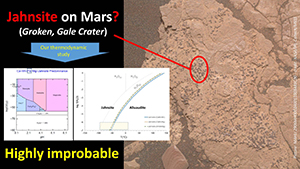
On the occurrence of jahnsite/whiteite phases on Mars: A thermodynamic study
https://doi.org/10.2138/am-2022-8174
(See also Graphical Abstract on the website). The thermodynamic predictions by Drouet et al. and predominance/stability calculations and experimental data strongly suggest the very unlikely presence of Jahnsites/Whiteites in Gale Crater on Mars, which was recently hypothesized from Curiosity analyses. Jahnsites are not favorable phases to form directly, contrary to other more favorable phases, and extrapolation to present and past Martian conditions also argues against their direct precipitation at the surface of Mars or their preservation if formed indirectly.
« ‹ 1 … 30 31 32 33 34 … 85 › »ADDITIONAL RESOURCES