
Editor’s Notes
Total Results: 1697
Volume 107 : September 2022 Issue
Hydroxymcglassonite-(K), KSr4Si8O20(OH)·8H2O, the first Sr-bearing member of the apophyllite group, from the Wessels mine, Kalahari Manganese Field, South Africa
https://doi.org/10.2138/am-2022-8210
In this work by Yang et al., a new mineral species, hydroxymcglassonite-(K), has been found in the Wessels mine, Kalahari Manganese Field, Northern Cape Province, South Africa. It is isostructural with hydroxyapophyllite-(K) and represents the first Sr-bearing mineral of the apophyllite group.
Volume 107 : August 2022 Issue
Estimating kaolinite crystallinity using near-infrared spectroscopy: Implications for its geology on Earth and Mars
https://doi.org/10.2138/am-2022-8025
Pineau et al. investigated the near-infrared (NIR) spectral signatures of kaolinite to see if they can be used as a proxy of kaolinite crystallinity. The authors acquired NIR reflectance spectra of terrestrial kaolinites with well-constrained geological origins and estimated their crystallinity using XRD. They then studied the NIR signature of kaolinite by using specific spectral criteria developed using the second and third derivative NIR spectra. They compared the spectral criteria values with the XRD indices and observed high correlations between these, showing that NIR signature of kaolinite can be used as a semi-quantitative proxy to estimate its crystallinity. The authors also show that the crystallinity of kaolinite can be used as a proxy to determine its geological origin: (1) well-ordered kaolinites are not restricted to hydrothermal deposits; (2) kaolinites from a similar sedimentary or pedogenetic context can have contrasting crystallinities; (3) poorly crystalline kaolinites are more likely to have a sedimentary or pedogenetic origin. This study provides a methodology to quickly estimate the crystallinity of a kaolinite sample using NIR data, which gives important information about its geology. This work has implications in diverse domains, from industrial exploitation of kaolin to planetary exploration.
The interplay between twinning and cation inversion in MgAl2O4-spinel: Implications for a nebular thermochronometer
https://doi.org/10.2138/am-2021-7874
Manga et al. conducted a density-functional-theory study of the thermodynamics of spinel twins. They report a stable-cation inversion associated with the planar fault. The predicted cation-inversion near the twin is in stark contrast to the inversion that is known for the bulk spinel and has implications for different fields ranging from materials science to earth and planetary sciences. To the field of cosmochemistry, the study reports a nebular thermochronometer based on the predicted twin-induced cation-inversion.
The effect of fluorine on reaction-rim growth dynamics in the ternary CaO-MgO-SiO2 system
https://doi.org/10.2138/am-2022-8123CCBY
"Reaction rims are a border of secondary minerals formed at the margin of a primary grain in metamorphic rocks. Several features of reaction rims, such as the layer (phase) sequence, the relative layer thickness, and the internal microstructure, contain valuable information about the respective rim formation conditions, which all may be affected by the presence of volatile components. These features of reaction rims may, therefore, not only be used to reconstruct the P-T-t history of a metamorphic rock but also can tell something about the fluid composition in fluid-mediated metasomatic reactions. Frank and Joachim-Mrosko investigated the effect of fluorine on the growth dynamics and microstructure of reaction rims. Results show that natural reaction rims may have the potential to serve as ""geofluidometers"", which would be of great importance for samples that have lost all direct clues, such as fluid inclusions that usually allow us to unravel the chemical composition of metasomatic fluids."
Seeing through metamorphic overprints in Archean granulites: Combined high-resolution thermometry and phase equilibrium modeling of the Lewisian Complex, Scotland
https://doi.org/10.2138/am-2022-8214CCBY
The Lewisian Complex in NW Scotland presents a record of the transition from the Neo-Archean to the Paleoproterozoic. However, this record is complicated by a long and varied history after peak metamorphism that has erased and/or partially reset much of the early history of the rocks. Such overprinting is a common feature of Archean granulites, and it poses a substantial problem when trying to understand the tectonic processes that were active prior to the onset of modern plate tectonics. By combining careful petrography with phase diagram modeling and a range of exchange thermometers, Gopon et al. obtained the peak and retrograde temperature history of the Lewisian Complex from a single, well preserved, representative sample of garnet-bearing mafic granulite. They present the application of high-resolution electron probe microanalysis (HR-EPMA) to sub-micrometer orthopyroxene exsolution lamellae in clinopyroxene. They discuss ways to mitigate issues associated with HR-EPMA including surface contamination, beam drift, standards, and the need to correct for secondary fluorescence effects. The resulting compositions from HR-EPMA analyses provide an independent measure of the retrograde temperature conditions and can also be used to back-calculate the compositions of clinopyroxene in the peak assemblage. They obtain peak metamorphic conditions for the Lewisian of > 11 kbar and >1025 °C and constrain subsequent metamorphic overprints to 850 °C (Grt-Cpx), 590 °C (Opx-Cpx), and 460 °C (Mag-Ilm).
Interphase misorientation as a tool to study metamorphic reactions and crystallization in geological materials
https://doi.org/10.2138/am-2021-7902
Morales presents a new method for the study of orientation relationships in minerals based on interphase misorientation angle/axes, which can be calculated from crystallographic orientation data acquired using electron backscatter diffraction. The results using this methodology have been obtained for several examples, including clacite-aragonite, olivine-antigorite, magnetite-hematite, plagioiclase-olivine, and plagioclase-ilmenite.
Trace element partitioning between olivine and melt in lunar basalts
https://doi.org/10.2138/am-2022-7971
Chen et al. found that the partition coefficients for most elements between olivine and melt in lunar basalts (LB) fall within the range in terrestrial basalts (TB), except for three elements, Li, V, and Cr. Li partition coefficient (DLi) in LB is higher than in TB due to compositional differences between LB and TB. DV in LB is higher than in TB due to fO2 difference. DCr in LB is lower than in TB due to a combination of fO2 and compositional difference. Even though Cr is compatible and V is fairly incompatible during TB evolution, Cr is an incompatible element in primitive LB, with a similar degree of incompatibility as V, leading to nearly constant V/Cr ratio of 0.039 in lunar basalts.
Solving the iron quantification problem in low-kV EPMA: An essential step toward improved analytical spatial resolution in electron probe microanalysis—Fe-sulfides
https://doi.org/10.2138/am-2022-8027
In electron probe microanalysis (EPMA), the decrease of the electron beam size permitted by Schottky field emission sources combined with the reduction of the electron interaction volume obtained by decreasing the accelerating voltage from traditional 15-20 kV to 7 kV, may allow for accurately quantifying submicrometer-sized features. Moy et al. describe two low accelerating voltage EPMA techniques to quantify Fe. The first method uses the low-intensity Fe Ll X-ray line, while the second method uses the area of the combined Fe Lalpha-Lbeta X-ray lines. The second method is based on a calibration curve that can be applied to any electron microprobe, for measurements performed at 7 kV with 40 ° takeoff angle spectrometers, without having to recalibrate. The calibration curve is used to convert experimental Fe Lalpha-Lbeta area k-ratios, calculated with a pure metallic Fe standard, into Fe concentrations. Both methods have been successfully applied to the quantification of Fe-sulfide specimens, producing substantial improvements compared to the traditional EPMA quantification method, which uses the Fe Lbeta X-ray line.
Zircon geochronological and geochemical insights into pluton building and volcanic-hypabyssal-plutonic connections: Oki-Dōzen, Sea of Japan—A complex intraplate alkaline volcano
https://doi.org/10.2138/am-2021-7861
Scarrow et al. studied the Oki-Dozen ocean island complex intraplate alkaline volcano, Sea of Japan, which preserves temporally associated evolved intrusions, dikes, and lavas, revealing magma storage architecture and processes. SHRIMP U-Th-Pb zircon ages, 6.4 to 5.7 Ma, combined with compositional data, show the pluton formed by low flux protracted amalgamation of discrete magma pulses. The rhyolite dike preserves an evolved segregate of these, whereas the trachyte magma, derived from the same source, stalled at relatively shallow depths prior to eruption.
Using cathodoluminescence to identify oscillatory zoning of perthitic K‑feldspar from the equigranular Toki granite
https://doi.org/10.2138/am-2022-8146
Yuguchi et al. report on novel use of cathodoluminescence (CL) in observing oscillatory zoning in perthitic K-feldspars from the equigranular Toki granite, central Japan. Based on the CL patterns, two types of zoning were identified: single core oscillatory zoning (SCOZ) and multiple core oscillatory zoning (MCOZ). This study demonstrates that CL patterns can reveal crystal growth behavior and nucleation of magmatic K-feldspar, which are useful for revealing the spatial extent of element partitioning between the melt and crystal and that of mass transfer from the melt into the crystal during the evolution of magma chamber processes.
Influence of intensive parameters and assemblies on friction evolution during piston-cylinder experiments
https://doi.org/10.2138/am-2022-7958
Piston-cylinder presses are used worldwide to mimic the pressure and temperature conditions in the planetary interiors up to ~5 GPa. However, the accuracy of targeted pressure during an experiment is highly debated because piston-cylinder assemblies exhibit inhomogeneous pressure distributions and biases compared to the theoretical pressure applied to the hydraulic press. Condamine et al. conducted almost 40 experiments to provide an overview of the cell performance for the most common pressure media and their applicability for Earth science experiments.
Formation process of Al-rich calcium amphibole in quartz-bearing eclogites from The Sulu Belt, China
https://doi.org/10.2138/am-2022-7996
Enami et al. studied the Al-rich and Si-poor amphibole in quartz-bearing (Si-saturated) eclogites from the Sulu ultrahigh-pressure (UHP) metamorphic belt by electron probe micro analyzer (EPMA), focused ion beam system (FIB)-transmission electron microscope (TEM), and electron backscattered diffraction (EBSD) method, and discussed why the Al-rich and Si-poor amphibole formed in quartz-bearing (Si-saturated) rocks. This amphibole occurs around garnet porphyroblast, and these two phases have characteristically very similar molecular Al/Si and Ca/Si values to each other. The Al-rich and Si-poor amphibole is a pseudomorph after garnet and formed by the preferential diffusions of Mg, Fe2+, and alkali elements between garnet and the matrix during exhumation and hydration stages of the Sulu eclogites. In contrast, Si, Al, and Ca, which have smaller diffusion coefficients, probably did not migrate much and contributed to the growth of the Al-rich and Si-poor amphibole with little change in their ratios from the garnet value. The formation process of the amphibole is discussed in relation to the very rapid exhumation rate of the Sulu UHP metamorphic belt, which has been proposed by many studies.
Helvine-danalite mineralogy of the Dulong Sn-Zn polymetallic deposit in southeast Yunnan, China
https://doi.org/10.2138/am-2021-7919
Southeastern Yunnan is a major Sn polymetallic province of China, with the Dulong large Sn-Zn polymetallic deposit being one of the most representative deposits. Liu et al. investigated helvine-danalite mineralogy of the Dulong Sn-Zn deposit and showed that (1) helvine-group minerals at Dulong include oscillatory-zoned helvine-danalite; (2) oscillatory zoning mainly formed by fluctuations of the ore-fluid fS2 and fO2; (3) helvine zone likely formed under higher fS2 and lower fO2 than the danalite zone; and 4) cassiterite U-Pb dating yielded 86.5 ± 1.6 Ma, coeval with sulfide mineralization.
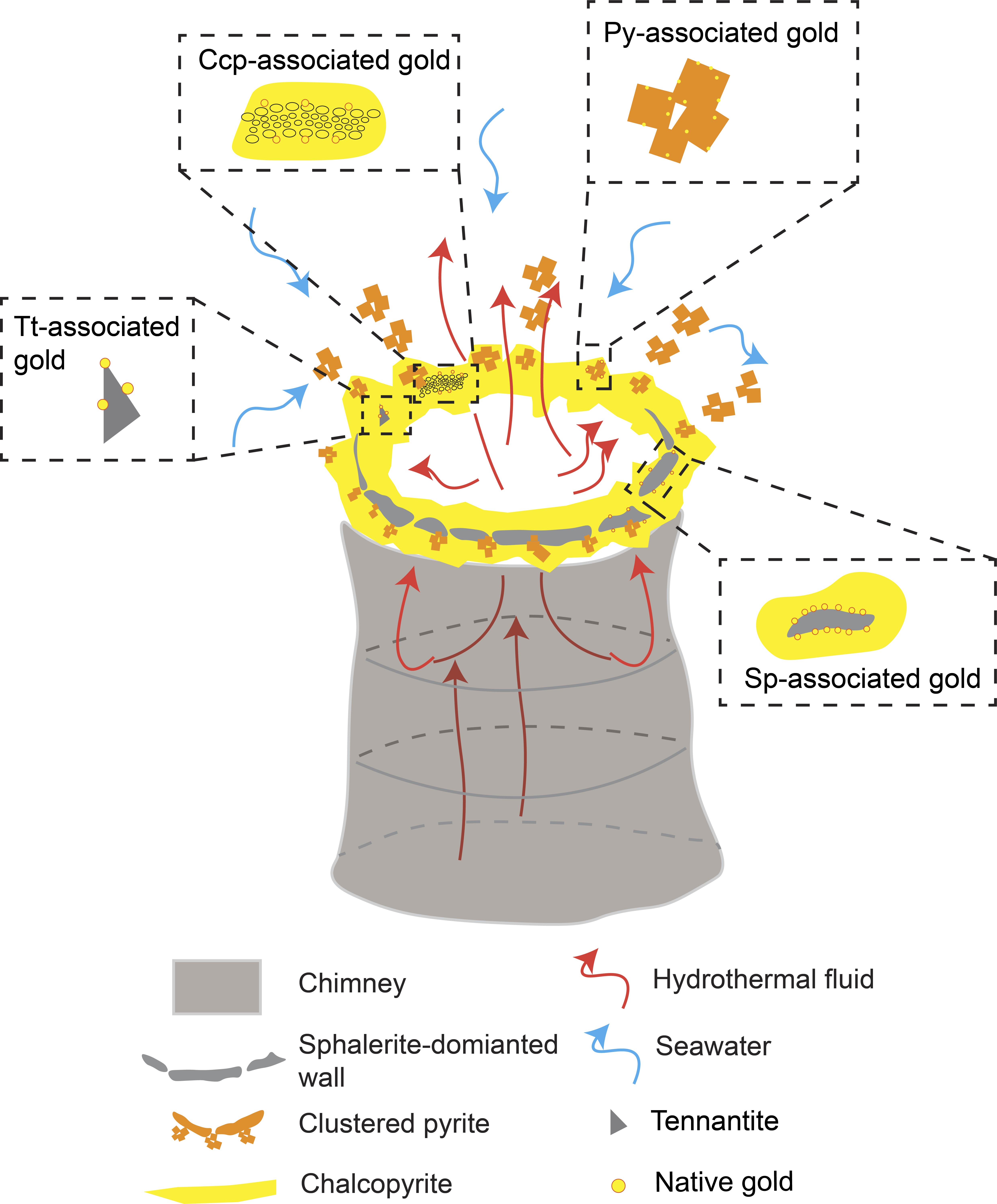
Native gold enrichment process during growth of chalcopyritelined conduits within a modern hydrothermal chimney (Manus Basin, PNG)
https://doi.org/10.2138/am-2021-7866
Seafloor hydrothermal chimneys from back-arc basins are important hosts for metals, such as Cu, Zn, Pb, Ag, and Au, and detailed knowledge of mineralogy and chimney growth history will help understand the spatial distribution and enrichment mechanism of precious metals. To unravel the mechanism of native gold precipitation during the growth of multiple chalcopyrite-lined conduits as part of a modern chalcopyrite-sphalerite chimney, Hu et al. conducted a submicrometer- to a millimeter-scale investigation of the mineralogy and microstructures with a combination of SEM-EBSD and Synchrotron XRF. Gold occurrence in chalcopyrite-lined conduit walls is relatively rare and often associated with tennantite or Bi-tellurite. This study showed that gold is closely associated with various sulfides, including chalcopyrite, sphalerite, tennantite, and pyrite, and may precipitate during different mixing processes between hydrothermal fluids and surrounding fluids. The observed board spectrum of gold-sulfide associations in chalcopyrite-lined chimney walls provides important implications for searching for native gold in more modern seafloor hydrothermal chimneys, as well as in ancient volcanogenic massive sulfide deposits.
Pliniusite, Ca5(VO4)3F, a new apatite-group mineral and the novel natural ternary solid-solution system pliniusite–svabite– fluorapatite
https://doi.org/10.2138/am-2022-8100
Pekov et al. report the discovery of a new apatite-group mineral, pliniusite, ideally Ca5(VO4)3F, the second vanadate mineral of the apatite supergroup, in fumarole exhalations at the Tolbachik volcano (Kamchatka, Russia) and in a pyrometamorphic rock of the Hatrurim Complex (Israel). Pliniusite, fluorapatite Ca5(PO4)3F, and svabite Ca5(AsO4)3F form an almost continuous ternary solid-solution system with wide variations of T5+ = P, As, and V. The combination of high temperature, low pressure, and high oxidizing potential is favorable for the incorporation of V5+ into calcium apatite-type compounds and in general for the formation of fluorovanadates.
Heamanite-(Ce), (K0.5Ce0.5)TiO3, a new perovskite supergroup mineral found in diamond from Gahcho Kué, Canada
https://doi.org/10.2138/am-2022-8098
Anzolini et al. report the discovery and description of a new perovskite-group mineral, heamanite-(Ce), ideally (K0.5Ce0.5)TiO3, found as an inclusion in a diamond from the Gahcho Kue mine in the Northwest Territories, Canada. Heamanite-(Ce) is the K-analog of loparite-(Ce), ideally (NaCe)Ti2O6. This finding not only represents the sixth perovskite-structured mineral to occur in Earth's mantle, along with perovskite sensu stricto, K-REE- Cr-rich tausonite, bridgmanite, CaSiO3-perovskite, and goldschmidtite, but also indicates that perovskite-structured oxides have the potential to be significant hosts for K and LREE in the mantle. To precipitate a phase with such high concentrations of incompatible elements, we suggest that extreme levels of fractionation occurred in the fractionating metasomatic fluid. Moreover, the high concentration of radiogenic elements in heamanite-(Ce) may allow for future isotopic dating, making this discovery of interest to geochemists, kimberlite petrologists, and mineralogists.
A revised analysis of ferrihydrite at liquid helium temperature using Mössbauer spectroscopy
https://doi.org/10.2138/am-2021-7802
Ferrihydrite is ubiquitous in the environment and is a major component of the bioavailable global iron pool. A powerful analytical approach for studying ferrihydrite is 57Fe Moessbauer spectroscopy. However, despite the first spectrum being published several decades ago, there remain conflicting and contradicting reports in the literature on the best way to fit it. Byrne and Kappler have rigorously fitted 2-line and 6-line ferrihydrite using a range of models and multiple sites to determine the most statistically relevant approach to interpreting this enigmatic mineral.
First find of merrillite, Ca3(PO4)2, in a terrestrial environment as an inclusion in lower-mantle diamond
https://doi.org/10.2138/am-2022-8175
Kaminsky and Zedgenizov found merrillite as inclusions in lower-mantle diamonds from the Juina area in Brazil. Previously this rare mineral was known only in meteorites and Lunar rocks. This finding may be of importance because merrillite and tuite are considered members of the deep Earth minerals and potential hosts for rare earth elements and large ion lithophile elements.
NEW MINERAL NAMES
https://doi.org/10.2138/am-2022-NMN107813
New Mineral Names: Hydrous Minerals
Book Review: Deep Carbon: Past to Present
https://doi.org/10.2138/am-2022-B107814
Book Review: Deep Carbon: Past to Present
« ‹ 1 … 31 32 33 34 35 … 85 › »ADDITIONAL RESOURCES