
Editor’s Notes
Total Results: 1697
Volume 107 : May 2022 Issue
Thermal conductivity of single-crystal brucite at high pressures: Implications for thermal anomaly in the shallow lower mantle
https://doi.org/10.2138/am-2022-7986
Chien et al. reveal the critical roles that brucite, an important water-carrying mineral in subducting slabs, could play in affecting lower-mantle dynamics and seismic structures. They directly measured brucite’s thermal conductivity to lower mantle pressures and found that as brucite decomposes to periclase at ~800 km depth there would be a significant increase in the thermal conductivity by a factor of ~6-19. The large thermal conductivity discontinuity upon brucite’s decomposition to periclase will induce a local high-temperature anomaly within a subducting slab, enhancing the slab’s buoyancy and promoting its stagnation in the shallow lower mantle. The high-temperature anomaly also destabilizes surrounding hydrous minerals, which facilitates the release of water to the ambient mantle to form dehydration melts, resulting in seismic low-velocity zones at the top of the lower mantle.
Magmatic volatiles and platinum-group element mineralization in the Stillwater layered intrusion, U.S.A.
https://doi.org/10.2138/am-2022-7982
The activity of volatile-rich fluids may underpin the evolution of basaltic magmatic systems and associated precious metal ore formation. The platinum-group metal deposits of the Stillwater layered intrusion (U.S.A.) have long been held up as a classic example of a locality where the mineralization preserves evidence of a volatile control. The new halogen dataset in this paper by Parker et al. supports and extends the understanding of the role of volatiles in concentrating precious metals in fossil basaltic magmatic systems.
Impact of fluorine on the thermal stability of phlogopite
https://doi.org/10.2138/am-2022-8051
Sun et al. reveal the links between fluorine, the behavior of hydroxyl, and the lattice of phlogopite, which is important to constrain volatile cycling and fluorine’s role in the physical and chemical properties of the upper mantle.
Ferrous hydroxychlorides hibbingite [γ-Fe2(OH)3Cl] and parahibbingite [β-Fe2(OH)3Cl] as a concealed sink of Cl and H2O in ultrabasic and granitic systems
https://doi.org/10.2138/am-2022-8011
Kodera et al. studied ferrous hydroxychlorides and concluded their paper with the description of the new mineral parahibbingite. They show that parahibbingite and hibbingite are likely to be frequently present in hydrothermally altered ultramafic rocks if they were in contact with chloride-rich anoxic brines. However, as these minerals are extremely susceptible to oxidation and hydration, they might have escaped the attention of researchers. Both minerals should be considered as storage sites of Cl and H2O in large volumes of altered basic and ultrabasic rocks; thus, they could play an important, but yet unrecognized, role in the remobilization of sulfidic ores (if these minerals are dissolved by later fluids) and as vehicles for H2O and Cl transport into the lower crust at shallow levels of subduction zones. Hibbingite was found to be a common daughter mineral in high salinity brines and salt melt inclusions worldwide, where it indicates cooling under reducing conditions. In liquid-free, salt melt inclusions, identification of this mineral enables an exact calculation of the amount of water dissolved in these extreme fluids. γ-Fe2(OH)3Cl (parahibbingite) is already known to occur in environments where low-carbon steel interacts with chloride-rich anoxic brines, however, the presence and the importance of the other polymorph β-Fe2(OH)3Cl (hibbingite) was not previously considered. Kodera et al. also show that Raman spectroscopy can be used as a simple and fast tool for quick and non-destructive recognition of both Fe2(OH)3Cl polymorphs in geological and archaeological materials.
Chukochenite, (Li0.5Al0.5)Al2O4, a new lithium oxyspinel mineral from the Xianghualing skarn, Hunan Province, China
https://doi.org/10.2138/am-2021-7932
Rao et al. report the occurrence of the new lithium oxyspinel mineral chukochenite. They reveal the structural relationships between the structures of chukochenite and other (Li0.5Al0.5)Al2O4 phases. The discovery of chukochenite will draw attention to the study of phase transitions between polymorphs of (Li0.5Al0.5)Al2O4. The structural features of polymorphs of (Li0.5Al0.5)Al2O4 may help to explain their luminescence and magnetism.
Ground-truthing the pyrite trace element proxy in modern euxinic settings
https://doi.org/10.2138/am-2022-8024
Gregory et al. provide the first pyrite trace element data from the Black Sea and additional stratigraphically resolved data from the Cariaco Basin. These data show variability in trace elements from different basins, which has important implications for interpretations made from pyrite trace element chemistry from ancient rocks. Furthermore, analyses from outside euxinic (sulfidic) water column deposition show potential errors that might be made if interpreting pyrite formed in non-euxinic basins.
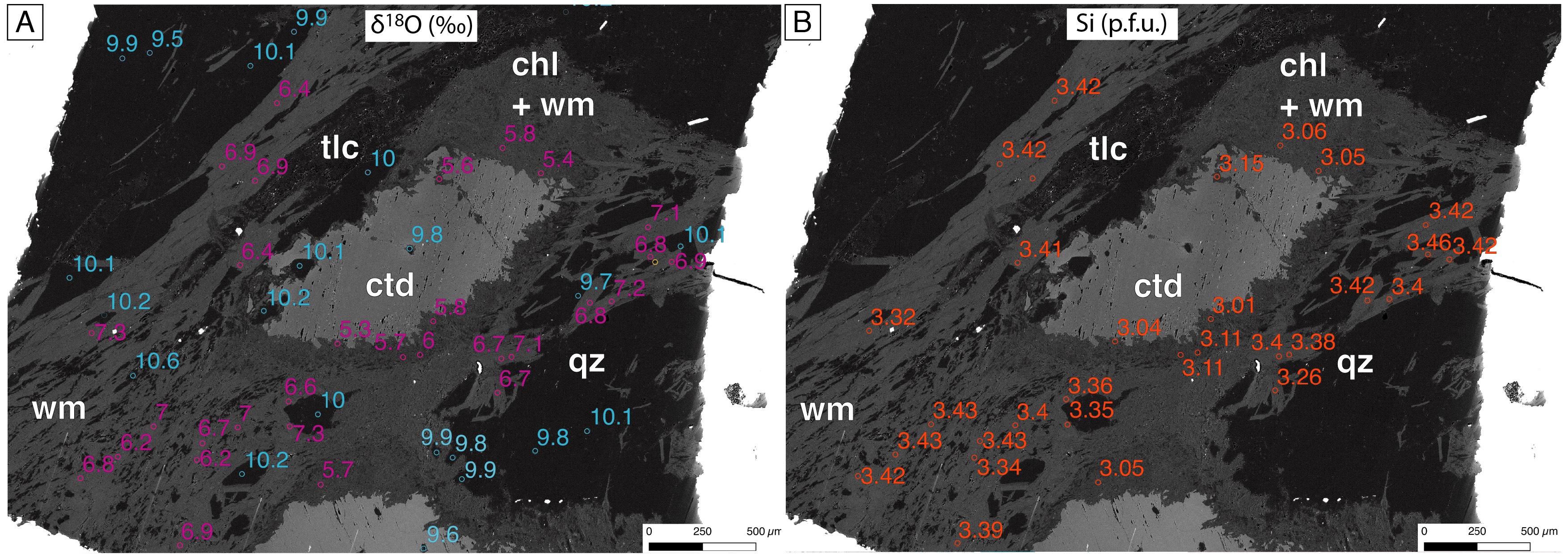
Interplay between fluid circulation and Alpine metamorphism in the Monte Rosa whiteschist from white mica and quartz in situ oxygen isotope analysis by SIMS
https://doi.org/10.2138/am-2020-7523
Luisier et al. present a new set of white mica reference materials for in situ 18O/16O measurements by SIMS. Oxygen isotope compositions were measured in metagranite and whiteschists from the Monte Rosa nappe in the Western Alps. Several generations of white mica are characterized based on oxygen isotope composition, chemistry, and microtextural observation. Oxygen isotopes allow us to identify two fluid infiltration events: the first leading to pervasive alteration and a second late local fluid infiltration.
Atomic-scale structure and non-stoichiometry of meteoritic hibonite: A transmission electron microscope study
https://doi.org/10.2138/am-2022-8014
The mineralogy and petrography of primitive carbonaceous chondrite meteorites provide a window into events that occurred at the birth of this solar system ~4.567 billion years ago. Hibonite (CaAl12O19) is of particular interest because it is a common refractory mineral in Ca-Al-rich inclusions (CAIs) in primitive meteorites and is predicted to be one of the earliest phases to condense from a cooling gas of solar composition. Atomic resolution, high-angle, annular dark-field (HAADF) imaging, and energy-dispersive X-ray (EDX) analyses were used by Han et al. to determine the nature and origin of planar defects in hibonite from the Allende meteorite. Hibonite grains display lamellar intergrowths of common 1.6 nm spacing and less commonly 2.0 nm and 2.5 nm spacing, interspersed in stoichiometric hibonite showing 1.1 nm (002) spacing. Stoichiometric hibonite consists of alternating Ca-containing (“R”) and spinel-structured (“S”) blocks stacked in the sequence RS. In contrast, the 1.6 nm layers result from a doubled S block such that the stacking sequence is RSS, while in the widest defect observed, the stacking sequence is RSSSS. These intergrowths are epitaxial and have coherent, low-strain boundaries with the host hibonite. Atomic resolution EDX maps of hibonite grains in the Allende CAI confirm the preferred site occupancy of Mg on tetragonal M3 sites in S blocks and of Ti on trigonal bipyramidal M2 and octahedral M4 sites in R blocks. Mg is highly concentrated, but Ti is absent, in the planar defects where wider S blocks show Al-rich compositions compared to stoichiometric MgAl2O4 spinel. Therefore, Mg likely played a major role in the formation and metastability of planar defects in hibonite. The occurrence of non-stoichiometric hibonite in the Allende CAI deviates from the mineral formation sequence predicted from equilibrium condensation models. Our atomic resolution TEM observations signify non-equilibrium, kinetically controlled crystal growth during the high-temperature formation of refractory solids in the early solar nebula.
Synthesis, structure, and single-crystal elasticity of Al-bearing superhydrous phase B
https://doi.org/10.2138/am-2022-7989
Dense hydrous magnesium silicates (DHMSs), such as superhydrous phase B (shy-B), with large water contents and wide stability fields are potential H2O reservoirs in the deep Earth. The incorporation of Al in shy-B will expand its phase stability to higher pressures and temperatures compared with Al-free shy-B. Li et al. synthesized shy-B with different Al contents. The crystal structure, substitution mechanisms, and elasticity were determined by various techniques. Their study helps to explain the low velocity zone and high anisotropy region in the subducted slabs located beneathTonga.
Specific roles of sodium for the formation process of manganese-substituted octacalcium phosphate
https://doi.org/10.2138/am-2021-7901
Manganese (Mn) is a good candidate as a substitutional element for bone substitutes because of its regulation process of bone remodeling that could control osteo-cellular activities, but it strongly inhibits octacalcium phosphate (OCP) formation. Sugiura et al. investigated the specific effect of Na-to-Mn substitution in OCP. They demonstrate that Na-induced OCP formation enhances the HPO4-OH layer structure of OCP and can overcome the Mn inhibition effect. Consequently, the Mn-substituted OCP-induced Na (OCP-Mn,Na) shows a 4.7 ° peak in the X-ray diffraction pattern. Sub-peaks at 9.2 ° and 9.7 ° of OCP disappeared, but an extra peak at 9.3 ° was visible. The thermal stability of OCP-Mn,Na is significantly lower than that of conventional OCP because the layer structure of the former decomposes above ~70 °C. The results indicate that ionic conjugation to Mn is a unique phenomenon for Na.
Oxygen isotope heterogeneity of olivine crystals in orogenic peridotites from Songshugou, North Qinling Orogen: Petrogenesis and geodynamic implications
https://doi.org/10.2138/am-2022-7990
Yu et al.’s study of oxygen isotopes indicates that olivines in the Songshugou peridotites are heterogeneous in oxygen isotopes. They explain the origin of low-δ18O olivine due to seawater infiltration into the peridotites in the oceanic lithosphere mantle. The peridotites reside in the mantle only for a short time (<20 Ma) so that the low-δ18O olivine is preserved. The high-δ18O olivines found by Yu et al. are due to oxygen exchange with δ18O-shifted melts and/or fluids during exhumation at low temperatures.
Effects of arsenic on the distribution and mode of occurrence of gold during fluid-pyrite interaction: A case study of pyrite from the Qiucun gold deposit, China
https://doi.org/10.2138/am-2021-7675
Zhang et al. focus on the distribution and modes of occurrence of gold and their link with arsenic and microstructures within arsenian pyrites from the epithermal Qiucun gold deposit (China). They found that arsenic-induced lattice defects are of significance for the incorporation of invisible gold as a homogeneous solid solution in pyrite lattice. Most visible auriferous inclusions are hosted at the fluid-pyrite reaction interface or fractures and grain boundaries within the As-deficient interiors of pyrite. A conceptual model is proposed to describe Au scavenging from the hydrothermal fluids and to illustrate the genetic relationship between visible- and invisible gold. These findings highlight the significance of systematic composition and textural observations in interpreting fluid-rock interactions; advance our understanding of the mechanisms of trace element incorporation in minerals, and provide guidance on the determination of mineral paragenetic sequences, further enabling us to understand the gold mineralization process.
Xuite, Ca3Fe2[(Al,Fe)O3(OH)]3, a new mineral of the garnet group: Implications for the wide occurrence of nanominerals
https://doi.org/10.2138/am-2022-8023
Lee and Guo present the mineral Xuite, Ca3Fe2[(Al,Fe)O3(OH)]3, a new member of the garnet supergroup discovered in basaltic scoria from Menan Volcanic Complex, Idaho, U.S.A. The mineral has been approved by the Commission on New Minerals, Nomenclature and Classification (CNMNC) of the International Mineralogical Association (IMA 2018-135a).
Raman spectroscopy-based screening of zircon for reliable water content and oxygen isotope measurements
https://doi.org/10.2138/am-2022-8075
Water content and the source region of melt have a pivotal influence on magmatic processes, such as magma origin, partial melting, and fractionation. Zircon is a ubiquitous, uranium-rich accessory mineral in magmatic rocks, characterized by high physical and chemical stability, and zircon oxygen isotopes are useful tracers of magma sources and processes. Meanwhile, the low diffusivity of water enables the zircon to be the ideal mineral to preserve its water. Study of zircon oxygen isotope and water content yields new insights into magmatic processes. Trace amounts of water that partitions into zircon from the melt during its crystallization are termed primary water, which can be used to infer the water content in the melt. The assignment of primary water is not straightforward because secondary water can enter zircon as OH or H2O molecules after crystallization. Metamictization caused by the accumulation of radiation damage markedly increases the water storage capacity of zircon and was considered the main cause for the absorption of secondary water. Such secondary water would interfere with the accurate analysis of oxygen isotope compositions. Using laser Raman spectroscopy, Yang et al. propose criteria to select the least metamict zircon for reliable primary water content and oxygen isotope composition analysis.
Halogen (F, Cl, Br, I) contents in silt and clay fractions of a Cambisol from a temperate forest
https://doi.org/10.2138/am-2021-7600
Epp et al. investigated the proportions of F, Cl, Br, and I that are surface sorbed or incorporated in the structure of clay minerals and pedogenic oxides for different soil size fractions. Halogens can occur as radionuclides 36Cl and 129I with a long half-life or as organic and inorganic pollutants. A detailed understanding of halogen sorption in soil is crucial for potential pollutant retention processes in landfills or radioactive waste disposal to prevent harmful impacts on humans and nature.
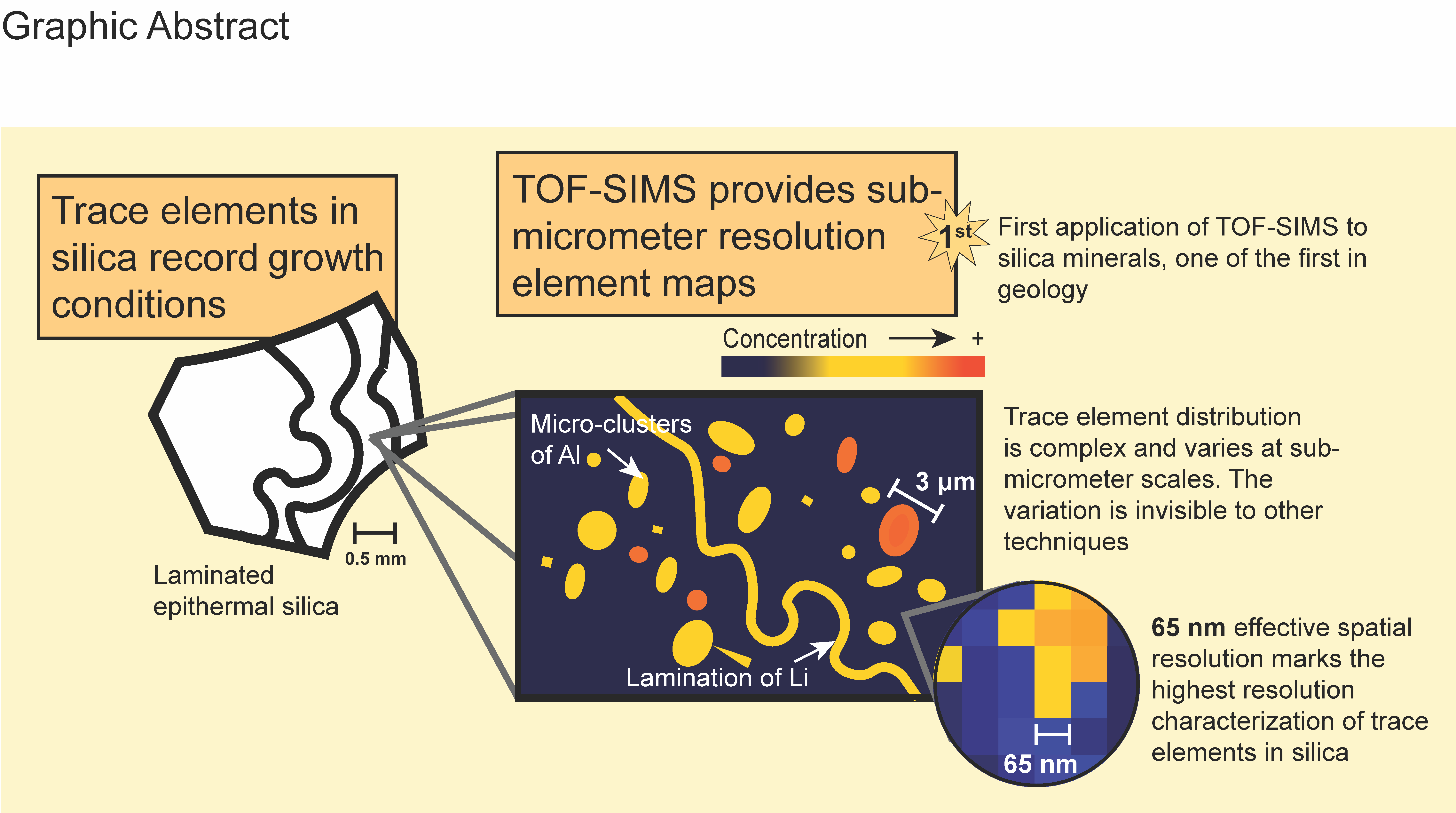
Resolving sub-micrometer-scale zonation of trace elements in quartz using TOF-SIMS
https://doi.org/10.2138/am-2021-7896
North et al. characterized quartz and silica at higher spatial resolution than previously possible by the novel application of time-of-flight secondary ion mass spectrometry (TOF-SIMS). Sub-micrometer resolution (65 nm) maps reveal complex trace element distributions (including the light element lithium) in silica minerals that could not be observed with lower resolution techniques. The use of TOF-SIMS could be advantageous in the Earth sciences for characterizing a range of other minerals. (See graphical abstract)
Hexagonal magnetite in Algoma-type banded iron formations of the ca. 2.52 Ga Baizhiyan Formation, North China: Evidence for a green rust precursor?
https://doi.org/10.2138/am-2022-7981
Sun et al. studied hexagonal magnetites that occur in the 2.52 Ga Baizhiyan Formation, North China, and concluded that hexagonal magnetites were transformed from green rusts in ferruginous seawater. Green rust has a great impact on Precambrian biogeochemical cycles.
Volume 107 : April 2022 Issue
Resolving the conundrum of equilibrium solubility of smectites
https://doi.org/10.2138/am-2022-8213
Smectites are a group of clay minerals that have been recently discovered to be abundant on Mars. A better understanding of the behavior of this group of minerals in water will help us to understand how they form, and applying these to occurrences on Mars may enable a better understanding of aspects of the early history of the planet. However, some fundamental questions about these minerals have persisted for nearly 50 years. This perspective by Stephen U. Aja reviews the most recent studies that have a bearing on these questions and concludes that much of those questions may have been misguided.

Manjiroite or hydrous hollandite?
https://doi.org/10.2138/am-2021-7848
This study by Post et al. raises questions about the material originally described as manjiroite by Nambu and Tanida (1967), suggesting that either there is considerable variation of the Na concentration in the type locality samples or an error in the original analyses. Although the low Na concentrations in the samples studied here ruled out a classification as manjiroite sensu stricto, they nevertheless represented a novel hydrous hollandite-like mineral. As such, they provided the opportunity for the first detailed characterization of the structure and dehydration behavior of a natural hollandite-like mineral with molecular water as the predominant tunnel species -- filling approximately three-quarters of the tunnel sites. This work focuses new attention on the role of molecular water in hollandite minerals, especially those associated with low-temperature aqueous systems. Studies of synthetic hydrous hollandites suggest that structural water affects their cation-exchange properties. Additionally, recent studies have shown that birnessite-like phyllomanganates, which are the major Mn oxide phases in soils and sediments, transform into hollandite-like phases and other tunnel structures under ambient environmental conditions. The structural water inherited from the interlayers of these phyllomanganates ends up in the tunnels as H2O and as OH-, and the hydrous components of the hollandite-like phases are important factors in determining their capacities to exchange or accommodate various cations, such as Li+, Na+, Ba2+, Pb2+, and K+, in natural systems.
Petrologic evolution of boninite lavas from the IBM Fore-arc, IODP Expedition 352: Evidence for open-system processes during early subduction zone magmatism
https://doi.org/10.2138/am-2021-7733
Analysis of IODP Expedition 352 boninite lavas, using EPMA and LA-ICP-TOF, reveals anomalous pyroxene overgrowths, complex pyroxene zoning patterns, and oscillatory zoning in olivine. Pyroxene overgrowths likely formed during the rapid cooling and decompression in the eruptive process. Complex pyroxene zoning patterns suggest that crystals experience multiple undercooling and magma mixing events prior to eruption. Mg-Fe oscillatory zoning patterns in olivine support the hypothesis that magma mixing events occur prior to boninite eruptions. The presence of olivine xenocrysts in boninite lavas indicates that melts likely mix within an axial magma chamber. This study by Scholpp et al. highlights the importance of multi-element chemical maps and chemical transects in studies of zoned minerals in igneous systems. These techniques reveal chemical patterns within minerals, which would typically be overlooked, and can provide a better understanding of complex crystallization histories in igneous systems. This study also highlights the scientific benefits of an ostensibly education-focused investigation of a significant suite of rock samples.
« ‹ 1 … 34 35 36 37 38 … 85 › »ADDITIONAL RESOURCES