
Editor’s Notes
Total Results: 1697
Volume 106 : September 2021 Issue
Cr2O3 in corundum: Ultrahigh contents under reducing conditions
https://doi.org/10.2138/am-2021-7680
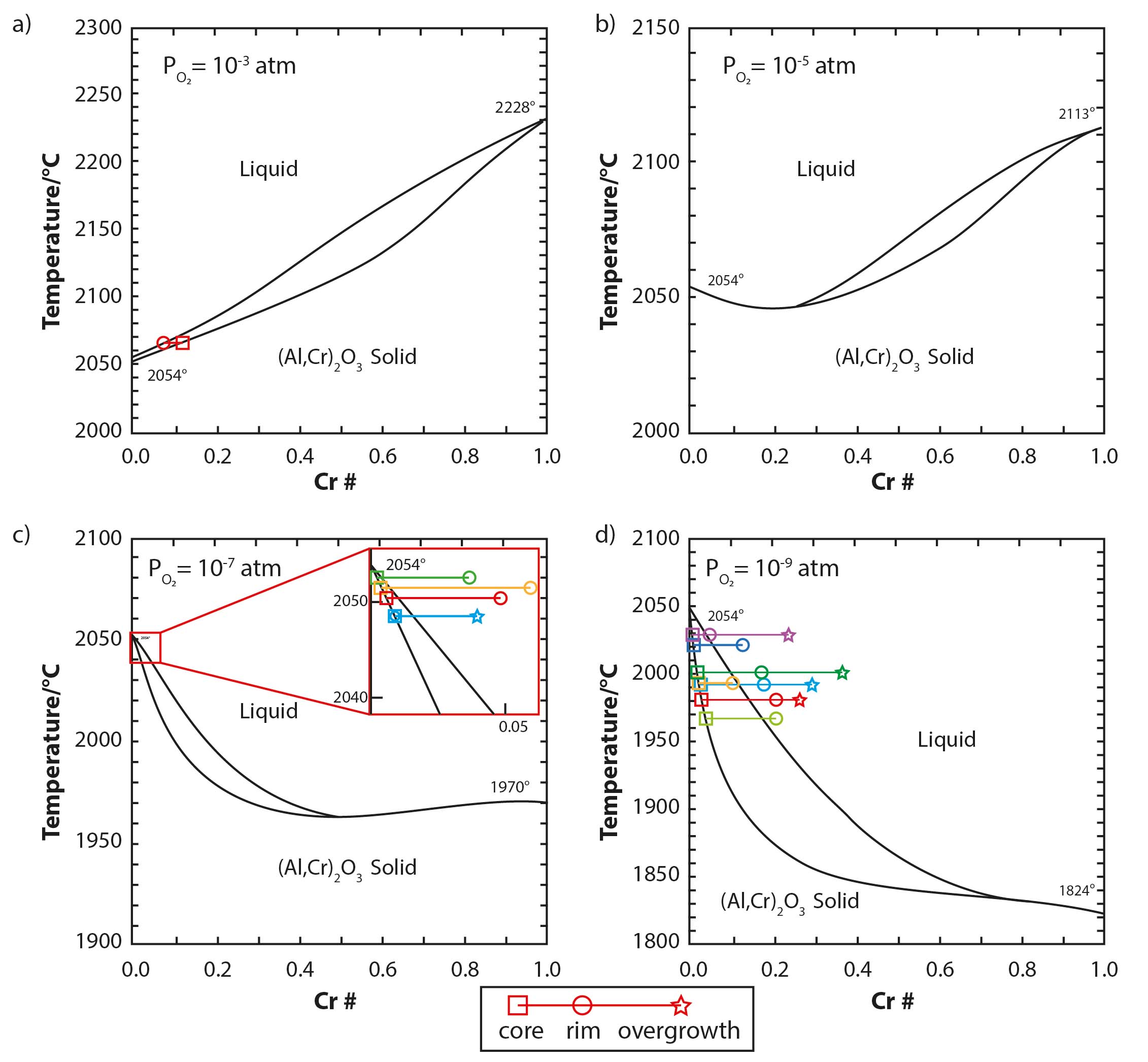
Griffin et al. describe a suite of corundum xenocrysts in Cretaceous, mafic, pyroclastic rocks on Mt Carmel, Israel, which includes rubies with the highest recorded contents of Cr2O3. Many coexist with K- and Na-beta alumina phases and native chromium, requiring extremely reducing conditions, indicating oxygen fugacities circa 5 log units below the Iron-Wustite buffer. Zoning patterns indicate a progressive decrease in oxygen fugacity during crystallization (Fig. 1), which is interpreted as tracking the interaction of oxide melts with mantle-derived methane and hydrogen near the crust-mantle boundary.
Plagioclase population dynamics and zoning in response to changes in temperature and pressure
https://doi.org/10.2138/am-2021-7491
In this paper by Andrews, the numerical model SNGPlag tracks the numbers, sizes, morphologies, and compositional zoning of plagioclase crystals through time in response to changes in magmatic conditions. Low growth rates and dissolution result in significant fractions of time (>>50%) missing from the final crystal record. Growth of complexly zoned phenocrysts requires the addition of new magma. Crystal records are biased towards more recent intervals and periods of decreasing temperature. Crystallization (or dissolution) acts to return magmas to near-equilibrium crystal fractions within hundreds of days.
Limited channelized fluid infiltration in the Torres del Paine contact aureole
https://doi.org/10.2138/am-2021-7622
This paper by Siron et al. describes the metamorphic evolution of the Torres del Paine contact aureole that experienced a limited amount of fluid infiltration from the crystallizing granite. This evolution was tracked using hydrogen and oxygen isotopes and Cl concentrations in biotite. The potential of these different tracers to track fluid-rock interactions is evaluated and highlights the sensitivity of hydrogen vs. oxygen isotopes for such use. Cl content in biotite is also a promising tool for such work.
Quantitative determination of the shock stage of L6 ordinary chondrites using X-ray diffraction
https://doi.org/10.2138/am-2021-7554
The mean lattice strain and grain size factor for olivine and orthopyroxene of 14 L6 chondrites were determined by Imae and Kimura from analyses based on Williamson-Hall plots via X-ray diffraction. The combination of mean lattice strain with grain size factor enables the construction of a shock barometer.
A new method to rapidly and accurately assess the mechanical properties of geologically relevant materials
https://doi.org/10.2138/am-2021-7455
This new method by Deng et al. will enable geological scientists and engineers to rapidly determine the elastic behavior of any rock or mineral in a simple manner with a robust statistical response. It will also facilitate the determination of elastic properties of rocks and minerals as a function of composition, structure, hydration, or other physical variables. This will undoubtedly impact the development of geologic-based deformation models through knowledge of the constituent material properties for validation and prediction accuracy.
Two-stage magmatism and tungsten mineralization in the Nanling Range, South China: Evidence from the Jurassic Helukou deposit
https://doi.org/10.2138/am-2021-7678
In this study, Cao et al. report LA-ICP-MS zircon U-Pb and molybdenite Re-Os ages of the Helukou W deposit, which is a representative W deposit located in the Guposhan district, SW of Nanling Range, South China. This geochronological data aims to reveal persistent (Early to Jurassic) granitic magmatism and related W-Sn mineralization events in the Nanling region. In addition, the in-situ trace element and Sr isotopes compositions of scheelite from the skarn- and altered granite-type ores of the Helukou W deposit are reported, with the purpose of outlining the nature of the ore-forming fluids in the long-lived magmatic-hydrothermal system. The data reveals two stages of magmatism and tungsten mineralization in the Guposhan ore field during Early Jurassic (~180 Ma) and Middle Jurassic (~165 Ma). This 20 m.y. long-lived successive magmatism and mineralization in the Nanling Range will provide new insights into the magmatism, mineralization, and metallogenesis in this region.
Constraints on scheelite genesis at the Dabaoshan stratabound polymetallic deposit, South China
https://doi.org/10.2138/am-2021-7499
Stratabound polymetallic deposits serve as one of the most important reserves of base metals in South China, but the genetic relationship between stratabound base metal mineralization and porphyry mineralization remains in dispute. Scheelite occurs as a characteristic mineral in many stratabound polymetallic deposits and in the adjacent porphyry system. In this paper, Su et al. use scheelite geochemistry, zircon, and hydrothermal apatite U-Pb dating to constrain the genesis of scheelite in stratabound orebodies at Dabaoshan. By integrating scheelite CL textures, trace element characteristics, and the new dating results, they demonstrate that ore-forming fluids responsible for scheelite formation in stratabound orebodies were derived from the Dabaoshan porphyry system. Furthermore, Jurassic porphyry mineralization at least partially contributed to Cu mineralization in the stratabound orebodies. This work suggests that scheelite geochemistry, combined with geochronology studies, can contribute to our understanding of stratabound orebody genesis.
Crystal chemistry of schreibersite, (Fe,Ni)3P
https://doi.org/10.2138/am-2021-7766
Schreibersite is the most common phosphide mineral and the main carrier of reduced phosphorus in the celestial bodies. The present paper by Britvin et al. reports on previously obscured trends in Fe and Ni distribution across schreibersite structures, which are directly related to crystallization histories of metal-rich planetary interiors.
Elastic geobarometry: How to work with residual inclusion strains and pressures
https://doi.org/10.2138/am-2021-7928
Gilio et al. discuss the difference between various approaches to retrieve the residual pressures and residual strains from Raman measurements of inclusions. They provide general guidelines on how to deal with inclusion strain, measurements, inclusion pressure, and their uncertainties.
Controls on tetrahedral Fe(III) abundance in 2:1 phyllosilicates—Discussion
https://doi.org/10.2138/am-2021-7865
Controls on tetrahedral Fe(III) abundance in 2:1 phyllosilicates—Discussion
Controls on tetrahedral Fe(III) abundance in 2:1 phyllosilicates—Reply
https://doi.org/10.2138/am-2021-8107
Controls on tetrahedral Fe(III) abundance in 2:1 phyllosilicates - Reply
NEW MINERAL NAMES
https://doi.org/10.2138/am-2021-NMN106921
New Mineral Names
BOOK REVIEW
https://doi.org/10.2138/am-2021-B106922
Book Review: Geochronology and Thermochronology
Volume 106 : August 2021 Issue
Crustal melting: Deep, hot, and salty
https://doi.org/10.2138/am-2022-8108
Lamadrid and Steele-MacInnis provide perspective on the study by Ferrero et al.: High pressure, halogen-bearing melt preserved in ultra-high temperature felsic granulites of the Central Maine Terrane, Connecticut (U.S.A.).
Petrogenetic and tectonic interpretation of strongly peraluminous granitic rocks and their significance in the Archean rock record
https://doi.org/10.2138/am-2022-8001
Strongly peraluminous granitic rocks first become abundant in the rock record in the Neoarchean. In this study by Frost and Da Prat (MSA Presidential Address by Carol Frost), six suites of Neoarchean strongly peraluminous granitic rocks are described from the Wyoming province. These are shown to form in both subduction and collisional environments from a variety of sources, including hornblende-plagioclase rocks, biotite-bearing gneisses, and two-mica metapelitic rocks. The appearance of strongly peraluminous granitic rocks in the rock record signals the development of strong, thick felsic continental crust and the formation of the first supercontinents.
Partial melting and P-T evolution of eclogite-facies metapelitic migmatites from the Egere terrane (Central Hoggar, South Algeria)
https://doi.org/10.2138/am-2021-7342
This contribution by Arab et al. improves our understanding of high-pressure metapelites from Central Hoggar, provides very advanced P-T modeling, and shows the first description of evidence of partial melting phenomena from Hoggar. This study resolves numerous problems regarding the metamorphic evolution of the Egere area and their geodynamic implication within the Tuareg belt.
High-pressure, halogen-bearing melt preserved in ultrahigh-temperature felsic granulites of the Central Maine Terrane, Connecticut (U.S.A.)
https://doi.org/10.2138/am-2021-7690
Ferrero et al. performed micro-petrology experiments on preserved droplets of melt in garnet from the ultrahigh temperature felsic granulites of the Central Maine Terrain (Connecticut, U.S.A.). The results reveal a history of metamorphism and melting at a depth consistent with the orogenic roots, ~70 km, twice the previous estimates for these rocks. The high-pressure melt here preserved is peculiar: it has an uncommonly high mafic component, coupled with significant amounts of carbon dioxides and halogens (chlorine and fluorine). Whereas the first phenomenon results from the extreme melting temperatures, the halogens abundance likely relates to the presence of brines (highly saline liquids) at depth during melting. The latter is a direct evidence that brines may play a role in promoting melt production when the crust attains temperature in excess of 1000 °C, where melt production is actually expected to be hindered by the extremely dehydrated character of the rocks.
Targeting mixtures of jarosite and clay minerals for Mars exploration
https://doi.org/10.2138/am-2021-7415
Hinman et al. compared, with multiple techniques, the detectability and abundance of organic matter associated with clay minerals and the sulfate salts, alunite, and jarosite, from a hydrothermal area in Yellowstone National Park, Wyoming, U.S.A. Spectroscopy and diffractometry produced comparable mineral identifications in sample matrices. The matrix material (clay minerals or sulfate salts) had no effect on the detection of organic matter by Raman spectroscopy. However, mineral matrix composition had a significant effect on the detectability of organic matter by laser-desorption, Fourier transform mass spectrometry (LD FTMS). Indeed, LD FTMS detected diverse organic compounds in samples containing jarosite, more so than in samples dominated by aluminosilicate minerals, despite higher organic content in the later matrix. Further, organic compounds were detected more frequently in jarosite samples than in aluminosilicate samples. Consequently, jarosite-bearing sites on Mars could be potential targets for life detection, especially if associated with clay minerals.
Zirconolite from Larvik Plutonic Complex, Norway, its relationship to stefanweissite and nöggerathite, and contribution to the improvement of zirconolite end-member systematics
https://doi.org/10.2138/am-2021-7510
"Haifler et al. performed crystal-chemical characterization of a complex zirconolite from Larvik Plutonic Complex, Norway. A concept called ""edgemembers"" was introduced to quantitatively express compositional variation of a complex solid solution. Moreover, a modified scheme of zirconolite end-member set and redefinition of a composition space was suggested."
Nanomineralogy of hydrothermal magnetite from Acropolis, South Australia: Genetic implications for iron-oxide copper gold mineralization
https://doi.org/10.2138/am-2021-7557
The Acropolis prospect is a magnetite dominant iron-oxide copper gold (IOCG) prospect in the Olympic Dam district (South Australia). Verdugo-Ihl et al. used complementary microbeam techniques (HAADF STEM, XMg-in-magnetite thermometry, and nanothermobarometry using ilmenite-magnetite pairs) to characterize titanomagnetite from veins hosted in volcanic rocks and Ti-poor magnetite from a granite body stratigraphically higher in the sequence. Hydrothermal titanomagnetite from Acropolis is comparable with magmatic magnetite in granites across the district and should typify early alkali-calcic alteration. Open-fracture circulation, inhibiting additional supply of Si, Ca, K, etc., during magnetite precipitation, prohibits formation of silician magnetite hosting calc-silicate NPs, as known from IOCG systems characterized by rock-buffered alteration of host lithologies. Obliteration of trellis textures during subsequent overprinting could explain the scarcity of this type of hydrothermal magnetite in other IOCG systems.
« ‹ 1 … 41 42 43 44 45 … 85 › »ADDITIONAL RESOURCES