
Editor’s Notes
Total Results: 1697
Volume 106 : November 2021 Issue
Carletonmooreite, Ni3Si, a new silicide from the Norton County aubrite meteorite
https://doi.org/10.2138/am-2021-7645
A new mineral named carletonmooreite, Ni3Si is described from the Norton County aubrite meteorite by Garvie et al.. This new mineral is named in honor of Carleton B. Moore, chemist and geologist, and founding director of the Center for Meteorite Studies, Arizona State University, for his many contributions to cosmochemistry and meteoritics.
Sulfur content at sulfide saturation of peridotitic melt at upper mantle conditions
https://doi.org/10.2138/am-2021-7649
"Blanchard et al. present new high-pressure and high-temperature experimental data that are used to understand the evolution of the solubility of sulfur in peridotitic melts. They show that pressure and temperature have an opposite effect: the higher the temperature, the higher the solubility of sulfur, and the higher the pressure, the lower the solubility of sulfur. This is coherent with previous studies using extrapolations from lower pressure and temperature experiments. We extrapolated our results to pressure and temperature conditions of the Earth's primitive magma ocean and show that FeS will exsolve from the molten silicate and can effectively be extracted to the core by a process that has been termed the ""Hadean Matte""."
Johnkoivulaite, Cs(Be2B)Mg2Si6O18, a new mineral of the beryl group from the gem deposits of Mogok, Myanmar
https://doi.org/10.2138/am-2021-7785
Palke et al. describe the new mineral johnkoivulaite from the legendary gem deposits of Mogok, Myanmar. Johnkoivulaite, Cs(Be2B)Mg2Si6O18, is the 7th member of the beryl group, a collection of silicate minerals in which the main identifying structural feature are Si6O18 rings which stack along the crystallographic c-axis. Johnkoivulaite is unusual in that magnesium and cesium are not typically enriched through the same geochemical processes. The chemistry of this mineral suggests potential interaction between pegmatites intruding gneisses and/or limestones.
Age determination of oriented rutile inclusions in sapphire and of moonstone from the Mogok metamorphic belt, Myanmar
https://doi.org/10.2138/am-2021-7487
Shi et al. found that dating of acicular rutile inclusions in sapphire and furnace step-heating 40Ar/39Ar dating of moonstone (antiperthite) in syenites from the Mogok metamorphic Belt (MMB) yield ages of 13.43 0.92 and 13.55 0.08 Ma. Myanmar sapphire and moonstone formed at the same time, and the ages are the youngest published in the region. Origin of the oriented rutile inclusions in the sapphire prefers coprecipitation instead of exsolution. The ages provide insight into the complex histories and processes of magmatism and metamorphism of the MMB, the formation of gemstone species in this belt, and the collision between India and Asia.
X-ray computed microtomography of diamondiferous impact suevitic breccia and clast-poor melt rock from the Kara astrobleme (Pay-Khoy, Russia)
https://doi.org/10.2138/am-2021-7578
"Zubov et al. describe three types of suevitic breccias, clast-poor melt rock and a melt clast from suevite by X-ray computed microtomography. The effect of indirect data with ""underestimation"" or ""overestimation"" of the natural attenuation coefficients is described. The features of low contrast in X-rays of impact mineral products are discussed. The perspectives of X-ray computed microtomography for 3D petrography of impactites and contrast mineral phases distribution are proposed."
Volume 106 : October 2021 Issue
Fingerprinting REE mineralization and hydrothermal remobilization history of the carbonatite-alkaline complexes, Central China: Constraints from in situ elemental and isotopic analyses of phosphate minerals
https://doi.org/10.2138/am-2021-7746
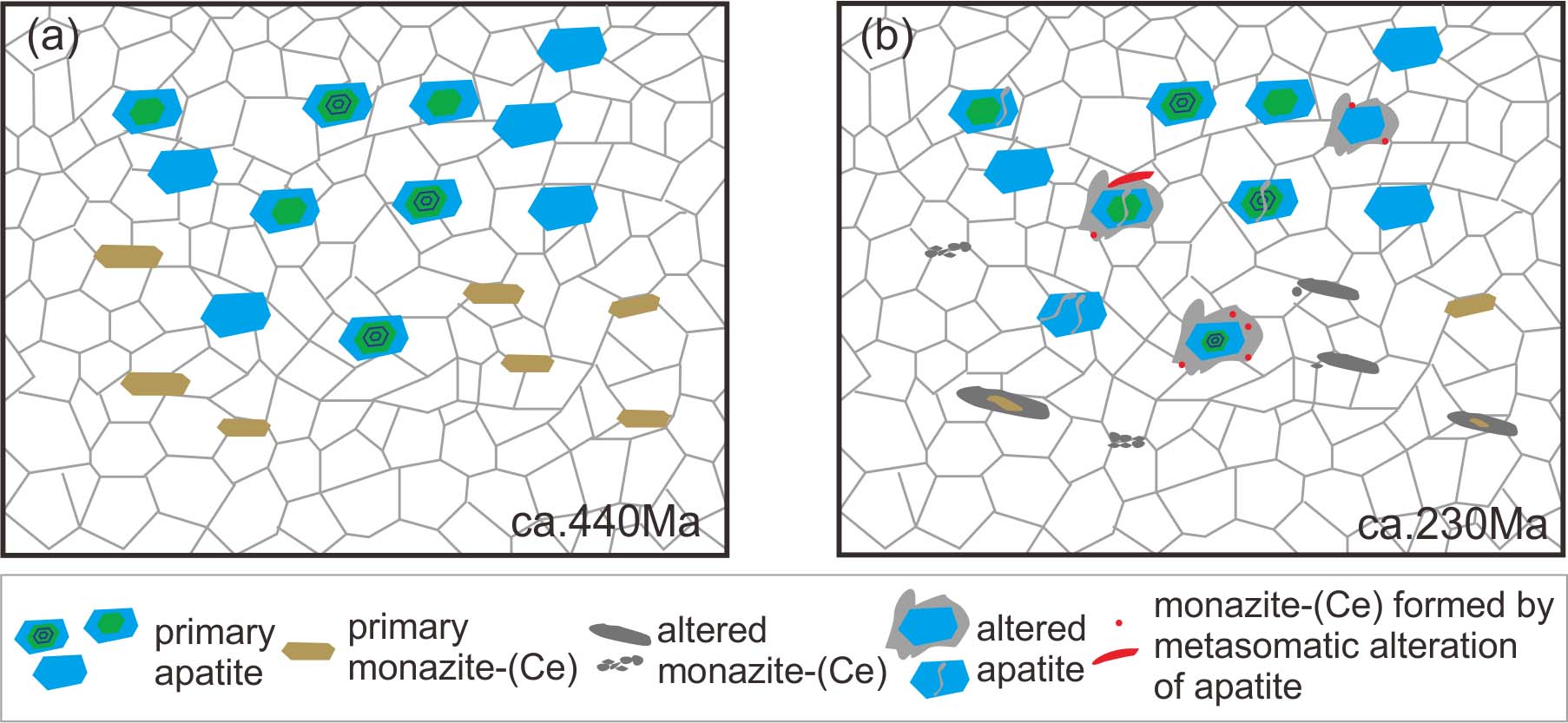
Carbonatites and related alkaline rocks host most REE resources around the world. However, it is still controversial whether late-stage tectonothermal events are crucial for REE enrichment in carbonatite. Su et al. report in situ elemental and isotopic analyses on phosphates (monazite and apatite) from two mineralized carbonatite complexes, Central China. They suggest that most REE minerals were crystallized from primary carbonatite during the Silurian and only locally remobilized by Triassic regional metamorphism.
Formation of miarolitic-class, segregation-type pegmatites in the Taishanmiao batholith, China: The role of pressure fluctuations and volatile exsolution during pegmatite formation in a closed, isochoric system
https://doi.org/10.2138/am-2021-7637
The processes that lead to the formation of pegmatitic textures (large crystals) are poorly understood. Most models require a rapid shift away from equilibrium conditions driven by either volatile-exsolution from the melt or significant undercooling of the melt. The resulting liquidus deficit leads to rapid crystal growth to produce a pegmatitic texture. Here, Yuan et al. describe an alternative method to drive the system from equilibrium during pegmatite formation in a closed, constant volume system. Rapid and significant pressure decrease leads to a liquidus deficit that drives crystallization as the system attempts to return to an equilibrium state. They propose that this pressure-driven mechanism is appropriate for miarolitic class, segregation style pegmatites that form in the waning stages of crystallization of moderate to deep magmas.
Fractal distribution of mineral species among the crystallographic point groups
https://doi.org/10.2138/am-2021-7698
Hummer performed an analysis of the symmetry of thousands of mineral species and found that symmetry is distributed among minerals in a fractal pattern. Within each crystal system, the number of minerals belonging to each symmetry group scales as a power law function with respect to the order of the symmetry group, but the comparison between crystal systems follows the opposite trend. These results indicate that the incorporation of symmetry itself into crystalline materials follows a universal scaling law of the same sort as objects with fractal geometry.
The suppression of lone-pair stereoactivity in [Cu+(As3+O3)4] clusters in dixenite: A tribute to Paul B. Moore
https://doi.org/10.2138/am-2021-7719
Hathorne and Hughes describe the crystal structure of dixenite, which is one of two minerals known to contain a metallic cluster in an oxide matrix. The mineral contains [Cu+(As3+O3)4] clusters in which four (As3+O3) groups link to a central Cu+ that occupies the positions normally taken by the stereoactive lone-pairs of electrons.
A Grüneisen tensor for rutile and its application to host-inclusion systems
https://doi.org/10.2138/am-2021-7618
Musiyachenko et al. report the full phonon-mode Gruneisen tensors for the Raman active modes of rutile. They show that stiff inclusions in a softer host (e.g., rutile inclusions in garnet) exhibiting residual pressures are, in fact, multiphase inclusions that include a softer phase. They describe how to model the variation of elastic properties of such mixed-phase inclusions in order to predict their residual pressures.
Various antiphase domains in garnet-hosted omphacite in low-temperature eclogite: A FIB-TEM study on heterogeneous ordering processes
https://doi.org/10.2138/am-2021-7784
The omphacite antiphase domains (APDs) are keys to understanding the mineral growth kinetics during eclogitization. In this open access paper, Fukushima et al. conducted a transmission electron microscopic (TEM) study combined with a focused ion beam technique (FIB) on omphacite inclusions within a prograde-zoned garnet. The FIB-TEM observation confirms two types of APD morphology: (1) equiaxed and (2) columnar. Size distributions of the equiaxed APDs indicate multiple nucleation events of the ordered phase. The columnar APDs aligned perpendicularly to garnet-omphacite interfaces suggest heterogeneous spatial distribution of syngenetic omphacite. These features demonstrate a potential to understand the kinetics of the cation ordering and mineral inclusion processes.
Characterization and assessment of the potential toxicity/ pathogenicity of Russian commercial chrysotile
https://doi.org/10.2138/am-2021-7710
"Di Giuseppe et al. report the first complete characterization of a representative commercial chrysotile from Orenburg region, Russia. The results demonstrate that Russian chrysotile can be considered a potential health hazard. The toxicity/pathogenicity index of commercial Russian chrysotile is lower than that of amphibole asbestos but above the threshold limit for ""safe"" mineral fibers. It was found that the investigated representative sample is similar to the Italian Balangero chrysotile and does not contain any amphibole asbestos."
Graphite paradox in Baikal geyserite paleovalley, Russia
https://doi.org/10.2138/am-2021-7711
"Shumilova et al. describe unusual graphite mineralization in hydrothermalites of the Baikal geyserite paleovalley (Russia). They found that the co-existence of relict and newly formed graphite presents the observed ""high temperature"" paradox in Baikal travertines and geyserites ""in situ"" being the result of redeposition of host rocks metamorphic graphite within H2O-rich low-pressure low-temperature C-O-H fluid."
Establishing the P-T path of UHT granulites by geochemically distinguishing peritectic from retrograde garnet
https://doi.org/10.2138/am-2021-7681
The P-T evolution (and particularly the prograde path segment) of ultrahigh-temperature (UHT) granulites is commonly ambiguous, hampering our understanding of deep crustal processes. Jiao et al. establish the P-T path by distinguishing garnet origin (peritectic or retrograde) based on the combined Ca, Ti, Zr, and Y+REE chemical signatures, coupled with the application of the Ti-in-Grt geothermometer and the Ca-in-Grt geobarometer and phase equilibria modeling, using the residual UHT granulites of the Khondalite Belt, North China Craton, as a test case. The integrated results allow formulation of an earlier, high-pressure, high-temperature garnet formation and a later abundant retrograde garnet formation during post-peak cooling. The authors conclude that change of Zr and other elements (e.g., Ti, Ca, Y, and Eu/Eu*) can well distinguish different garnet formation events in UHT granulites, which is critical for the P-T path establishment, and further sheds light on the cause of UHT metamorphism and the geodynamic evolution.
Dissolution-reprecipitation vs. solid-state diffusion in electrum: Examples from metamorphosed Au-bearing, volcanogenic massive sulfide (VMS) deposits
https://doi.org/10.2138/am-2021-7674
Electrum is the predominant precious metal host in Au-bearing volcanogenic massive sulfide (VMS) deposits. Liu and Beaudoin present detailed textural and compositional data of electrum from the Ming (Canada) and Boliden (Sweden) Au-bearing VMS deposits. The analyses by EPMA and LA-ICP-MS confirm the chemical zoning in heterogeneous electrum grains. Electrum zoning formation is attributed to a complex interaction between fluid facilitated solid-state diffusion (SSD) within the grain and coupled dissolution and reprecipitation (CDR) reactions at the grain interface in response to changing fluid composition and extrinsic parameters. The authors suggest that metamorphic events probably provide the elevated temperature and deformation to allow pervasive fluids to remobilize trace metals in electrum in metamorphosed VMS deposits.
High-temperature and high-pressure Raman spectra of Fo89Fa11 and Fo58Fa42 olivines: Iron effect on thermodynamic properties
https://doi.org/10.2138/am-2021-7686
The harmonic approximation traditionally plays a central role in modeling the thermodynamic properties of minerals, such as the heat capacities, equations of state, and equilibrium isotopic fractionation factors. Nevertheless, such approximation deviates from reality, especially at high temperatures. Then the intrinsic anharmonic correction becomes necessary and crucial to restore agreement between theoretical models and experiments at high temperatures. Liu et al. evaluate the Fe effect on the harmonic contributions to the thermodynamic properties of olivine, the most abundant mineral in the upper mantle, by Raman spectroscopy at high pressures and temperatures.
Mixing of cogenetic magmas in the Cretaceous Zhangzhou calc-alkaline granite from southeast China recorded by in-situ apatite geochemistry
https://doi.org/10.2138/am-2021-7786
Mixing of cogenetic magmas represents an important process in granite petrogenesis but is difficult to identify and is consequently often overlooked due to the absence of obvious isotopic distinctions between the mixed melts. Zhang et al. conducted in situ elemental and O isotope analyses on apatite from Cretaceous Zhangzhou calc-alkaline granite in southeast China. Integration of these data with micro-analyses on other minerals (plagioclase, zircon, and titanite) as well as whole-rock geochemistry allows the authors to decipher the mixing history of this granitic complex, which involved mixing between two cogenetic magma batches, with variable degrees of subsequent differentiation. This study demonstrates that apatite geochemistry is potentially a suitable monitor of complex magmatic evolution, including devolatilization and mixing of isotopically indistinguishable magmas.
Hydrothermal upgrading as an important tool for the REE mineralization in the Miaoya carbonatite-syenite complex, Central China
https://doi.org/10.2138/am-2021-7779
Ma et al. conducted a combined textural and in situ chemical investigation on the REE mineralization in the ~430 Ma Miaoya carbonatite-syenite complex, central China. The results indicate that (1) REE-bearing fluorapatite and calcite were altered through a coupled dissolution-reprecipitation mechanism; (2) Fluids responsible for the REE remobilization were CO2-rich with medium temperature (227 to 340 C) and low salinity (1.42 to 8.82 wt%); and (3) Hydrothermal upgrading is an important tool for REE mineralization..
Volume 106 : September 2021 Issue
Stable and transient isotopic trends in the crustal evolution of Zealandia Cordillera
https://doi.org/10.2138/am-2021-7626
Schwartz et al. use zircon δ18O and Lu-Hf isotope analyses to explore the interplay between spatial and temporal magmatic signals in the Mesozoic Zealandia Cordillera. They find that Mesozoic pluton chemistry was controlled by both crustal/upper mantle architecture and a transient process involving a mantle-controlled flare-up event that involved mantle melts contaminated with recycled sediments. Their data demonstrate that spatial and temporal signals are intimately linked, and when evaluated together they provide important insights into the role of stable and transient arc magmatic trends in Cordilleran batholiths.
An evolutionary system of mineralogy, Part V: Aqueous and thermal alteration of planetesimals (~4565 to 4550 Ma)
https://doi.org/10.2138/am-2021-7760
The evolutionary system of mineralogy classifies minerals based on their roles in planetary evolution. The first five parts of the system summarize all known minerals that emerged prior to the formation of planet Earth. Most of those minerals are preserved in the meteorites that still fall to Earth today. In Part V, by Hazen and Morrison, the focus is on the varied secondary minerals that formed in planetesimals more than 4.5 billion years ago through the often linked processes of aqueous alteration and thermal metamorphism. In this contribution Hazen and Morrison catalog 166 secondary meteorite minerals, including the earliest known appearances of species with the chemical elements Co, Ge, As, Nb, Ag, Sn, Te, Au, Hg, Pb, and Bi. Among the varied secondary meteorite minerals are the earliest known examples of halides, arsenides, tellurides, sulfates, carbonates, hydroxides, and a wide range of micas and clay minerals.
« ‹ 1 … 40 41 42 43 44 … 85 › »ADDITIONAL RESOURCES