

Editor’s Notes
Total Results: 1697
Volume 107 : January 2022 Issue
Celleriite, □(Mn22+Al)Al6(Si6O18)(BO3)3(OH)3(OH), a new mineral species of the tourmaline supergroup
https://doi.org/10.2138/am-2021-7818
Bosi et al. describe the structure and chemical characteristics of new tourmaline mineral (celleriite) recently approved by the IMA-CNMNC, and its genesis is in the pegmatite environment. Celleriite appears to be valuable in understanding Earth as a complex, evolving system in which metasomatic fluid-rock interactions may lead to new mineral-forming environments, in particular for B minerals. Moreover, the crystal overgrowth of celleriite implies that while the dark termination (the so-called Moor’s head textural type) is characteristic for the Elba Island pegmatites, it is not a feature exclusively produced by Fe enrichment but may also imply the presence of a Mn-dominant component.
Jingsuiite, TiB2, a new mineral from the Cr-11 podiform chromitite orebody, Luobusa ophiolite, Tibet, China: Implications for recycling of boron
https://doi.org/10.2138/am-2021-7647
The lithophile element boron is generally taken to be quintessentially crustal since it is greatly enriched in the upper continental crust relative to primitive mantle by processes such as weathering, adsorption onto clay minerals in marine sediments, partial melting of sedimentary rocks, and differentiation of the resulting granitic melts. However, under highly reducing conditions, boron becomes siderophile, much preferring intermetallic melts to silicate melts (Griffin et al. 2020). This switch in behavior has resulted in the crystallization of a new B mineral found by Xiong et al. in association with Ti intermetallics such as osbornite, khamrabaevite, Ti10(Si,P)6-7, and Ti-Fe silicides during rapid exhumation from the upper mantle. The presence of qingsongite (cubic BN) in a fragment of crustal rock that had been buried at 400 km depth implies B can be recycled back to the mantle, yet how B is retained in the subducting slab is an open question. Dehydration and melting, the processes receiving the most attention for their impact on the subducted rocks, lead to extraction of B from the subducting slab. Could the siderophile behavior of B under highly reducing conditions play a major role in retaining B in the subducted slab as it does in rapidly exhumed rocks at Mount Carmel and Cr-11? Although the minerals associated with qingsongite and N isotopes in osbornite indicate crystallization at 12 GPa at 400 km depth, there are several striking similarities between the qingsongite-bearing fragment and jingsuiite-bearing assemblages included in corundum.
Incorporation of incompatible trace elements into molybdenite: Layered PbS precipitates within molybdenite
https://doi.org/10.2138/am-2021-7609
Yang et al. found that several percentages of Pb atoms can incorporate into the structure of molybdenite at high temperature. The incompatible Pb atoms tend to migrate along the (001) plane forming nano-scale Pb heterogeneity within the structure of molybdenite. The incorporation of Pb atoms can lead to stacking disorder of S-Mo-S “sandwich” layers in molybdenite, which transforms into a Pb-poor ordered 2H1 polytype with the exsolution of Pb. The migration and storage of incompatible Pb in molybdenite may shed new light on the understanding of heterogeneity of incompatible trace elements in molybdenite and may better constrain geochemical data obtained by in-situ analysis techniques.
Experimental melt inclusion homogenization in a hydrothermal diamond-anvil cell: Comparison with homogenization at one atmosphere
https://doi.org/10.2138/am-2021-7781
Li et al. compared measured phase transition temperatures of melt inclusions (MIs) using HDAC and Linkam stages. Phase transition temperatures in HDAC group were as much as 374 °C lower than that of the Linkam stage. They assessed the reliability of HDAC in the MIs actual phase transition temperatures measurement. They concluded that HDAC is the preferred platform for MIs homogenization with advantages of in situ observation of phase changes during heating while elevating external pressure on MIs
Thermoelastic properties of zircon: Implications for geothermobarometry
https://doi.org/10.2138/am-2021-7731
Ehlers et al. report new data and combine it with previously published data to calculate an EoS for non-metamict zircon that is as accurate and precise as current experimental capabilities allow. The new EoS reported here opens up the opportunity for the conditions of zircon entrapment during metamorphism to be combined with dating on the zircons themselves to provide P-T-time points in metamorphic histories.
A Rayleigh model of cesium fractionation in granite-pegmatite systems
https://doi.org/10.2138/am-2021-7855
David London models the fractionation of Cs (and Rb) in granite-pegmatite systems and verifies that model in the field, demonstrating the model’s validity. Primary, igneous feldspars, and micas record chemical fractionation of Cs that results from the crystallization of these phases from silicate liquid without the involvement of an aqueous solution. The model demonstrates that the fractionation of Cs between feldspars and aqueous solution would yield low or decreasing Cs contents in the feldspars that are not those of the principal chemical trends that are found in pegmatites. Loss of Cs is observed only in the latest stages of pegmatite consolidation, when miarolitic cavities form, and when primary K-feldspar, whether perthitic or not, experiences hydrothermal alteration in an open system. The conclusion of the manuscript is that the patterns of K/Rb or K/Cs in K-feldspar and micas in pegmatites conform to crystal-melt fractionation in which an aqueous solution played no part.
The atomic arrangement and electronic interactions in vonsenite at 295, 100, and 90 K
https://doi.org/10.2138/am-2021-7851
Maderazzo et al. present structure refinements of a natural vonsenite at 295, 100, and 90 K. They observe and characterize a structural phase transition in the temperature range covered. They consider the electronic distribution observed, introduce the Peierls instability and its consequences, and provide context for the electronic interactions and correlations observed in the phase.
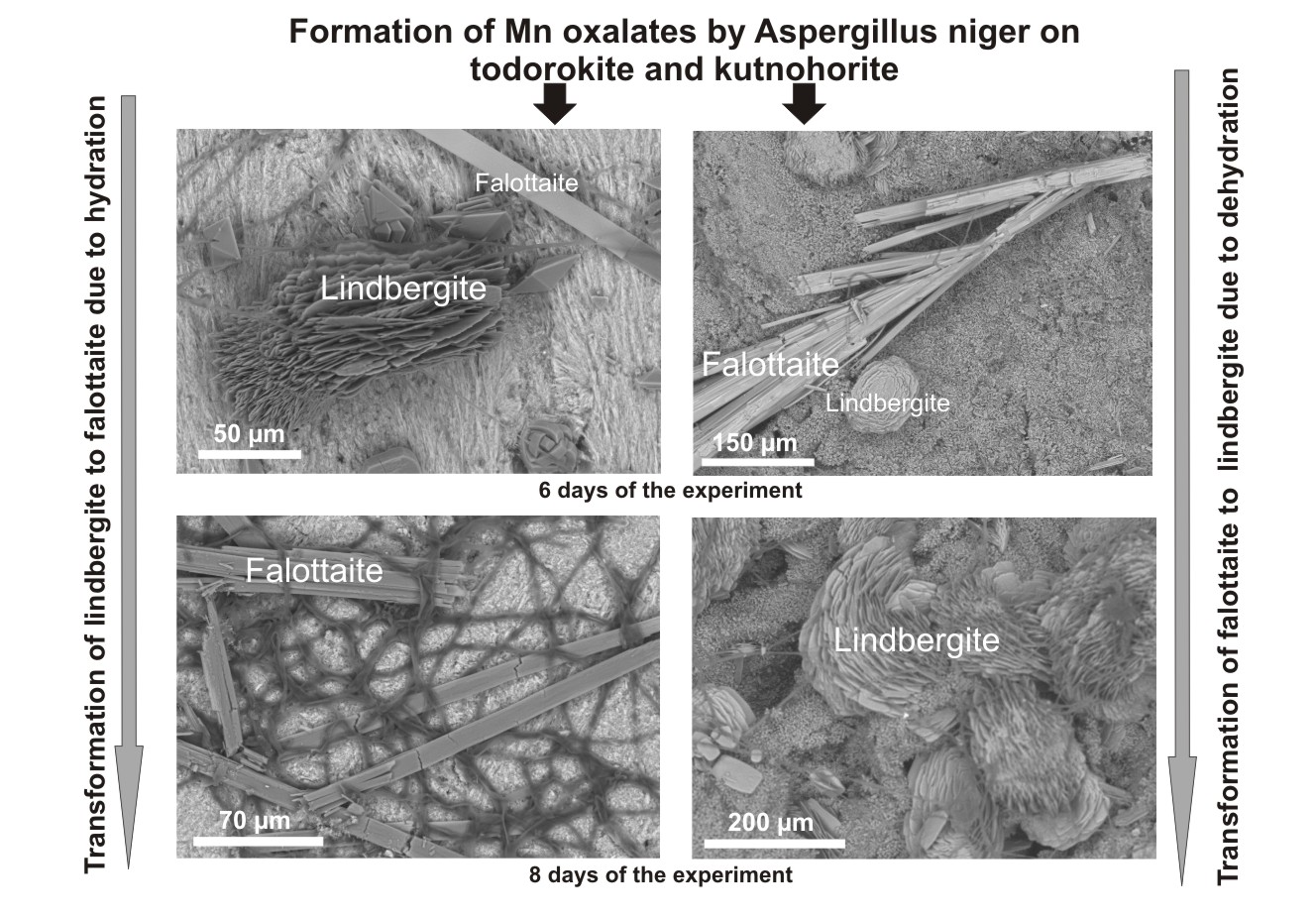
Oxalate formation by Aspergillus niger on minerals of manganese ores
https://doi.org/10.2138/am-2021-7651
Microscopic fungi play an important role in rock and minerals alteration, often leading to formation of insoluble biogenic oxalates (oxalic acid salts) on their surface. In recent years, the world scientific community has shown significant interest in the mechanisms of biomineralization with the participation of microorganisms, which is associated with the study of modern mineral formation at the nano and micro levels, as well as processes and phenomena occurring at the border of living and nonliving. These fundamental results, in this paper by Frank-Kamenetskaya et al., create the scientific basis for the development of modern nature-like biotechnologies in various fields of science.
High-pressure experimental study of tetragonal CaSiO3-perovskite to 200 GPa
https://doi.org/10.2138/am-2021-7913
Because the addition of Ti could elevate the phase transition temperature of CaSiO3-perovskite from the tetragonal to cubic phase studies on the physical properties of tetragonal CaSiO3-perovskite are important to better understand the structure of the Earth’s lower mantle. Here structure and equation of state of tetragonal CaSiO3-perovskite were determined up to 200 GPa. Sun et al. further compare the density and sound velocity of tetragonal CaSiO3-perovskite to the cubic phase to discuss the importance of this phase transition in the lower mantle.
Mesoproterozoic seafloor authigenic glauconite-berthierine: Indicator of enhanced reverse weathering on early Earth
https://doi.org/10.2138/am-2021-7904
Ma et al. report several results. (1) Seafloor authigenic glauconite and berthierine occur in the 1.4 Ga basal Xiamaling Formation, NC. (2) Reverse weathering (authigenic formation of clay minerals) is enhanced by Fe- and Si-rich seawater. (3) Mid-Proterozoic enhanced reverse weathering maintained high CO2 levels and a warm climate.
Chemical variability in vyacheslavite, U(PO4)(OH): Crystal-chemical implications for hydrous and hydroxylated U4+, Ca, and REE phosphates
https://doi.org/10.2138/am-2021-7875
Steciuk et al. show that vyacheslavite, ideally U(PO4)(OH), has a greater chemical variability than originally thought. This variability is manifested namely by the presence of Ca and REEs and consequently by the increased content of H2O (despite pure vyacheslavite being considered as anhydrous phase ). Vyacheslavite, along with ningyoite and rhabdophane, is an important source of U in the sedimentary U-deposits all around the world.
Bennesherite, Ba2Fe2+Si2O7: A new melilite group mineral from the Hatrurim Basin, Negev Desert, Israel
https://doi.org/10.2138/am-2021-7747
Krzatala et al. report a discovery of a new mineral, bennesherite—the first barium member of the melilite group. This mineral was found in a rankinite paralava from the Hatrurim Basin, Negev Desert, Israel. Bennesherite is the only Ba- and Fe-mineral in the melilite group, although iron is a usual minor element in other melilite-group minerals. The presence of Fe2+ in bennesherite sheds light on the problem of rankinite paralavas genesis.
Single-crystal elasticity of phase Egg AlSiO3OH and δ-AlOOH by Brillouin spectroscopy
https://doi.org/10.2138/am-2022-8056
Wang et al. report the full elastic constants of phase Egg and δ-AlOOH determined by Brillouin scattering measurements at ambient conditions. Their results indicate that the hydrogen-bond configurations in the crystal structures of the two phases have a profound effect on their principal elastic constants. The anisotropic factors and aggregated elastic properties are determined from obtained elastic constants and compared with other typical mantle minerals. The results indicate phase Egg is likely a candidate mineral causing seismic anisotropy in subducting slabs and may result in a high-velocity anomaly at a depth of the base of the upper mantle, while δ-AlOOH may result in a high-velocity anomaly at a depth of mantle transition zone.
On the Origin of Martian Blueberries
https://doi.org/10.2138/am-2022-8167
The initial discovery, made by Opportunity rover, of iron-rich Martian blueberries was exciting because it suggested that water was needed for their formation, and, therefore, water was present on Mars. Other workers contended that water was not needed because the blueberries could have formed by aerial condensation of mineral clouds related to bolide impact. There is ample evidence for the presence of water on Mars, even without the blueberry evidence. However, D.D. Eberl shows in this contribution that the size distributions of the blueberries have a more detailed story to tell. Not only do the shapes of their PSDs indicate the presence of water, but they also indicate initial relative solution concentrations, and they may reveal relict concentration gradients in regional groundwater systems. More measurements of blueberry PSDs from existing rover photos may yield further information about hydrologic systems in this remote and exotic environment.
Volume 106 : December 2021 Issue
Contrasting magma compositions between Cu and Au mineralized granodiorite intrusions in the Tongling ore district in South China using apatite chemical composition and Sr-Nd isotopes
https://doi.org/10.2138/am-2021-7497
Pan et al. demonstrated that apatite is a good petrogenetic and metallogenic indicator. The compositions of apatite from Tongling region suggest that the Au-mineralized magma is less oxidized and has higher S contents and Cl/F ratios than the Cu-mineralized magma due to the more mantle-derived components in the former. Dramatic variation of apatite Cu content indicates that extremely high Cu concentration in magma may not be an essential requirement to form a porphyry and skarn Cu deposit.
Halogen heterogeneity in the subcontinental lithospheric mantle revealed by I/Br ratios in kimberlites and their mantle xenoliths from South Africa, Greenland, China, Siberia, Canada, and Brazil
https://doi.org/10.2138/am-2021-7332
Toyama et al. report new halogen data of rocks derived from the subcontinental lithospheric mantle (SCLM) of distinct locations worldwide. This work enables tracing compositional variabilities and similarities on a global scale. The authors distinguish two groups of compositions, defined by high and low I/Br ratios. This observation is interpreted to mirror halogen heterogeneities within the SCLM derived from subducted serpentinites and altered oceanic crust after discarding several competing arguments, e.g., contributions of crustal xenoliths to the host magma, dissolution of major halogen carrier minerals during alteration, degassing of halogens during magma emplacement.
Mineralogy of the 2019 Aguas Zarcas (CM2) carbonaceous chondrite meteorite fall
https://doi.org/10.2138/am-2021-7815
The 2019 Aguas Zarcas CM2 meteorite fall is the most significant carbonaceous chondrite CM2 fall since Murchison in 1969. Samples collected immediately following the fall and studied here by Garvie provide the rare opportunity to analyze the bulk mineralogy of a CM2 meteorite largely free of terrestrial contamination. Analysis of this meteorite provides the basis for understanding the mineralogy of samples returned from hydrated, carbonaceous asteroids, including Bennu and Ryugu.
Keplerite, Ca9(Ca0.5◻0.5)Mg(PO4)7, a new meteoritic and terrestrial phosphate isomorphous with merrillite, Ca9NaMg(PO4)7
https://doi.org/10.2138/am-2021-7834
Keplerite is a Ca-dominant counterpart of the most abundant meteoritic phosphate, merrillite. The solid solutions merrillite-keplerite is a main reservoir of phosphate phosphorus in the solar system. The Na-number measure, 100xNa/(Na+Ca), is herein proposed by Britvin et al. for the characterization of the minerals intermediate between merrillite and keplerite.
Thermodynamic, elastic, and vibrational (IR/Raman) behavior of mixed type-AB carbonated hydroxylapatite by density functional theory
https://doi.org/10.2138/am-2021-7826
The work by Ulian et al. extends the overall knowledge of thermodynamic, elastic, and vibrational properties of type-AB carbonated apatite. Carbonated hydroxylapatite is the main mineral phase in bone and dental tissues and in most phosphate-based biomaterials. The knowledge of its thermodynamic, elastic, and vibrational properties is important to understand the basics of this mineral and to develop new synthetic analogs for a wide range of biomedical applications.
Internal stress-induced recrystallization and diffusive transport in CaTiO3-PbTiO3 solid solutions: A new transport mechanism in geomaterials and its implications for thermobarometry, geochronology, and geospeedometry
https://doi.org/10.2138/am-2021-7588
Beyer and Chakroborty conducted a series of high-temperature experiments to study the incorporation of Pb in natural CaTiO3 single crystals. They observed a partial replacement of the original CaTiO3 crystal by a polycrystalline rim composed of (Ca,Pb)TiO3 microcrystals. The shape and chemical zonation of the rim suggest that diffusion and dissolution-precipitation processes work in parallel. The newly discovered process has a distinctly smaller activation energy than the diffusion alone. This has consequences for geothermobarometry, geochronology, and geospeedometry.
« ‹ 1 … 38 39 40 41 42 … 85 › »ADDITIONAL RESOURCES