
Editor’s Notes
Total Results: 1697
Volume 106 : December 2021 Issue
Experimental determination of carbon diffusion in liquid iron at high pressure
https://doi.org/10.2138/am-2021-7644
Carbon dissolves readily in liquid iron, and most of Earth's carbon is expected to be in the core. The behavior of carbon in liquid iron at high pressure (P) and temperature (T) is therefore essential for understanding the formation and evolution of planetary cores. Here, Rebaza et al. measured the diffusion rates of carbon in liquid iron at high P-T in the laboratory. Their data show that carbon transport is insensitive to P over the conditions studied but may be affected by the presence of nickel.
Reduction of structural Fe(III) in nontronite by humic substances in the absence and presence of Shewanella putrefaciens and accompanying secondary mineralization
https://doi.org/10.2138/am-2021-7828
Zuo et al. demonstrated that humic substances, a common type of soil organic matter, can serve as electron donor, shuttle, and even acceptor to mediate abiotic and biotic reduction of structural Fe(III) in a clay mineral nontronite. Different types of humic substances show dramatically different effects in Fe(III) reduction and mineral transformations due to their intrinsic differences in electrochemical and molecular compositions. Mineralogical transformations accompany such redox reactions, forming high-temperature minerals under ambient low-temperature conditions. This study highlights a strong need for understanding the interaction between soil organic matter and clay minerals under environmental relevant conditions.
Trace-element segregation to dislocation loops in experimentally heated zircon
https://doi.org/10.2138/am-2021-7654
Peterman et al. conducted nanoscale analysis of an Archean zircon that was experimentally heated to 1450 C for 24 h and found trace-element-enriched crystal defects (5 to 25 nm) that replicate features observed in natural zircon. The formation and distribution of these features are controlled by crystallography, effective radiation dose, and the rate of heating and structural recovery. The entrapment of trace elements in nanoscale defects may have practical minerals engineering applications, such as storage of significant nuclear elements.
Tin isotopes via fs-LA-MC-ICP-MS analysis record complex fluid evolution in single cassiterite crystals
https://doi.org/10.2138/am-2021-7558
Liu et al. present cathodoluminescence imaging, trace element, and in-situ Sn isotope compositions of two cassiterite crystals from an early and a relatively late stage of ore formation of the Xiling vein-style Sn deposit, China. Their results indicate compositional heterogeneity at the sub-millimeter scale in terms of trace elements and tin isotope composition, which reveal a more complex fluid evolution than expected by analytical bulk mineral techniques. The features of the tin isotope fractionation can be attributed to fractional crystallization of cassiterite, both in relatively closed-system and open-system environments.
Tracking dynamic hydrothermal processes: Textures, in-situ Sr-Nd isotopes, and trace-element analysis of scheelite from the Yangjiashan vein-type W deposit, South China
https://doi.org/10.2138/am-2021-7677
Li et al. present characterization of textures, in-situ Sr-Nd isotopes, and trace element analysis of scheelite from the Yangjiashan vein-type W deposit, China. The results suggest that fluid compositions, different substitution mechanisms, and primary-secondary processes all contribute to the variation in REE fractionation patterns. These in-situ data emphasize that Sr and Nd are both mobile during hydrothermal process, indicating that conventional bulk powder analysis of Sr and Nd isotope compositions may be problematic for texturally complicated scheelite. Careful analysis enables the source of ore-forming metals to be identified and the dynamics of the hydrothermal process constrained.
Oxygen isotope evidence for input of magmatic fluids and precipitation of Au-Ag-tellurides in an otherwise ordinary adularia-sericite epithermal system in NE China
https://doi.org/10.2138/am-2021-7825
Gao et al. present evidence for the involvement of magmatic fluids in the formation of Te-rich epithermal Au-Ag deposits using mineral textures and CL images to guide high spatial resolution SIMS (10-micrometer scale) oxygen isotope analysis and fluid inclusion microthermometric measurements on the same generation of banded quartz. The results show that magmatic fluid inputs are critical to formation of Te-rich adularia-sericite epithermal Au-Ag deposits. The correlation of fluid inclusion temperatures with in situ analysis of oxygen isotope ratios by SIMS is novel and has important advantages.
Thalliomelane, TlMn4+7.5Cu2+0.5O16, a new member of the coronadite group from the preglacial oxidation zone at Zalas, southern Poland
https://doi.org/10.2138/am-2021-7577
Gołębiowska et al. present data on a new mineral thalliomelane, TlMn4+7.5Cu2+0.5O16, a member of the coronadite group, which is interesting not only due to exotic composition, but also probable conditions of its formation. It is the first Mn oxide containing abundant Tl, and along with recent studies of Wick et al. (2019) on sorption of Tl onto manganese oxides, may document the replacement of other large tunnel cations (K, perhaps Ba) in minerals of the coronadite group by Tl+ in supergene geological environments.
NEW MINERAL NAMES
https://doi.org/10.2138/am-2021-NMN1061225
New Mineral Names
Volume 106 : November 2021 Issue
First-principles Molecular Dynamics maps out complete mineral surface acidity landscape
https://doi.org/10.2138/am-2022-7991
Highlights and Breakthroughs
Spectroscopic evidence for the Fe3+ spin transition in iron-bearing δ-AlOOH at high pressure
https://doi.org/10.2138/am-2021-7541
Su et al. performed high-pressure X-ray emission (XES) experiments on δ-(Al0.85Fe0.15) up to 53 GPa using silicone oil as a PTM in a DAC. Laser Raman spectroscopy experiments were conducted on the δ-(Al0.85Fe0.15) OOH and δ-(Al0.52Fe0.48) OOHsamples up to 57 and 62 GPa, respectively, using neon as a PTM. Our XES spectra of δ-(Al0.85Fe0.15)OOH showed a broadening spin crossover approximately from 30 to 42 GPa. By contrast, our laser Raman spectra of δ-(Al0.85Fe0.15)OOH and δ-(Al0.52Fe0.48)OOH illustrated a relatively sharp change at 32−37 and 41−45 GPa, respectively, across the spin transition. Together with literature data, we found that the spin transition pressure of δ-(Al,Fe)OOH slightly increases with increasing iron content. These results shed new insights into the knowledge of iron effects on the spin transition pressure and vibration properties of δ-(Al,Fe)OOH. The presence of iron in δ-AlOOH can substantially influence its high-pressure behavior and stability at the deep mantle conditions and play an important role in the deep-water cycle.
Quantitative WDS compositional mapping using the electron microprobe
https://doi.org/10.2138/am-2021-7739
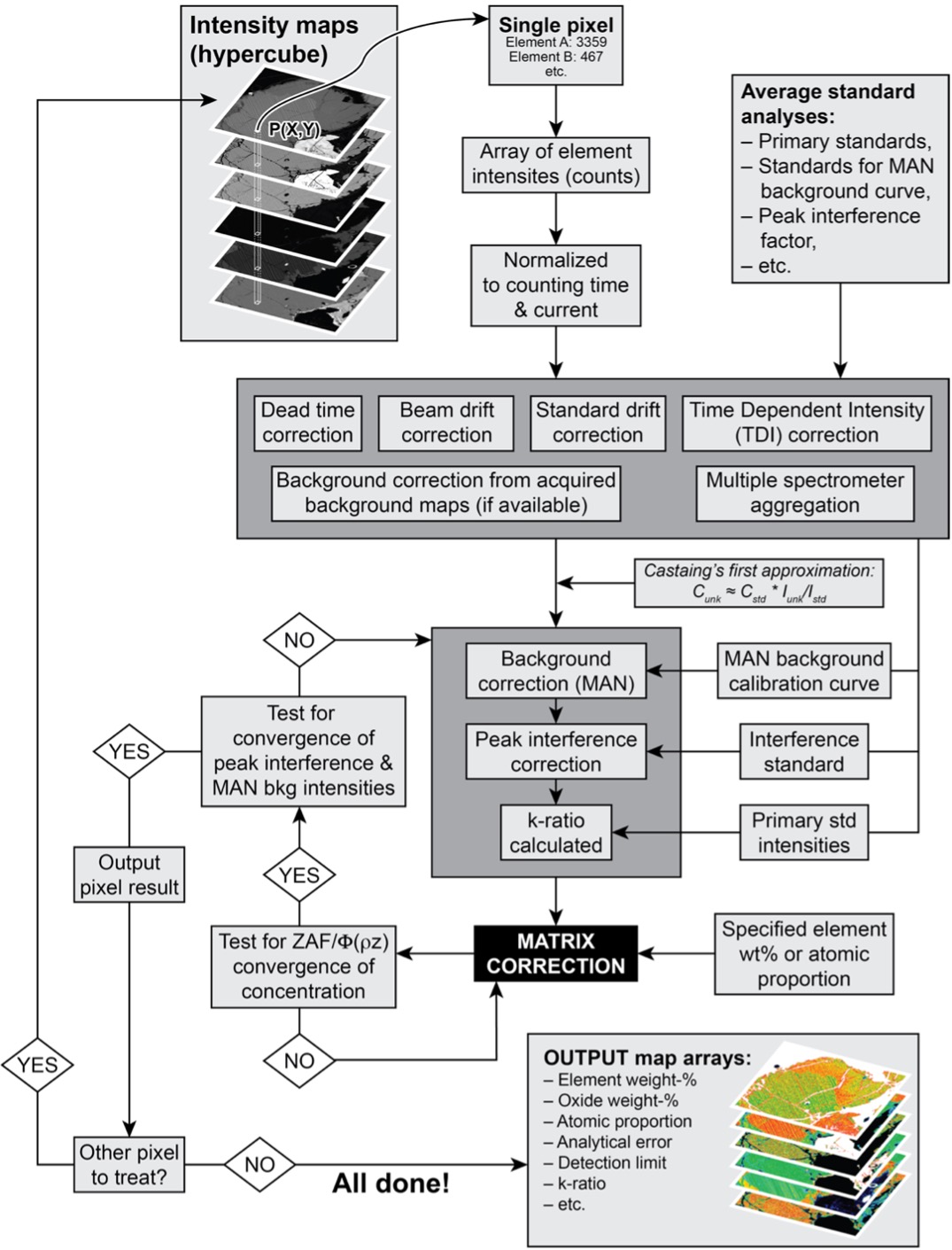
Elemental zoning in minerals contains critical information for the interpretation of rocks and is commonly investigated by EPMA X-ray mapping. However, raw X-ray intensity maps can contain analytical artifacts from the effects of matrix effects, interferences, beam damage, and continuum production. Donovan et al. present a rigorous quantification protocol for the treatment of WDS element X-ray maps to produce accurate results and discusses the impact of these corrections relative to the raw data.
Interfacial structures and acidity constants of goethite from first-principles Molecular Dynamics simulations
https://doi.org/10.2138/am-2021-7835
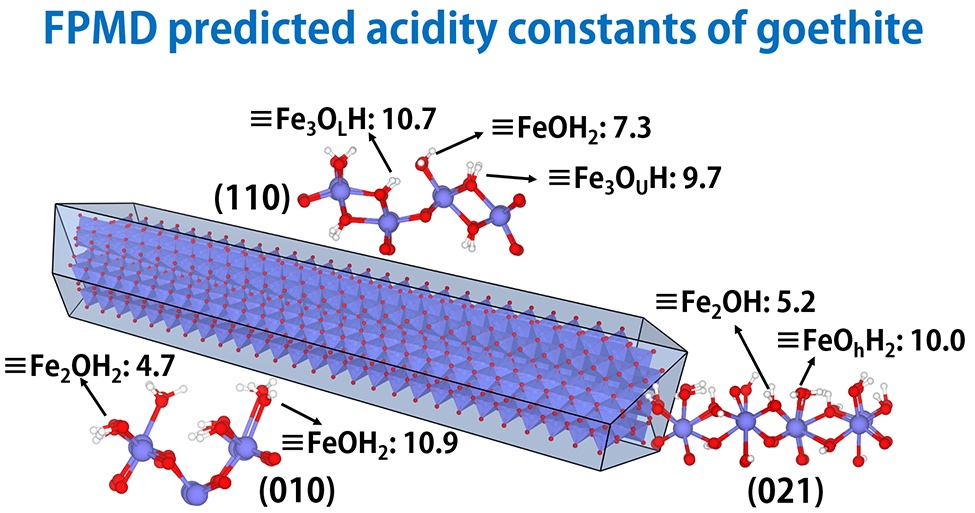
Goethite plays important roles in numerous geochemical processes, and its interface chemistry has attracted significant attention. pKa values are central to surface reactivity of goethite, but they are still lacking up to now. To fill this gap the advanced FPMD technique was applied by Zhang et al. to study the major surfaces. The derived interfacial structures and pKa values can be directly used to investigate a wide range of processes including surface complexation reactions. The findings form a microscopic basis for understanding the processes on goethite interfaces.
Sound velocities of iron-nickel (Fe90Ni10) alloy up to 8 GPa and 773 K: The effect of nickel on the elastic properties of bcc-iron at high P-T
https://doi.org/10.2138/am-2021-7716
In this paper, Wang et al. report the acoustic velocity measurements of bcc-Fe90Ni10 alloy up to 8 GPa and 773 K in a multi-anvil apparatus. Fe-Ni alloys are considered as the major constituent of Earth's and other planetary cores. Understanding the elastic properties of Fe-Ni alloys at high pressure and high-temperature conditions is essential to compare with seismological observations of the core and then place constraints on its composition. The study reports the elastic moduli (KS and G) and their pressure derivatives and, for the first time, provides the temperature dependences of the elastic bulk and shear moduli of bcc-Fe90Ni10. These findings should motivate future acoustic measurements of various Fe-Ni-light elements alloys and compounds at simultaneous high P-T conditions to provide a more comprehensive understanding of the composition and thermal structure of Earth's and planetary cores.
Formation of metallic-Cu-bearing mineral assemblages in type-3 ordinary and CO chondrites
https://doi.org/10.2138/am-2021-7689
Both thermal and shock metamorphism could be responsible for the formation of metallic Cu in chondrites. Li et al. found that Ni-rich metal is the main Cu-carrier for CO3.2-3.7 chondrites, and most metallic Cu in CO3 chondrites were formed during thermal metamorphism. The growth of metallic Cu in ordinary chondrites seems to be related to shock heating and post-shock metamorphism. We also predict that some other groups of carbonaceous chondrites (e.g., CM and CI) are less likely to produce metallic Cu.
Behavior and origin of hydrogen defects in natural orthopyroxene during high-temperature processes
https://doi.org/10.2138/am-2021-7741
To understand complex features of hydrogen defects in mantle orthopyroxene, Yang et al. carried out in situ high-temperature FTIR spectroscopic investigations on hydrogen defects in three natural orthopyroxenes. The study revealed what happens to hydrogen defects during high-temperature processes. These new data are enlightening for correctly relating features of hydrogen defects to geological processes.
Phase transitions in CaCO3 under hydrous and anhydrous conditions: Implications for the structural transformations of CaCO3 during subduction processes
https://doi.org/10.2138/am-2021-7575
The detailed phase transition processes among CaCO3-I (calcite), CaCO3-II, III/IIIb, and aragonite at P-T conditions up to 2.5 GPa and 600 °C, in hydrous and anhydrous environments, were investigated by Yuan et al. Our results show that in contrast to the displacive CaCO3-I ↔ II transformation and the reconstructive CaCO3-II → III transformation which is divided into two sub-stages by the occurrence of intermediate CaCO3-IIIb, the reconstructive phase transition between CaCO3-I or II and aragonite requires greater activation energy and can only be achieved by progressive solid recrystallization under high P-T conditions (e.g., above 450 °C and 1.5 GPa), or alternatively via fluid-assisted dissolution-precipitation under relatively lower temperatures (e.g., 100-300 °C), depending upon the presence of aqueous fluids and the heating rate of the system. Considering the high P-T condition, low heating rate, and considerable amounts of aqueous fluids being generated during the subduction of hydrous oceanic crust, the CaCO3-I/II →aragonite transformation via the dissolution-precipitation process should commonly occur, and that the calcite aragonite →CaCO3-VII →post aragonite should be the predominant phase transition sequence during transport of CaCO3 into the deep earth through subduction processes.
Strain-induced partial serpentinization of germanate olivine with a small amount of water
https://doi.org/10.2138/am-2021-7735
Sawa et al. demonstrate that strain-induced hydration of germanate olivine results in antigorite formation even in the presence of only small amounts of water. Thus, partly hydrated peridotite in the oceanic lithosphere can be formed under slight water infiltration due to high strain accumulated by the subduction.
The origin of trapiche-like inclusion patterns in quartz from Inner Mongolia, China
https://doi.org/10.2138/am-2021-7454
Farfan et al. found that split crystal and two-dimensional nucleation-growth morphology preferentially trap clay inclusions to form trapiche-like patterns within quartz crystals from Inner Mongolia, China. This natural example of crystal growth hosts abundant inclusions complements materials science studies of synthetic split crystals on the nano-scale and suggests that split growth may be an indicator for highly supersaturated and/or turbid formation fluids.
Upper temperature limits of orogenic gold deposit formation: Constraints from TiO2 polymorphs in the Dongyuan Au deposit, Jiangnan Orogen, China
https://doi.org/10.2138/am-2021-7754
TiO2 minerals are commonly formed during the early stage of the Au mineralization and may therefore be used to fingerprint and investigate the formation of orogenic Au deposits. Raman spectroscopy, EPMA, and TEM analyses by Wu et al. show that orogenic Au deposits, such as the Dongyuan deposit, contain TiO2 polymorphs of anatase, anatase-rutile intergrowths, and rutile, which formed in the early stage of auriferous vein formation. The TiO2 polymorphs constrain the upper temperature limits of the Au vein formation to 450-550 °C, based on the thermodynamics of TiO2 polymorphs. Compared with TiO2 mineral compositions from magmatic-hydrothermal deposits (e.g., porphyry Cu/W deposits), they have distinct features in orogenic Au deposits, reflecting that ore-forming fluids stemmed from, or flowed through, metamorphic rocks. Furthermore, orogenic Au deposits widely distributed in the low-intermediate-grade metamorphic rocks stem from the deeply sourced fluids (e.g., from granulite-facies rocks of the middle to lower crust).
Formation of clinohumite ± spinel in dolomitic marbles from the Makrohar Granulite Belt, Central India: Evidence for Ti mobility during regional metamorphism
https://doi.org/10.2138/am-2021-7755
Karmakar documents an occurrence of the rare mineral clinohumite in a suite of forsterite marbles from a part of the Central Indian Tectonic Zone. The humite group of minerals has a limited paragenesis wherein Ti- and F-bearing clinohumites have been reported from very few contact or regionally metamorphosed limestones, dolomites, and skarns, with only 4 reported occurrences in India. The clinohumite developed due to infiltration of T-i and F-bearing H2O-rich fluids, which in turn indicates that the presence of F in H2O-rich fluids must enhance Ti mobility. Ti is generally considered immobile during regional metamorphism and the constant-Ti frame of reference is widely used in most mass-flux calculations in fluid transport, to evaluate open-system behavior during metasomatism. As a result, documenting natural examples of mobility of Ti in metamorphic fluids is crucial to understanding the recycling of such commonly perceived nominally soluble elements and to understand HFSE recycling during metamorphic processes.
« ‹ 1 … 39 40 41 42 43 … 85 › »ADDITIONAL RESOURCES