
Editor’s Notes
Total Results: 1697
Volume 106 : July 2021 Issue
Crystal chemistry and high-temperature vibrational spectra of humite and norbergite: Fluorine and titanium in humite-group minerals
https://doi.org/10.2138/am-2021-7538
The humite-group minerals on the brucite-olivine join may be important carriers of H2O into the Earth’s deep interior, as well as water reservoirs in subduction zones and the upper mantle in extremely hydrous compositions. In this study, Liu et al. carried out single-crystal X-ray diffraction and used in-situ high-temperature Raman and Fourier transform infrared (FTIR) measurements on natural humite and norbergite samples to study the effects of F and Ti incorporation on the hydrogen behavior in these hydrous minerals. The OH-stretching modes above 3450 cm-1 are affected by the neighboring H-H repulsion, while the ones below 3450 cm-1 could be explained by F/Ti substitutions, both of which could relieve the H-H repulsion effect. The Raman-active OH bands below 3450 cm-1 are determined by Ti-substitution, while the IR-active ones are contributed by both F and Ti substitutions. Both the structure refinements and high-temperature vibrational spectra on natural humite samples could provide microscopic insight for understanding F and Ti effects on the stability field of the hydrous minerals (such as humite-group minerals) in subducting slabs.
Exomorphism of jacobsite precipitates in bixbyite single crystals from the Thomas Range in Utah
https://doi.org/10.2138/am-2021-7715CCBYNCND
Peter et al. investigated single crystals of bixbyite via transmission electron microscopy (TEM), revealing a lamellar 3D network consisting of the tetragonal manganese-silicate braunite. Additionally, nanometer-sized precipitates were found and identified as jacobsite, a cubic iron-manganese-spinel, not previously known to occur in the Thomas Range. The presence of spinel implies higher formation temperatures than described in the literature, possibly acting as a novel geo-thermometer. Interestingly, TEM observations indicate that the shape of the crystallites is exomorphously determined by the braunite lamellae, leading to their unusual cuboid morphology, which is, to the best of our knowledge, the first report on exomorphism of a naturally formed spinel.
Ferropyrosmalite-bearing fluid inclusions in the North Patagonian Andes metasedimentary basement, Argentina: A record of regional metasomatism
https://doi.org/10.2138/am-2021-7525
Sosa et al. present new cathodoluminescence, Raman spectroscopy, and microthermometric data of fluid inclusions in metamorphic quartz segregations from metasedimentary rocks of northwestern Patagonia (Argentina). This information is combined with heating experiments of fluid inclusions, which allowed studying equilibrium conditions of ferropyrosmalite with clino-amphibole, providing novel insights into their genetic conditions and mineral equilibria. Implications for fluid evolution during regional metasomatic processes are included in this work.
Memorial of Alden Bliss Carpenter (1936–2019)
https://doi.org/10.2138/am-2021-1009
Memorial of Alden Bliss Carpenter (1936–2019)
NEW MINERAL NAMES
https://doi.org/10.2138/am-2021-NMN106714
New Mineral Names
Volume 106 : June 2021 Issue
Cation partitioning among crystallographic sites based on bond-length constraints in tourmaline-supergroup minerals
https://doi.org/10.2138/am-2021-7804
Bacik and Fridrichova determined the positions of major, minor, and trace elements in the tourmaline structure based on the calculated bond lengths. Major elements can be divided into the structural sites based on the chemical and structural data, but it is far more complicated for minor and trace elements due to their low contents. Predictions can be made based on bond-length constraints for each site. Theoretical bond-length calculation from ideal bond valences for each ion and coordination can predict ion site preference in the structure.
Magnesio-lucchesiite, CaMg3Al6(Si6O18)(BO3)3(OH)3O, a new species of the tourmaline supergroup
https://doi.org/10.2138/am-2021-7496
Scribner et al. describe magnesio-lucchesiite, a new species of the tourmaline supergroup. The mineral originates from the replacement of mafic minerals by boron-rich metasomatic fluids; it may also form in metacarbonate rocks during crystallization of common uvitic tourmaline. High miscibility with other tourmaline end-members indicates the large petrogenetic potential of magnesio-lucchesiite in Mg,Al-rich calcsilicate rocks, as well as contact-metamorphic, and metasomatic rocks.
Raman spectroscopic quantification of tetrahedral boron in synthetic aluminum-rich tourmaline
https://doi.org/10.2138/am-2021-7758
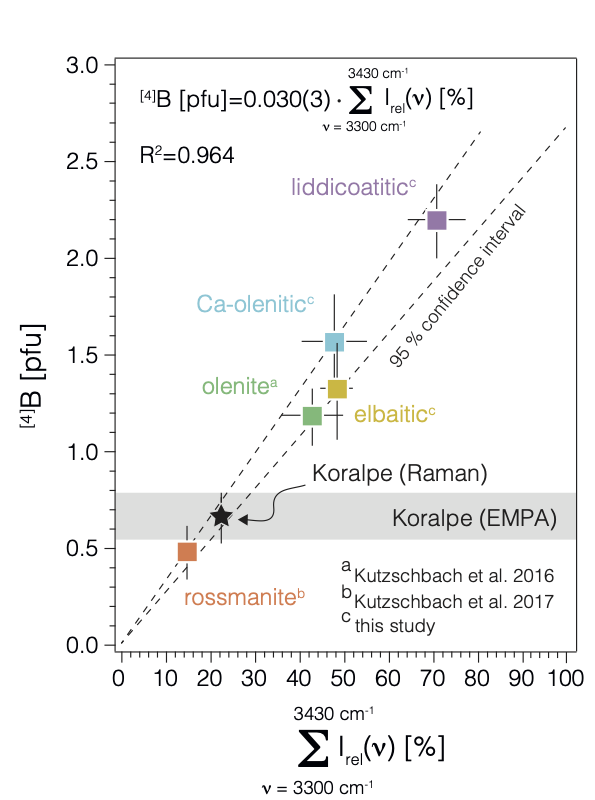
Kutzchbach et al. describe the correlation of the tetrahedral B content in synthetic Al-rich tourmaline determined by EMPA analyses with the summed relative intensity of all OH-stretching bands between3300–3430 cm–1. Applying the regression equation to natural 4B-bearing tourmaline from the Koralpe (Austria) reproduces the EMPA-derived value. This demonstrates that Raman spectroscopy provides a fast and easy-to-use tool for the quantification of tetrahedral boron in tourmaline. The knowledge of the amount of tetrahedral boron in tourmaline has important implications for the better understanding and modeling of B-isotope fractionation between tourmaline and fluid/melt, widely used as a tracer of mass transfer processes.
Thermal expansion of minerals in the pyroxene system and examination of various thermal expansion models
https://doi.org/10.2138/am-2021-7650
Based on the new data for thirteen chemically distinct pyroxenes, Hovis et al. provide a review of thermal expansion data and models for clino- and orthopyroxenes and model changes in thermal expansion with temperature according to the Fei empirical and Kroll physical models of thermal expansion. Conclusions are drawn about the effects of Fe2+- Mg substitution, Ca-Na concentration, and other chemical substitutions on the magnitudes of volume and axial thermal expansion. In part, differences in thermal expansion can be related to the concentration of M1 polyhedra along the b axis and relative charges of the substituted cations in that site. These results have implications for the modeling of geophysical and thermodynamic behavior of high-temperature pyroxene-bearing assemblages.
Incorporation of tetrahedral ferric iron into hydrous ringwoodite
https://doi.org/10.2138/am-2021-7539
Thomson et al. synthesized hydrous Fo91 ringwoodite crystals at 20 GPa and high-temperature conditions using a multi-anvil press. Recovered crystals were analyzed using electron microprobe analysis, Raman spectroscopy, infrared spectroscopy, synchrotron Mossbauer spectroscopy, single-crystal X-ray diffraction, and single-crystal Laue neutron diffraction to characterize the chemistry and crystallography of the samples. Analysis of the combined datasets provides evidence for the presence of tetrahedrally coordinated ferric iron and multiple hydrogen incorporation mechanisms within ringwoodite. Tetrahedral ferric iron is coupled with cation disorder of silicon onto the octahedrally coordinated site. Cation disorder in mantle ringwoodite minerals may be promoted in the presence of water, which could have implications for current models of seismic velocities within the transition zone.
The evolution of saponite: An experimental study based on crystal chemistry and crystal growth
https://doi.org/10.2138/am-2021-7625
Zhang et al.’s synthesis experiments on saponite show that element distributions within clay minerals are related to the synthesis temperature gap between starting materials and resultant products. Larger Mg- or Ni- clusters can form when the respective synthesis temperature of the starting materials and of the resultant products are close (i.e., low T). Thus, the clustering is not only related to given temperature conditions but also to the characteristics of the starting materials in terms of crystallinity degree and particle size. Crystal-chemistry and crystal growth could be used to predict the environmental transition and element migration. Similar experiments with more complexities could offer potentials to predict the mineral geochemistry and better understand and parametrize natural processes.
Hydroxylpyromorphite, a mineral important to lead remediation: Modern description and characterization
https://doi.org/10.2138/am-2021-7516
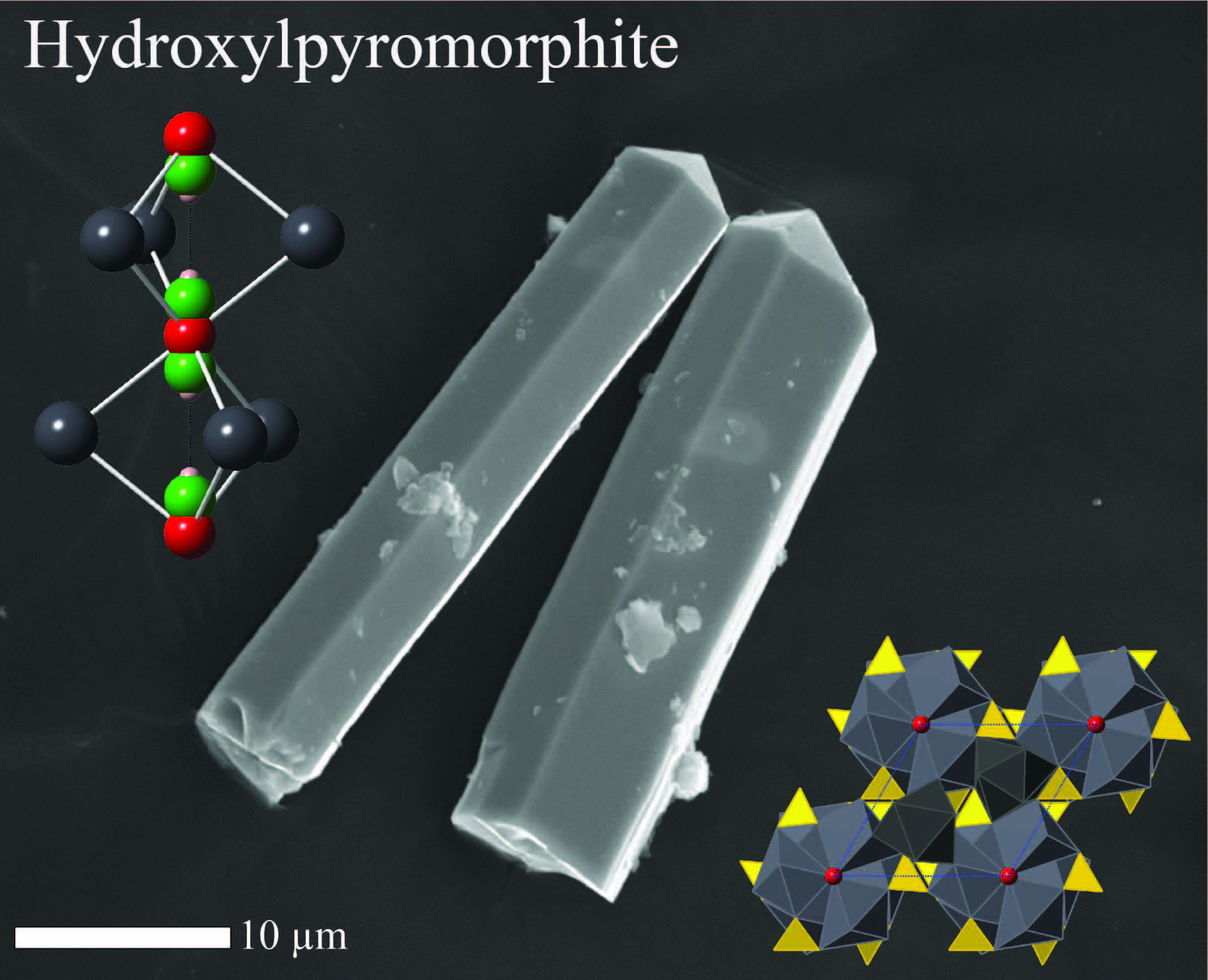
Olds et al. describe the structure and properties of a new mineral, hydroxylpyromorphite. Hydroxylpyromorphite is a key phase used for remediation of Pb-polluted aquifers and its ability to remove Pb from drinking water has been heavily studied. Their description provides a deeper understanding to the anion column arrangements in pyromorphites and other Pb-bearing apatites, which may help guide and optimize Pb sequestration, or reveal how anion and cation substitution affects important properties such as solubility, reactivity, and mobility of Pb in natural systems.
Experiments on two techniques for the removal of barite from detrital zircon
https://doi.org/10.2138/am-2021-7436
Martin et al. performed experiments on two techniques for the removal of barite from detrital zircon: conventional milling method and a new chemical technique. Milling in a ball mill fractures and removes zircon along with barite. Milling thus can introduce bias into a detrital zircon sample. Boiling in aqueous Na2CO3 solution converts barite to barium carbonate, which can be separated from zircon by hand or by hot nitric acid bath. Boiling in concentrated HNO3 did not affect the U-Pb or Lu-Hf isotopic systems in zircon and boiling in Na2CO3 solution followed by HNO3 did not disturb the Lu-Hf system. Boiling in concentrated Na2CO3 solution followed by HNO3 did affect the U-Pb isotopic system in zircon. These results highlight the importance of proper technique during zircon isolation to minimize the introduction of bias into the sample.
Discovery of terrestrial allabogdanite (Fe,Ni)2P, and the effect of Ni and Mo substitution on the barringerite-allabogdanite high-pressure transition
https://doi.org/10.2138/am-2021-7621
Britvin et al. report the discovery of a high-pressure phosphide, allabogdanite, (Fe,Ni)2P, in phosphide assemblages confined to the surficial metamorphic rocks at the Dead Sea basin in Israel. High-pressure high-temperature experiments show that the low- to high-pressure phase transition for natural (Fe,Ni)2P from the Dead Sea occurs at a pressure of 25 GPa (~250 kbar) and a temperature of ~1400 °C.
Pseudomorphic 9-line silician ferrihydrite and Fe-rich serpentine- group minerals in FeTi oxide-rich ferroan peridotite, Laramie anorthosite complex, Wyoming, U.S.A.
https://doi.org/10.2138/am-2021-7768
Evans et al. describe a unique occurrence of the mineral ferrihydrite as a pseudomorph after a sulfide mineral in a Larimie Complex, Wyoming, peridotie. Ordinarily, ferrihydrite is a supergene mineral occurring as mine waste. In this new occurrence, ferrihydrite displays elemental covariations never before described in this mineral. Co-variations of Si, Mg, and total Fe represent a crystal chemical response to subsurface altering solutions and its superior (9-line) crystallinity.
Synthesis and characterization of Fe(III)-Fe(II)-Mg-Al smectite solid solutions and implications for planetary science
https://doi.org/10.2138/am-2020-7419CCBYNCND
Fox et al.’s detailed characterization of the full compositional range of smectite minerals using techniques analogous to those employed in planetary exploration will help improve these capabilities for identification and compositional quantification, and in turn better the ability to interpret alteration environments throughout the solar system. They synthesize and report on the spectroscopic properties of a suite of smectite samples that span the intermediate compositional range between Fe, Mg, and Al end-member species, including both Fe(III)- and Fe(II)-dominated samples.
Evidence for a two-stage particle attachment mechanism for phyllosilicate crystallization in geological processes
https://doi.org/10.2138/am-2021-7529
He et al. describe a nonclassical crystallization process for phyllosilicates forming at elevated temperatures in magmatic and metamorphic environments whereby oriented attachment of building blocks occurs along the (001) plane and/or the &91;001&93; direction simultaneously. Nanoparticles are basic building blocks for coarsening of phyllosilicate crystals. The results suggest that the microstructure of magmatic and high-grade metamorphic minerals may have the potential to reveal the evolution history of melts and high-temperature metamorphic processes.
Multiple generations of tourmaline from Yushishanxi leucogranite in South Qilian of western China record a complex formation history from B-rich melt to hydrothermal fluid
https://doi.org/10.2138/am-2021-7473
Liu and Jiang studied elemental and boron isotopic compositions of tourmaline in leucogranite dike in the Yushishanxi Nb-Ta mining area in the Yushishan district of the South Qilian orogenic belt in western China. They identified five distinct types of tourmaline that show significant chemical variations and core-rim zoning trends. Detailed petrological, geochemical, and isotopic studies reveal four major generations of tourmaline growth from magmatic to hydrothermal, all of which belong to the alkali group and schorl-dravite solid solution series. The authors propose that the isotopically light fluids may have derived from B release during mica breakdown within the surrounding metamorphic rocks.
Zhanghuifenite, Na3Mn2+4Mg2 Al(PO4)6, a new mineral isostructural with bobfergusonite, from the Santa Ana mine, San Luis province, Argentina
https://doi.org/10.2138/am-2021-7598
Yang et al. describe the physical and chemical properties of a new mineral, zhanghuifenite, and its crystal structure determined from single-crystal X-ray diffraction data, illustrating its structural relationships to bobfergusonite in particular and alluaudite-type minerals in general. Furthermore, they predict the existence of three more new minerals in the bobfergusonite group based on the data.
Re-examination of the heterotype solid solution between calcite and strontianite and Ca-Sr fluid-carbonate distribution: An experimental study of the CaCO3-SrCO3-H2O system at 0.5–5 kbar and 600 °C
https://doi.org/10.2138/am-2021-7783
Schiperski et al. present a revised phase diagram in the system CaCO3-SrCO3 at 600 °C and 0.5-5.0 kbar based on new experimental data and thermodynamic calculations. In addition, for the first time Kd-values of Ca/Sr carbonate-fluid are presented at this condition. Results show that Sr has a high tendency for being accumulated into carbonates rather than in the fluid, which is a substantial difference from silicate-fluid systems.
« ‹ 1 … 43 44 45 46 47 … 85 › »ADDITIONAL RESOURCES