
Editor’s Notes
Total Results: 1697
Volume 106 : June 2021 Issue
On the formation of arrays of micro-tunnels in pyrope and almandine garnets
https://doi.org/10.2138/am-2021-7939
Rabier et al. show that the intricate tunnels imaged in pyrope and almandine garnets found in soils and river sediments can be fully explained by abiogenic etching of dislocation microstructures contained within the minerals. There are striking geometric similarities between these tunnels and dislocation networks that have been documented in numerous natural and synthetic garnets.
BOOK REVIEW
https://doi.org/10.2138/am-2021-B106613
Book Review: Natural Quasicrystals: The Solar System’s Hidden Secrets. (2020) 44317
Volume 106 : May 2021 Issue
How to apply elastic geobarometry in geology
https://doi.org/10.2138/am-2021-7845
"This paper by by Fabrizio Nestola highlights the new ""EntraPT"" web application, published by Mazzucchelli et al. (2021) in American Mineralogist, which provides all recent advances of elastic geobarometry within a single platform. This application allows the user to interpret the residual strain of anisotropic inclusions in an intuitive and consistent manner. At the same time, the platform provides the tools needednto perform calculations of the residual pressure and of the entrapment pressure and temperature of isotropic and anisotropic systems using a self-consistent set of thermoelastic properties."
Early Archean alteration minerals in mafic-ultramafic rocks of the Barberton greenstone belt as petrological analogs for clay mineralogy on Mars
https://doi.org/10.2138/am-2021-7656
The upcoming Mars2020 rover analyses of Jezero crater will investigate phyllosilicate and carbonate-bearing outcrops in delta sediments, as well as basaltic bedrock containing olivine, chlorite, and serpentine (e.g., Goudge et al. 2017, Bramble et al. 2017; Amador et al., Brown et al. 2020). If chlorite- and serpentine-bearing rocks are encountered by Mars2020, the rock textures and spectral analyses in this study by Grosch et al. will provide ground truth to understand potential formation conditions for those rocks.
Characterization of the metasomatizing agent in the upper mantle beneath the northern Pannonian Basin based on Raman imaging, FIB-SEM, and LA-ICP-MS analyses of silicate melt inclusions in spinel peridotite
https://doi.org/10.2138/am-2021-7292
This study by Liptai et al. presents a combination of analytical methods applicable to silicate melt inclusions as an alternative to microthermometry. The combined analyses allow the acquisition of both geochemical properties and 3D structure of the daughter phases. With the use of these methods, composition, origin and crystallization history of a trapped metasomatizing melt was revealed in the upper mantle of the northern part of the Pannonian Basin (Central Europe).
The potential for aqueous fluid-rock and silicate melt-rock interactions to re-equilibrate hydrogen in peridotite nominally anhydrous minerals
https://doi.org/10.2138/am-2021-7435
Hydrogen diffusion chronometry provides first-order constraints on how quickly mantle mineral water contents can be overprinted by hydrothermal alteration and melt-rock interactions. Peridotite xenoliths likely completely lose their mantle-inherited water contents prior to eruption due to fast H re-equilibration timescales. Re-equilibration occurs in as little as 10 minutes at 1000 °C to several of years at 600 °C, suggesting that both melt- and/or aqueous fluid-rock interactions can explain why many peridotites have water contents decoupled from trace elements and that are too high to reflect residues of melting. Lynn and Warren also posit in this contribution that hydrogen has the unique potential to be used at low-T (e.g., 300 °C) to investigate the timescales of serpentinization.
Oxygen isotope ratios in zircon and garnet: A record of assimilation and fractional crystallization in the Dinkey Dome peraluminous granite, Sierra Nevada, California
https://doi.org/10.2138/am-2021-7472
Quintero et al. demonstrate that δ18O variations in zircon and garnet from the Dinkey Dome peraluminous granite in the Sierra Nevada, California, show how a peraluminous pluton is constructed from multiple batches of variably contaminated melts, suggesting that early-stage arc magmas sample crustal heterogeneities in small melt batches. Further progressive invigoration of the arc more effectively blends with mantle melts in source regions. Peraluminous magmas provide key details of the nascent arc and pre-batholithic crustal structure.
An evolutionary system of mineralogy, Part IV: Planetesimal differentiation and impact mineralization (4566 to 4560 Ma)
https://doi.org/10.2138/am-2021-7632
The evolutionary system of mineralogy attempts to classify minerals based on their historical context, considering when and how the minerals formed, in addition to the traditional approach of documenting major element chemistry and atomic structure. In Part IV of their series, Morrison and Hazen consider minerals formed in the partially molten interiors of asteroids that began to separate metal-rich cores from silicate-rich mantles, as well as minerals transformed by high-pressure impacts. The 130 new natural kinds of minerals considered here all formed within the solar system's first 10 million years -- a time when high pressure first became an important factor in the formation of minerals.
Constraints on deep, CO2-rich degassing at arc volcanoes from solubility experiments on hydrous basaltic andesite of Pavlof Volcano, Alaska Peninsula, at 300 to 1200 MPa
https://doi.org/10.2138/am-2021-7531
Mafic magmas that enter Earth's crust from the mantle are commonly estimated to have appreciable CO2 concentrations, but direct experimental determinations are few of CO2 solubility at pressures appropriate for the continental lower crust and underlying uppermost mantle. This study by Mangan et al. determines CO2 solubility in that pressure range for basaltic andesite, a widespread subduction zone magma type, across a range of dissolved H2O concentrations suitable for arc magmas. Results show that basaltic andesite can retain substantial dissolved CO2 in the deep arc crust, consistent with geochemical estimates, but that published models of magmatic CO2 solubility are inaccurate for mid-crustal to uppermost mantle pressures, some overestimating and others underestimating the measured concentrations. Systematic studies varying individual melt compositional components may be required to improve understanding of controls on solubility and to develop robust models of H2O-CO2 degassing in the deep arc crust.
Electrical conductivity of diaspore, δ-AlOOH and ε-FeOOH
https://doi.org/10.2138/am-2021-7605
This study by Wang and Yoshino addresses the measurement of the electrical conductivity of three hydrous minerals: diaspore, δ-AlOOH, and ε-FeOOH. Investigations on such phases became hot topics because of their wide pressure-temperature stability field (Sano et al. 2008; Nishi et al. 2017; Duan et al. 2018; Hu et al. 2016, 2017). Electrical conductivity measurement of these minerals is also useful to understand deep water cycle. This study could provide important insights on the electrical behaviors of hydrous minerals and water cycle in the Earth's interior. Three significant outcomes were obtained from this study. (1) Diaspore shows a negative pressure dependence on the conductivity because of the ineffectual change of the length of O1H bond with increasing pressure. (2) δ-AlOOH and ε-FeOOH have shorter H...O2 bonds and longer O1H bonds which can account for the relatively higher conductivity than diaspore. (3) ε-FeOOH indicates higher conductivity than δ-AlOOH, which might be caused by the contribution of a small polaron conduction. The result of this study could be applied to the trends of the conductivity-depth relation for various lithologies including hydrous minerals in subduction zones such as altered oceanic crust, hydrous peridotites, and subducted sediments.
A reassessment of the amphibole-plagioclase NaSi-CaAl exchange thermometer with applications to igneous and high-grade metamorphic rocks
https://doi.org/10.2138/am-2021-7400
The existing calibrations of amphibole-plagioclase and amphibole-only thermometers yield inaccurate temperature estimates. Three new expressions of the amphibole-plagioclase NaSi-CaAl exchange thermometer are calibrated in this work by Molina et al. that yield an overall similar precision (plus or minus 50°C), but are significantly more accurate. The new expressions can be used in a wide range of igneous and high-grade metamorphic rocks that bear subcalcic to calcic amphibole and oligoclase or more calcic plagioclase
Structural variations across the nepheline (NaAlSiO4)–kalsilite (KAlSiO4) series
https://doi.org/10.2138/am-2021-7484
"Antao and Hovis obtained the crystal structure of 19 samples within the (Na,K)AlSiO4 series on a fine compositional scale. Well-defined structural variations occur across the Ne-Ks series. Natural samples are not yet available to give a complete understanding of Ne-Ks solid series, which is overcome by using ""synthetic"" ion-exchanged, powder samples instead of single crystals. Natural samples with limited solid solutions plot close to their ""synthetic"" samples, so their results apply to natural systems. However, it would be interesting to see how the results for other natural samples with different chemistries, if discovered, compare to the present results. Phase transitions in minerals and their reversibility continue to intrigue researchers. Synchrotron high-resolution powder X-ray diffraction uses a highly intense beam that is sensitive to fine-scale intergrowths or overlapping multi-phases with subtle change in symmetry that cannot be resolved with conventional powder X-ray diffraction. The P31c to P63 transition in kalsilite may be monitored using the 111 reflection that is clearly observable with HRPXRD. K-rich nepheline and kalsilite occur in volcanic rocks as high temperatures expand the aluminosilicate framework to accommodate large K atoms. Particularly, P63 Ks occurs in volcanic rocks, and low temperature P31c Ks occurs in metamorphic rocks. The high to low transition is not completely reversible."
The (chemical) potential for understanding overstepped garnet nucleation and growth
https://doi.org/10.2138/am-2021-7354
This paper by Nagurney et al. utilizes phase equilibria modeling to understand the energetic consequences of metamorphic minerals, specifically garnet, not forming at thermodynamic equilibrium. They compare the chemical potentials of garnet-forming oxide components (MnO, CaO, FeO, MgO, Al2O3) between two calculations: one in which Gibbs free energy is minimized and one in which the minimization proceeds under identical conditions but in the absence of garnet. This allows them to study the energetic differences between a garnet-bearing and a garnet-absent calculation. Their results highlight that immediately up temperature of garnet-in, differences in the chemical potentials between the two calculations are commonly minimal for some components. In all twelve examples used in this study the chemical potential of Al2O3 (mu-Al2O3) diverges between garnet-bearing and garnet-absent calculations at greater P-T conditions than that of MnO, CaO, FeO and MgO. This P-T point at which mu-Al2O3 diverges is a function of bulk-rock MnO content. Further, results emphasize that immediately up temperature of garnet-in the total volume of garnet in a rock is commonly calculated to be minimal. These results highlight the necessity for petrologists to interrogate phase equilibria modeling data when interpreting the amount of overstepping of the garnet-in reaction.
EntraPT: An online platform for elastic geothermobarometry
https://doi.org/10.2138/am-2021-7693CCBYNCND
During geodynamic processes minerals in rocks can recrystallize at depth in the Earth at high pressures and temperatures and new minerals form. During crystallization, growing minerals can trap other minerals within them as inclusions. After millions of years, some of these rocks are exposed on the Earth's surface and become available to researchers for direct observation. The inclusions deform during exhumation because of the removal of external pressure and temperature. By measuring the residual deformation in the inclusion and applying specific calculations it is possible to estimate the conditions (pressure and temperatures) of the recrystallization; the time when the inclusion was entrapped in its host. This in turn gives us a wealth of information to understand large scale geological processes such as the subduction and the collision of tectonic plates. In this Open Access paper, Mazzucchelli et al. present EntraPT, a new freely accessible online application that eases the interpretation of the residual deformation of inclusions and performs the calculations to estimate the entrapment conditions. EntraPT gives a standardized procedure to make it easier for researchers to check, store, and share their data.
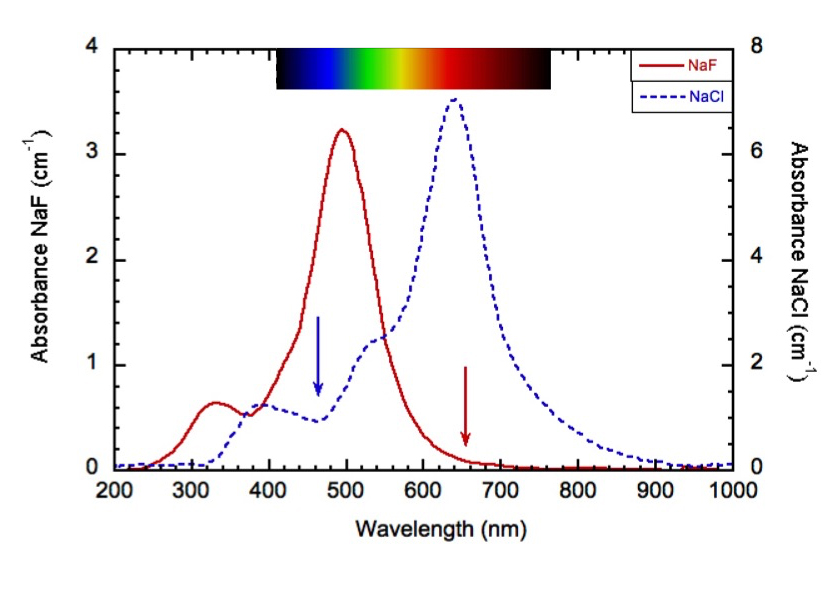
Sodium nanoparticles in alkali halide minerals: Why is villiaumite red and halite blue?
https://doi.org/10.2138/am-2021-7917
Radiation damage in natural alkali halides causes alkali ions to form metallic nanoparticles that produce vivid bright colors. In this paper by Calas et al., the Lorentzian lineshape of the main absorption band characterizes a Surface Plasmon Resonance effect due to Na colloids, about 2.5-3 nm large. As the resonance wavelength depends on the refractive index of the mineral, the position of this band shifts between the two minerals. The resulting change of the transmission window causes a dramatic change of color from red villiaumite to blue halite. This approach may also help understand the purple color of irradiated fluorite, which also arises from the presence of metal colloids.
Volume 106 : April 2021 Issue
Gamma-enhancement of reflected light images: A rapid, effective tool for assessment of compositional heterogeneity in pyrite
https://doi.org/10.2138/am-2020-7606
Zhu et al. developed a gamma correction method to display impurity-induced reflectance variation of pyrite at grain scale. This method enhances optical digital signal differences obtained under reflected light using an optical microscope. Incorporation of As in pyrite reduces the total number of electrons that could be excited to produce reflected light, resulting in decrease of reflectance. Gamma correction is a rapid, effective tool for the assessment of compositional heterogeneity in pyrite and other ore minerals with negligible bireflectance. Gamma-enhanced images may help constrain links between textures and compositions of minerals prior to subsequent quantitative analyses.

Thermal metamorphic history of Antarctic CV3 and CO3 chondrites inferred from the first- and second-order Raman peaks of polyaromatic organic carbon
https://doi.org/10.2138/am-2021-7507
Yesiltas et al. determined the first- and second-order carbon Raman peak parameters in an effort to infer asteroidal thermal metamorphic history. The second-order carbon peaks are quantitatively studied for the first time, which contain information that the first-order peaks don't. Peak metamorphic temperatures of the investigated meteorites have been estimated based on the width of the D band as well as the calculated Raman spectral curvature.
A quantitative description of fission-track etching in apatite
https://doi.org/10.2138/am-2021-7614
Aslanian et al. propose a quantitative model of fission-track etching in apatite and use it for calculating the shapes and dimensions of etched tracks in different faces. Their model replaces an earlier model and invalidates certain restrictive dating practices based on it. This can have a profound effect on fission-track dating. Their measurements show that the length of confined tracks increases with etch time at a decreasing average rate that differs from the track-etch rate as well as from that of undamaged apatite. Step-etch experiments are shown to be useful for reducing or eliminating procedure-related effects from the track-length data and so for accessing more fundamental track properties resulting from formation and annealing.
Spectroscopic analysis of allophane and imogolite samples with variable Fe abundance for characterizing the poorly crystalline components on Mars
https://doi.org/10.2138/am-2020-7329
Poorly crystalline nanophase minerals that occur as weathering products on Mars contain critical information about the evolution of the early martian climate. Jeute et al. present compositional, structural, and spectroscopic data on a set of synthetic Mars analog nanophase aluminosilicates, including imogolite and allophanes with varying Al-Si ratios. They show that changes in the Al-Si ratio can be remotely detected, and that this measurement will help evaluate current models for the climatic evolution of Mars.
Relationship between 207Pb NMR chemical shift and the morphology and crystal structure for the apatites Pb5(AO4)3Cl, vanadinite (A = V), pyromorphite (A = P), and mimetite (A = As)
https://doi.org/10.2138/am-2021-7368
NMR spectroscopy of single crystals is the method of choice to precisely determine the full tensors of NMR interaction parameters via orientation-dependent measurements. Zeman et al. conducted a series of single-crystal NMR experiments on natural minerals, in particular on lead-bearing compounds, with the aim to extract the chemical shift tensor of 207Pb in high precision. Going beyond mere tensor determination, they noted that within the mineral family of vanadinite, pyromorphite, and mimetite, the NMR chemical shift may be related to some structural parameters such as unit-cell volume. From evaluating the number of the NMR resonances and their respective line widths, information about the mosaicity of these minerals could be derived.
« ‹ 1 … 44 45 46 47 48 … 85 › »ADDITIONAL RESOURCES