
Editor’s Notes
Total Results: 1697
Volume 106 : January 2021 Issue
Effects of pH and Ca exchange on the structure and redox state of synthetic Na-birnessite
https://doi.org/10.2138/am-2020-7112
Elmi et al. investigate the structures of a series of synthetic Ca-birnessite analogs prepared by cation-exchange with synthetic Na-birnessite at pH concentrations from 2 to 7.5. The exchange experiments described in this paper, performed over a range of pH values (3 to 7.5) and Ca2+ concentrations that are relevant to natural environments, yielded Ca-birnessite products that all have the same triclinic structure with nearly identical unit-cell parameters. Their results reveal that the transformation of Na- to Ca-birnessite is more than a simple replacement of Na by Ca.
A systematic assessment of the diamond trap method for measuring fluid compositions in high-pressure experiments
https://doi.org/10.2138/am-2020-7453
Rustioni et al. provide tests of the diamond trap method to study fluid compositions in experimental charges in order to evaluate the reliability of this method. They also describe several experimental improvements of the method that will be useful for further studies. This paper will be quite interesting for a wide audience of experimental petrologists and geochemists.
Origin, properties, and structure of breyite: The second most abundant mineral inclusion in super-deep diamonds
https://doi.org/10.2138/am-2020-7513
Breyite is the second most abundant mineral inclusion after ferropericlase in diamonds of super-deep origin. The occurrence of breyite is widely used as a strong indication of a lower mantle (>670 km depth) or at least lower transition zone (>520 km depth) origin of both the host diamond and the inclusion suite. Brenker et al. demonstrate through different formation options that the finding of breyite alone in a diamond is not a reliable indicator for the formation depth, accompanying paragenetic phases such as ferropericlase and/or MgSiO3 are needed. As a large set of papers were published in recent years based on findings on breyite in super-deep diamonds and used to determine the chemical composition of the deep Earth and to decipher deep Earth processes, the new work presented here question some of the conclusions drawn if based on the sole finding of breyite.
Why Tolbachik diamonds cannot be natural
https://doi.org/10.2138/am-2020-7562
Litasov et al. provide comprehensive evidence that type Ib cuboctahedral diamonds and microcrystalline diamonds from Kamchatka volcanic rocks and alluvial placers cannot be natural and undoubtedly represent synthetic materials, which appear in the natural rocks by anthropogenic contamination. The major arguments provided in favor of the natural origin of those diamonds can be easily disproved. The cavitation model proposed for the origin of Tolbachik diamonds is also unreliable, since cavitation can cause the formation of nanosized diamonds only.
Deciphering the enigmatic origin of Guyana’s diamonds
https://doi.org/10.2138/am-2020-7486
Bassoo et al. present a comprehensive study of Guyana's diamonds, using cathodoluminescence, UV fluorescence, Raman spectroscopy, FTIR and δ13C analyses. Inclusion suites and δ13C values indicate diamonds are derived from peridotitic lithospheric mantle at ~1120 °C. Dissolution textures suggest diamonds were hosted in a H2O rich magma. Detrital zircon geochronology and accessory mineral chemistry suggest most diamonds are likely sourced from middle to late Trans-Amazonian rocks which have since weathered into the ~1.98 Ga Roraima Supergroup conglomerates and volcaniclastics. However, provenance of a population of pristine, non-abraded diamonds is enigmatic, because cathodoluminescence and dissolution textures suggest a lesser metamorphic overprint and different source melt than abraded diamonds. This study characterizes and places Guyana's diamonds into the wider context of Guiana Shield and West African Craton evolution.
Precipitation of low-temperature disordered dolomite induced by extracellular polymeric substances of methanogenic Archaea Methanosarcina barkeri: Implications for sedimentary dolomite formation
https://doi.org/10.2138/am-2020-7381
"Dolomite [CaMg(CO3)2] is a common mineral in the rock record. However, the rarity of modern dolomite and the notorious difficulty in synthesizing dolomite abiotically under Earth-surface conditions result in the long-standing enigma in sedimentary geology, known as the ""dolomite problem."" Anaerobic microorganisms, such as sulfate-reducing bacteria (SRB) and methanogens have been recognized to mediate dolomite precipitation. However, the mechanistic link between anaerobic bacteria and dolomite formation is still not revealed. In the present study, Zhang et al. report precipitation of disordered dolomite in Ca-Mg carbonate solutions containing purified inactive biomass of a natural consortium of the methanogen Methanosarcina barkeri. Carbonate precipitation experiments in solutions containing capsular extracellular polymeric substances (EPS) extracted from the biomass showed that EPS was the active component that triggered dolomite crystallization. The present study clearly demonstrates the catalytic role of EPS in dolomite formation. It also proves the possible involvement of fermentative bacteria in dolomite formation, which to their best knowledge has not been reported previously. This study provides significant insight into the formation mechanism of microbial-induced dolomite with heavy δ13Cvalues during diagenesis."
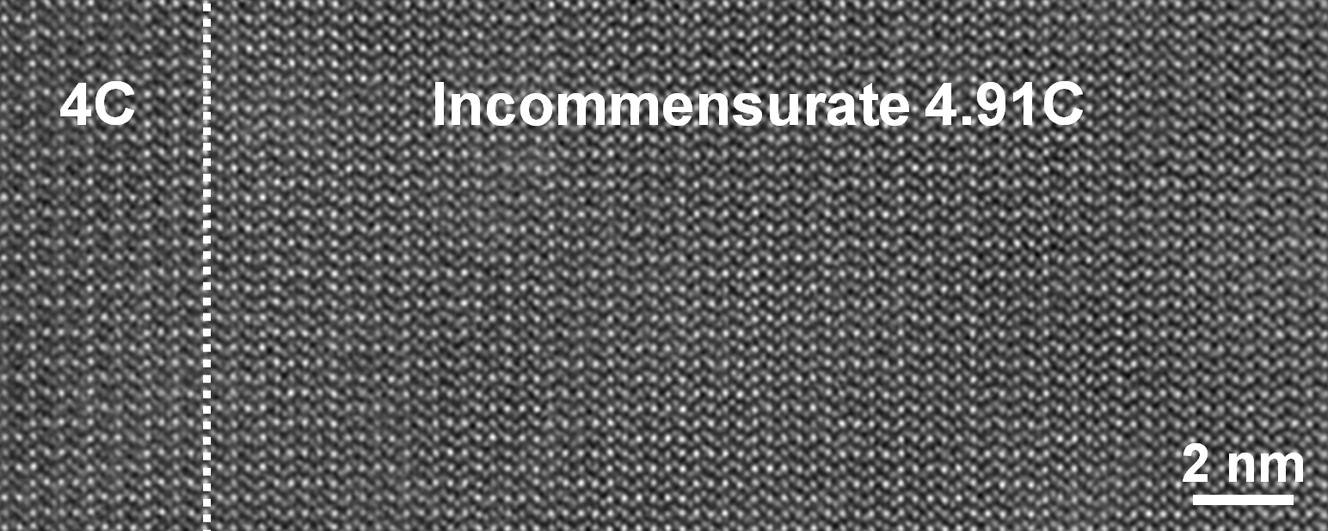
Atomic-scale characterization of commensurate and incommensurate vacancy superstructures in natural pyrrhotites
https://doi.org/10.2138/am-2020-7479CCBY
Jin et al. report that (1) Superstructures formed by Fe vacancy ordering in natural pyrrhotites are revealed using atomic-resolution scanning transmission electron microscopy; (2) Picometer-scale shifts of individual Fe atomic columns are consistent with a model for the structure of 4C pyrrhotite derived using X-ray diffraction; and (3), 5C-like unequally-sized nano-regions joining at anti-phase-like boundaries lead to the incommensurability observed in 4.91 ± 0.02 C pyrrhotite.
Three-dimensional and microstructural fingerprinting of gold nanoparticles at fluid-mineral interfaces
https://doi.org/10.2138/am-2021-7696
Zhou et al. present the first 3D FIB/SEM tomography images and TEM microstructures of gold nanoparticles in an ore mineral, in this case from the world-class Beiya Au deposit, China. The results unravel how intrinsic and extrinsic factors drove the formation of Au nanoparticles at fluid-mineral interfaces. Non-lattice-bound gold in ore minerals is commonly interpreted to be remobilized from exsolution of earlier formed minerals. However, their work offers an alternative explanation that this gold can also be introduced by hydrothermal fluids during later mineralization stages. They also suggest that this gold in many ore minerals may reflect nano-scale permeability between nanopores that developed during dissolution-reprecipitation reactions involving earlier minerals.
Seaborgite, LiNa6K2(UO2)(SO4)5(SO3OH)(H2O), the first uranyl mineral containing lithium
https://doi.org/10.2138/am-2020-7540
Kampf et al. report on the first uranyl mineral containing essential lithium, which plays an important role in this structure. The structure is unique among both natural and synthetic phases.
Reheating and magma mixing recorded by zircon and quartz from high-silica rhyolite in the Coqen region, southern Tibet
https://doi.org/10.2138/am-2020-7426
Chen et al. report on: (1) High-silica rhyolites (HSRs) erupted at ~74 Ma from the Coqen region, southern Lhasa terrane; (2) Trace element characteristics of zircons from Nuocang HSRs indicate multi-stage magmatic processes involving magma mixing; (3) Ti geothermometers of zircon and quartz suggest reheating in the magma reservoir; and (4) Zircon and quartz with distinct internal textures provide critical insights into the formation of HSR.
Crystal chemistry and thermal behavior of Fe-carpholite from the Pollino Massif, southern Italy
https://doi.org/10.2138/am-2020-7385
Mesto et al. report on: (1) new insights into the crystal chemistry of Fe-Mg carpholites; (2) new data on the thermal evolution of the species, obtained by TG-DTA as well as in situ high-temperature powder diffraction analysis; (3) new Raman data; and (4) first study on the thermal behavior of the most common carpholite composition occurring in HP/LT metasediments in collisional contexts.
New insights into the control of visible gold fineness and deposition: A case study of the Sanshandao gold deposit, Jiaodong, China
https://doi.org/10.2138/am-2020-7475
Peng et al. report on: (1) Mineralogy and chemistry research on the gold-producing zone from –4000 m depth to surface; (2) Two generations of gold grains with different fineness show different gold-precipitating processes; (3) Three types of pyrite record the temporal and spatial evolution of ore-forming fluid; and (4) Integrated gold fineness, pyrite trace element, and sulfur isotope reveal a comprehensive genetic model.
A comment on “An evolutionary system of mineralogy: Proposal for a classification of planetary materials based on natural kind clustering”
https://doi.org/10.2138/am-2021-7590
A comment on “An evolutionary system of mineralogy: Proposal for a classification of planetary materials based on natural kind clustering”
Reply to “A comment on ‘An evolutionary system of mineralogy: Proposal for a classification of planetary materials based on natural kind clustering’”
https://doi.org/10.2138/am-2021-7773
"Reply to ""A comment on 'An evolutionary system of mineralogy: Proposal for a classification of planetary materials based on natural kind clustering'"""
NEW MINERAL NAMES
https://doi.org/10.2138/am-2021-NMN106131
New Mineral Names
Volume 105 : December 2020 Issue
The incompressibility of atoms at high pressures
https://doi.org/10.2138/am-2020-7123
How compressible is an atom? Here, Gibbs et al. report the impact of pressure on the sizes of the bonded radii of a diverse range of atoms by calculating their bonded interactions and electron density distributions as a function of pressure. The results provide novel insights about the compressibility of atoms and changes in their chemical bonding at high pressure.
Phase transitions in ε-FeOOH at high pressure and ambient temperature
https://doi.org/10.2138/am-2020-7468
Constraining the accommodation, distribution, and circulation of hydrogen in the Earth's interior is vital to our understanding of the deep Earth due to the significant influence of hydrogen on the material and rheological properties of minerals. Recently, a great deal of attention has been paid to the high-pressure polymorphs of FeOOH. These structures potentially form a hydrogen-bearing solid solution with AlOOH and phase H (MgSiO4H2) that may transport water (OH-) deep into the lower mantle. In this study, Thompson et al. re-evaluated the high-pressure evolution of FeOOH up to ~75 GPa using a combination of synchrotron X-ray diffraction, Fourier transform infrared spectroscopy, and optical absorption spectroscopy. Based on these measurements, the authors report on the phase transitions which occur in ε-FeOOH at ambient temperature and pressures up to 70 GPa.
Thermal state of the upper mantle and the origin of the Cambrian-Ordovician ophiolite pulse: Constraints from ultramafic dikes of the Hayachine-Miyamori ophiolite
https://doi.org/10.2138/am-2020-7160
Kimura et al. demonstrated that a global thermal state of the upper mantle in the Cambrian-Ordovician time, which corresponds to the period of high production of ophiolites, called a ophiolite pulse, was similar to the present one by quantitatively estimating the mantle potential temperature from an arc ophiolite. They also showed that a slab breakoff tectonics is responsible for the magma generation and further argued that such tectonics frequently took place during the Cambrian-Ordovician time resulting in the ophiolite pulse.
Quadrivalent praseodymium in planetary materials
https://doi.org/10.2138/am-2020-7325
Praseodymium is a rare earth element (REE) that predominantly occurs in the trivalent oxidation state like most other REEs. However, in some cases it can occur as tetravalent Pr, leading to a subtle anomaly in REE patterns. It is stabilized by high oxygen fugacities and low temperatures. Anenburg et al. find Pr4+ in tetravalent Ce minerals (cerianite and stetindite), and they discuss the possibility of finding a pure tetravalent Pr mineral.
Quantitative microscale Fe redox imaging by multiple energy X-ray fluorescence mapping at the Fe K pre-edge peak
https://doi.org/10.2138/am-2020-7359
Ellison et al. describe a synchrotron-based X-ray spectroscopic approach that allows microscale quantitative mapping of Fe valence state by extending the Fe XANES pre-edge technique. An area of interest is mapped at 10 excitation energies, allowing reconstruction, baseline subtraction, and integration of the pre-edge feature to determine Fe(III)/ΣFe at every pixel. By combining the Fe redox mapping approach with hyperspectral Raman mapping, the Fe oxidation state distributions of the major mineral phases can be revealed. They provide an example of application of this method to a partially serpentinized peridotite from the Samail Ophiolite (Oman) that displays a variety of secondary mineral phases with a range of Fe redox states. Quantification of Fe(II) and Fe(III) in these phases allows for determination of the sequence of reactions and Fe transformations that produced the observed alteration assemblage.
« ‹ 1 … 47 48 49 50 51 … 85 › »ADDITIONAL RESOURCES