
Editor’s Notes
Total Results: 1697
Volume 110 : December 2025 Issue
Synthesis of zircon-hafnon to determine oxygen isotope matrix effects in secondary ionization mass spectrometry
https://doi.org/10.2138/am-2025-9886
Oxygen isotopes in natural minerals carry important geochemical information, but variability at the micrometer scale requires high-resolution analytical techniques to extract it. This can be achieved using secondary ion mass spectrometry (SIMS), in which instrumental mass fractionation is corrected by comparison with a natural reference zircon. In this study, Schmitt et al. synthesized crystals with a wide range of Zr and Hf abundances to quantify how this compositional variation affects the accuracy of SIMS oxygen isotope data. The results demonstrate that Hf abundances in most natural zircon are uncritical relative to other uncertainty sources in SIMS oxygen isotope analysis, but conventional calibration introduces significant bias for Hf-rich zircon from pegmatites.
Using multimodal X-ray computed tomography to advance 3D petrography: A non-destructive investigation of olivine inside a carbonaceous chondrite
https://doi.org/10.2138/am-2023-9213
Pankhurst et al. present a step-change in petrography/mineralogy towards full 3D, non-destructive analysis at the microscale. 3D data of rocks allows for true shape, size, and spatial characteristics and relationships to be measured and used to reveal patterns and trends between features and their 3D contexts that are impossible to see with 2D data. The grains' individual characteristics, like size and composition, can be individually inter-comparable, rather than populations with characteristics, like frequencies of composition or size distributions.
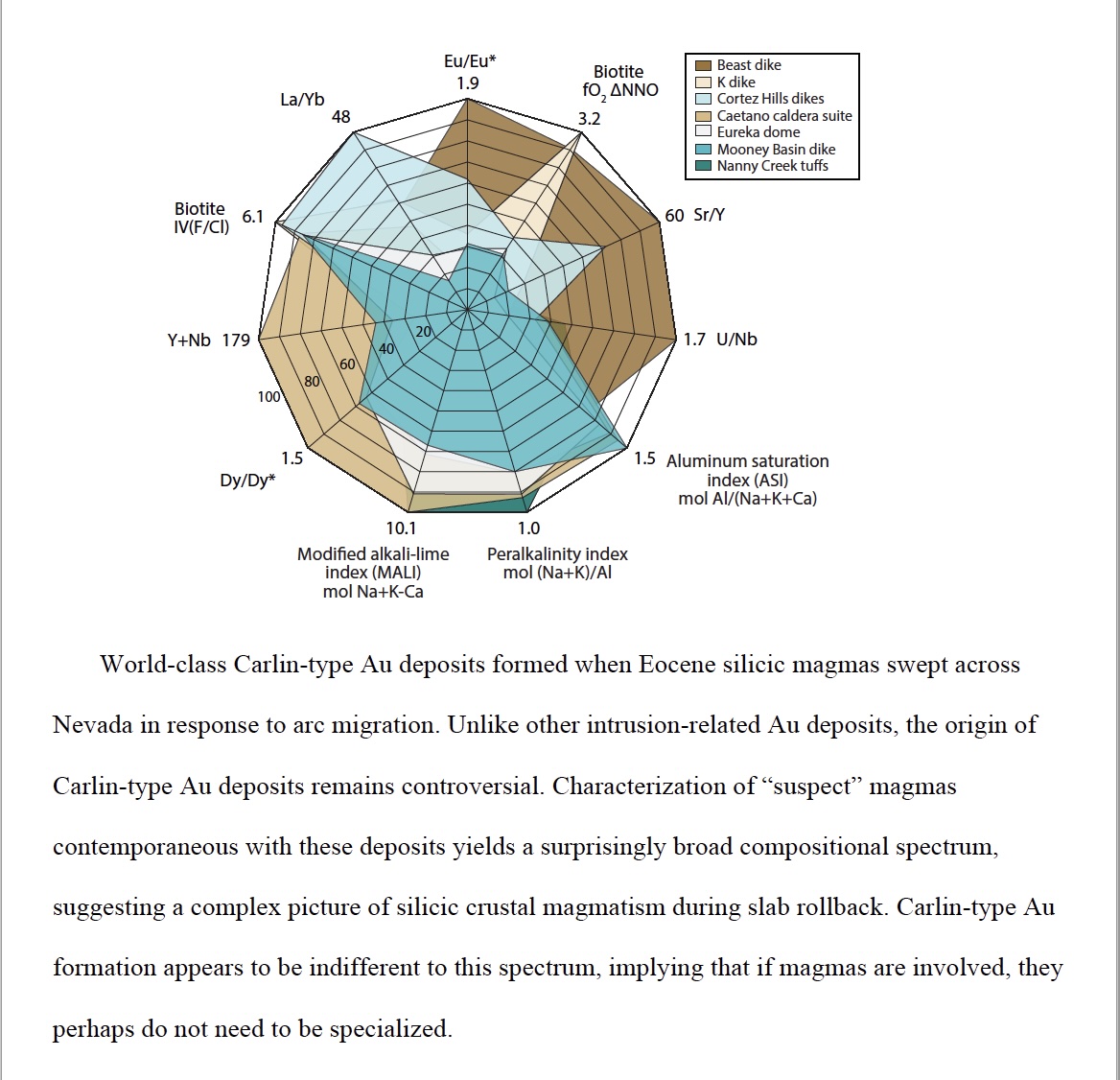
Pre-eruptive characteristics of "suspect" silicic magmas in Carlin-type Au-forming systems
https://doi.org/10.2138/am-2024-9372
World-class Carlin-type Au deposits formed when Eocene silicic magmas swept across Nevada in response to arc migration. Unlike other intrusion-related Au deposits, the origin of Carlin-type Au deposits remains controversial. In this study by Mercer et al., characterization of "suspect" magmas contemporaneous with these deposits yields a surprisingly broad compositional spectrum, suggesting a complex picture of silicic crustal magmatism during slab rollback. Carlin-type Au formation appears to be indifferent to this spectrum, implying that if magmas are involved, they perhaps do not need to be specialized.
Accurate XANES determination of microscale Fe redox state in clinopyroxene: A multivariate approach with polarization-dependent Fe K-edge XAFS
https://doi.org/10.2138/am-2024-9712
Clinopyroxene shows significant variation in X-ray absorption depending on its crystallographic orientation relative to X-ray propagation and polarization. Ito et al. applied multivariate statistical techniques to determine microscale Fe2+/Fe3+ ratios irrespective of orientation with uncertainties of ±7.2–8.5%Fe3+ from X-ray absorption spectra. This result is a significant improvement on conventional methods (±13.5–15.3%Fe3+). The new method allows reliable measurements of Fe redox states using standard petrographic thin sections without destroying textures.
Apatite geochemistry records crustal anatexis: A case study of metapelites and granitic gneisses from the Cona area in the eastern Himalaya
https://doi.org/10.2138/am-2024-9685
Apatite, a common accessory mineral found in almost all types of metamorphic rocks, offers a valuable avenue for exploring its geological significance. Ji et al. investigated apatite in a series of metapelites and granitic gneisses that underwent amphibolite-to-granulite facies metamorphism in the Himalayan orogen. Apatite in these rocks exhibits distinct mineralogical features and major-trace element compositions. The results demonstrate that apatite geochemistry can effectively differentiate protolith type, metamorphic grade, and anatectic mechanism. By evaluating the mechanisms by which these factors influence the anatectic reaction, this study found that apatite can act as both a reactant and a product, with its geochemical composition serving as an indicator of the anatectic mechanism.
Mineralogy and precipitation controls on saprolite lithium isotopes during intensive weathering of basalt
https://doi.org/10.2138/am-2024-9515
Understanding how Li isotopes respond to the changes in silicate weathering processes and climate is vital for reconstructing the weathering and climate history. Zhu et al. present Li isotope compositions of the saprolites and unaltered bedrock in a weathering profile developed on basalt in Hainan Island where abundant rainfall and the least dusty regions in China, and the δ7Li data from different rivers were compiled to decipher the dissolved δ7Li signatures. The results show that the effect of rainwater Li input on saprolite δ7Li values is indirectly by the adsorption and desorption of secondary minerals. Mineral control on saprolite Li isotopes yields distinct δ7Li values in the basaltic and granitic catchments. Diverse types of secondary minerals formed in the suspended load of the rivers may be another reason for the shifts in δ7Li values of rivers at different lithological regions. This work illustrates how precipitation affects the Li isotopic signatures of dissolved Li, thereby helping to decipher the seawater lithium isotope record over geological history.
Texture and geochemistry of multi-stage hydrothermal scheelite in the Dongyuan porphyry-type W-Mo deposit, South China: Implications for the ore-forming process and fluid metasomatism
https://doi.org/10.2138/am-2024-9716
The complex textures of minerals, such as scheelite, can yield crucial insights into fluid evolution history in ore deposits. Dong et al. employed optical microscopy, SEM-CL, EPMA, and LA-ICP-MS to analyze texturally complex scheelite, together with high-resolution fs-LA-MC-ICP-MS for sulfides coexisting with scheelite in the Dongyuan porphyry-type W-Mo deposit, South China. The analyses evaluate the origin, nature, and evolution of ore-forming fluids, the influence of surrounding rocks, and the formation mechanisms of different scheelite generations. Based on the results, the authors propose a model of host-rock interaction, assimilation, and the evolution of ore-forming fluids that contribute to W-Mo mineralization in the Dongyuan deposit.
Anoxic and iron-rich seawater conditions facilitated reverse weathering: Evidence from the Mesoproterozoic siliceous rocks
https://doi.org/10.2138/am-2024-9543
Ke et al. investigated authigenic berthierine and stilpnomelane in siliceous rocks of the Songziyuan Formation in South China. Petrographic and geochemical evidence indicate that silica-rich, anoxic, and iron-rich conditions facilitate the authigenesis of these minerals. Enhanced reverse weathering may have helped maintain the long-term greenhouse climate during the mid-Proterozoic.
The effect of H2O on the crystallization of orthopyroxene in a high-Mg andesitic melt
https://doi.org/10.2138/am-2024-9593
Koch et al. experimentally investigated the crystallization behavior of orthopyroxene in a silicate melt at varying H2O concentrations and pressures. The results show that the crystallization temperature of orthopyroxene is depressed linearly with increasing water concentration in the melt. These findings can help improve current petrological models by providing a parameterization for the effect of H2O on crystallization temperatures of orthopyroxene.
Bradleyite Na3Mg(PO4)(CO3) inclusion in diamond: Structure and significance
https://doi.org/10.2138/am-2024-9704
Kaminsky et al. identified bradleyite Na3Mg(PO4)(CO3), a rare mineral, as an inclusion in a diamond. Since its discovery in 1941, the ab initio structure of bradleyite has been studied for the first time. The analysis of all known localities of bradleyite to date demonstrates that it is a polygenetic mineral, formed both in continental salt deposits under atmospheric pressure and in deep-formed igneous rocks, such as kimberlites and carbonatites, under high P-T conditions. The new finding of bradleyite demonstrates its stability in diamond-forming environmental conditions.
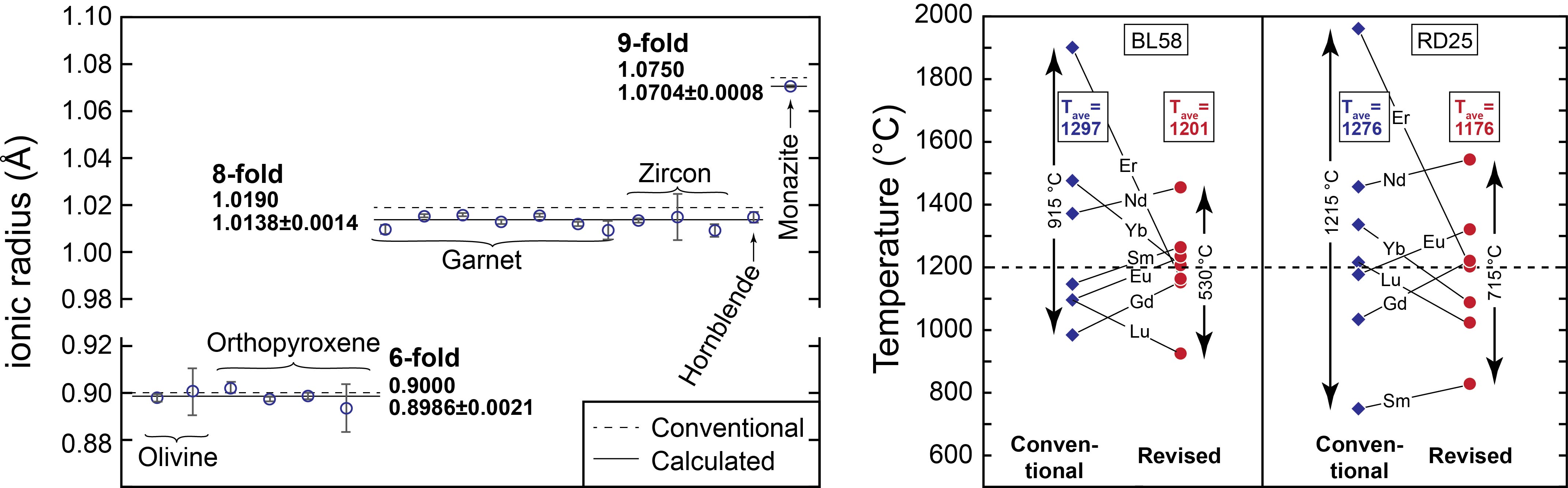
Revision of Y3+ ionic radii in common minerals based on trace element partitioning
https://doi.org/10.2138/am-2025-9771
The ionic radii of rare-earth elements (Sc, Y, and the lanthanides) are widely used for petrogenetic tracing as well as for thermometry. The accuracy of ionic radii underpins many applications. Kohn and Schwartz show that the ionic radius of trivalent Y is smaller than commonly assumed. Corrections improve thermometer accuracy by tens to hundreds of degrees.
Aqueous fluid drives rhenium depletion in the continental crust
https://doi.org/10.2138/am-2025-9774
This study resolves the long-standing mystery of rhenium (Re) depletion in the continental crust by demonstrating that post-magmatic fluid exsolution—not sulfide cumulation—dominates Re extraction. Shuo et al. show that Re partition coefficients between aqueous fluids and silicate melts scale systematically with H2O fugacity, revealing a fluid-driven depletion mechanism. During arc magma differentiation, approximately 80% of Re is scavenged by aqueous fluids, leaving the continental crust profoundly Re-depleted. These findings redefine our understanding of rhenium cycling in magmatic systems and underscore the critical role of fluid-mediated processes in shaping the geochemical architecture of the continental crust. The work also provides a quantitative framework for interpreting Re anomalies in arc lavas and ore-forming systems.
Synthesis and crystal structure of V-rich tourmaline
https://doi.org/10.2138/am-2025-9882
Setkova et al. investigated the newly formed overgrown layers of dark green tourmaline up to 0.7 mm in size with vanadium contents up to ~12 wt% V2O3 (~1.6 apfu) and ~41 wt% V2O3 (~6 apfu) for the systems (V1) V2O3-Al2O3-SiO2-B2O3-H2O and (V2) Na2O-MgO-V2O3-Al2O3-SiO2-B2O3-H2O, respectively. Synthetic tourmalines are triclinic (P1) due to cation orderings and could be considered as dimorphs of V-dominant analog of alumino-oxy-rossmanite (V1) and oxy-vanadium-dravite (V2).
Ertlite, NaAl3Al6(Si4B2O18)(BO3)3(OH)3O, a new mineral species of the tourmaline supergroup
https://doi.org/10.2138/am-2025-9816
Cempírek et al. describe ertlite, the first tourmaline species in which boron replaces silicon at the tetrahedral site. The existence of the species has been anticipated since the late 1990s. Ertlite is defined using two tourmalines with the highest recorded tetrahedral boron contents to date. The discovery of ertlite allows recognition of its potential petrological importance in B-bearing sedimentary rocks, salar-type sedimentary sequences, or their low-grade metamorphic analogs.
Volume 110 : November 2025 Issue
High-resolution analysis of clay minerals and amorphous materials in martian analog environments
https://doi.org/10.2138/am-2023-9290
Thorpe et al. document a combined high-resolution approach to better understand the nano-structure and composition of mud-sized sediments from a glacier- and river-fed watershed in southwest Iceland. Results demonstrate that sediments from the frigid climate of Iceland are more altered than previously thought and that the secondary amorphous assemblage is dynamic within the journey of sediment from the mountains to the ocean. On Earth, underestimating the extent of alteration in modern sediments has implications for interpreting the paleoclimate preserved in the geological record and for fully understanding the carbon cycle, as weathering can be a sink for CO2. This work emphasizes the importance of using high-resolution techniques for sample return missions, showing how the terrestrial reference frame can better interpret the sedimentary history of other rocky bodies.
Origin and evolution of granitic pegmatite rare metal deposits in the northern Mufushan batholith, South China: Insights from muscovite chemistry
https://doi.org/10.2138/am-2024-9636
Granite pegmatites are generally considered to be the final products of the differentiation of the continental crust and are an important source of incompatible rare metal elements. However, the origin of granite pegmatites and the enrichment mechanism of rare metals remain a subject of debate. In this study, Zheng et al. focus on the coeval, cogenetic barren and rare metal pegmatites as well as the associated granitic intrusions in the northern Mufushan batholith in South China. Overlapping initial εNd(t) permits the pegmatite groups to be related. The authors calculated the initial melt compositions in equilibrium with muscovite for both types of pegmatites. The results show that pegmatites may represent distinct degrees of Rayleigh fractionation (from 50 to 90%) with constitutional zone refinement. These findings may be widely applied to granite pegmatites worldwide.
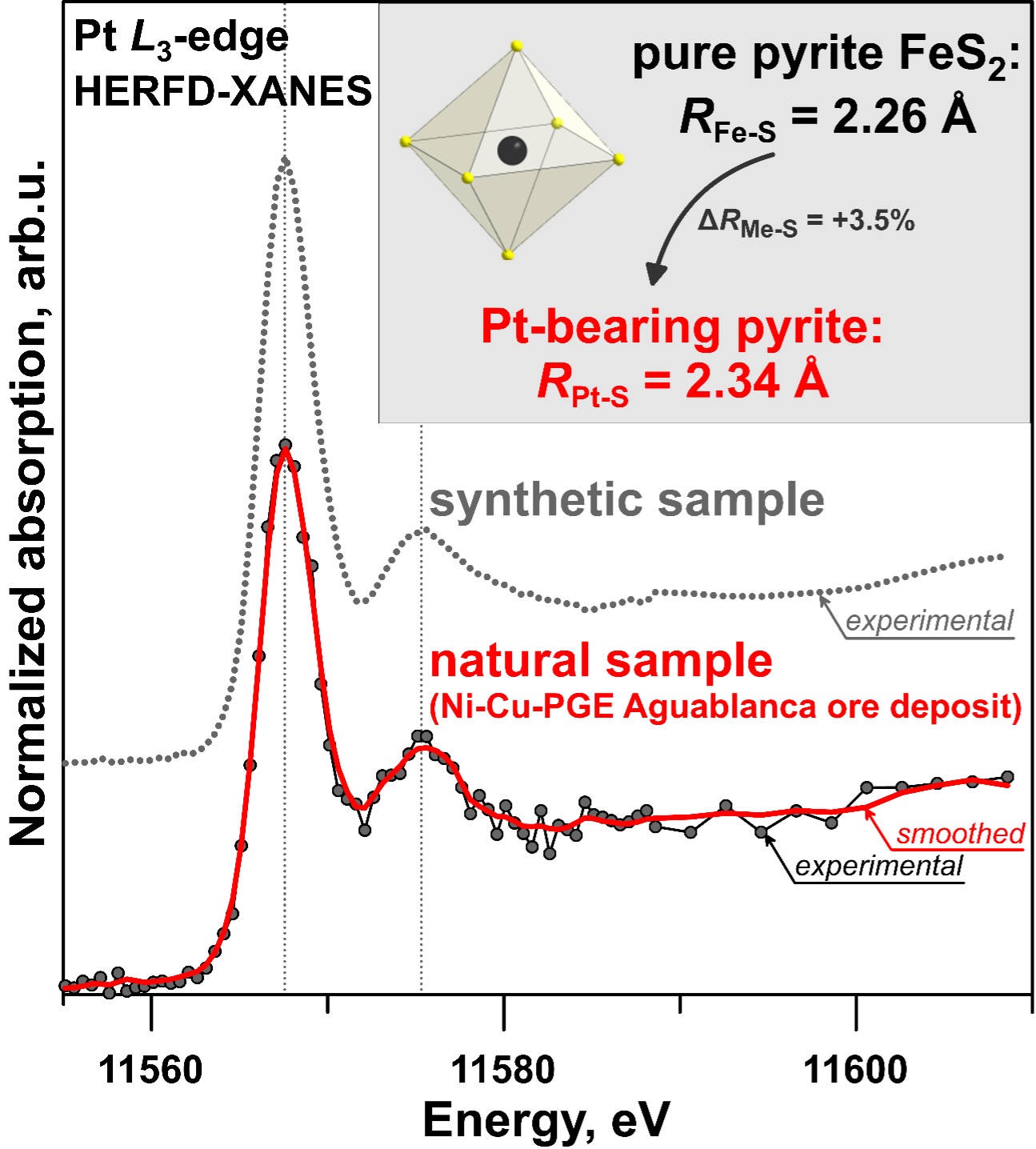
High-energy resolution X-ray absorption spectroscopy study of the state of Pt in pyrite
https://doi.org/10.2138/am-2024-9596
Platinum replaces Fe in pyrite from the Ni-Cu-PGE Aguablanca ore deposit in a way equivalent to synthetically Pt-doped pyrite (identical Pt-S interatomic distances). The authors demonstrate this is not the effect of nano- or microinclusions. The "formal" oxidation state of isomorphous Pt in pyrite Fe2+S2 sample is close to +3.5. The partial atomic charge of isomorphous Pt in pyrite is close to +0.4. The covalent radii control the Pt incorporation into Fe sites of pyrite structure (ca. 3% different). The process of Pt-enrichment of pyrite sample took place at T > 360 °C.
Nanoscale mapping of ZrSiO4 phases in naturally shocked zircon using electron energy loss spectroscopy
https://doi.org/10.2138/am-2024-9455
Roddatis et al. demonstrate a fast and reliable method to map a phase distribution of zircon and reidite in shocked zircon. The results were collected using EELS and verified with precession electron diffraction (PED). They describe differences in high- and low-loss spectra between zircon and reidite and demonstrate advantages of the method, such as very high spatial resolution and very short acquisition time, which can be applied to many other geological samples. This work presents important findings for mapping phases with identical chemical compositions (e.g., silicon oxides and calcium carbonates), whereas other methods are very time-consuming and have lower reliability.
Nanogeochemistry of Ni, Co, and Cu in zoned marcasitepyrite crystals
https://doi.org/10.2138/am-2024-9508
This study investigates the micro-to-nanoscale features of zoned marcasite-pyrite crystals from the Sierra de Orihuela vein-type mineralization, revealing new insights into the partitioning of Ni, Co, and Cu during the formation of hydrothermal ore systems. The partitioning is attributed to solid solution and Ni-Co-Cu-rich nanoparticles. These findings highlight the economic potential of pyrite in ore deposits, emphasizing the importance of nanoscale studies in improving metal recovery.
Genetic types of Zn-Pb deposits revealed by sphalerite geochemistry
https://doi.org/10.2138/am-2024-9575
The identification of the genetic type of a mineral deposit, based on the compositional characteristics of specific minerals, is an important goal of economic geologists. Sphalerite often incorporates information from more than 10 elements, making it challenging to accurately represent the compositional nuances of these elements within traditional 2D diagrams. This study employs four extensively utilized machine learning algorithms to train 4908 sets of element data for sphalerite compiled from five distinct Zn-Pb deposit types. All the models exhibit satisfactory performance, achieving F1 scores that surpass 95%, which reflects the reliability of using sphalerite geochemistry to distinguish Zn-Pb mineralization types. The models from were used to classify three Zn-Pb deposits with unclear genetic types, with results consistent with geological observations. An Excel macro program was created to facilitate discrimination of the genetic type of Zn-Pb deposit.
« ‹ 1 2 3 4 5 … 85 › »ADDITIONAL RESOURCES