

Editor’s Notes
Total Results: 1697
Volume 110 : August 2025 Issue
Formation of nano-CdS solid solution: A mechanism for Cd enrichment in sphalerite
https://doi.org/10.2138/am-2024-9524
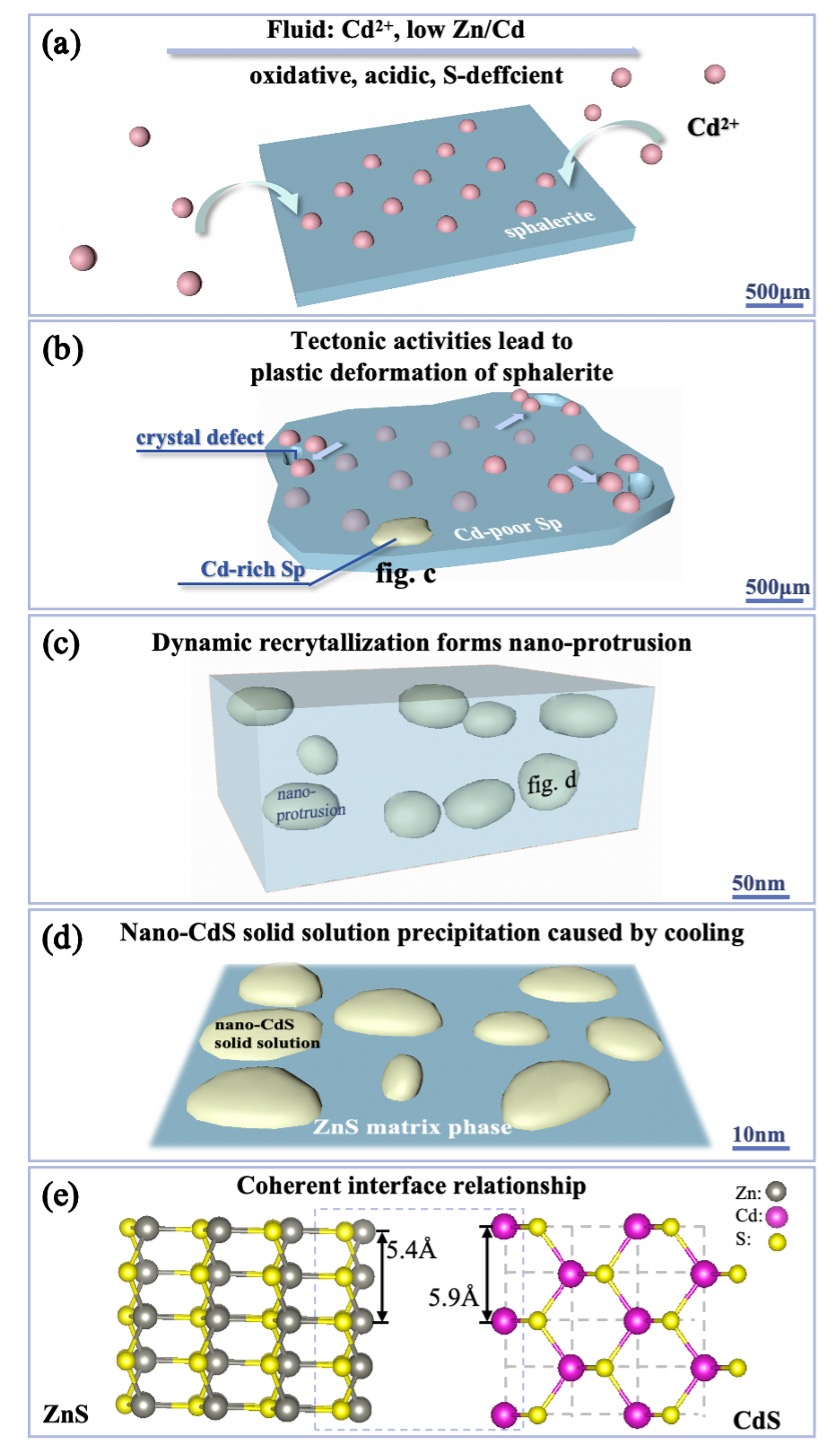
Yan et al. investigates the mechanism for Cd enrichment in sphalerite. In relatively Cd-poor areas, Cd was found to occur as a lattice substitution for Zn, whereas in Cd-rich areas, a new nano-scale occurrence state of Cd, namely nano-CdS solid solution, was discovered. Reactivation and dynamic recrystallization induced by plastic deformation of sphalerite, as well as solid solution precipitation caused by cooling, are important mechanisms for Cd enrichment. The coherent interface relationship between CdS and ZnS is crucial for the formation and stable existence of nano-CdS solid solution. This study provides new nanoscale mineralogical evidence and insights for understanding the complex distribution characteristics of dispersed elements in sphalerite.
Identification of the nature of recycled carbonates in the mantle: Insights from the Mo-Mg isotopic pair
https://doi.org/10.2138/am-2024-9408
Lei et al. demonstrated that recycled carbonate sediments at sub-arc depths in the mantle may increase their δ98/95Mo values without significantly affecting their δ26Mg values, whereas recycled carbonate sediments at post-arc depths in the mantle would decrease both δ98/95Mo and δ26Mg values. Therefore, the Mo-Mg isotopic pair may be a unique tool for determining whether the mantle contains recycled carbonates and for identifying the types of carbonates involved during oceanic subduction.
Discriminating ionic mobility between diffusivity and electrical conductivity experiments on EarthÕs silicate materials
https://doi.org/10.2138/am-2024-9523
Ionic diffusivity and electrical conductivity are the two most typical transport properties of Earth's silicate materials, and a genetic link between them has long been assumed. Yang demonstrated for the first time that the two transport properties of silicate materials cannot be correlated with each other; the theoretical and experimental reasons are discussed.
Morphological approach to understanding mineral alteration and nanoparticle formation under alkaline conditions using granitic rock thin sections
https://doi.org/10.2138/am-2024-9261
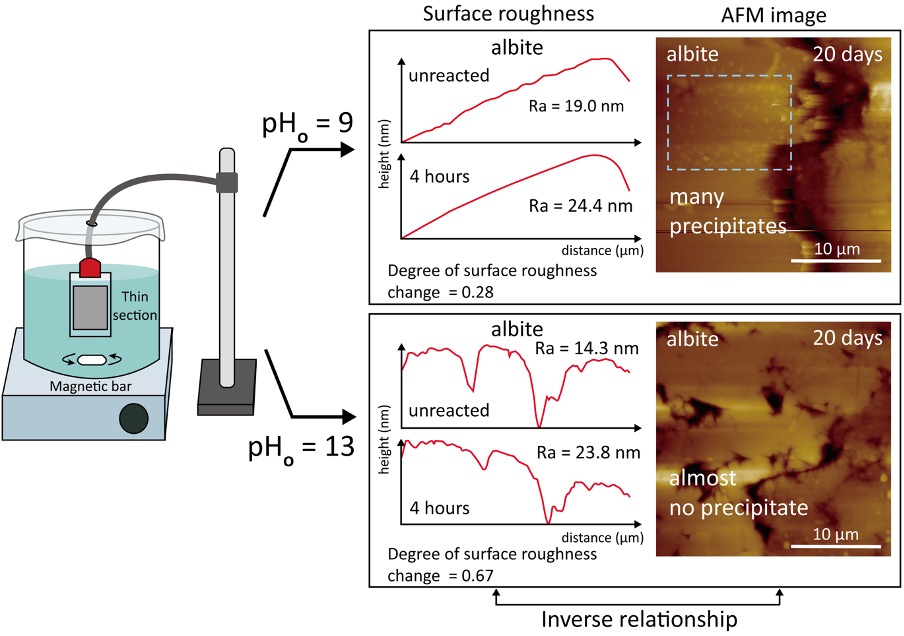
The cement components in deep geological disposal facilities (DGFs) for spent nuclear fuel can increase groundwater pH, potentially altering minerals within natural barriers. Previous studies investigating mineral alterations in deep geological rocks have used single mineral powder samples with high surface areas, which do not accurately represent the characteristics of real field-based geological environments involving coexisting minerals. In this study, Kim et al. investigated the alterations of various minerals (biotite, quartz, albite, chlorite, and K-feldspar) using samples that represent the exposed rock surface on the fracture planes of deep crystalline rocks. The morphological characteristics of granite rock thin sections exposed to alkaline aqueous solutions were examined using optical microscopy, atomic force microscopy, micro-X-ray fluorescence, and scanning electron microscopy with energy-dispersive X-ray spectroscopy. Furthermore, they investigated how mineral alterations affect the formation of secondary-phase nanoprecipitates. This study integrates multifaceted processes (such as dissolution, precipitation, and colloid formation) to provide a comprehensive understanding of the complex interplay between dissolution and precipitation reactions and demonstrates the importance of this integration using morphological analysis to visually exhibit these complex phenomena.
Identification of hydroandradite in CM carbonaceous chondrites: A product of calc-silicate alteration on C-complex asteroids
https://doi.org/10.2138/am-2024-9389
Hydroandradite, a water-bearing garnet, was found in two meteorites, Shidian and Kolang. This is the first identification of hydroandradite occurring in meteorites. Its occurrence near other hydrous minerals as well as in heated lithologies has implications for both its formation temperature and the temperatures at which it is stable. Hydroandradite may be found in more meteorites in the future.
Growth and crystallographic features of interpenetrant twins in natural diamonds
https://doi.org/10.2138/am-2024-9426
Sun et al. investigated the crystallographic features and growth mechanism of a group of interpenetrant twins in natural diamond from the Republic of Congo. Three types of theoretical twin models of natural diamond with interpenetrant twins have been established. From the observation of crystal morphology, all the samples exhibit a cubic habit with deformation. These crystals have a rough appearance and fibrous growth layers, indicating rapid crystallization under high driving force conditions. Combined with the growth features observed by the CL technique, two patterns emerge regarding the formation of interpenetrant twins in natural diamonds: 1) Grain originates in the nucleation stage of crystals in the form of twinned positions; and 2) The orientation of the growth layer arrangement changes during crystal growth. Moreover, a mixed type of twin structure was observed, indicating the complexity of the diamond twin growth process, which involves a transformation in the crystallization habit of the crystal.
Determination of the oxidation state of iron in calcic pyroxene using the electron microprobe flank method
https://doi.org/10.2138/am-2024-9467
Pyroxene is an important host mineral for ferric iron in igneous and mantle rocks. The oxidation state of iron (e.g., Fe3+/ΣFe) in pyroxene serves as a direct proxy for estimating the oxygen fugacity of magma and the mantle. Many techniques have been developed to determine the Fe3+/ΣFe ratio of pyroxene. The electron probe microanalysis (EPMA) flank method has several advantages, including easy accessibility, a micrometer-scale analysis area, and high efficiency. However, the application of this method to pyroxene groups has been explored in only a few studies and is further limited by a lack of appropriate calibration standards. In this study, Cao et al. examined nine natural pyroxene samples, including one aegirine, one hedenbergite, one diopside, and six augites. Based on the evaluation of these pyroxene samples, a multiple linear regression approach using the flank-method data, Fe2+, and ΣFe contents yields Fe2+ content and Fe3+/ΣFe ratios with an error of ±0.3 wt% and ±0.06, respectively, for calcic pyroxene containing 7 wt% total FeO. These well-characterized natural pyroxene samples can serve as reference materials for determining the Fe3+/ΣFe ratio in unknown calcic pyroxene.
Formation mechanism of boehmite and diaspore in karstic bauxites: Trace element geochemistry in source materials using a large sample geochemical dataset and a random forest model
https://doi.org/10.2138/am-2024-9499
Boehmite and diaspore are two economic ore minerals of karstic bauxites. A random forest (RF) model of machine learning was employed to extract the combined characteristics of trace elements in boehmite-type bauxite (BTB) and diaspore-type bauxite (DTB). The BTB predominantly exhibits higher median concentrations of Co, Ni, V, and Cr, while the DTB shows a more significant enrichment in U, Hf, Th, and Zr. BTB exhibits consistent characteristics with lateritic bauxite weathered from basic rock and its parent rocks. Similarly, DTB displays consistent characteristics with lateritic bauxite weathered from intermediate-felsic rock and their parent rocks. Through studying the relationship between Ni content and Fe3+/Fe2+ ratios, it has been discovered that the presence of trace elements like Ni in source materials can affect or regulate the ore-forming process, ultimately driving the transformation of gibbsite into either boehmite or diaspore.
High-temperature Raman spectroscopy of K2Ca(CO3)2 bütschliite and Na2Ca2(CO3)3 shortite
https://doi.org/10.2138/am-2024-9500
This study sheds light on the stability and vibrational properties of alkali/calcium carbonate minerals at high temperatures. The variation in anharmonicity between different vibrational modes of each of the low-temperature phases is assessed, yielding insights into inter-carbonate group couplings.
Effects of high-temperature annealing and low-temperature metamictization on Archean zircon: Constraints from U-Pb isotopes, trace elements, and Raman dating
https://doi.org/10.2138/am-2024-9502
Zircon is a common accessory mineral used to track high-temperature events, although its application to low-temperature chronometry is still debated. This study combines U-Pb in zircon dating, trace elements, and Raman spectroscopy to constrain the different behavior and thermal evolution of distinct lithologies at the same outcrop. The results indicate that high-temperature partial melting is unable to recover the structure of zircon grains, resulting in strong radiation damage and the influx of non-formula elements at lower temperatures. On the other hand, assimilation in mafic magmas leads to structure recovery, preservation of internal textures, and homogenization of trace elements. Raman zircon dating yields similar ages to U-Pb lower intercept ages, highlighting the potential of metamict zircon to track low-temperature events.
Nanoscale insights into weathering of Ti-bearing minerals and heterogeneous crystal growth mechanisms of nano Ti oxides in altered volcanic ash
https://doi.org/10.2138/am-2024-9573
Using a series of advanced nanoscale techniques, including focus ion beam, high-resolution transmission electron microscope (FIB-HRTEM), electron energy loss spectroscopy (EELS), and nano-computed tomography (Nano-CT), Liu et al. demonstrated that the growth of anatase and brookite nanoparticles within the volcanic ash matrix is regulated by Ostwald ripening (OR) with minor semi-oriented attachment (OA) and recrystallization. Meanwhile, the growth of brookite crystals in altered srilankite particles, which exhibits crystallization by particle attachment (CPA), is predominantly controlled by the oriented attachment mechanism. Under chemical weathering, the edges of TiO2 crystals tend toward amorphization, Ti4+ gradually reducing to the Ti3+ valence state. Following the alteration of srilankite, primary brookite crystals form in situ, initially growing into incomplete oriented particles through oriented attachment. Subsequently, these oriented particle fragments further grow by attaching to primary crystals in the matrix, forming large brookite crystals with consistent crystallographic orientations. This comprehensive dataset advances our understanding of the formation of authigenic/secondary Ti-bearing particles during diagenesis and the detailed alteration processes of TiO2 during the chemical weathering process in sedimentary systems.
High-pressure single-crystal X-ray diffraction and Raman spectroscopy of boltwoodite, K0.63Na0.37[(UO2)(SiO3OH)] (H2O)1.5
https://doi.org/10.2138/am-2024-9531
Chamberlain et al. report the first crystallographic and spectroscopic study of a uranyl mineral at high pressures. The uranyl silicate boltwoodite was selected for study because uranyl silicates are common in oxidized portions of uranium ore deposits, it forms when spent nuclear fuel is altered, good-quality natural crystals are available, and it has a relatively simple structure. A collection of single-crystal X-ray diffraction data and Raman spectra for multiple crystals contained in a diamond-anvil cell yielded insight into structural changes over the pressure range from ambient to 16.8 GPa. No obvious phase transitions were observed, with most changes to accommodate increasing pressure achieved through adjustments in the interlayer and increased corrugation of the uranyl silicate sheets.
Nanoscale characterization of chrysocolla, black chrysocolla, and pseudomalachite from supergene copper deposits of Atacama Desert in northern Chile
https://doi.org/10.2138/am-2024-9300
Kahou et al. conducted the first transmission electron microscopy (TEM) study on chrysocolla, black chrysocolla, and pseudomalachite samples from Mina Sur and Damiana supergene copper deposit. Chrysocolla and black chrysocolla are not homogeneous crystals but assemblages of nanoparticles embedded in an amorphous matrix. Scanning TEM (STEM) images reveal that chrysocolla presents rounded Cu-rich nanoparticles embedded in an amorphous matrix, while black chrysocolla presents needle-shaped Mn-rich and some rounded Cu-rich nanoparticles embedded in an amorphous matrix. Pseudomalachite is a massive polycrystalline mineral highlighted by large nanocrystal grains of ~500 nm. The results highlight the powerful advantage of TEM studies to yield important details about crystal structure and organization at nanoscales, which contributes to better understanding of textural characteristics and supergene copper minerals formation.
Volume 110 : July 2025 Issue
Boron coordination in omphacite and glaucophane derived from inter-mineral B isotope fractionation in natural rocks
https://doi.org/10.2138/am-2024-9482
The determination of boron coordination in the nominally boron-free minerals (e.g., clinopyroxene and amphibole) in natural samples is important for geochemical modeling of subduction. However, a direct determination of boron coordination at the trace-element level is analytically not feasible. Xu et al. provide an indirect way to estimate the proportions of trigonally and tetrahedrally coordinated boron in omphacite and glaucophane using their boron isotopic fractionations against tourmaline and phengite. Based on their B isotope fractionations, the authors concluded that 88 ±9% of the incorporation in clinopyroxene proceeds through the B(F,OH)Si-1O-1 substitution, and 12 ±9% of the B is incorporated by replacement of SiO4 tetrahedra by BO3 triangles. In contrast, B in glaucophane is exclusively incorporated in the tetrahedrally coordinated sites.
A machine-learning-based approach using clinopyroxene data to improve accuracy and efficiency in predicting tectonic settings: Implications for Rodinia supercontinent breakup triggered by mantle plume events
https://doi.org/10.2138/am-2024-9535
Clinopyroxene is a pervasive rock-forming mineral in basalt, carrying essential information about tectonic settings. In this study, three machine learning algorithms—Artificial Neural Network, Support Vector Machine, and Random ForestÑwere employed to analyze global big geochemical data of clinopyroxene to discriminate five tectonic environments, including continental within-plate, island arc, oceanic island, oceanic floor, and continental flood province. The findings demonstrate the efficacy of Support Vector Machine, which attains an accuracy of 92.1% (major element-based) and 95.2% (major and trace elements-based) for tectonic discrimination.
Correlations between the structural and impurity features reveal fluctuant growth conditions of natural fibrous diamonds
https://doi.org/10.2138/am-2024-9503
This study systematically correlated growth structures, plastic deformation, residual stress, and impurity, as well as micro-inclusion distribution features of coated diamonds from the Democratic Republic of Congo. Growth structures observed under CL were related to VN3H defects, while plastic deformation and residual stress were mainly associated with nitrogen impurities. Nitrogen content in the core could be contrastingly related to VN3H defects due to different annealing conditions. In the coat, nitrogen contents and VN3H defects were conventionally positively correlated. However, positive anomalies of nitrogen and VN3H contents appeared not only at dark fibrous layers with high micro-inclusion densities but also at light-yellow layers with low micro-inclusion densities. Considering factors influencing growth rates and the incorporation of nitrogen and hydrogen atoms during diamond growth, it was speculated that high water contents of growth mediums led to the formation of dark layers, and growth pressure decreases should be the major reason causing the formation of micro-inclusion-poor but nitrogen- and hydrogen-rich light-yellow fibrous layers. This study advanced our understanding of the unique fibrous growth of natural diamonds and exemplified the occurrence of multiple fluctuations in growth conditions during the rapid crystallization of diamonds. Therefore, careful attention should be paid to the layer position of analyzed micro-inclusions when investigating the compositions of mantle fluids trapped in fibrous diamonds
Effect of layer charge density and charge location on the swelling of smectite: Implications for geological storage of CO2 and high-level nuclear waste
https://doi.org/10.2138/am-2024-9557
Smectite is a mineral present in geological reservoirs considered for the storage of CO2 and high-level nuclear waste (HLNW). XRD experiments show that increasing temperature and brine concentration result in the contraction of smectite, whereas increasing pressure is of less importance. Geochemical modeling shows that the extent of dissolution of smectite is affected by its composition. Contraction or dissolution of smectite may affect the ability of geological reservoirs to effectively store CO2 or HLNW.
Kyanite-muscovite-dumortierite vein mineralization mechanisms from advanced microstructural analysis using EBSD
https://doi.org/10.2138/am-2024-9380
This is the first comprehensive microstructural EBSD study of dumortierite, an aluminous silicate containing boron, a critical element for the energy transition. Dumortierite crystallizes from reactive fluids transported by transient porosity waves generated along muscovite basal surfaces by new defects known as ripplocations. This mineralization mechanism has important implications for understanding the occurrence and distribution of dumortierite in muscovite-rich rocks.
Equilibrium oxygen isotope fractionation in Mg(OH)2-Ca(OH)2-H2O: Insights from in situ high-temperature and high-pressure vibrational spectroscopy
https://doi.org/10.2138/am-2024-9474
Vibrational spectra, including Raman and FTIR, are useful for modeling equilibrium isotope fractionations, especially for non-metallic isotopes, like C, O, H, Si. Synthetic reactions between Mg and Ca oxides and isotopically labeled water yielded hydroxides at high temperatures and pressure, permitting calculation of equilibrium oxygen isotope β(P,T) fractionation factors. The results were further used to better understand kinetic isotope fractionation in this system at lower temperatures.
Analcime-wairakite formation during experimental cement-bentonite alteration at 200‐300 °C
https://doi.org/10.2138/am-2024-9490
Understanding the environmental conditions that control radionuclide-sorbing properties of zeolites is a critical piece of assessing the resiliency of spent nuclear fuel repository design concepts. Zandanel et al. present experimental work characterizing the formation of zeolites during hydrothermal interactions between generic clay and cement barrier materials. Focus is given to the analcime-wairakite zeolite series that has known radionuclide sorption and exchange properties, and characterization of the mineral reaction products. The experimental approach combined engineered repository system materials (cement, clay buffer, steels) with a natural clay rock and synthesized groundwater solution to simulate water-saturated conditions in an argillaceous rock repository. Reactants were heated to 200 or 300 °C at 15 MPa, for 8–24 weeks. After reaction with cements, they observed the formation of analcime-group minerals in all experiments. The results show a fully realized analcime-wairakite solid solution that falls between Si/Al = 2 (ideal) and a trend of analcime minerals that have increasing Si/Al ratios with increasing Na/(Na+Ca). Additionally, these results illustrate the repository material interactions that may promote the formation of zeolites in the analcime-wairakite solid solution during heating events in the subsurface.
« ‹ 1 … 4 5 6 7 8 … 85 › »ADDITIONAL RESOURCES