

Editor’s Notes
Total Results: 1697
Volume 105 : December 2020 Issue
Quantification of excess 231Pa in late Quaternary igneous baddeleyite
https://doi.org/10.2138/am-2020-7449
Initial excess protactinium (231Pa) is a frequently suspected source of discordance in baddeleyite geochronology, which limits accurate U/Pb dating, but such excesses have never been directly demonstrated. In this study, Sun et al. quantified Pa incorporation in late Holocene baddeleyite from Vesuvius (Campanian Volcanic Province, Central Italy) and Laacher See (East Eifel Volcanic Field, Western Germany) by U-Th-Pa measurements using a large-geometry ion microprobe. Measured 231Pa excesses indicate preferred Pa baddeleyite-melt partitioning relative to U equivalent to, or possibly even more severe, than for zircon. These excesses require significant corrections for 207Pb/206Pb and 207Pb/235U ages. Comparison with partitioning of other trace elements suggests that Pa is predominantly present as Pa4+, even in comparatively oxidized melts. The crystallization age of baddeleyite crystals obtained here for the first time for Somma-Vesuvius syenitic ejecta, which represent parts of the solidified magma chamber margin, is also crucial for constraining magma chamber evolution before major eruptions.
Magma oxygen fugacity of mafic-ultramafic intrusions in convergent margin settings: Insights for the role of magma oxidation states on magmatic Ni-Cu sulfide mineralization
https://doi.org/10.2138/am-2020-7351
Cao et al. investigated the magma fO2 of the mafic-ultramafic intrusions in typical convergent margin settings to examine the correlation of magma fO2 and Ni-Cu sulfide mineralization. They calculated the magma and mantle fO2 for a number of Ni-Cu-sulfide-bearing mafic-ultramafic intrusions in the central Asian orogenic belt (CAOB), based on the olivine-spinel oxygen barometer and the newly established method of modeling the partition coefficient of V between olivine and melt. The results show that the high magma fO2 for the intrusions in the CAOB is likely related to the fractionation of hydrous magmas derived from slightly oxidized metasomatized mantle. This may be a fundamental feature to distinguish the magmas produced in the subduction zones from those in the mid-ocean ridges. They also discussed the relationship between the redox conditions of basaltic magmas and formations of Ni-Cu sulfide deposits in various settings, and proposed that the high fO2 of mantle-derived magmas may be able to dissolve enough mantle-derived sulfur to form economic Ni-Cu sulfide deposits in convergent margin settings.
Investigation of the crystal structure of a low water content hydrous olivine to 29.9 GPa: A high-pressure single-crystal X-ray diffraction study
https://doi.org/10.2138/am-2020-7444
Xu et al. conducted high-pressure single-crystal synchrotron X-ray diffraction experiments on a synthetic low water content hydrous Mg-rich olivine (Fo95; 1538 ppm water) to determine the effects of minor hydration associated with the Si sites on the structural evolution under compression. Previous studies on hydrous olivine indicated that the incorporation of water affects the structure of olivine at high pressure; however, the water contents of the olivine are much higher than expected in natural mantle olivine. Field observation and petrological experiments suggest that the water storage capability of olivine in peridotite in the upper mantle is lower than 2000 ppm. In this study, the authors investigated the structural evolution of a hydrous olivine whose water content is more accessible in natural olivine. The results indicate that low water content (less than 2000 ppm) has negligible effects on the EoS of olivine, though the incorporation of water softens the Si-O1 and Si-O2 bonds.
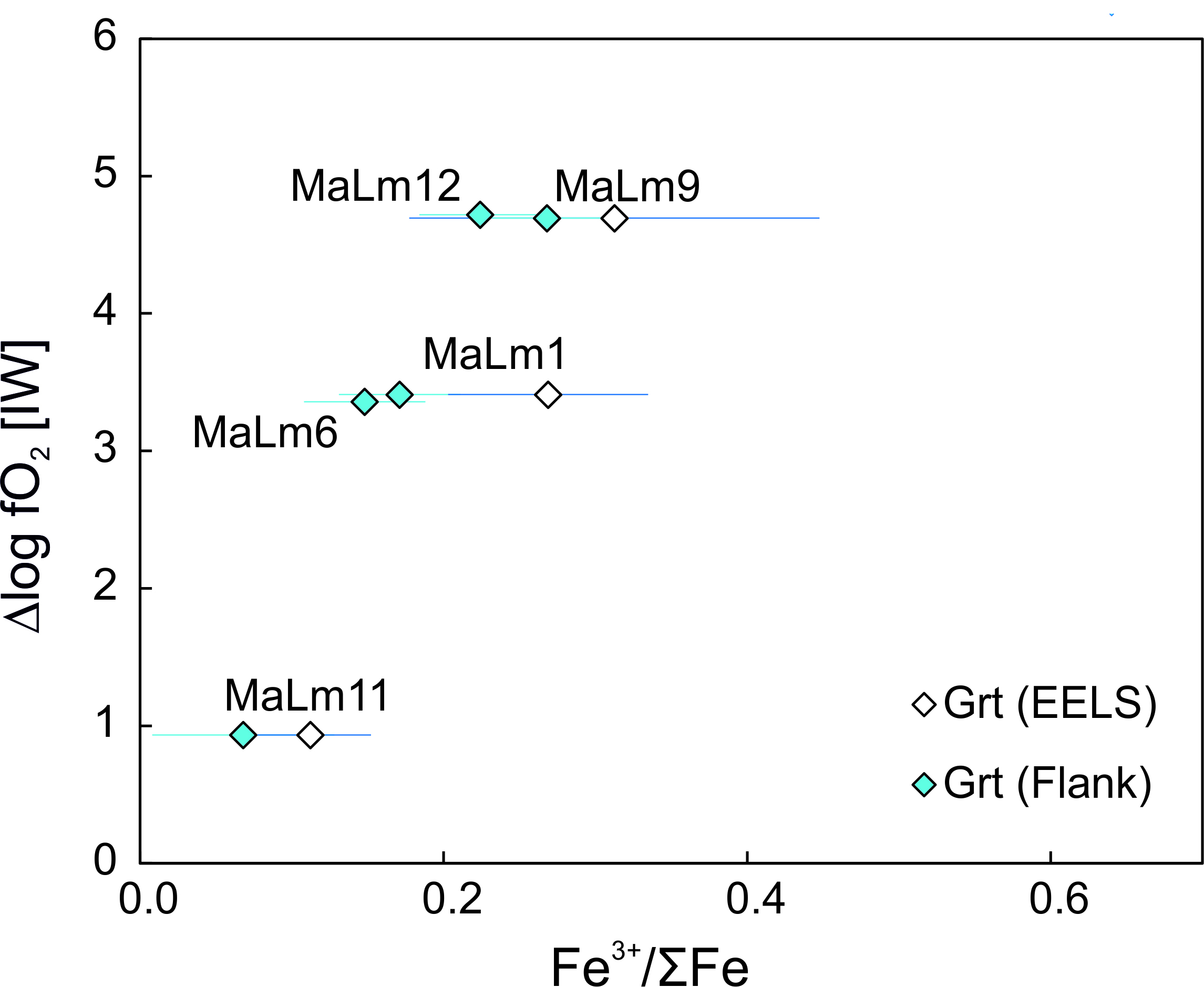
Ferric-ferrous iron ratios of experimental majoritic garnet and clinopyroxene as a function of oxygen fugacity
https://doi.org/10.2138/am-2020-7265
Rzehak et al. compared the Fe3+/ΣFe contents of experimental majorites and clinopyroxenes at 10 GPa with two analytical methods: EPMA flank and TEM-EELS analysis on the same samples. They used a FeO content of 8 wt% that is considered to be the natural bulk FeO content of the Earth's upper mantle. Previous studies have used much higher FeO contents (~25 wt%) to facilitate Fe3+/ΣFe measurements. Although results from the flank method are systematically lower than the EELS measurements, Fe3+/ΣFe obtained with both methods agree well within 2θ errors. The authors used their experimental results to compare four different geobarometers by Collerson et al. (2010), Wijbrans et al. (2016), Beyer and Frost (2017), and Tao et al. (2018) and found that all of them are recommendable for different settings.
The origin of Ti-oxide minerals below and within the eastern Athabasca Basin, Canada
https://doi.org/10.2138/am-2020-7235
Titanium oxides along a major fault within and below the eastern Athabasca Basin record a protracted geological history of the area. Early rutile records regional metamorphism of the basement and reducing hydrothermal activity prior to the deposition of the Athabasca sandstones. Anatase in the sandstones and basement formed from oxidizing, acidic basinal fluids. Anatase in the basement records the incursion of basin fluids into the basement, which marks the onset of hydrothermal activity related to the formation of unconformity-type uranium deposits. This study by Adlakha et al. confirms that Ti-oxides are useful in unraveling the geological history of an area that underwent prolonged hydrothermal alteration.
Partition behavior of platinum-group elements during the segregation of arsenide melts from sulfide magma
https://doi.org/10.2138/am-2020-7477
Pina et al. determined experimentally the partition behavior of platinum group elements (PGE) between arsenide and sulfide melt when an arsenide melt segregates by immiscibility from a sulfide melt after As oversaturation. The results show that PGE are strongly compatible into arsenide melt supporting empirical observations in several Ni-Cu-PGE sulfide deposits where PGE occur preferentially concentrated in the most As rich zones. The implications for exploration are considerable: the formation of arsenide melts in PGE-bearing natural sulfide systems can lead to the formation of As-PGE-rich orebodies associated with S-rich and As-poor mineralized zones.
Vapor-bubble growth in olivine-hosted melt inclusions
https://doi.org/10.2138/am-2020-7377
Olivine-hosted melt inclusions (MI) are the best tool for studying magmatic volatiles. Recent studies have shown that vapor bubbles, commonly found in MI, contain up to ~90% of entrapped CO2 contents. This revelation has put much of the last 30 years of MI work into question because many studies required knowledge of entrapped CO2 contents but did not account for bubble growth. CO2-reconstruction methods exist, but their accuracy has not been tested. Rasmussen et al. describe bubble growth, evaluate existing corrections, and develop improved experimental and computational (MIMiC program) methods.
Volume 105 : November 2020 Issue
Parageneses of TiB2 in corundum xenoliths from Mt. Carmel, Israel: Siderophile behavior of boron under reducing conditions
https://doi.org/10.2138/am-2020-7375
Natural titanium diboride (TiB2) occurs rarely on Earth, but is widespread in mantle-derived aggregates of corundum found in the volcanic ash of small Cretaceous volcanoes on Mt Carmel, Israel. Petrographic studies by Griffin et al. show that the highly reduced igneous melts trapped in these aggregates during their growth later separated into immiscible metallic (Fe-Ti-Si) and silicate (Ca-Mg-Al-Si-O) melts. TiB2 crystallized mainly from the metallic melts, and less commonly from the silicate melts. This indicates that boron, though usually a lithophile element, becomes a strongly siderophile element under reducing conditions, like those expected in the deep mantle. Metallic melts in the mantle may be the major reservoir for boron below the crust.
Crystal structure and Raman spectroscopic studies of OH stretching vibrations in Zn-rich fluor-elbaite
https://doi.org/10.2138/am-2020-7360
Pieczka et al. present results of their study of OH stretching vibrations in the Raman spectrum of Zn-rich fluor-elbaite. Deconvolution of the bands provides new insights into crystal chemical and structural details of the studied crystals, even at the nano-scale, and direct evaluation of Li and OH (Li2O and H2O) concentrations, two components not measured in microprobe analysis and usually only calculated.
Crystal structure of Ag-exchanged levyne intergrown with erionite: Single-crystal X-ray diffraction and Molecular Dynamics simulations
https://doi.org/10.2138/am-2020-7500
Cametti and Churakov report the crystal structure characterization of a Ag-exchanged levyne intergrown with erionite. Ag-exchanged zeolites are particularly interesting due to their improved catalytic, photocatalytic, adsorption, and luminescent properties. To resolve the extreme disorder of Ag ions within the zeolitc pores we combined experimental (X-ray diffraction) and theoretical approachs (Molecular dynamics).
Br diffusion in phonolitic melts: Comparison with fluorine and chlorine diffusion
https://doi.org/10.2138/am-2020-7372
Balcone-Boissard et al. investigated the diffusion of Br in phonolitic melts with differing Na/K ratios, which had previously been used to study Cl and F diffusion, and compared their results to published studies of Br diffusion in magmatic melts. Br diffusion may be affected by the Na/K ratio of phonolitic melts, as previously seen for Cl, but not for F, diffusion. Similarly to noble gases, halogen diffusivity at a given temperature in the phonolitic melts appears related to the ionic porosity of the silicate structure, and Br diffusion appears to be at least partially decoupled from melt viscosity.
Crystal chemistry and microfeatures of gadolinite imprinted by pegmatite formation and alteration evolution
https://doi.org/10.2138/am-2020-7355
Alteration patterns observed by Tomašić et al. in gadolinite from pegmatites of southern Norway point to late magmatic and metasomatic changes of local mineral chemistry. The general alteration path suggests a shift to a more Ca-rich mineral chemistry within the gadolinite group. The changes induced by alteration mechanisms are related to the metamictization-inherited structural properties of gadolinite, thus promoting gadolinite as one indicator of late magmatic processes in these pegmatite systems.
A new occurrence of corundum in eucrite and its significance
https://doi.org/10.2138/am-2020-7361
Corundum is an important indicator of Al-rich and Si-poor regions and/or lithologies. It is rarely observed in samples from extraterrestrial differentiated celestial bodies, although shock-induced corundum has recently reported by Li et al. In this study, Li et al. report the presence of non-shock-induced corundum in a eucrite. The petrographic texture of corundum and its associated pyroxenes and their compositions indicate that corundum has an indigenous origin and was captured during the ascent of a basaltic melt. Its presence suggests a hidden Al-rich and Si-poor region or lithology in the interior of Vesta and further implies that this asteroid’s internal evolution could be much more complicated than previously thought.
Zircon survival in shallow asthenosphere and deep lithosphere
https://doi.org/10.2138/am-2020-7402
Borisova et al. experimentally investigated the behavior of zircon in mafic/ultramafic melts to predict zircon survival in the terrestrial lithosphere and shallow asthenosphere. They performed high-temperature experiments on zircon dissolution in natural mid-ocean ridge basaltic and synthetic haplobasaltic melts at temperatures of 1250 to 1300 degrees Celsius and pressures from 0.1 MPa to 0.7 GPa coupled with electron probe microanalyses of the experimental products. For the first time, the zirconium diffusion coefficient (2.87 x 10⁻¹² m2/s) at 1300{degree sign}C and 0.5 GPa pressure in a natural tholeiitic basaltic melt has been estimated. The experimental data raise questions about the origin of zircons in mafic and ultramafic rocks, in particular, in shallow oceanic asthenosphere and deep lithosphere, as well as the meaning of the zircon-based ages estimated from these minerals. Large zircon megacrysts in kimberlites, peridotites, alkali basalts, and other magmas suggest the fast transport and short interaction durations between zircon and melt.
Reconsidering initial Pb in titanite in the context of in situ dating
https://doi.org/10.2138/am-2020-7274
The mineral titanite has become a popular U-Pb geochronometer, but determination of dates requires a correction for non-radiogenic (initial) Pb. This contribution by Bonamici and Blum reviews different methods for handling initial Pb in titanite, specifically when U-Pb data are collected by in situ mass spectrometry techniques that sample small domains within grains. Their results show that initial Pb is heterogeneous both between and within the studied titanite grains. In addition, analysis of U-Pb data patterns suggests that some titanite grains have lost Pb by diffusion during a high-temperature metamorphic event. They demonstrate that even when U-Pb data are scattered and precise ages cannot be determined with in situ techniques, analysis of U-Pb data patterns can provide information about the processes that caused the scatter.
Solubility of Na2SO4 in silica-saturated solutions: Implications for REE mineralization
https://doi.org/10.2138/am-2020-7470
The solubility of Na2SO4 is traditionally considered to display retrograde behavior in aqueous solutions. Chen et al. show experimentally that the solubility of Na2SO4 changes from retrograde to prograde in the presence of silica. The authors show that sulfate-rich fluids are capable of transporting large quantities of REE’s and that mass balance calculations demonstrate that hidden, deep-seated magma chambers are not necessary for the Maoniuping carbonatite-related rare earth element (REE) deposit (SW China).
Vanadium micro-XANES determination of oxygen fugacity in olivine-hosted glass inclusion and groundmass glasses of martian primitive shergottite Yamato 980459
https://doi.org/10.2138/am-2020-7321
Nakada et al. focuses on the oxidation states of redox-sensitive elements in an olivine-hosted glass inclusion and groundmass glasses in a Martian meteorite; these glass phases reflect the earliest and latest stages of formation of basaltic rocks on Mars. The study shows that the oxygen fugacity (fO2) was almost equal to the Iron-Wüstite (IW) buffer (IW-0.07{plus minus}0.32) for the glass inclusion, whereas the groundmass glass is 0.9 log units more oxidized than the IW buffer (IW+0.93{plus minus}0.56). This fact suggests that the fO2 of the parent magma of Yamato 980459, which is believed to have evolved in a closed system, increased during magma ascent and emplacement. Our findings show that the µ-XANES technique is useful to investigate the redox conditions of volcanic rocks, when they do not possess mineral phases applicable to conventional oxybarometers, and surely contributes to better understanding of the redox evolution in the Martian interior.
Donwilhelmsite, [CaAl4Si2O11], a new lunar high-pressure Ca-Al-silicate with relevance for subducted terrestrial sediments
https://doi.org/10.2138/am-2020-7393
Donwilhelmsite (IMA 2018-113) is a new lunar high-pressure mineral identical to the calcium aluminum silicate, CAS, phase first reported from static pressure experiments. This paper by Fritz et al. details the first extraterrestrial mineral with a crystal structure solved by three dimension electron diffraction (3D ED). The name honors the lunar geologist Don E. Wilhelms. In the feldspathic lunar meteorite Oued Awlitis 001, donwilhelmsite crystallized as micrometer-sized needles in shock melt pockets at high-pressure and temperature conditions mimicking the conditions in the Earth's mantle. On Earth, donwilhelmsite is an important mineral in continentally derived sediments subducted into the deep mantle (460 to 700 km) and likely associated with the enriched mantle components EM1 and EM2.
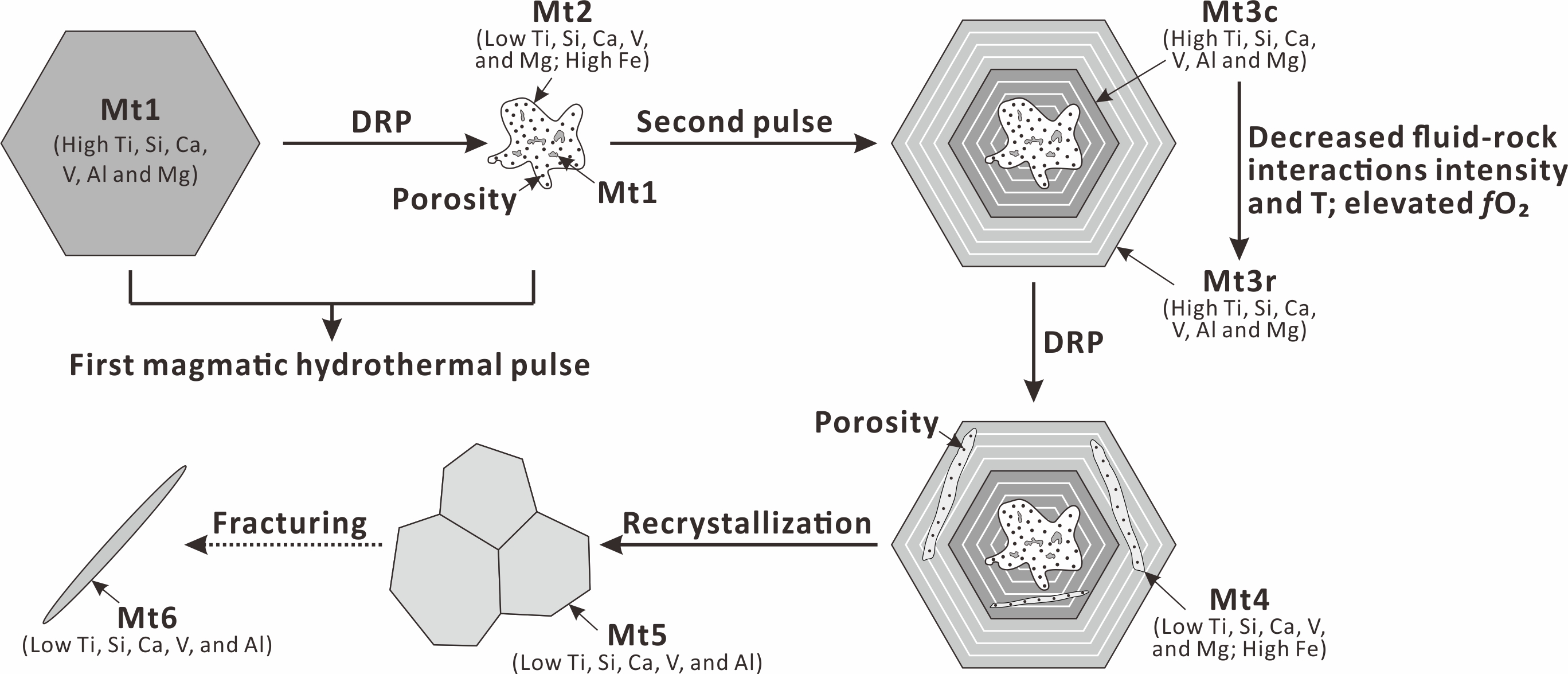
Magnetite texture and trace-element geochemistry fingerprint of pulsed mineralization in the Xinqiao Cu-Fe-Au deposit, Eastern China
https://doi.org/10.2138/am-2020-7414
Zhang et al. use magnetite to investigate the Cu-Fe-Au mineralization of the Xinqiao ore deposit. They find 6 different generations of magnetite, including veins that formed later than pyrite and are genetically linked to elevated fO2 resulting from fracturing. Furthermore, the magnetite textures and chemistry imply that multiple pulses of fluids from a magmatic-hydrothermal system played an important role in the generation of the ore deposit.
Magmatic haggertyite in olivine lamproites of the West Kimberley region, Western Australia
https://doi.org/10.2138/am-2020-7456
Jaques et al. report the first occurrence of the alkali titanate mineral haggertyite (BaTi5Fe6MgO19) as a magmatic phase in two individual olivine lamproite bodies from the classic West Kimberley lamproite province in Western Australia. This is only the second report of haggertyite. In the original description of haggertyite (American Mineralogist 1996) from the Prairie Creek lamproite, the haggertyite was inferred to be of metasomatic origin. The haggertyite in the West Kimberley lamproites varies in composition (Fe, Ti) and in the calculated Fe3+ and Fe2+ depending on the prevailing fO2 as a result of the coupled substitution between Ti + Fe2+ on one side of the reaction and and 2 Fe3+ On the other. They show that the haggertyite crystallized at relatively low temperatures (650 to 800 degrees Celsius) and that the haggertyite in one of the lamproite pipes crystallized under increasing fO2 conditions whereas in the other it formed under more reducing conditions and decreasing fO2. Jaques et al. present major and trace element analyses of the haggertyite and co-existing titanate and alkali titanate minerals. Their new data show that haggertyite is not an isolated occurrence, but one of an increasing number of new minerals in upper mantle rocks, and volcanics derived from the upper mantle, hosting large-ion-lithophile and high field strength cations. They suggest that haggertyite may be more widespread than thought, perhaps having been overlooked or misidentified.
« ‹ 1 … 48 49 50 51 52 … 85 › »ADDITIONAL RESOURCES