
Editor’s Notes
Total Results: 1697
Volume 105 : July 2020 Issue
Experimental investigation of the effect of nickel on the electrical resistivity of Fe-Ni and Fe-Ni-S alloys under pressure
https://doi.org/10.2138/am-2020-7301
It is commonly assumed that nickel does not significantly affect the chemical and physical properties of core analogues. However, the effect of Ni on electrical and thermal resistivity is not well-constrained under temperature and pressure conditions, as the very few previous electrical studies on Fe-Ni alloys were conducted either at room temperature or at atmospheric pressure. Pommier shows experimentally that at defined temperature, Fe-Ni(-S) alloys are more resistive than Fe (by a factor of ~3) and Fe-Ni alloys containing 5 and 10 wt% Ni present comparable electrical resistivity values. A comparison is made with data on pure iron and Fe-5S samples. Pommier also provides estimates of the lower and upper bounds of thermal conductivity. These estimates suggest that the thermal conductivity values used as part of recent numerical modeling of the cores of Ganymede and the Moon are too high, and thus, this paper has the potential to better constrain future thermochemical models of planetary cores. Pommier shows that a similar amount of heat is conducted at any depth along the adiabat gradient of a Fe-Ni(-S) core, whereas less heat is conducted down this gradient at shallow depth in a Ni-free core. Because variation in heat conduction is critical for driving convection, this implies that it may be easier to drive convection in a Ni-free core than in a Ni-bearing core.
An experimental approach to examine fluid-melt interaction and mineralization in rare-metal pegmatites
https://doi.org/10.2138/am-2020-7216
McNeil et al. establish an experimental technique to investigate solubilities of minerals in melts via fluid-melt interactions, through the interactions of a melt enriched in HFSEs with a hydrothermal fluid enriched in a fluid mobile element. HFSE minerals that crystallize from fluid-melt interactions texturally occur as euhedral crystals as phenocrysts in glass, i.e., are purely magmatic textures. Therefore, crystallization of HFSE minerals from fluid-melt interactions in rare metal granites and pegmatite deposits may be more widespread than previously recognized. This is significant because the formation of these deposits may require magmatic-hydrothermal interaction to explain the textures present in deposits worldwide, rather than always being the result of a single melt or fluid phase.
Crystal-chemistry of sulfates from the Apuan Alps (Tuscany, Italy). VI. Tl-bearing alum-(K) and voltaite from the Fornovolasco mining complex
https://doi.org/10.2138/am-2020-7320
Sulfates play an important role in determining the dispersion in the environment of acids and potentially toxic metals related to the weathering of ore deposits, coals, and mine wastes. Alum-(K) and voltaite are two common phases in sulfate assemblages, and they may be able to host high contents of the toxic element Tl. Through a multi-technique study of these minerals, Biagioni et al. found that it was possible to highlight their role as scavengers of Tl in acid mine drainage systems.
First-principles modeling of X-ray absorption spectra enlightens the processes of scandium sequestration by iron oxides
https://doi.org/10.2138/am-2020-7308
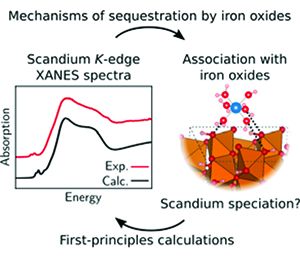
Chassé et al. investigate the mechanisms of scandium sequestration by iron oxides combining first-principles calculations with X-ray absorption near-edge structure spectroscopy. Their results show the specificities of scandium sorption processes, explaining its concentration in iron-oxide rich surficial environment, with implications for mineral processing. This work demonstrates the relevance of the approach to study the speciation of trace metals in the environment.
Effects of the dissolution of thermal barrier coating materials on the viscosity of remelted volcanic ash
https://doi.org/10.2138/am-2020-7334
The chemical interaction between remelted volcanic ash and ceramic coatings of yttria-stabilized zirconia (YSZ) and/or gadolinium zirconate (GZO) is of special importance for the design of volcanic ash melt-resistant thermal barrier coatings (TBCs) for aviation turbine technologies. Müller et al.’s investigation of the high-temperature viscosity of five volcanic ash samples of basaltic, andesitic, rhyolitic, and phonolitic compositions, each doped with 6.5 wt% YSZ or GZO, revealed a reduction of viscosity for all samples compared to their natural counterparts. With respect to thermal barrier coatings, it can be concluded that once the dissolution of the YSZ or GZO coating material in contact with a silicate melt starts, the viscosity will decrease, enabling an enhanced spreading on the surface and/or infiltration in the coating. A simple parameterization of the effects of YSZ and GZO on the viscosity of melts of volcanic ash samples can be expressed as a linear relationship. This parameterization should be employed in any future modeling of the dynamics of CMAS or natural ash melt interaction with TBCs.
NEW MINERAL NAMES
https://doi.org/10.2138/am-2020-NMN105714
New Mineral Names
Volume 105 : June 2020 Issue
Halogens in amphibole and mica from mantle xenoliths: Implications for the halogen distribution and halogen budget of the metasomatized continental lithosphere
https://doi.org/10.2138/am-2020-7174
Hecker et al. conducted a study on the halogen contents (F and Cl) in amphibole and phlogopite in mantle xenoliths of variable modal compositions (dunites, harzburgites, lherzolites, wehrlites, olivine websterites, websterites, and clinopyroxenites) complemented by amphibole and phlogopite megacrysts from several localities and samples from the metasomatized Finero peridotite massif in northern Italy. For comparison, the authors also analyzed amphibole from several mafic magmatic cumulates (hornblendites). Totally, data for 12 localities in Europe and Africa are presented. The data provide insight into halogen storage and redistribution in the mantle and demonstrate the importance of amphibole and mica for the total halogen budget of the lithospheric mantle and their potential role as a halogen source for mantle-derived melts. The data also record large differences in Cl concentrations (which correlate negatively with F/Cl ratios) between samples of the same region, recording desiccation processes that may cause very large variations in mantle halogen contents on a regional scale.
New insights on Br speciation in volcanic glasses and structural controls on halogen degassing
https://doi.org/10.2138/am-2020-7273
Despite their relatively low concentrations compared to H2O and CO2, halogens (F, Cl, Br, and I) are considered key actors in magmatic processes, because they may have a significant effect on melt properties. Their volcanic degassing may also lead to considerable perturbations of atmospheric chemistry, with the rapid transformation of HBr to reactive BrO during explosive eruptions notably known to trigger ozone depletion on various temporal and spatial scales. While recent analytical developments enable a better detection and characterization of their concentrations in magmas and volcanic gases, current understanding of incorporation mechanisms in silicate melts is scarce and potentially limits the interpretation of elemental ratios and modeling of degassing behavior. Here, Louvel et al. take advantage of the development of high-energy resolution fluorescence detection X-ray absorption spectroscopy (HERFD-XAS) to study Br speciation in natural volcanic glasses that contain 100-3000 ppm Br. The measurements reveal that Br speciation in basalt, andesite, and rhyodacite differs significantly from that previously recorded in haplogranite laboratory analogs, with Br being incorporated in at least three distinct sites, surrounded by Na, K, or Ca. The reported structural environment for natural glasses are similar to those found for Cl in silicate and borosilicate glasses, suggesting that melt composition may not play a significant control on Cl and Br incorporation in natural melts, and further supporting their coupled degassing in volcanic systems.
Decoupled water and iron enrichments in the cratonic mantle: A study on peridotite xenoliths from Tok, SE Siberian Craton
https://doi.org/10.2138/am-2020-7316
Doucet et al. provide new data of water contents of olivine and pyroxenes from peridotite xenoliths that represent the cratonic lithospheric mantle at the edge of the Siberian Craton. The peridotite xenoliths display significant iron enrichment due to complex metasomatic history that might have led to the destruction/delamination of the cratonic root beneath the Anabar shield in the southeastern part of the Siberian Craton. This study addresses the fundamental question of the role of water and iron on the stability and longevity of the cratonic lithosphere and describes, in particular, the role of “wet” and “dry” metasomatism on the physical properties of the lithospheric mantle.
Deconvolution of the composition of fine-grained pyrite in sedimentary matrix by regression of time-resolved LA-ICP-MS data
https://doi.org/10.2138/am-2020-7202
Sedimentary pyrite is an important host of many trace elements. The LA-ICP-MS analysis of sedimentary pyrite by Stepanov et al. results in variable, mixed data. Pyrite composition is calculated from the mixed data using an algorithm based on linear regression. The algorithm involves segmentation of the time-resolved signal, normalization to total, calculation of the regression equations, and estimation of explanatory variable normalizing to total. Regression analysis of time-resolved mixed LA-ICP-MS data is a powerful technique for the analysis of complex substances.
A multi-method characterization of natural terrestrial birnessites
https://doi.org/10.2138/am-2020-7303
Ling et al. investigate a variety of natural birnessites collected from freshwater environments. Birnessite exists in two varieties, triclinic and hexagonal birnessite, which can determine the metal cycling and redox reactions in which they are involved. Laboratory experiments suggest that biotically produced birnessite is hexagonal, although little is known about the varieties of birnessite that exist in freshwater environments. From the analyses of 11 non-marine birnessite samples, they found that the birnessite samples span the entire spectrum of triclinic to hexagonal birnessite, including intermediate structures.
REE redistributions during granite weathering: Implications for Ce anomaly as a proxy for paleoredox states
https://doi.org/10.2138/am-2020-7148
Different response of Ce to redox state from those of the other light rare earth elements (LREEs) can be used to understand paleo redox states. In order to establish the possibility of using Ce anomaly as a proxy for paleo-environments, Ichimura et al. examined the mineralogical and chemical characteristics of bulk samples and REE-bearing minerals of a modern weathering profile developed on granite using a number of experimental techniques. They have classified LREE redistributions in both secondary minerals and bulk weathered samples during oxic weathering and suggested that Ce anomaly can provide useful information on paleoredox states if Ce anomalies of both bulk samples and secondary REE-bearing minerals are determined.
The relationship of destinezite to the acid sulfate alteration at the El Laco magnetite deposit, Chile
https://doi.org/10.2138/am-2020-7122
The giant El Laco magnetite-(apatite) deposit, Chile, has been interpreted as a complex polyphase magmatic-hydrothermal mineralization in which most of the existing magnetite and apatite formed as lava flows or (crypto)-domes. However, there are opinions that support a genesis exclusively related to an intense hydrothermal replacement of preexisting andesitic rocks. Among the geological evidences that support the first explanation has been argued the presence of unconsolidated Fe-P-oxide materials ejected as tephra (volcanic bombs) by the El Laco volcano, currently replaced by destinezite forming enigmatic lumps. However, these rare (almost) monomineralic rocks, affected by hydrothermal alteration and weathering, have received little attention. In this study, Velasco et al. use conventional geological information and mineralogical identification of the lumps, besides thermal decomposition of pure destinezite to derive its thermodynamic properties. These new data have been used to discuss the extension of fields of stability of this mineral and predict the favorable conditions for destinezite formation. Finally, they propose that quoted destinezite formed at low-temperature hydrothermal conditions, an origin very different from the traditionally proposed one for this mineral (i.e., supergene).
Crystallographic preferred orientation of talc determined by an improved EBSD procedure for sheet silicates: Implications for anisotropy at the slab–mantle interface due to Si-metasomatism
https://doi.org/10.2138/am-2020-7006
Nagaya et al. carried out EBSD measurements of talc grains and obtained the crystallographic preferred orientation (CPO) of talc from talc schists formed due to Si-metasomatism by subduction zone fluids into ultramafic rocks. Talc CPO shows a strong concentration of the pole to the (001) plane, which is normal to the foliation. The strongest concentration of the [100] direction is parallel to the lineation. The combination of TEM and EBSD observations of talc grains implies that the use of EBSD orientation data of talc grains with MAD values in the range of less than 1.3° to less than 0.7° enables determination of a relatively accurate talc CPO when using the thin-section parallel to the foliation of talc schist. As with talc, CPO measurements of most clay minerals have not been reported. The methods used here may be applicable to other mechanically-weak minerals. Their calculations of seismic anisotropies based on the talc CPO obtained demonstrate that Vp and AVp of talc schist can show slower and stronger values, respectively, as compared with antigorite schist at deeper domains. Therefore, if S-waves with different ray paths through the same anisotropic domain show a larger variation in Vp values than that predicted in antigorite schist, this anisotropic domain may be composed of talc schist. The strong talc CPO and the significantly weak layer developed in the slab-mantle interface in the subduction zone can promote spatial expansion of the slip area during an earthquake in the wedge.
The occurrence, origin, and fate of water in chromitites in ophiolites
https://doi.org/10.2138/am-2020-7270
Su et al. presented direct petrographic, mineralogical, and geochemical evidence confirming the occurrence, origin, and fate of water in podiform chromitites. They provided the petrological evidence in clinopyroxene-bearing chromitites for the presence of water, self-alteration features in podiform chromitites, chemistry of clinopyroxene associated with chromite, and water contents and Li isotopic ratios of olivine and clinopyroxene. Additionally, the fate of surface fluids on chromite grains and the importance of water in the formation and evolution of chromite deposits, as inferred by earlier experimental studies, were described.
Thermoelasticity of tremolite amphibole: Geophysical implications
https://doi.org/10.2138/am-2020-7189
Peng and Mookherjee evaluate whether anomalously low seismic velocities observed in the mid lithospheric discontinuities (MLD) could be caused by mantle metasomatism i.e., hydrated layer consisting of amphibole and phlogopite. In order to do so, they determine thermoelastic parameters of tremolite using density functional theory calculations. Then they calculate the velocity depth profile for hydrated lithologies with varying amphibole and phlogopite contents. They compare the velocity of hydrated lithology with that of the dry lithology and deduce that while the presence of amphibole and phlogopite in metasomatized mantle might reduce velocity, it may not be the sole mechanism to explain MLD.
Stability of fcc phase FeH to 137 GPa
https://doi.org/10.2138/am-2020-7153
Kato et al. propose a revised phase diagram of iron hydride, FeH, which is a candidate component of the Earth’s core. Contrary to previous studies, the experimental results suggest that face-centered cubic (fcc) FeH has a wide stability field at high pressure and temperature instead of a double-hexagonal closed packed (dhcp) FeH. They also examined the compression behavior of fcc FeH and observed a change in compressibility at about 60 GPa, which could be due to a magnetic transition, as suggested by ab initio computation. Fcc FeH could be an endmember in the Fe-FeH system at the Earth’s core conditions.
Partition coefficients of trace elements between carbonates and melt and suprasolidus phase relation of Ca-Mg-carbonates at 6 GPa
https://doi.org/10.2138/am-2020-7098
The presence of Ca-Mg-carbonates affects the melting and phase relations of peridotites and eclogites in the mantle and (partial) melting of carbonates liberates carbon from the mantle to shallower depths. The onset and composition of incipient melting of carbonated peridotites and carbonated eclogites are influenced by the pure CaCO3-MgCO3-system, making understanding of the phase relations of Ca-Mg-carbonates fundamental in assessing carbon fluxes in the mantle. By performing high pressure and temperature experiments, Sieber et al. clarify the supra-solidus phase relations of the nominally anhydrous CaCO3-MgCO3-system at 6 GPa (~200 km deep) showing that Ca-Mg-carbonates will (partially) melt at temperatures above ~1300 °C. A comparison with data from thermodynamic modelling confirms the experimental results. Furthermore, partition coefficients for Li, Na, K, Sr, Ba, Nb, Y and rare earth elements between calcite and dolomitic melt, Ca magnesite and dolomitic melt and magnesite and dolomitic melt are established.
Systematics of H2 and H2O evolved from chlorites during oxidative dehydrogenation
https://doi.org/10.2138/am-2020-7326
Lempart et al. performed thermogravimetric analysis combined with quadrupole mass spectrometry to give a complete picture of the thermal decomposition for Fe(II)-containing phyllosilicates. The evolved gas analysis of chamosties, Fe-clinochlores, and biotite revealed that H2 was generated along with H2O under inert atmosphere conditions in the temperature range 500-1000 °C. The higher the Fe(II) content in the chlorites, the more intense the H2 evolution, which results in the increased oxidation of structural Fe(II). H2O and H2 gas are, respectively, indicators of dehydroxylation and oxidative dehydrogenation. These molecules evolve simultaneously, but independently, as they are governed by different mechanisms and kinetics. Despite ongoing dehydrogenation, under oxidizing gas conditions, no H2 was detected, as it immediately combines with an external oxygen to form H2O in the carrier gas. Potential dehydrogenation of Fe(II)-bearing phyllosilicates affects the pathways of fluids released during the deep burial of sedimentary rocks and during metamorphism and melting. This changes the budget of both water and H2 gas in metamorphic and magmatic processes, not only on Earth but also on Mars. The thermal heating experiments were carried out under both an inert and oxidizing atmospheres, which closely reflect anaerobic and aerobic geological environments. The occurrence of oxidative dehydrogenation complicates the interpretations based on the valence of Fe (or Mn), because the Fe(III)/Fetot ratio does not directly reflect oxygen fugacity nor temperature of formation.
Texture and geochemistry of multi-stage hydrothermal scheelite in the Tongshankou porphyry-skarn Cu-Mo(-W) deposit, eastern China: Implications for ore-forming process and fluid metasomatism
https://doi.org/10.2138/am-2020-7194
SEM and CL imaging of scheelit can reveal textures that are not seen under transmitted light imaging and shed light on the dissolution-reprecipitation process in scheelites. During this process, the REE patterns and Sr isotopes of the scheelites were modified without significantly modifying their morphology and appearance. Therefore, it is crucial to evaluate such a process according to the textures and geochemical characteristics before using scheelite as an indicator mineral for hydrothermal ore deposits. This study by Han et al. provides a good example of the use of scheelite textures and geochemistry to reveal the nature and source of ore-forming fluids. The scheelite-precipitating fluids were not depleted in Mo based on the coexistence of molybdenite and chalcopyrite and the coexistence of scheelite and chalcopyrite. The Mo contents in the scheelites reflect the fluid oxygen fugacity and, together with the observed Eu anomalies, suggest that the scheelite-fluid partition coefficient of Eu2+ may be greater than that of Eu3+.
« ‹ 1 … 52 53 54 55 56 … 85 › »ADDITIONAL RESOURCES