Editor’s Notes
Total Results: 1697
Volume 105 : May 2020 Issue
Acceptance of the 2018 MSA Award of the Mineralogical Society of America
https://doi.org/10.2138/am-2020-AP10553
2020 MSA Awards
Presentation of the Dana Medal of the Mineralogical Society of America for 2019 to Matthew J. Kohn
https://doi.org/10.2138/am-2020-AP10554
2021 MSA Awards
Acceptance of the Dana Medal of the Mineralogical Society of America for 2019
https://doi.org/10.2138/am-2020-AP10555
2022 MSA Awards
Presentation of the Mineralogical Society of America Award for 2019 to Olivier Namur
https://doi.org/10.2138/am-2020-AP10559
2023 MSA Awards
Acceptance of the Mineralogical Society of America Award for 2019
https://doi.org/10.2138/am-2020-AP10558
2024 MSA Awards
Presentation of the 2019 MSA Distinguished Public Service Medal to Rodney C. Ewing
https://doi.org/10.2138/am-2020-AP10556
2025 MSA Awards
Acceptance of Distinguished Public Service Award of the Mineralogical Society of America for 2019
https://doi.org/10.2138/am-2020-AP10557
2026 MSA Awards
Presentation of the 2019 Roebling Medal of the Mineralogical Society of America to Peter R. Buseck
https://doi.org/10.2138/am-2020-AP105510
2027 MSA Awards
Acceptance of the 2019 Roebling Medal of the Mineralogical Society of America
https://doi.org/10.2138/am-2020-AP105511
2028 MSA Awards
Volume 105 : April 2020 Issue
Buoyant rise of anorthosite from a layered basic complex triggered by Rayleigh-Taylor instability: Insights from a numerical modeling study
https://doi.org/10.2138/am-2020-6985
Massif type anorthosites constitute a major puzzle of Proterozoic geology. Formation of these rocks from basaltic magma by floatation of plagioclase crystals at the top of a magma chamber is not supported by observations of the major layered basic intrusions of the world. This numerical modelling study by Mukherjee et al. proposes a new genetic process for the origin of massif type anorthosites. It shows that layered basic intrusions may generate Rayleigh-Taylor instability between the anorthosite layers and the layers of denser rocks, when all these rocks behave like Newtonian or non-Newtonian power law fluids. This instability would trigger a vertical movement of the unstable anorthosite as anorthosite diapirs across the lower and middle crust. The result provides for the first time a dynamic basis and a testable hypothesis for the rise of anorthosite from the Earth's mantle into crust.
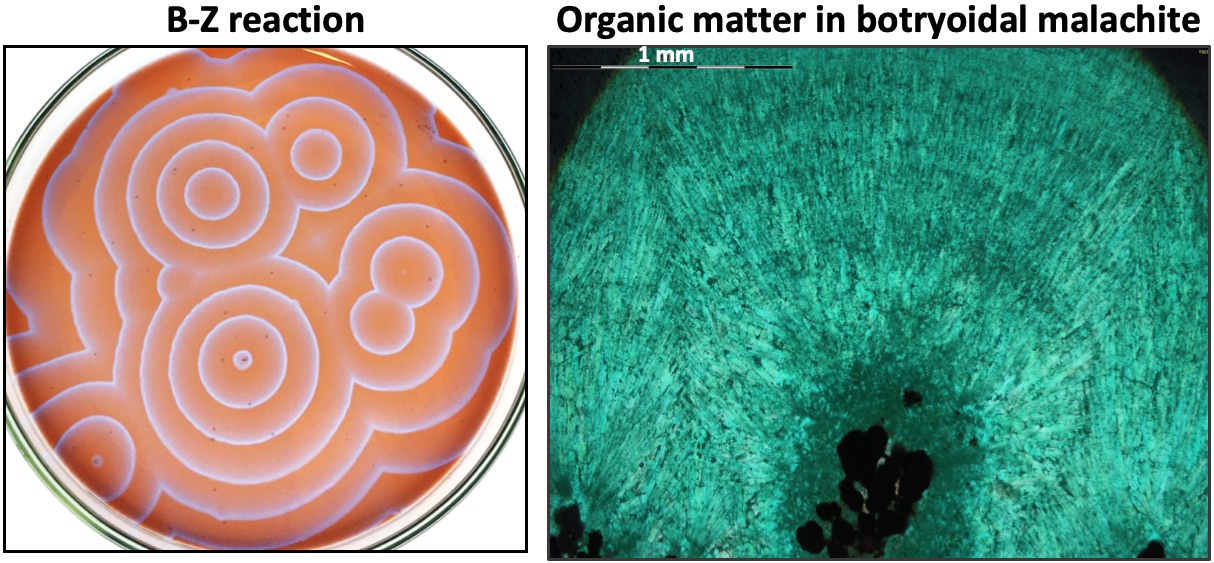
Chemically oscillating reactions in the formation of botryoidal malachite
https://doi.org/10.2138/am-2020-7029
The Belousov-Zhabotinsky reaction displays the same kind of patterns as botryoidal malachite. Arborescent organic structures commonly occur in the geometric center of malachite botryoids. Papineau interprets this in the context of chemical oscillations during the diagenetic decarboxylation of biological organic matter.
Micro- and nano-size hydrogarnet clusters in calcium silicate garnet: Part II. Mineralogical, petrological, and geochemical aspects
https://doi.org/10.2138/am-2020-7257
Geiger and Rossman investigate mineralogical, petrological, and geochemical characteristics of hydrogarnet clusters in nominally anhydrous garnet. New scientific understanding is obtained because the cluster model not only explains measured infrared spectra, but also permits an atomistic interpretation of many varied experimental results obtained on various calcium silicate garnets over the years.
Petrogenetic insights from chromite in ultramafic cumulates of the Xiarihamu intrusion, northern Tibet Plateau, China
https://doi.org/10.2138/am-2020-7222
Song et al. study the geochemistry of chromite, one of the first crystallized phases in mafic melts. Although it can be altered by reaction with hosting mineral and trapped liquid, important clues of parental magma and magma evolution can be preserved. In the Xiarihamu ultramafic intrusion, northern Tibet Plateau, China, the most primitive chromites hosted in olivine with Fo > 87 have similarities with MORB chromite in TiO2 and Al2O3, depleted in Sc and enriched in Ga relative to MORB chromite. This indicates a partial melting of the metasomatized asthenospheric mantle at garnet stable pressures.
Enigmatic diamonds from the Tolbachik volcano, Kamchatka
https://doi.org/10.2138/am-2020-7119
Diamonds, found in products of the recent Tolbachik volcano eruption in Kamchatka, Russia, were studied comprehensively by Galimov et al. Their mineralogical and geochemical features demonstrate that the diamonds were formed from volcanic gases under low pressure conditions. This implies that diamond is a polygenetic mineral, which may be formed at both high- and low-pressure conditions.
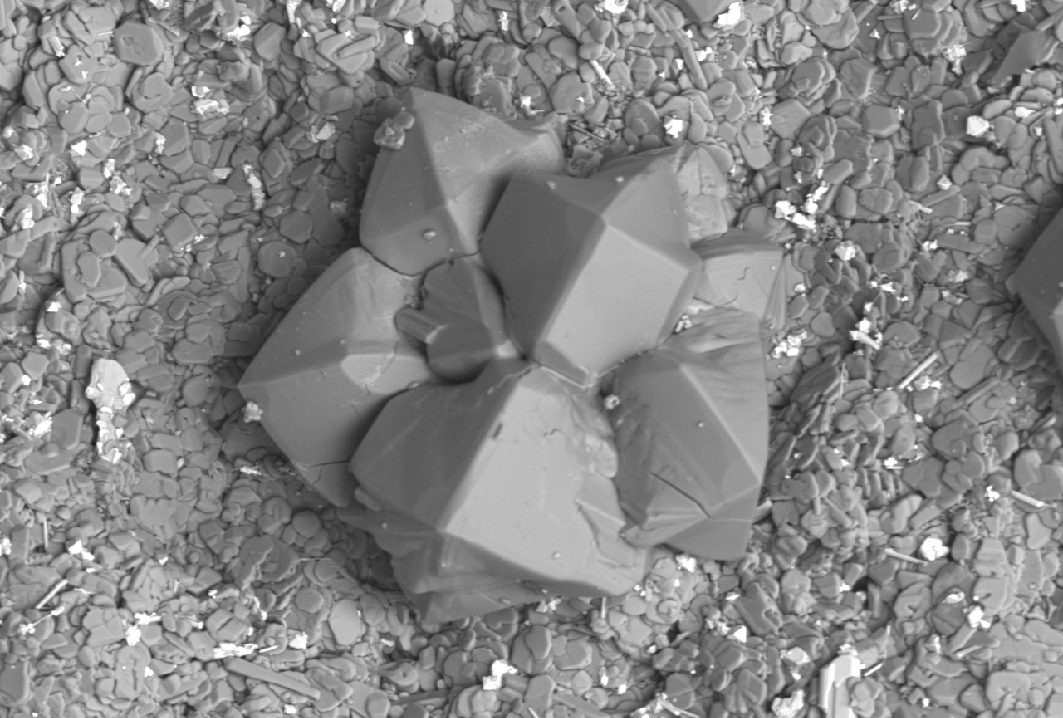
Volcanic SiO2-cristobalite: A natural product of chemical vapor deposition
https://doi.org/10.2138/am-2020-7236
Schipper et al. study the formation of vapor-phase SiO2-cristobalite in volcanic rocks, which is a natural proxy for Chemical Vapor Deposition. Although metastable, cristobalite may be the most widely occurring SiO2 polymorph in extrusive igneous rocks.
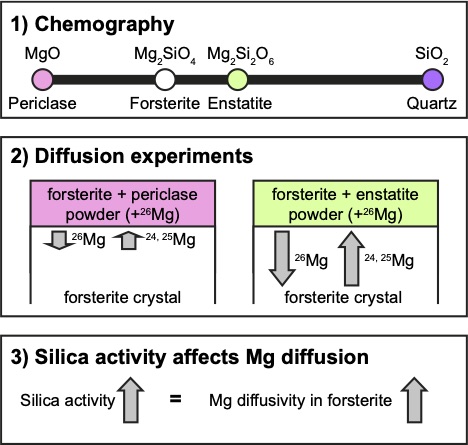
Mg diffusion in forsterite from 1250–1600 °C
https://doi.org/10.2138/am-2020-7286
New Mg isotopic diffusion experiments in forsterite show a clear dependence of diffusivity on silica activity, with higher Mg diffusivities at protoenstatite-buffered conditions than in experiments buffered by periclase. The new data by Jollands et al. reconciles some previous discrepant datasets.
Alteration of magmatic monazite in granitoids from the Ryoke belt (SW Japan): Processes and consequences
https://doi.org/10.2138/am-2020-7025
Skrzypek et al. describe two different processes responsible for the alteration of magmatic monazite in granitic rocks from SW Japan: monazite replacement by allanite, apatite, and Th-U phases at low temperature and monazite recrystallization with the formation of U-Y-enriched domains at high temperature. The versatility of the accessory mineral monazite gives a unique chance to constrain the nature and timing of metasomatic events. The different alteration processes can be ascribed to hydrous fluid or granitic melt infiltration. In situ age dating of monazite alteration textures gives information on: the age of magmatic crystallization (primary monazite domains), the age of high-temperature recrystallization (secondary monazite domains), and the timing of low-temperature replacement (Th-U-rich phases).
Smamite, Ca2Sb(OH)4[H(AsO4)2]·6H2O, a new mineral and a possible sink for Sb during weathering of fahlore
https://doi.org/10.2138/am-2020-7133
Plášil et al. discovered smamite, a new supergene arsenate-hydrate phase that contains both calcium and antimony. Since this new mineral is rather inconspicuous, it is highly possible that it has remained overlooked by mineralogists for decades. As one of the few Sb(V) supergene minerals, it can serve as a sink for Sb during supergene weathering.
The new K, Pb-bearing uranyl-oxide mineral kroupaite: Crystal-chemical implications for the structures of uranyl-oxide hydroxy-hydrates
https://doi.org/10.2138/am-2020-7311
Plášil et al. report on the new mineral, kroupaite, which is an additional member of the schoepite-family of minerals. This family is important due to environmental issues associated with the storage of irradiated or spent nuclear fuel in geological repositories.
Changes in the cell parameters of antigorite close to its dehydration reaction at subduction zone conditions
https://doi.org/10.2138/am-2020-7159
Shen et al. report TEM studies of natural antigorite after being equilibrated in a piston cylinder in the P-T range of 600-650 °C and 25-45 kbar. The length of the a-axis of antigorite samples (can be expressed as m value) was determined and a P-T-m diagram has been constructed based on the new experimental and previous data. The m-value of antigorite changes systematically with pressure and temperature (due to loss of water), which could be used to better constrain the formation conditions of subducted serpentinites.
« ‹ 1 … 54 55 56 57 58 … 85 › »ADDITIONAL RESOURCES