

Editor’s Notes
Total Results: 1697
Volume 105 : January 2020 Issue
Memorial of Enver Murad 1941–2019
https://doi.org/10.2138/am-2020-m695
Memorial of Enver Murad 1941-2019
Volume 104 : December 2019 Issue
High-pressure minerals
https://doi.org/10.2138/am-2019-6594
This issue of American Mineralogist starts with a Centennial Review on high-pressure minerals by Tschauner (page 1701). The review is dedicated to the occurrence, relevance, and structure of minerals whose formation involves high pressure. Over the past ten years more high-pressure minerals have been discovered than during the previous fifty years. The previously unexpected richness in distinct high-pressure mineral species allows for assessing differentiation processes in the deep Earth.
Investigation of the kieserite–szomolnokite solid-solution series, (Mg,Fe)SO4·H2O, with relevance to Mars: Crystal chemistry, FTIR, and Raman spectroscopy under ambient and martian temperature conditions
https://doi.org/10.2138/am-2019-6983
Talla and Wildner (page 1732) performed detailed crystal-chemical and spectroscopic studies on a continuous solid solution series between kieserite and szomolnokite, (Mg,Fe)SO4·H2O, under ambient and Martian temperature conditions. Their verification of the existence of this sold solution series suggests that respective intermediate compositions are expected to occur in Fe-rich environments, such as the surface of Mars. The presented data can generally assist in the characterization of kieserite, szomolnokite and their solid solutions based on FTIR-, Raman-spectroscopic and structural data.
Intra-eruptive trachyte-phonolite transition: Natural evidence and experimental constraints on the role of crystal mushes
https://doi.org/10.2138/am-2019-6963
Brenna et al. (page 1750) investigate the role of crystal mushes on intra-eruptive trachyte-phonolite transition from natural evidences and experimental constraints. The transition of magma composition from trachyte to phonolite within a single eruption is an uncommon occurrence and cannot be derived from closed-system fractionation processes. The authors performed experiments to test the conditions that generated such a transition. Both experiments and natural samples suggest the formation of phonolite from trachyte as a result of open-system interaction between trachyte magma and extensively crystallized framework of feldspar with interstitial phonolitic glass.
Geochemistry of phosphorus and the behavior of apatite during crustal anatexis: Insights from melt inclusions and nanogranitoids
https://doi.org/10.2138/am-2019-7054
Yakymchuk and Acosta-Vigi (page 1765) compare the measured concentrations of P2O5 in nanogranites and melt inclusions with existing solubility expressions for apatite in anatectic systems. They first identify discrepancies between the measured values and the predicted values and then use this information to discuss the implications for the behavior for apatite in anatectic systems. They provide a detailed analysis of the factors that contribute to apatite behavior in high-temperature metamorphic rocks and finally highlight some broader implications for the Nd isotope values of granites and the mechanisms of anatexis in migmatites and granulites.
Static compression of Fe4N to 77 GPa and its implications for nitrogen storage in the deep Earth
https://doi.org/10.2138/am-2019-7065
Breton et al. (page 1781) conducted static compression experiments of γ’-Fe4N up to 77 GPa to examine its stability and elastic properties. From the obtained data together with existing data, the authors established a pressure-temperature phase diagram for the system Fe-N. The diagram shows the high-pressure stability of γ’-Fe7N3 to 56 GPa at 300 K beyond which β-Fe7N3 phase is stable. If Earth's core contains nitrogen, β-Fe7N3 is the most likely stable iron nitride phase in the solid inner core.
A comparison between the stability fields of a Cl-rich scapolite and the end-member marialite
https://doi.org/10.2138/am-2019-6907
Almeida and Jenkins (page 1788) investigate the stability field (P-T-X) of an intermediate composition scapolite and compare the stability field of this Cl-rich scapolite with that of the end-member marialite. The results demonstrate that a small change in the scapolite composition from marialite to intermediate scapolite (Ma85Me15) causes a shift in its stability, relative to the plagioclase plus salt assemblage, by 260 °C from 990 to 730 °C at 2.0 GPa. The combined effects of a broader thermal stability field and tolerance to lower salinities mean that intermediate scapolites will be more commonly encountered in shallow- to mid-crustal levels at temperatures of ~500 °C or higher.
Electrical conductivity studies on silica phases and the effects of phase transformation
https://doi.org/10.2138/am-2019-7120
Amulele et al. (page 1800) conducted high-pressure electrical conductivity measurements, via impedance spectroscopy, on the silica polymorphs quartz and coesite. The authors compare their data to previously published values for quartz and stishovite and apply these data to a magnetotelluric profile to provide geophysical context. This study holds significance as quartz and the associated polymorphs of coesite and stishovite are prevalent in the Earth's crust and upper mantle. The authors propose that these data and the interpretations therein will serve as a useful tool to the geophysical and mineral physics communities.
REE-, Sr-, Ca-aluminum-phosphate-sulfate minerals of the alunite supergroup and their role as hosts for radionuclides
https://doi.org/10.2138/am-2019-7116
Owen et al. (page 1806) investigated REE-, Sr-Ca-aluminum-phosphate-sulfate (APS) minerals of the alunite supergroup and their role as hosts for radionuclides. Woodhouseite-svanbergite-dominant APS assemblages are interpreted as paragenetically late with respect to the Cu-(Fe)-sulfides and associated gangue which they consistently replace (they also replace earlier REE-bearing phosphates). This interpretation adds to the growing body of evidence for a low-temperature hydrothermal overprint at Olympic Dam and represents a valuable contribution to a holistic mineralogical-geochemical-geometallurgical model of REE behavior in the Olympic Dam IOCG-U-Ag deposit. The observed sorption properties of the Ca-Sr-dominant APS minerals and their ability to scavenge radionuclides from the 238U decay chain from 226Ra onwards highlight both the need to suppress natural APS phases in copper concentrates and prevent crystallization of new, anthropogenic APS phases during leaching or elsewhere during the processing-refining cycle. Alternatively, the capacity of APS minerals to scavenge radionuclides could be used in the removal of the products of U decay from processing streams, provided that these phases can be re-dissolved or otherwise removed from the final product.
Experimental quantification of the Fe-valence state at amosite-asbestos boundaries using acSTEM dual-electron energy-loss spectroscopy
https://doi.org/10.2138/am-2019-7218
"Vigliaturo et al. (page 1820) determined the Fe-valence state on amosite-asbestos boundaries using acSTEM dual-electron energy-loss spectroscopy (EELS). The authors determined the Fe-valence state from the core-loss region of the electron energy-loss spectra and compared the results with those obtained independently from X-ray photoelectron spectroscopy and a simple geometric model of the fiber boundaries. Dual-EELS allows collection of simultaneously low-loss and high-loss spectra, making it possible in the near future to apply this approach to the ""soft"" organic materials, which can be intimately associated with asbestos fiber surfaces after the interaction with human cells. This study will help in promoting the use of acSTEM dual-EELS in both medical mineralogy and general mineralogy."
Thermoelasticity, cation exchange, and deprotonation in Fe-rich holmquistite: Toward a crystal-chemical model for the high-temperature behavior of orthorhombic amphiboles
https://doi.org/10.2138/am-2019-6966
Oberti et al. (page 1829) investigated the thermoelastic behavior, cation exchange and deprotonation processes of a Fe-rich holmquistite using high-temperature single-crystal X-ray diffraction up to 1023 K. The results contribute to paving the way towards a general crystal-chemical model that can explain how orthorhombic amphiboles responds to changes in physiochemical conditions, especially high temperature, and allows the release of water in diverse geological settings.
Chemical and textural relations of britholite- and apatite-group minerals from hydrothermal REE mineralization at the Rodeo de los Molles deposit, Central Argentina
https://doi.org/10.2138/am-2019-6969
Lorenz et al. (page 1840) conducted a detailed textural and geochemical study on a relatively unknown but important rare-earth element bearing mineral group called britholite. The studied britholite occurrence at the Rodeo de los Molles deposit, central Argentina, is exceptional in its high concentration of this unusual mineral within vein mineralizations. The authors discovered intergrowth textures of apatite and britholite, which makes it very likely that a miscibility gap between these two phases exists. The paper also discusses the strong alteration of the mineral, which could be of particular interest for the field of nuclear waste containment, as phases with the britholite structure have been used to store liquid nuclear waste.
Bicapite, KNa2Mg2(H2PV5+14O42)·25H2O, a new polyoxometalate mineral with a bicapped Keggin anion from the Pickett Corral mine, Montrose County, Colorado, U.S.A.
https://doi.org/10.2138/am-2019-7027
Kampf et al. (page 1851) describe a new mineral, bicapite, KNa2Mg2(H2PV5+14O42)·25H2O, from the Pickett Corral mine, Montrose County, Colorado. The structure of this mineral contains the [H2PV5+12O40(V5+O)2]7- protonated bicapped α-isomer of the Keggin heteropolyanion. The mines of the Colorado Plateau are a rich source of minerals with complex heteropolyions, which have formed in low-temperature, post-mining mineral assemblages. The discovery of these minerals advances our knowledge and understanding of mineral complexity on Earth, provides new insights into complex ions that can exist in near-surface environments, and informs researchers in other fields of new avenues to explore in developing phases with potential technological uses.
Solubility of carbon and nitrogen in a sulfur-bearing iron melt: Constraints for siderophile behavior at upper mantle conditions
https://doi.org/10.2138/am-2019-7103
"Sokol et al. (page 1857) investigated carbon solubility in a Fe melt and the iron-loving behavior of C and N in a carbon-saturated Fe-C-N-S system at 5.5 and 7.8 GPa and 1450-1800 °C. Carbon becomes twice less soluble as nitrogen increases in a graphite-saturated melt but the solubilities of C and N are commensurate in the presence of 1-1.7 wt.% S. Nitrogen partitioning between diamond and an N- and S-bearing Fe melt, DNDm/Met, is in the range 0.012-0.025. This study is another step forward to the understanding of nitrogen ""deficit"" and carbon ""excess"" in the mantle."
EDITOR'S NOTE
https://doi.org/10.2138/am-2019-Ed1041223
Belakovskiy et al. (page 1866) introduce 11 new minerals, including cesiodymite, cryptochalcite, feodosiyite, fluoro-tremolite, itelmenite, ozerovaite, ramazzoite, redcanyonite, selivanovite, vanderheydenite, and wrightite. This issue ends with an Editors’ Note (page 1872) on mineral localities in Kaminsky et al. (2019, American Mineralogist, 104, 140-149).
Volume 104 : November 2019 Issue
Thermal diffusivity and thermal conductivity of granitoids at 283–988 K and 0.3–1.5 GPa
https://doi.org/10.2138/am-2019-7099
Fu et al. (p. 1533). Granite is one of the most abundant rock types of the continental crust. Heat transfer and temperature distribution in the crust could be strongly influenced by the thermal properties of granite. In this study, the thermal diffusivity and thermal conductivity of four natural granitoids are simultaneously measured under high pressure and high temperature. The calculated geotherms suggest that the presence of partial melting induced by muscovite or biotite dehydration likely occurs in the upper-middle crust of southern Tibet. This study provides new insights into the origin of low-velocity and high-conductivity anomaly zones revealed by geophysical observations in this region.
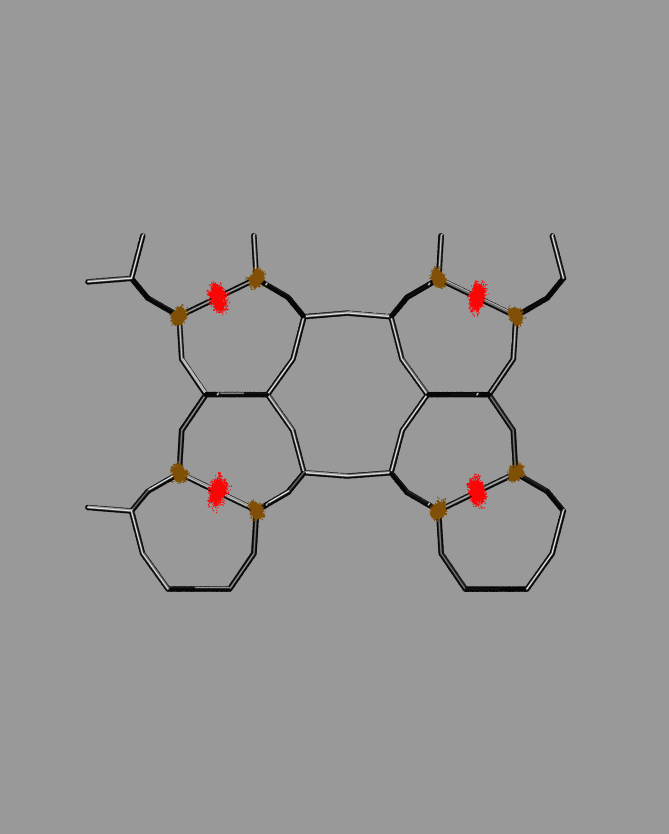
Computer modeling of apparently straight bond angles: The intriguing case of all-silica ferrierite
https://doi.org/10.2138/am-2019-6951
Trudu et al. (p. 1546). A long-standing issue is the presence of linear Si-O-Si bridges in silicates. We investigate the structure of the all silica zeolite ferrierite and explain the origin of the instability of its linear linkages. The relationship between linear Si-O-Si angles and metastability of a zeolite framework is a key to better understanding of the possible phase-transition mechanisms of open-framework (alumino-) silicate minerals at elevated pressure and temperature conditions of geological relevance.
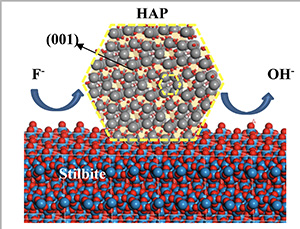
Composite materials based on zeolite stilbite from Faroe Islands for the removal of fluoride from drinking water
https://doi.org/10.2138/am-2019-7076
Díaz et al. (p. 1556). Composite materials based on natural stilbite zeolites from Faroe Islands have been prepared where nanoparticles of hydroxyapatite are grown in a particular orientation on the zeolite external surface. Such nanoparticles are very efficient for the removal of fluoride from water through anion-exchange with hydroxides, allowing reducing the fluoride concentration below the admissible level.
The Italian Solfatara as an analog for Mars fumarolic alteration
https://doi.org/10.2138/am-2019-6899
Flahaut et al. (p. 1578). The characteristics and mineralogic diversity of the Italian Solfatara fumarolic field were surveyed as an analog for some of Mars' hydrothermal environments. Several techniques of mineral identification (VNIR spectroscopy, Raman spectroscopy, XRD) were used and reveal the presence of varying alteration patterns as a distance from the crater center and vents. The authors discuss the possibility of identifying such environments -which represent prime astrobiological targets- on Mars.
Change of crackling noise in granite by thermal damage: Monitoring nuclear waste deposits
https://doi.org/10.2138/am-2019-7058
Xie et al. (p. 1565). The results of our research have two major implications. Firstly, it can be used for continuous monitoring of burial sites and other geothermal engineering projects. The acoustic emission (AE) energy distribution exponent can easily be measured using highly sensitive thermostability AE sensors attached to the host rock or normal sensors located around the burial site. The data analysis method used in this study also can be easily implemented through online evaluation of the AE signals. In addition, the relationship between mineral structure and avalanche dynamics is the focus of many studies of crackling noise. Here we show that avalanches are heavily influenced by temperature and that local 'crumbling' is a key mechanism for softening of geomaterials (rather than elastic softening). This result will now attract more theoretical and simulation studies in this field.
« ‹ 1 … 57 58 59 60 61 … 85 › »ADDITIONAL RESOURCES