
Editor’s Notes
Total Results: 1697
Volume 105 : February 2020 Issue
Cl-bearing fluorcalciobritholite in high-Ti basalts from Apollo 11 and 17: Implications for volatile histories of late-stage lunar magmas
https://doi.org/10.2138/am-2020-7180
Greenwood et al. report the second fluorine-bearing mineral found from the Moon, a Cl-bearing fluorcalciobritholite. This mineral has only been found in mesostasis of high-Ti magmas with fluorapatite. This F- and Cl-bearing mineral crystallizes after fluorapatite, implying that high-Ti lunar magmas were not volatile-poor.
Amphibole-rich cumulate xenoliths in the Zhazhalong intrusive suite, Gangdese arc: Implications for the role of amphibole fractionation during magma evolution
https://doi.org/10.2138/am-2020-7199
Although the importance of precipitating amphibole has been inferred through distinctive geochemical fingerprints of derivative products, this study by Zhou et al. provides a direct snapshot of this differentiation process. With progressive accumulation, the amphibole-rich sponge will form in the arc crust, which is fundamental to interpreting many issues in petrology. Particularly, the amphibole-rich xenoliths have petrological similarities to appinites, and their results suggest that some appinites likely represent amphibole-rich cumulates.
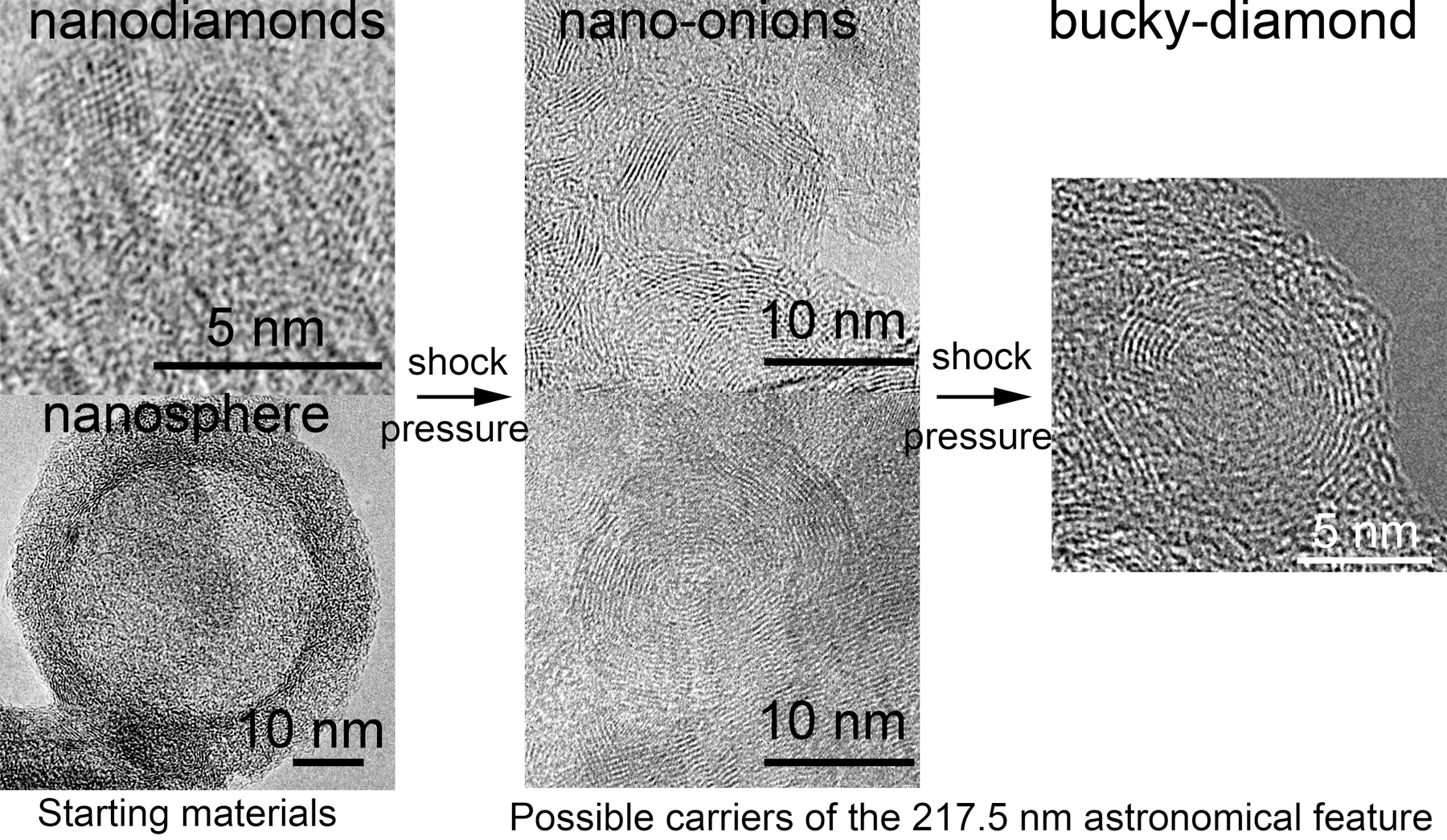
Extraterrestrial, shock-formed, cage-like nanostructured carbonaceous materials
https://doi.org/10.2138/am-2020-7305
Németh and Garvie report the first natural carbon nano-onions resembling large multilayered fullerenes and bucky-diamonds from the impact-shocked Gujba (CBa) meteorite. They propose that the carbon nano-onions formed from the primitive carbonaceous materials, whereas bucky-diamonds could have formed through the high-pressure transformation of nano-onions. Both nano-onions and bucky-diamonds are fullerene-type structures, and as such could be a component of the astronomical 217.5 nm absorption feature.
Pyrite: Fool’s gold records starvation of bacteria
https://doi.org/10.2138/am-2020-7234
This paper by Gregory and Kohn gives an introduction to a high-school level audience on pyrite, and the sulfur isotopes contained within it, and how that can be used to understand past ocean conditions.
2019 REVIEWERS
https://doi.org/10.2138/am-2020-696
The issue ends with a list of 2019 reviewers for American Mineralogist (https://doi.org/10.2138/am-2020-696) and a book review by Tony Barber on Geological Belts, Plate Boundaries, and Mineral Deposits in Myanmar (2017) by Andrew Mitchell, Elsevier, eBook ISBN: 9780128033838; Paperback ISBN: 9780128033821, 524 p. (https://doi.org/10.2138/am-2020-B10521)
BOOK REVIEW
https://doi.org/10.2138/am-2020-B10521
Book Review by Tony Barber: Geological Belts, Plate Boundaries, and Mineral Deposits in Myanmar (2017) by Andrew Mitchell, Elsevier, eBook ISBN: 9780128033838; Paperback ISBN: 9780128033821, 524 p.
A new emerald occurrence from Kruta Balka, Western Peri-Azovian region, Ukraine: Implications for understanding the crystal chemistry of emerald
https://doi.org/10.2138/am-2020-7010
Franz et al. investigated emerald, the bright-green gem variety of beryl, from a new locality at Kruta Balka, Ukraine, and compare its chemical characteristics with those of emeralds from selected occurrences worldwide to clarify the types and amounts of substitutions as well as the factors controlling such substitutions. They applied secondary ion mass spectrometry and showed that—although beryl in general has quite variable Be-contents—emeralds are surprisingly simple. However, Li-contents, even small, are important; the new occurrence is unusual, because Li (together with Na) is substituting for Al, and not, as at most other emerald localities, for Be, and small amounts of Li can sit in a 'hollow' channel position. The green color of emerald is produced by the incorporation of small amounts of Cr and V.
Volume 105 : January 2020 Issue
Regolith-hosted rare-earth elements: The phyllosilicate connection
https://doi.org/10.2138/am-2020-7312
Elliott’s Highlights and Breakthroughs paper details how Li and Zhou describe the role of halloysite in sorbing rare-earth elements (REE) in a regolith setting in SE China. This mineral-based model explains the occurrences of the ion-sorbed REE in this regolith setting, which is a leading source of the heavy, and technologically important, rare-earth elements (Gd-Lu, Y).
Heirs of the revolution: X-ray diffraction and the birth of the Mineralogical Society of America
https://doi.org/10.2138/am-2020-7205
The founding of the MSA in 1919 followed the discovery of X-ray diffraction so closely that one might hypothesize a causal link between the events. This review by Peter Heaney explores the efforts of the MSA founders to communicate the importance of the crystallography revolution to their contemporaries, and it argues that the then-new conceptions of atomicity differentiated mineralogy from other styles of geological investigation, thereby warranting the establishment of a specialized professional society.
Deep Earth carbon reactions through time and space
https://doi.org/10.2138/am-2020-6888CCBY
"Carbon reactions take place in the deep Earth and have played a critical role in our planet's development. McCammon et al. describe these reactions, including carbon capture during Earth's formation, freezing of liquid iron-carbon to form Earth's inner core, and oxidation-reduction reactions in the modern-day mantle. Although these reactions are ""invisible"" because they are not observed on Earth's surface, our planet would be vastly different if none of these reactions had taken place during its history."
Magmatic carbon outgassing and uptake of CO2 by alkaline waters
https://doi.org/10.2138/am-2020-6986CCBY
The Earth in Five Reactions project was part of the Deep Carbon Observatory program, a decade-long effort to understand the quantities, movements, forms, and origin of carbon in Earth. In this paper, Edmonds et al. review the reactions involved when carbon exsolves from silicate melts in magmatic intrusions and volcanic eruptions and the reactions that occur when carbon is dissolved into aqueous solutions, with a particular reference to alkaline lakes. They discuss the implications of our understanding of these natural reactions for forecasting the longevity and effects of anthropogenic carbon release.
New insights into the evolution of Mississippi Valley-Type hydrothermal system: A case study of the Wusihe Pb-Zn deposit, South China, using quartz in-situ trace elements and sulfides in situ S-Pb isotopes
https://doi.org/10.2138/am-2020-7021
The Upper Yangtze Pb-Zn metallogenic province (South China) covers an area of 170,000 km2 and contains approximately 400 carbonate-hosted epigenetic Pb-Zn deposits totaling ~26 Mt of metal reserves. Despite the Wusihe deposit resembling Mississippi Valley Type, MVT, deposits in North America, it shows many distinctive geological and geochemical features warranting further investigation. Luo et al. take the Wusihe Pb-Zn deposit as a case study, employing LA-ICPMS in situ quartz trace element analysis, bulk and NanoSIMS in situ S isotopes, and femtosecond LA-MC-ICPMS in situ Pb isotopes to reveal the evolution of this MVT hydrothermal system. The trend of trace element compositions in quartz indicates the role of an acid-producing process resulting from sulfide precipitation and acid consumption by carbonate buffering. New bulk δ34S values of sulfides imply that in addition to thermochemical sulfate reduction (TSR), bacterial sulfate reduction (BSR) may also play an important role in the formation of S2-. In situ δ34S values suggests a mixing of two isotopically distinct sources of S2- produced by TSR and BSR. New galena Pb isotopic ratios suggest that the metal sources in the Wusihe deposit are mainly Proterozoic basement rocks. Hence, a multi-process model (i.e., basin-mountain coupling, fluid mixing, local sulfate reduction, in situ acid-production, and involvement of black shales and carbonate sequences) was responsible for the formation of the Wusihe deposit, whilst S2- was produced by both TSR and BSR, providing new insights into the evolution of MVT hydrothermal systems.
Celestine discovered in Hawaiian basalts
https://doi.org/10.2138/am-2020-6995
Celestine was discovered in basalt from a Hawaii. This represents the first report of celestine in an oceanic basalt. Garcia and Hellebrand document the mode of occurrence of celestine in Ka'ula Island basalts using backscattered electron imagery, present high precision electron microprobe analyses of celestine, examine the effects of alteration on the geochemistry of Ka'ula basalts, and discuss possible origins for the formation of celestine in these rocks. Future studies of hydrothermally altered basalts from active volcanoes on oceanic islands, especially for basalts with elevated Sr contents (e.g., 1000 ppm), should be aware of the possible presence of celestine in moderately altered lavas.
Microstructural controls on the chemical heterogeneity of cassiterite revealed by cathodoluminescence and elemental X-ray mapping
https://doi.org/10.2138/am-2020-6964
Cassiterite (SnO2) has gained attention recently as a geochronometer for Sn-bearing mineralized systems, but there is no clear framework for the interpretation of cathodoluminescence imaging frequently employed prior to analysis. In this paper, Bennett et al. use a combination of hyperspectral cathodoluminescence and quantitative X-ray element mapping to constrain the growth history of cassiterite crystals.
Hornblende as a tool for assessing mineral-melt equilibrium and recognition of crystal accumulation
https://doi.org/10.2138/am-2020-6972
Recent studies have proposed that hornblende major element compositions can be used to calculate equilibrium anhydrous melt compositions. In this study, Fe/Mg partitioning relationships and hornblende chemometry are used to evaluate the extent to which hornblende from several plutonic and volcanic rocks are in equilibrium with their associated bulk-rock and/or glass compositions. Werts et al. found that hornblendes from many plutonic and volcanic rocks are not in equilibrium with their bulk-rock compositions; instead they are in equilibrium with melts that are more silicic than the bulk-rock sample, indicating that some degree of crystal accumulation and/or melt loss has occurred and requiring removal and/or redistribution of silicic melts. The application of hornblende partitioning relationships and chemometry to bulk-rock and glass samples has wide-ranging implications on discerning volcano-plutonic connections, the ways in which magmatic processes are determined and quantified, and on the distribution of melt compositions in the crust.
The role of clay minerals in formation of the regolith-hosted heavy rare earth element deposits
https://doi.org/10.2138/am-2020-7061
Heavy rare earth elements (HREEs) have become significantly important in our modern society. The dominant source of HREE is from regolith-hosted deposits, presumably occurring as adsorbed on the clay minerals in weathering crusts. However, the actual relationship between the HREEs and clay minerals has not been comprehensively examined before. In this study, for the first time, Li and Zhou link the properties of clay minerals to HREE accumulation through comprehensive mineralogical and geochemical studies exemplifying the world's largest regolith-hosted HREE deposit, Zudong, South China. Abundant poorly crystallized halloysite and kaolinite of high specific surface area, pore volumes, and low crystallinity in the lower part of soil profiles transform to well-crystallized vermicular kaolinite of low specific surface area, pore volumes, and high crystallinity in the upper part of the soil profile during progressive weathering, which is correlated with a significant decrease in the clay-adsorbed REE concentrations. Variation in physicochemical properties of the clay minerals during progressive weathering is one of the key factors for REE accumulation and enrichment in weathering crusts to form the regolith-hosted deposits.
The tetrahedrite group: Nomenclature and classification
https://doi.org/10.2138/am-2020-7128
Biagioni et al. show how the new IMA-CNMNC approved classification of the tetrahedrite group allows the full description of the chemical variability of these widespread sulfosalts and is able to convey important information not only to mineralogists but also to ore geologists and industry professionals.
Caseyite, a new mineral containing a variant of the flat-Al13 polyoxometalate cation
https://doi.org/10.2138/am-2020-7181
The new mineral caseyite records the presence of technologically important polyoxometalate ions in geochemical fluids, both as cations and as anions. This report by Kampf et al. is the first of a naturally occurring nanocluster resembling the “flat-Al13” polyoxocation that is used to make thin films for electronics, optics, and optoelectronics applications, and it lends greater credence to research suggesting that the flat-Al13 cluster is an important aqueous ionic species in natural systems. The discovery of a new flat-Al13 variant containing a V5+ substituent suggests new avenues for developing technologically useful modifications of the flat-Al13 structure.
Incorporation of Mg in phase Egg, AlSiO3OH: Toward a new polymorph of phase H, MgSiH2O4, a carrier of water in the deep mantle 2 4
https://doi.org/10.2138/am-2020-7204
Bindi et al. demonstrate that Phase Egg, considered one of the main players in the water cycle of the mantle, can incorporate large amounts of Mg in its structure and that there exists a solid solution with a new hypothetical MgSiH2O4 end-member. The new hypothetical MgSiH2O4 end-member would be a polymorph of Phase H, a leading candidate for delivering significant water to the deepest part of the lower mantle.
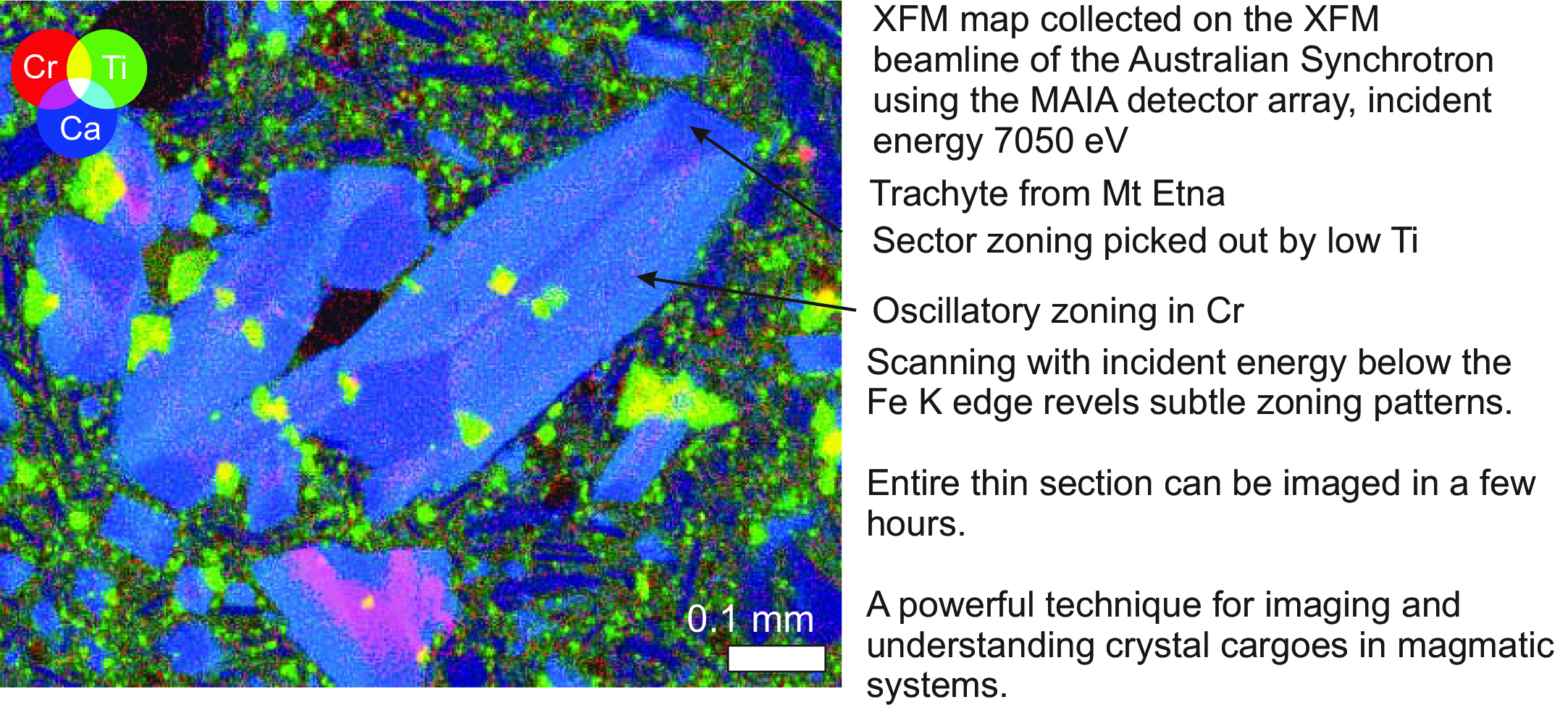
Imaging trace-element zoning in pyroxenes using synchrotron XRF mapping with the Maia detector array: Benefit of low-incident energy
https://doi.org/10.2138/am-2020-7228
Microbeam XRF mapping with synchrotron radiation lets Barnes et al. reveal subtle trace element zoning in igneous phases. Scanning with incident energy below the Fe K edge improves sensitivity and precision. An entire thin section can be imaged in a few hours. This is a powerful technique for imaging and understanding crystal cargoes in magmatic systems.
« ‹ 1 … 56 57 58 59 60 … 85 › »ADDITIONAL RESOURCES