
Editor’s Notes
Total Results: 1697
Volume 104 : October 2019 Issue
Factors controlling the crystal morphology and chemistry of garnet in skarn deposits: A case study from the Cuihongshan polymetallic deposit, Lesser Xing’an Range, NE China
https://doi.org/10.2138/am-2019-6968
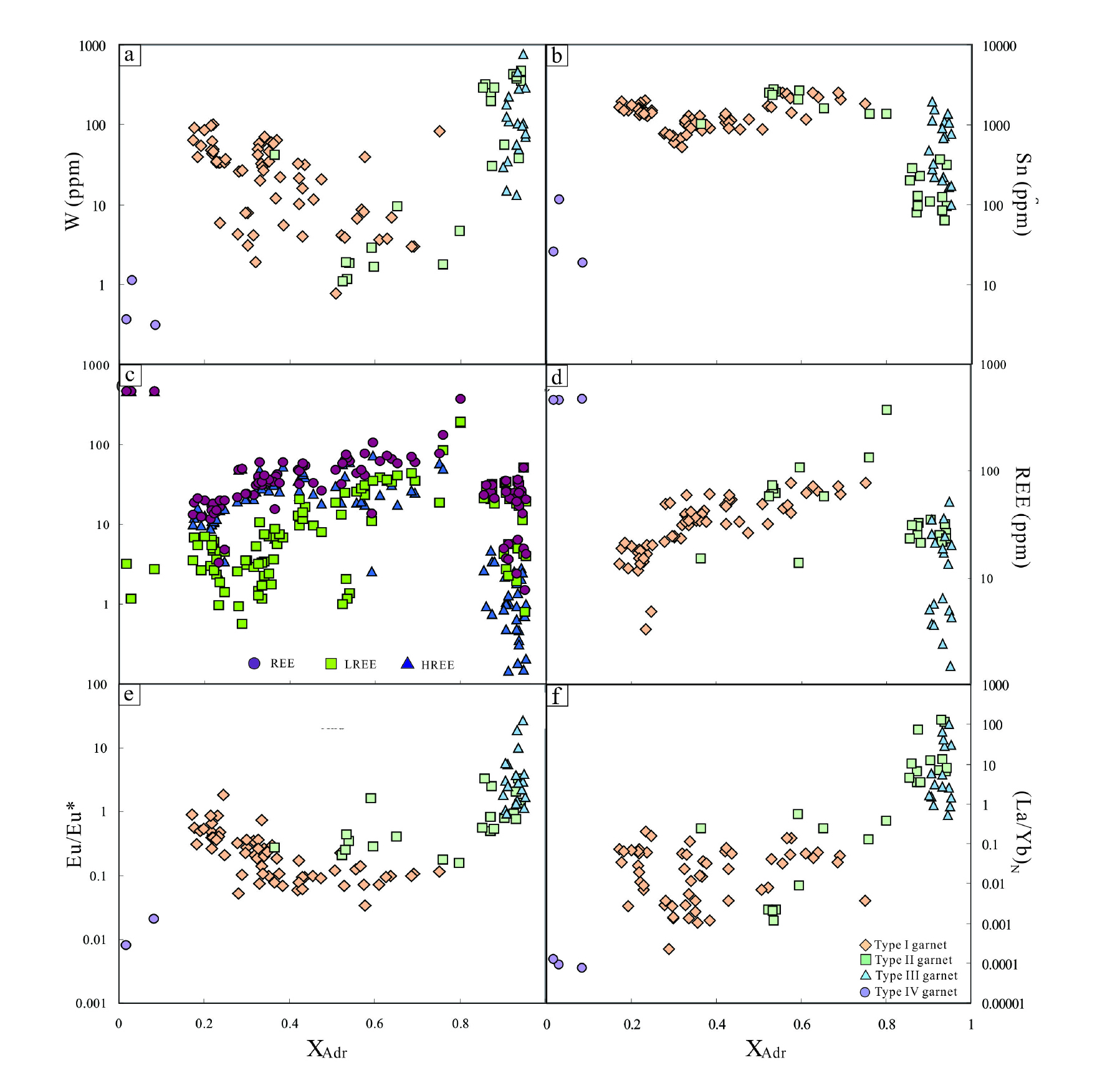
Fei et al. (page 1455) investigated the factors that control the crystal morphology and chemistry of garnets in the Cuihongshan polymetallic skarn deposit, China. Major findings include: 1) Strain from lattice mismatch at substitution and twin probably causes the birefringence in garnets; 2) REE concentrations are probably influenced by the relative proportion and temperature of the system; 3) LREE-HREE fractionation of garnets can be attributed to relative compositions of grossular-andradite system; and 4) W and Sn concentrations in garnets can be used as indicators for the exploration of W-Sn skarn deposits.
Gasparite-(La), La(AsO4), a new mineral from Mn ores of the Ushkatyn-III deposit, Central Kazakhstan, and metamorphic rocks of the Wanni glacier, Switzerland
https://doi.org/10.2138/am-2019-7028
Vereshchagin et al. (page 1469) report a new mineral, gasparite-(La), La(AsO4), from Mn ores of the Ushkatyn-III deposit, Central Kazakhstan and from alpine fissure in metamorphic rocks of the Wanni glacier, Binn Valley, Switzerland. Gasparite-(La) has a monoclinic structure with the space group P21/n. The samples from the Ushkatyn-III deposit and Wanni glacier have different origins. La/Ce and As/P/V ratios in gasparite-(La) may serve as an indicator of formation conditions. Raman spectra of gasparite-(La) can be used to identify its origin.
Cation ordering, valence states, and symmetry breaking in the crystal-chemically complex mineral chevkinite-(Ce): Recrystallization, transformation, and metamict states in chevkinite
https://doi.org/10.2138/am-2019-6458
Stachowicz et al. (page 1481) investigated the cation ordering, valence states, and symmetry breaking in a Nb-rich chevkinite-(Ce) from the Biraya rare-metal deposit, Russia, using electron probe microanalysis, X-ray diffraction, and photoelectron spectroscopy. Annealing the sample at 750 °C resulted in the structural transformation C2/m→P21/α, which defines chevkinite stability relations. This transformation seems to be a rapid version of a naturally occurring process that possibly involves twinning of the crystals. Nb-rich chevkinite-(Ce) occurs naturally as two polymorphs, C2/m and P21/α, the latter of which is the stable form under ambient conditions. There are some distinct differences between the two structures, such as their mean M-O distances and site scattering values of particular sites, which can be associated with the redistribution of lighter cations, mainly Mg2+, within the structures.
Discrete Zr and REE mineralization of the Baerzhe rare-metal deposit, China
https://doi.org/10.2138/am-2019-6890
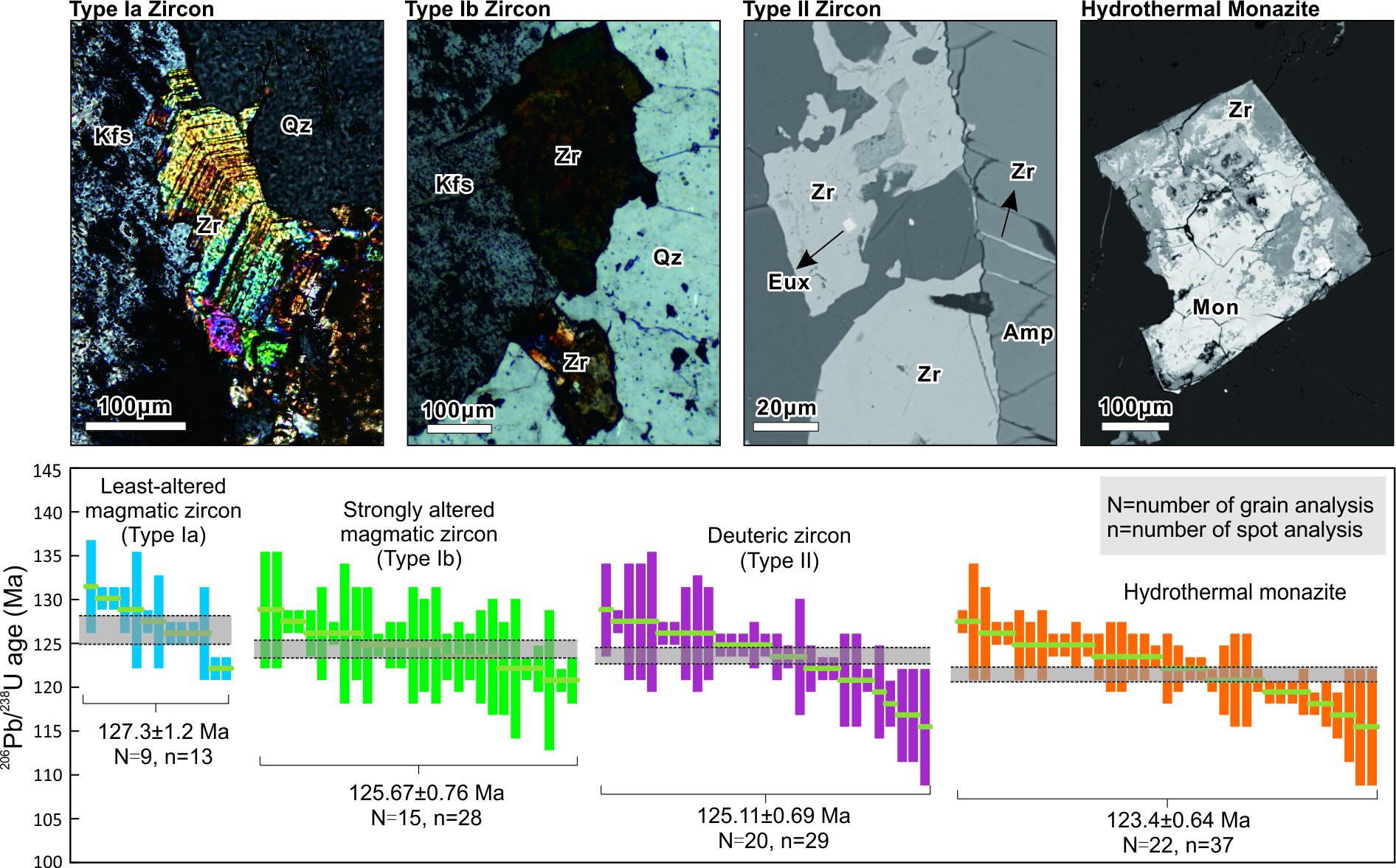
Qiu et al. (page 1487) present geochronological data showing that Zr and REE mineralization events of the Baerzhe rare-metal deposit in Northeastern China spanned roughly two million years. The Zr and REE mineralization events are temporally distinct but both are genetically related to the same mineral system. Three distinct types of magmatic through deuteric zircon along with hydrothermal monazite are considered the most significant ore minerals.
Origin of Monte Rosa whiteschist from in-situ tourmaline and quartz oxygen isotope analysis by SIMS using new tourmaline reference materials
https://doi.org/10.2138/am-2019-7012
Marger et al. (page 1503) present one of the first in-situ oxygen isotope analyses from zoned tourmaline crystals using secondary ion mass spectrometry. The authors document that tourmaline is refractory for oxygen isotope compositions, and can be used to track fluid-rock interactions. They developed a set of tourmaline reference materials spanning the composition range of the most abundant metamorphic and igneous tourmalines. By combining a detailed petrologic study with the oxygen isotope compositions of quartz and tourmaline, this study demonstrates that oxygen isotopes measured in-situ can be used to resolve the debated question about whiteschist formation in the western Alps. It also shows that the protolith of the whiteschists were Hercynian granites, and the metasomatism predated Alpine metamorphism.
Chenmingite, FeCr2O4 in the CaFe2O4-type structure, a shock-induced, high-pressure mineral in the Tissint martian meteorite
https://doi.org/10.2138/am-2019-6999
Ma et al. (page 1521) report a new mineral, chenmingite, FeCr2O4, with a Pnma CaFe2O4-type structure. This is the third high-pressure mineral the authors have discovered (in addition to ahrensite and tissintite) during their nanomineralogy investigation of the Tissint shergottite. Further, chenmingite is one of thirteen newly-approved high-pressure minerals discovered in shocked meteorites since 2013. Their meteoritic occurrences can also inform the study of deep earth systems at high pressures and temperatures.
Single-crystal elasticity of iron-bearing phase E and seismic detection of water in Earth’s upper mantle
https://doi.org/10.2138/am-2019-7084
Satta et al. (page 1526) determined the elastic properties of phase E single crystals using Brillouin spectroscopy. The results show that phase E has the lowest isotropic compressional and shear velocities among the Dense Hydrous Magnesium Silicate (DHMS) phases and other relevant upper mantle and transition zone minerals. This study suggests that even small amounts of phase E can significantly reduce acoustic wave velocities in isotropic aggregates, opening the possibility of linking the presence of water-rich phase E assemblages with velocity anomalies detected by seismology in subduction scenarios.
BOOK REVIEW
https://doi.org/10.2138/am-2019-B1041015
Chen (page 1530) reviews a book entitled “Understanding Minerals and Crystals” by Terence McCarthy and Bruce Cairncross (2015), Struik Nature, 312 pp. The focus of this book is mineral resources education, and it distinguishes itself from other mineralogy books by containing rich conceptual and visual content as an introductory guide for mineralogy.
BOOK REVIEW
https://doi.org/10.2138/am-2019-B1041016
Johnson (page 1531) reviews a book entitled “A Practical Guide to Rock Microstructure (2nd edition)” by Ron H. Vernon (2019), Cambridge University Press, 440 pp. This book contains detailed descriptions of multiple hypotheses on the generation of each texture and provides extensive references for exploring the origin of textures in more depth. It can serve as a reference for graduate students, professionals, or undergraduate research projects.
Volume 104 : September 2019 Issue
Seeking the most hydrous, primitive arc melts: The glass is half full
https://doi.org/10.2138/am-2019-7124
Steele-MacInnis this issue (page 1217) highlights the recent publications by Gavrilenko et al. (July issue, p. 936; https://doi.org/10.2138/am-2019-6735) that investigated the contradiction between experimental studies that predict that primitive arc melts may contain up to and greater than 15 wt% H2O, but that, curiously, the breadth of analytical data on melt inclusions consistently show to have lower values, mostly less than 6 wt%. Gavrilenko et al. showed experimentally that this apparent contradiction is likely rooted in a “quench control,” whereby wetter melts are incapable of being quenched to glass. This study neatly reconciles experimental and observational data and provides a key insight into how best to analyze and interpret the H2O contents of melt inclusions from subduction settings. https://doi.org/10.2138/am-2019-7124
Hydrous LABZ beneath a subduction zone was reconstructed for the first time
https://doi.org/10.2138/am-2019-7113
Takahashi (page 1219) discusses the breakthrough by Sato and Ozawa’s study of the lithosphere under the Japanese subduction zone (page 1285; https://doi.org/10.2138/am-2019-6858). The LABZ (lithosphere-asthenosphere boundary Zone) under oceanic plates, young continents and subduction zones has remained largely in question, due to the lack of proper geobarometry for spinel lherzolite facies. Y. Sato and K. Ozawa, for the first time, describe the petrologic features of the LABZ beneath a subduction zone. A reconstructed LABZ beneath Ichinomegata is similar to those reported from the bottom of the subcratonic lithospheric mantle in various aspects, but the boundary layer beneath Ichinomegata is much shallower (40-60 km) and colder (~1050 °C). https://doi.org/10.2138/am-2019-7113
U, Th, and K partitioning between metal, silicate, and sulfide and implications for Mercury’s structure, volatile content, and radioactive heat production
https://doi.org/10.2138/am-2019-7000
Boujibar et al. (page 1221) investigate the origin of the elevated concentration of K relative to U and Th on the surface of Mercury found by the MESSENGER mission. These measurements suggested an enrichment of volatile elements (such as K) relative to refractory elements (such as U and Th), in comparison to Earth and Venus. They conducted experiments in an O-depleted environment typical of Mercury's formation, to assess whether K, U, and Th were distributed differently between the different layers inside Mercury (mantle, core, and possible sulfide layer) and found that if an iron sulfide layer exists between the core and mantle, more U and Th then K would be sequestered in that layer, leading to higher K/U and K/Th ratios in the crust and mantle, measurable on the surface by MESSENGER spacecraft. By taking into account this possible sulfide layer, Mercury appears to be as volatile depleted as the Earth and Venus and more depleted than Mars. These results confirm the depletion of volatile elements in the inner part of the Solar System, where Mercury, Venus, and Earth formed. https://doi.org/10.2138/am-2019-7000
Valleyite: A new magnetic mineral with the sodalite-type structure
https://doi.org/10.2138/am-2019-6856
Lee et al. (page 1238) study a new magnetic mineral (valleyite) that was discovered in a basaltic scoria. Valleyite has sodalite-type structure with low density. The magnetization hysteresis loop indicates the magnetic exchange coupling between valleyite (soft magnet) and luogufengite (hard magnet), which will help us better understand magnetic properties and paleo-magnetism of basaltic rocks. The new mineral with the sodalite-type cage structure, and the magnetic property is potentially a functional material. https://doi.org/10.2138/am-2019-6856
An analysis of the magnetic behavior of olivine and garnet substitutional solid solutions
https://doi.org/10.2138/am-2019-6839CCBYNCND
Geiger et al. (page 1246) analyzed the magnetic and and Néel temperature, TN, properties of four silicate solid solutions. The four systems are: fayalite-forsterite olivine, Fe2+2SiO4-Mg2SiO4, and the garnet series, grossular-andradite, Ca3(Alx,Fe3+1-x)2Si3O12, grossular-spessartine, (Cax,Mn2+1-x)3Al2Si3O12, and almandine-spessartine, (Fe2+x,Mn2+1-x)3Al2Si3O12. https://doi.org/10.2138/am-2019-6839CCBYNCND
Pyrite trace-element and sulfur isotope geochemistry of paleo-mesoproterozoic McArthur Basin: Proxy for oxidative weathering
https://doi.org/10.2138/am-2019-6873
Mukherjee et al. (page 1256) demonstrate that the trace-element concentrations (and their ratios) of sedimentary pyrite in three black shale formations of the McArthur Basin provide evidence for a gradual increase in atmospheric oxygenation from 1730 to 1360 Ma. They observe a marked change in pyrite sulfur isotopic compositions in the three black shale formations, i.e., a marked increase in mean δ34Spyrite values from the Wollogorang Formation to the Velkerri Formation. This change is possibly indicative of the expansion of oxygenated waters and decreasing areal extent of anoxia. Results from both techniques have major implications on the atmospheric redox evolution in “Boring Billion”, a period known to witness non-fluctuating redox conditions. https://doi.org/10.2138/am-2019-6873
Compressional behavior and spin state of δ-(Al,Fe)OOH at high pressures
https://doi.org/10.2138/am-2019-6913
Ohira et al. (page 1273) investigate the δ-(Al,Fe3+)OOH solid solution, one of the hydrous phases stable under lower mantle conditions. This study shows that the δ-(Al,Fe)OOH could cause an anomalously high ρ/νΦ ratio at depths corresponding to the spin crossover region (~900 to ~1000 km depth), whereas outside the spin crossover region a low ρ/νΦ anomaly would be expected. The results suggest that the presence of δ-(Al,Fe)OOH could be detectable and provide new insight for understanding the heterogeneity in the lower mantle. https://doi.org/10.2138/am-2019-6913
Reconstruction of the lithosphere-asthenosphere boundary zone beneath Ichinomegata maar, Northeast Japan, by geobarometry of spinel peridotite xenoliths
https://doi.org/10.2138/am-2019-6858
Sato and Ozawa (page 1285) develop a method for accurate estimation of derivation depths of shallow upper mantle materials (xenoliths) occurring as fragments in volcanic ejecta. Its application to xenoliths from the Ichinomegata maar in the back-arc side of Northeast Japan Arc was successful in revealing, for the first time, the structure of lithosphere-asthenosphere boundary zone in arc settings, which was found to consist of water-saturated lithospheric mantle and underlying partially molten asthenosphere. https://doi.org/10.2138/am-2019-6858
High-pressure phase stability and elasticity of ammonia hydrate
https://doi.org/10.2138/am-2019-7057
Li et al. (page 1307) investigate ammonia-water mixtures that are an important component of the giant ice planets. Using Raman spectroscopy, they investigate the phase stability of ammonia hydrate (AHH) in different ratios at high pressures. The experimental results show that all the ammonia hydrate will dehydrate into ammonia hemihydrate and ice-VII. More importantly, ice-VII will gradually separate out from ammonia hydrate and could grow to be a single crystal. They also measure the sound velocity and elasticity of ammonia hydrate and single-crystal ice-VII using Brillion scattering up to 53 GPa. Measured elasticity of ice-VII shows anomalous variations at 10-20 GPa and 42-53 GPa, respectively, which is associated with the structural change of single-crystal ice-VII. Modeling the velocity of AHH and ice-VII mixture indicates that the mantle of ice giants may have strong anisotropies in velocity. https://doi.org/10.2138/am-2019-7057
A multi-methodological study of kurnakovite: A potential B-rich aggregate
https://doi.org/10.2138/am-2019-7072
Diego Gatta et al. (page 1315) re-investigate the crystal structure and crystal chemistry of kurnakovite by a multi-methodological approach (i.e., single-crystal neutron diffraction at room and low temperature, titrimetric analysis for the determination of B and Mg content, inductively coupled plasma atomic emission spectroscopy for REE and other minor elements, ion selective electrode for F, high-T mass loss for H2O content). Kurnakovite does not act as a geochemical trap of industrially relevant elements (e.g., Li, Be, or REE). It is a potentially B-rich addition to concretes used for the production of radiation-shielding materials due to the elevated ability of 10B to absorb thermal neutrons, because it can mitigate the risk of releasing undesirable elements, for example sodium, which could promote deleterious reactions affecting the durability of cements. https://doi.org/10.2138/am-2019-7072
Identification of the occurrence of minor elements in the structure of diatomaceous opal using FIB and TEM-EDS
https://doi.org/10.2138/am-2019-6917
Yuan et al. (page 1323) treated diatomaceous opals using Focused Ion Beam (FIB) to characterize separately the composition of the internal siliceous parts and the surface/near-surface locations by means of EDS on a TEM. The results demonstrate that minor elements, such as Al, Fe, Ca, and Mg, conclusively exist within the siliceous framework. In addition, foreign minerals (mostly aluminosilicates) largely contribute to the bulk and surface properties of diatomaceous opal. These findings renew the knowledge that diatomaceous opal is “pure” silica mineral or materials. https://doi.org/10.2138/am-2019-6917
« ‹ 1 … 59 60 61 62 63 … 85 › »ADDITIONAL RESOURCES