

Editor’s Notes
Total Results: 1697
Volume 104 : November 2019 Issue
Constraining the timing and character of crustal melting in the Adirondack Mountains using multi-scale compositional mapping and in-situ monazite geochronology
https://doi.org/10.2138/am-2019-6906
Williams et al. (p. 1585). The Adirondack Highlands have been held as an example of the middle crust during continental collision. Gneissic rocks interpreted to have undergone partial melting are common, but the timing and setting of melting are uncertain. This contribution uses in-situ monazite petrochronology to suggest that melting occurred at two main times, ca. 1.15 Ga and 1.05 Ga. Further, the amount of melting in the second event depends on the degree of melt segregation in the first event. High-resolution microprobe mapping and analysis provide a powerful tool for linking geochronology to deformation fabrics and metamorphic reactions.
Melting in the Fe-FeO system to 204 GPa: Implications for oxygen in Earth’s core
https://doi.org/10.2138/am-2019-7081
Oka et al. (p. 1603). We performed melting experiments on Fe-O alloys to 204 GPa and determined the change in liquidus phase diagram in the Fe-FeO system, in particular the eutectic liquid composition, with increasing pressure on the basis of ex-situ textural and chemical characterizations of recovered samples. Our main conclusions are the following: (1) The oxygen content in the Fe-FeO eutectic liquid increases remarkably upon reduction in the immiscible two-liquids region to ~40 GPa. (2) Such observation is different from that in the recent study by Morard et al. (2017) that was mainly based on in-situ XRD measurements. The difference is likely attributed to the contamination by carbon that occurred in their experiments and some of ours. (3) Our data to 204 GPa allows extrapolation to 330 GPa, indicating the eutectic liquid includes ~15 wt% O at the ICB. We estimated the range of possible liquid core compositions in Fe-O-Si-S-C, which crystallize solid Fe that forms a dense inner core and account for the density and sound velocity observed in the outer core.
Controls on tetrahedral Fe(III) abundance in 2:1 phyllosilicates
https://doi.org/10.2138/am-2019-7036
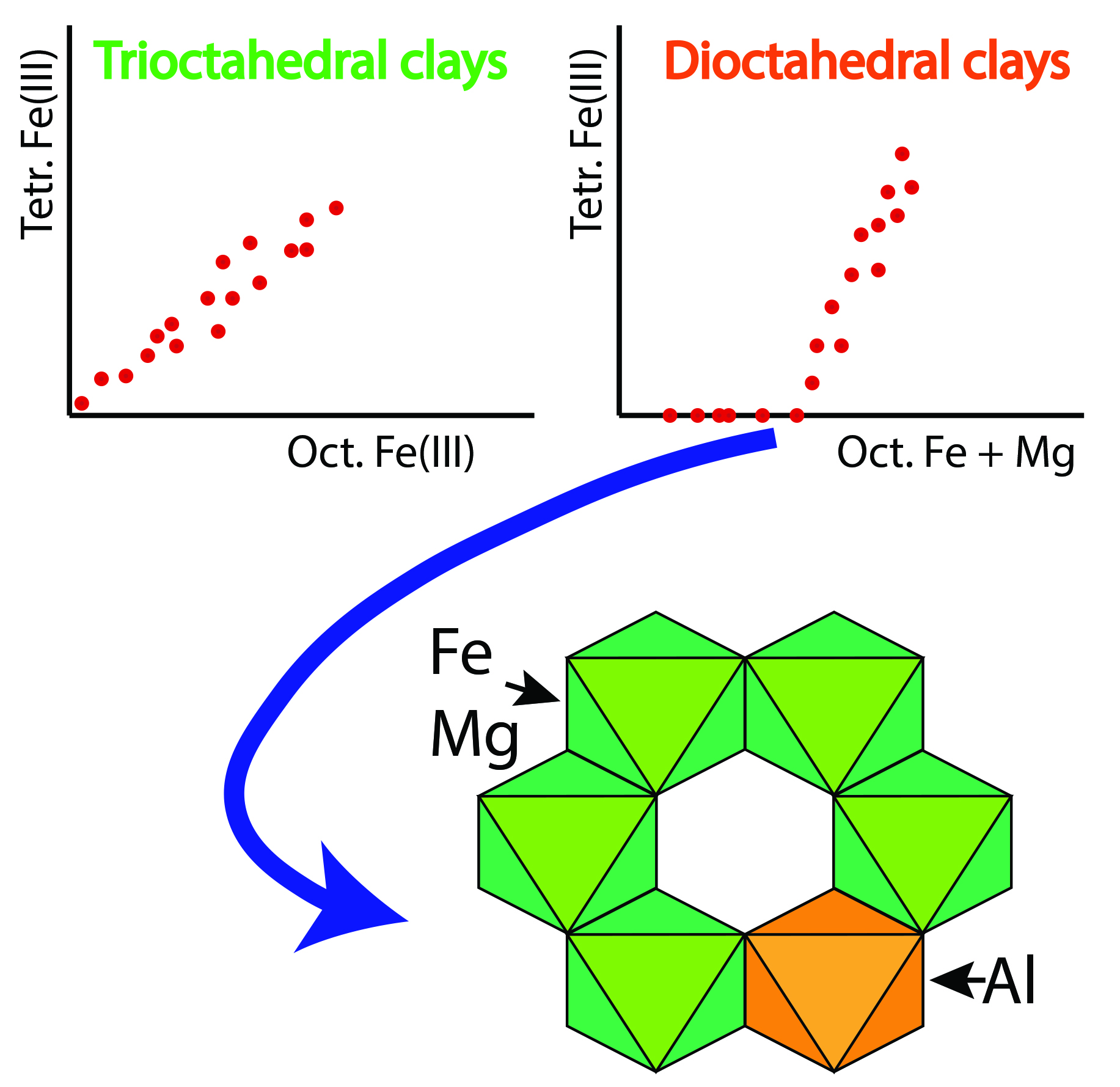
Cuadros et al. (p. 1608). The controls on Fe(III) distribution between tetrahedral and octahedral sites in phyllosilicates have been a matter of great interest in order to understand the interplay between formation environment and crystal-chemical factors during crystallization of Fe-phyllosilicates. Here, for the first time, we present a model describing the controls of Fe(III) distribution between octahedral and tetrahedral sites in all 2:1 phyllosilicates. The results are from a survey of 70 analyses covering a wide range of dioctahedral and trioctahedral phyllosilicates, including endmember and interstratified minerals. Dioctahedral phyllosilicates have a steric control whereby tetrahedral Fe(III) is only allowed if at least five out of six octahedral atoms are larger than Al (typically Fe[III], Fe[II], Mg). In this expanded structure tetrahedral sites can accommodate Fe(III). After this threshold, ~73 % of further Fe(III) atoms occupy tetrahedral sites. In trioctahedral 2:1 phyllosilicates there is no steric hindrance; on average, Fe(III) enters tetrahedral and octahedral sites in similar proportion, and the only control on Fe(III) abundance is Fe(III) availability during crystallization.
Stability, composition, and crystal structure of Fe-bearing Phase E in the transition zone
https://doi.org/10.2138/am-2019-6750
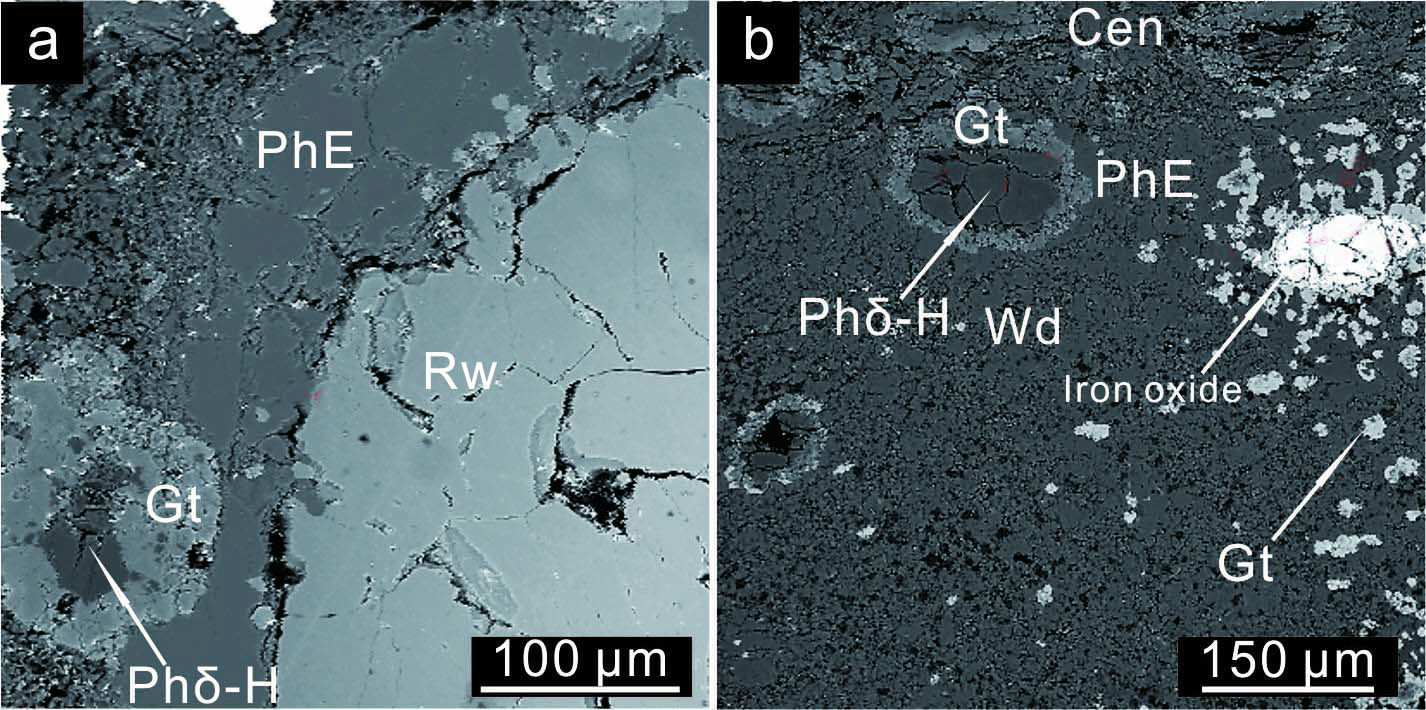
Zhang et al. (p. 1620). In this study, Fe-bearing phase E (one of the dense hydrous magnesium silicates) coexisting with ringwoodite and wadsleyite has been synthesized at 18 and 19 GPa, and 1400 °C. The long heating duration time (27 hours) of syntheses implies that phase E may be a stable component of the mantle transition zone at near-geotherm temperatures, if transition-zone regions adjacent to subducting slabs are hydrated by fluids generated at the top of the lower mantle.
Enrichment of manganese to spessartine saturation in granite-pegmatite systems
https://doi.org/10.2138/am-2019-6938
Maner IV et al. (p. 1625). The enrichment of Mn to the point of spessartine saturation in granitic liquids is explained using experimentally derived mineral-melt partition coefficients for garnet, tourmaline, and cordierite. The partition coefficients are used in a Rayleigh fractional crystallization model to show the amount of crystallization required to concentrate enough Mn to saturate melt with respect to spessartine. The model indicates that approximately 95% of an S-type granitic melt must crystallize to achieve spessartine saturation.
Al and Si diffusion in rutile
https://doi.org/10.2138/am-2019-7030
Cherniak and Watson (p. 1538). This paper reports on experimental measurements of Al and Si diffusion in rutile, investigating effects of oxygen fugacity and orientation on diffusion. Little diffusional anisotropy is observed, with only minor effects of oxgyen fugacity over the range of conditions studied. Si and Al are among the slowest-diffusing species in rutile. These slow diffusivities indicate that the recently developed Al-in-rutile crystallization geothermobarometer (Hoff and Watson, 2018) will be more resistant to diffusional alteration than the Zr-in-rutile crystallization thermometer.
Sound velocity of neon at high pressures and temperatures by Brillouin scattering
https://doi.org/10.2138/am-2019-7033
Wei et al. (p. 1650). We have determined the compressional-wave velocity (VP) of Ne at simultaneously high P-T condition up to 53 GPa and 1100 K. The obtained results provide crucial constraints on the combined effect of pressure and temperature on VP. In particular, VP of super-critical Ne fluid exhibit a weak dependence on pressure above 800 K and 20 GPa. The velocity contrast in VP between the super-critical Ne fluid and the solid phase increases with increasing temperature.
A Cr3+ luminescence study of natural topaz Al2SiO4(F,OH)2 up to 60 GPa
https://doi.org/10.2138/am-2019-7079
O'Bannon, III and Williams (p. 1656). Topaz is an important subduction zone mineral that transports water and fluorine into the deep Earth. Previous studies have characterized the bulk crystallographic response of topaz to high-pressure. Here we used Cr3+ luminescence which is a sensitive site-specific probe of the bonding environment of the Al-sites in topaz. We have characterized for the first time the high-pressure behavior up to 60 GPa of all three Al environments simultaneously. Our results reveal that topaz is one of the most metastable tetrahedrally coordinated silicates that is known.
Two generations of exsolution lamellae in pyroxene from Asuka 09545: Clues to the thermal evolution of silicates in mesosiderite
https://doi.org/10.2138/am-2019-7001
Pittarello et al. (p. 1663). Mesosiderite meteorites consist of a mixture of crustal basaltic or gabbroic material and core metal, and have experienced an extremely slow cooling rate from ca. 550 °C, as recorded in the metal (0.25-0.5 °C/Ma). Here we present a detailed investigation of two generations of exsolution features in a pyroxene from the Antarctic mesosiderite Asuka 09545, in an attempt to constrain the evolution of pyroxene from 1150 to 570 °C.
Crystallographic and fluid compositional effects on the halogen (Cl, F, Br, I) incorporation in pyromorphite-group minerals
https://doi.org/10.2138/am-2019-7068
Epp et al. (p. 1688). Pyromorphite-group minerals are the most common Pb-secondary minerals worldwide and their halogen incorporation is not only governed by crystallographic effects, but more predominantly by the fluid-composition. This enables further fluid monitoring applications such as deciphering single fluid flow episodes and the determination of surface processes. Furthermore, we developed a methodology to simultaneously determine Cl, F, Br and I. Since halogen data, especially concerning Br and I, is generally scarce, this is of interest to the broad geoscience audience.
Diffusion of F and Cl in dry rhyodacitic melt
https://doi.org/10.2138/am-2019-7095
Feisel et al. (p. 1689). We applied the diffusion couple technique on a homogeneous rhyodacitic melt over a temperature range relevant for natural systems. We analyzed the samples for diffusion induced concentration profiles using an electron microprobe. Our analytical conditions allow for very low F and Cl detection limits, which in turn results in very clear and smooth F- and Cl-concentration gradients across the experimental couples. Our results show that both F and Cl exhibit the same temperature dependence on diffusivity, but the diffusion of F is significantly faster than that of Cl. This means that the potential for diffusive fractionation exists and may occur especially under conditions of slow magma ascent and bubble growth. Compared to other melt compositions for which F and Cl diffusion data is available, our diffusivities are generally slower and correlate well with the atomic radius of the diffusing ion. With this investigation we have conducted the first study that quantifies and compares the diffusion rates of F and Cl elements in natural high-silica melts.
Volume 104 : October 2019 Issue
Carbonation and the Urey reaction
https://doi.org/10.2138/am-2019-6880
Kellogg et al. (page 1365) discuss two alternative hypotheses on the origin of carbon in Earth's continental crust. In the first hypothesis, the atmosphere is extracted directly from the early atmosphere through the Urey reaction. In the second hypothesis, the atmosphere is extracted from the mantle by volcanism. The authors argue that the current equilibrium content of carbon in the atmosphere is a balance between injection by volcanism and loss by the Urey reaction.
Carbonation and decarbonation reactions: Implications for planetary habitability
https://doi.org/10.2138/am-2019-6884
Stewart et al. (page 1369) discuss carbonation and decarbonation reactions, which are the primary mechanism for transferring carbon between the solid Earth and the ocean-atmosphere system, and their implications for Earth's climate and planetary habitability. These processes can be broadly represented by the reaction: CaSiO3 (wollastonite) + CO2 (gas) = CaCO3 (calcite) + SiO2 (quartz). The authors summarize their significance as part of the Deep Carbon Observatory’s “Earth in Five Reactions” project.
PO4 adsorption on the calcite surface modulates calcite formation and crystal size
https://doi.org/10.2138/am-2019-7015
Sugiura et al. (page 1381) investigated the effects of PO4 on CaCO3 formation from calcium sulfate anhydrate (CaSO4) at high-pH conditions, under which calcite is likely to form. PO4 regulates calcite formation and growth by adsorbing onto the surface of calcite. Therefore, under high PO4 concentrations, calcite crystals become small and porous. In addition, vaterite is likely to form to counteract the thermal instability of the solution. The results also indicate that PO4, which is an essential component of carbonate apatite, can control the physico-chemical properties of CaCO3, which is a precursor of carbonate apatite, a bone-replacement material.
High-pressure Raman and Nd3+ luminescence spectroscopy of bastnäsite-(REE)CO3F
https://doi.org/10.2138/am-2019-7011
Vennari and Williams (page 1389) conducted high-pressure Raman and Nd3+ luminescence spectroscopy of bastnäsite, a rare earth element (REE)-bearing carbonate that has geologic and economic importance due to its high REE content. The high-P measurements on bastnäsite allowed investigation of bonding changes in carbonate ions juxtaposed with halogens and REE within a carbonate matrix. This study provides evidence for how REE ions are coordinated with carbonate ions at depth with implications for both REE and carbon retention at depth.
Precipitates of α-cristobalite and silicate glass in UHP clinopyroxene from a Bohemian Massif eclogite
https://doi.org/10.2138/am-2019-6773
Hill et al. (page 1402) observed nanocrystals of -cristobalite that are epitaxially exsolved in cores of ultrahigh-pressure (UHP) clinopyroxene from the Bohemian Massif, Czech Republic, using transmission electron microscopy. This study revealed vacancies and OH- in high-pressure pyroxene that formed during subduction. When the host rock is exhumed, the incorporated OH- migrates out from the UHP pyroxene structure together with vacancies and excess silica in multiple forms of glass and cristobalite/amphibole precipitates. If the pyroxene-bearing slab subducts further into the mantle, the pyroxene may release the incorporated OH- into mantle during its phase transformation to garnet and/or perovskite.
Solubility behavior of δ-AlOOH and ɛ-FeOOH at high pressures
https://doi.org/10.2138/am-2019-7064
Xu et al. (page 1416) investigated phase relations in the AlOOH–FeOOH system at 15–25 GPa and 700–1200 °C. δ-AlOOH and ɛ-FeOOH, which have a CaCl2-type structure, were found to form partial solid solutions over wide ranges of pressures and temperatures. This result implies that CaCl2-type hydroxides may carry a certain amount of hydrogen into deeper regions of Earth interior and even Fe-rich Martian core in cold subduction regions.
Analyst and etching protocol effects on the reproducibility of apatite confined fission-track length measurement, and ambient-temperature annealing at decadal timescales
https://doi.org/10.2138/am-2019-7046
Tamer et al. (page 1421) investigated analyst and etching protocol effects on the reproducibility of apatite confined fission-track length measurement, and ambient-temperature annealing at decadal timescales. The authors show that fission-track etching is a continuous process, and they illustrate possible differences between two major apatite fission-track etching procedures, analyst biases on track recognition and measurements, and long-term ambient temperature fission-track annealing.
Identification of interstratified mica and pyrophyllite monolayers within chlorite using advanced scanning/transmission electron microscopy
https://doi.org/10.2138/am-2019-7074
Wang et al. (page 1436) developed a new approach combining multiple scanning/transmission electron microscopic techniques (HRTEM, STEM with EDS) to identify mixed layers in a chlorite sample. Since interstratified mineral phases appear only as a few layers, they are difficult to identify by conventional methods. Via lattice spacings, HRTEM and HAADF images, and EDS mapping, the authors distinguished the parallel-growing monolayer mica and pyrophyllite from chlorite domains. This method may be extended to the studies of other minerals, especially those e-beam sensitive phases.
Interdiffusion of major elements at 1 atmosphere between natural shoshonitic and rhyolitic melts
https://doi.org/10.2138/am-2019-6997
González-García et al. (page 1444) measured the diffusive exchange of six major elements in diffusion couple experiments, using natural shoshonitic and rhyolitic melts as endmembers. Experiments were run at atmospheric pressure and temperatures between 1230 and 1413 °C, and the concentrations were measured by electron microprobe. Arrhenius relationships were obtained. The results suggest that diffusive coupling is prevalent, i.e., all elements show similar diffusivities. These also expand a previous database with variably hydrous melts, allowing establishment of a linear relationship between diffusivity and the square root of water concentration. The results are of particular interest in the study of mass transfer phenomena in alkaline volcanic systems.
« ‹ 1 … 58 59 60 61 62 … 85 › »ADDITIONAL RESOURCES