
Editor’s Notes
Total Results: 1697
Volume 110 : October 2025 Issue
Sublattice disorder and Fe-Mg substitution in brucite: Implications for the subduction-zone water cycle
https://doi.org/10.2138/am-2024-9646
Gui et al. investigated the structure and properties of brucite, a hydrous mineral that plays an important role in the Earth's water cycle, under high-pressure high-temperature conditions. It is found that the stretching vibrations of hydroxyl groups in brucite change unexpectedly, in association with a second-order phase transition. In Fe-bearing brucite, a secondary vibration band appears due to iron substituting for magnesium in the structure. This vibration band dwindles with increasing pressure but remains at elevated temperatures at 1 bar. Additionally, Fe-bearing brucite decomposes at a lower temperature than pure brucite under oxidizing conditions. These findings provide insight into how brucite contributes to water transport at shallow subduction zones, which is important for understanding the Earth's evolution and habitability.
On the labyrinthine crystal-chemistry of boleite, a Pb-Ag-Cu hydroxyhalide
https://doi.org/10.2138/am-2024-9721
Gatta et al. investigated the chemical composition and crystal structure of boleite from the Amelia Mine (Boléo District, Mexico) using chemical analytical techniques, single-crystal X-ray, and neutron diffraction. Chemical data show no significant evidence of potential substituents of Pb, Ag, and Cu; the concentrations of REE, PGE, and other industrially relevant elements are insignificant. Despite a lack of crystallographic evidence, chemical data suggest that partial Cl– vs. OH– substitution can occur. The X-ray and neutron diffraction results confirm the previously reported general structural model of boleite but consistently show that a substitutional disorder affects the K site, manifested by a large and unusual displacement parameter. The H-bonding network in the structure of boleite is now unambiguously described on the basis of the neutron structural model.
Volume 110 : September 2025 Issue
Revisiting the importance of clay minerals in rock varnish
https://doi.org/10.2138/am-2025-9768
Highlights & Breakthroughs
Formation and transformation of clay minerals in Marsanalog rock varnish
https://doi.org/10.2138/am-2024-9585
Fang et al. examined clay minerals in rock varnish distributed across different climatic zones in China. Rock varnish is considered a representative analog for studying traces of life and water-rock interactions on Mars. The study found that the composition and crystallinity of clay minerals in rock varnish correlate with climatic background. Fang et al. found that illite exists in both detrital and authigenic forms, and it can transform into chlorite, a transformation typically reported in metamorphic conditions.
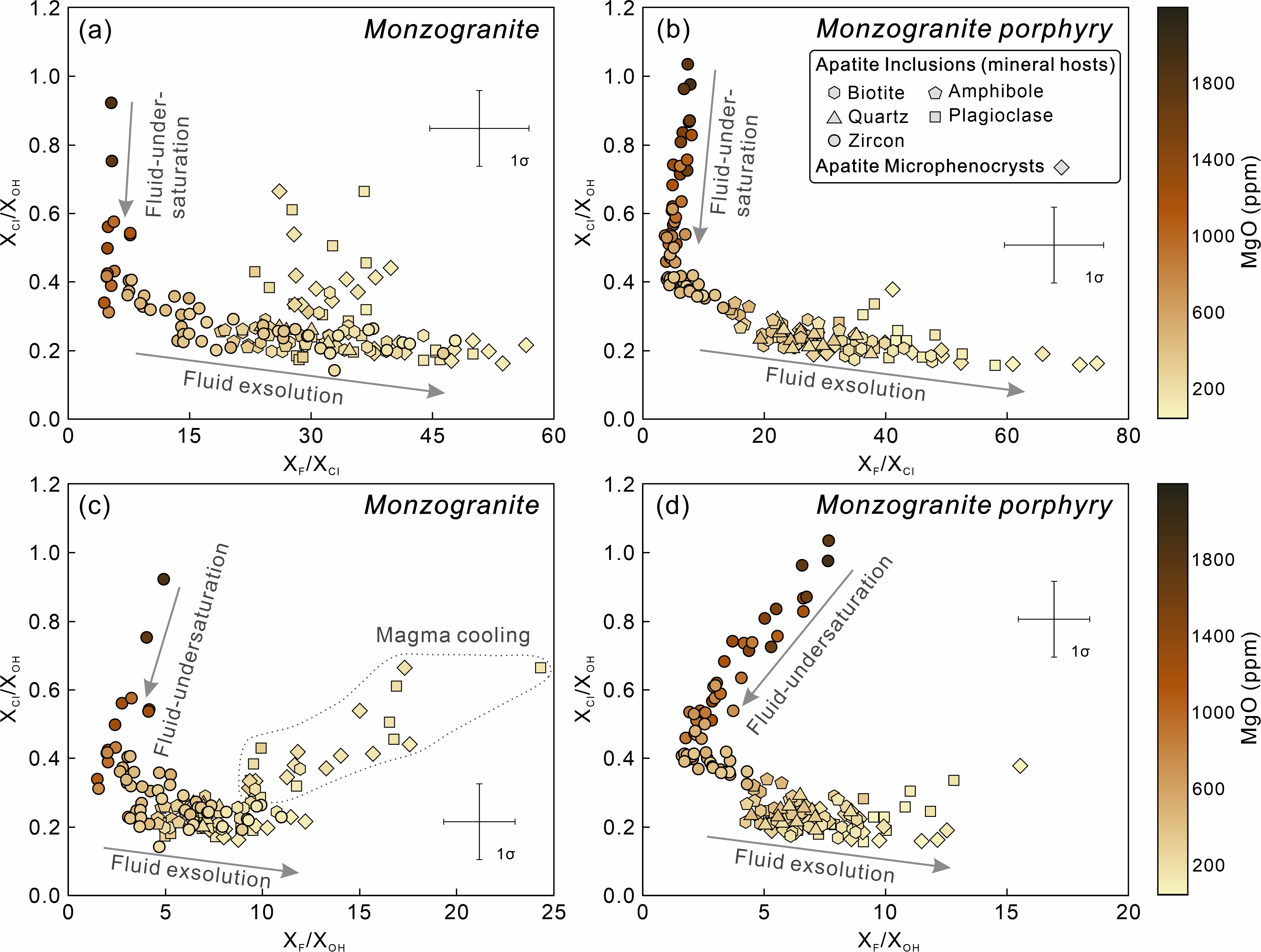
Reconstructing volatile evolution in melts using zirconhosted apatite inclusions: Implications for the use of apatite as a fertility indicator
https://doi.org/10.2138/am-2024-9561
The cathodoluminescence and chemical composition of apatite, particularly the Mn/Fe ratio and REE content, can effectively discriminate between primary magmatic apatite and hydrothermally altered apatite. Apatite-in-zircon is of superior value for reconstructing melt volatile evolution and could be a better Cu-fertility indicator than apatite inclusions hosted by other silicate minerals (e.g., amphibole, biotite, plagioclase, and quartz). Interpreted primary magmatic Cl contents are high in post-subduction porphyry Cu deposit and would effectively extract copper from melt to hydrothermal fluid during volatile exsolution in the magma chamber.
Vesuvianite as a key tool for the reconstruction of skarn formation conditions: An example from the Sauce Chico Complex, Argentina
https://doi.org/10.2138/am-2024-9588
The elasticity of the vesuvianite structure allows its chemical complexity and adaptation capability under different crystallization conditions, making it a useful mineral in the reconstruction of skarn formation conditions. The Loma Marcelo skarn is the result of superimposed processes related to the intrusion of an Ediacaran granite and the contribution of temperature and fluids related first to an alkaline early Cambrian magmatism and then to a Permian tectono-metamorphic event. The Loma Marcelo skarn vesuvianite reflects a retrograde process related to the Ediacaran magmatism. Despite subsequent events, the vesuvianite studied does not seem to undergo important structural modifications. That is, the vesuvianite structure is fixed at the time of its formation and does not change during later processes. This suggests that vesuvianite-group minerals have the potential to be a robust XRD-based thermometer as proposed by Panikorovskii et al. (2023), which does not undergo subsequent modifications, unlike, for example, stable isotope thermometers that require the isotopic equilibrium or fluid inclusions.
Germanium oxidation state and substitution mechanism in Ge-rich sphalerite from MVT deposits: Constraints from X-ray absorption fine structure (XAFS) and geometric optimization
https://doi.org/10.2138/am-2024-9485
Germanium is an abundant critical metal in sphalerite, especially in MVT Pb-Zn deposits. However, the distribution of Ge oxidation states in sphalerite remains unclear, and there is a lack of crystal structure information regarding the Ge substitution mechanisms into sphalerite. Based on synchrotron XAFS, we have observed that Ge4+ predominates when coupled with Cu, demonstrating a more ordered and stable structure. Conversely, when coupled by vacancy, a small amount of Ge2+ emerges, and the whole structure shows a significant disorder. The widespread Cu-Ge coupling mechanisms suggest that Cu plays a crucial role in facilitating the enrichment of Ge within sphalerite. The determination of the Ge oxidation state provides an important reference to infer the Ge substitution mechanism in sphalerite through elemental correlations. This study has modified the widely accepted Ge-vacancy coupling mechanism and confirmed that As enters the sphalerite lattice rather than being in nano-mineral Cu-S-As inclusions evenly distributed within sphalerite.
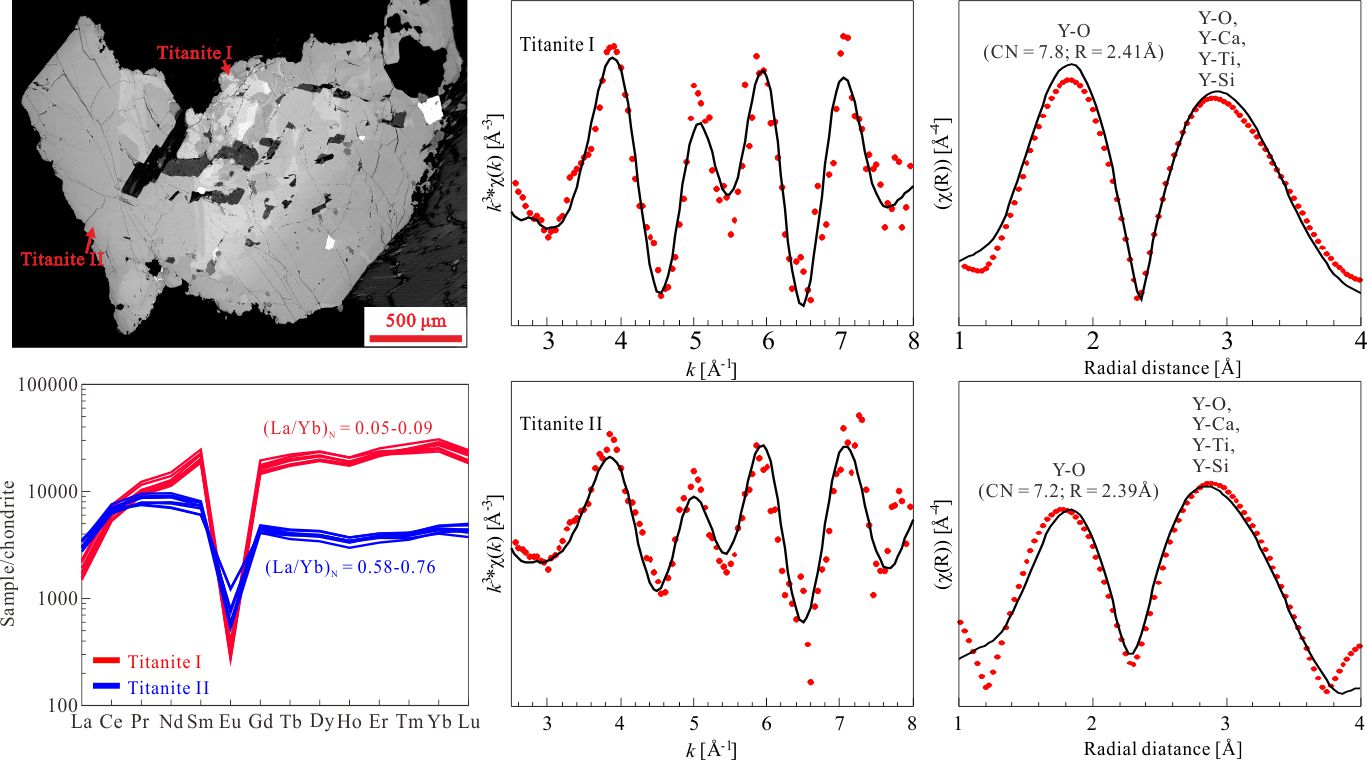
Enrichment mechanism of heavy rare earth elements in magmatic-hydrothermal titanite: Insights from SXAS/XPS experiments and first-principles calculations and implications for regolith-hosted HREE deposits
https://doi.org/10.2138/am-2024-9645
This study investigated two texturally distinct types of HREE-enriched titanite (titanite I and II) in granites from the Gucheng regolith-hosted HREE deposit in South China. The samples have different Y, HREE-O first shells, suggesting that Y3+ (and HREE3+) occupy the 7-coordinated Ca site via three substitutions, detailed by Feng et al. These findings support that the crystallization of HREE-enriched titanite in granites plays an important role in forming HREE-dominated regolith-hosted deposits.
Thorite: An oddity in phase stability among the zirconstructured orthosilicates at high pressures
https://doi.org/10.2138/am-2024-9443
Strzelecki et al. report a complete study of the thorite-to-huttonite transition under high pressure, with equations of state and bulk moduli derived for these two phases. The authors propose a new pressure-temperature phase diagram for ThSiO4 with an update for the boundary of the thorite-to-huttonite transition. As a result, the enthalpy of formation of huttonite, based on the Clapeyron equation, was found to be close to 0 kJ/mol, which suggests its metastability (and hence rarity) in natural systems.
High P-T single-crystal elasticity of zircon by Brillouin spectroscopy
https://doi.org/10.2138/am-2024-9458
Luu et al. performed high P-T single-crystal elasticity measurements of zircon using Brillouin spectroscopy at pressures up to 7 GPa and temperatures up to 700 K. The data have a high signal-to-noise ratio and provide the first high P-T single-crystal elasticity model of zircon. The study utilized the high P-T single-crystal elasticity data of zircon and garnet to evaluate the potential applications of zircon-garnet in elastic thermobarometry via elastic modelling. High incompressibility and stiffness over a range of T suggest zircon could be ideal to estimate entrapment conditions.
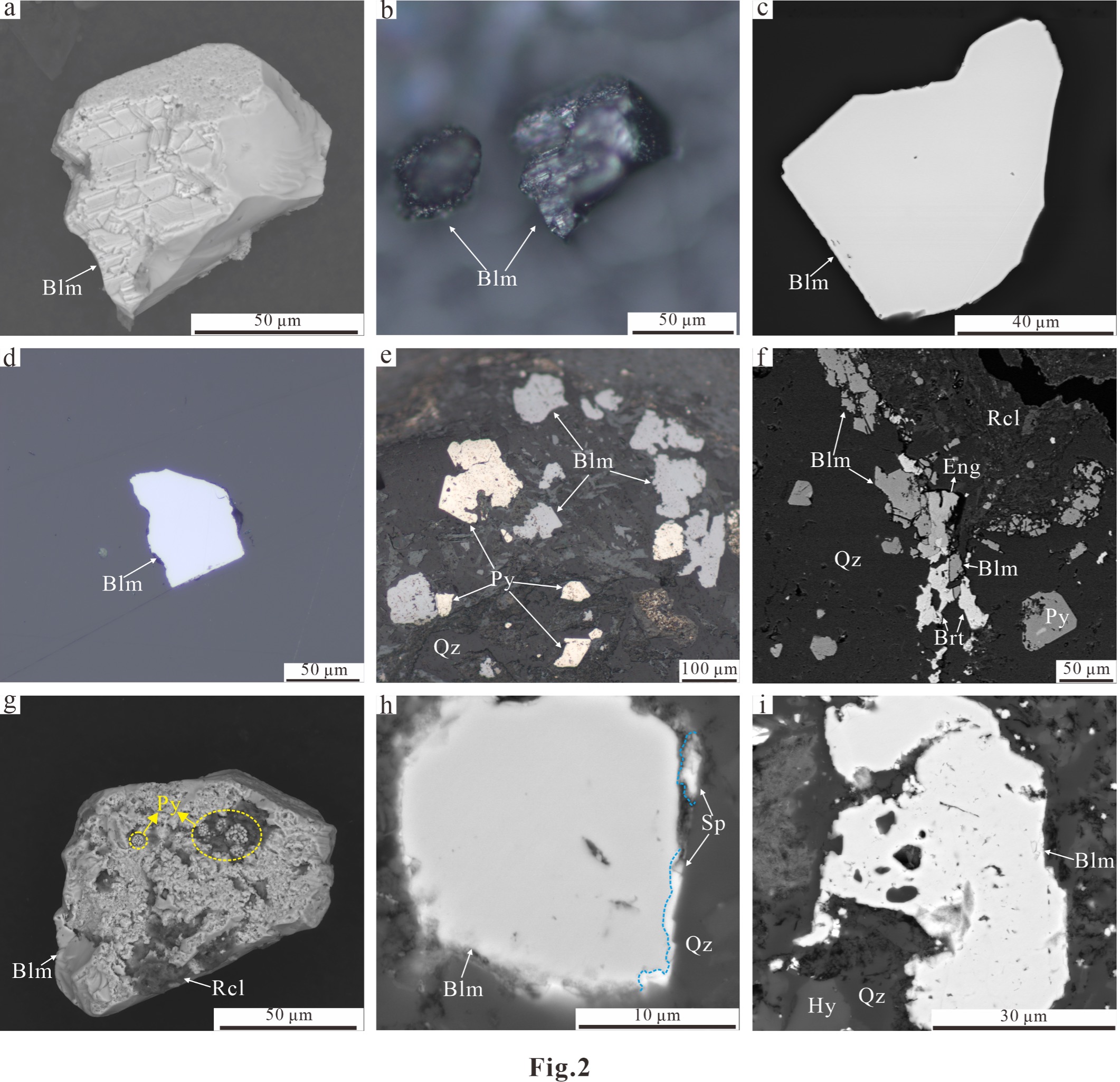
Berndlehmannite: A new V-bearing sulfide mineral from the black-shale-hosted Zhongcun vanadium deposit, South China
https://doi.org/10.2138/am-2024-9541
The new V-bearing sulfide mineral, berndlehmannite, was discovered in the black-shale-hosted Zhongcun vanadium deposit, South China. Berndlehmannite is a member of the carrollite subgroup within the spinel group. The ideal empirical formula of berndlehmannite is Cu(Cr,V)S6, and it has the highest component of V among the V-bearing minerals in black shales. The discovery of berndlehmannite potentially unveils a previously unrecognized hyper-enrichment process of vanadium in black shales, which requires further study.
In situ Raman spectroscopic investigation on the phase transition of grunerite at high pressures
https://doi.org/10.2138/am-2024-9560
In this study, Zheng et al. studied the phase transitions of grunerite at pressure up to ~23.66 GPa using a diamond anvil cell combined with in situ Raman spectroscopy. The study demonstrated the mode splits of the OH vibration modes with increasing pressure, corresponding to a C2/m-to-P21/m phase transition. The splitting of the OH stretching modes resulted from the distinct environments of two OH positions in the P21/m phase, in comparison to the crystallographically identical OH positions in the C2/m phase. The use of Raman spectroscopy, as presented, offers a quick and accessible analytical method for studying phase transitions in grunerite samples, with potential applications for other minerals within the amphibole group.
Silicate liquid immiscibility in the Chang'e 5 lunar mare magmas: Constraints on the petrogenesis of lunar granitic rocks
https://doi.org/10.2138/am-2024-9577
Silicon-rich melt inclusions hosted in fayalite fragments from Chang'e 5 lunar soil formed through late-stage silicate liquid immiscibility in lunar mare basaltic magmas. Their major and trace elemental compositions are similar to those of lunar granitic rocks. The results of this study support the possibility that lunar granitic rocks formed through silicate liquid immiscibility.
The high-pressure, vacancy-stabilized component in clinopyroxenes
https://doi.org/10.2138/am-2024-9609
Motivated by the recent discovery of albitic clinopyroxene, Baziotis et al. assess the molar volume of vacancy-rich, high-pressure clinopyroxenes. The authors compiled a series of data (including this study) and created a model for volumes of clinopyroxenes in a multi-component subsystem, showing that the symmetric excess volume model is the most appropriate way to fit the data. The proposed volume model provides a partial basis for assessing the formation conditions of vacancy-stabilized pyroxenes.
Lianbinite, (NH4)(C2H3O3)(C2H4O3), a new glycolate mineral from the Santa Catalina Mountains, Tucson, Arizona, U.S.A.
https://doi.org/10.2138/am-2024-9587
A new organic mineral species, lianbinite was discovered from the western end of Pusch Ridge in the Santa Catalina Mountains, north of Tucson, Arizona, U.S.A. Lianbinite is colorless and transparent, with a white streak, vitreous luster, low Mohs hardness (1–1 1/2), and perfect {100} cleavage. The crystal structure of lianbinite contains two forms of glycolate units: glycolate anions (GAs) and glycolic acid molecules (GMs), which alternate along [010] and are linked together by strong H-bonds to form chains. The discovery of lianbinite, together with other glycolate minerals documented thus far, namely lazaraskeite, stanevansite, domitrovicite, jimkrieghite, rasmussenite, and glecklerite, implies that glycolate minerals may be widespread in nature, thus serving as a potential reservoir for biologically fixed carbon.
Mariakrite, [Ca4Al2l(OH)12(H2O)4][Fe2S4]: A new mineral and the first layered double hydroxide intercalated with dithioferrate (iron disulfide) chains
https://doi.org/10.2138/am-2024-9624
This study reports the first representative of natural layered double hydroxides (LDH) with dithioferrate, [FeS2]– in the role of an interlayer anion, from pyrometamorphic rocks in the Negev Desert. The new mineral, mariakrite, is the first cementitious layered Ca-aluminate (AFm phase) intercalated with sulfide anion, and the first sulfide-bearing LDH with a completely solved crystal structure. Mariakrite is a unique example of dithioferrate in which disulfide chains have no contact with cations or anions, being suspended between hydroxide layers via the system of H-bonds. Consequently, the mineral might represent the near-ideal model for studying intricate physical properties of isolated quasi-one-dimensional dithioferrate chains. The chemical composition of mariakrite allows this mineral to be proposed as a single-phase precursor to forming meteoritic Ca-Fe oxysulfides in thermally metamorphosed carbonaceous chondrites of the CY group and their asteroid parent bodies.
NEW MINERAL NAMES
https://doi.org/10.2138/am-2025-NMN110915
New Mineral Names
BOOK REVIEW
https://doi.org/10.2138/am-2025-B110817
Book Review
Volume 110 : August 2025 Issue
Hematite (U-Th)/He thermochronometry unveils uniquev exhumation history: An example from the Dexing porphyry copper deposit, Southern China
https://doi.org/10.2138/am-2024-9555
Hematite (U-Th)/He thermochronology can be used to indicate the uplift and cooling history near the crust surface based on the optimized conditions that prevent U-loss and enhance accuracy. This study marks the first instance of integrating hematite, zircon, and apatite (U-Th)/He data to comprehensively track the temperature fluctuations associated with the uplift and exhumation history of porphyry deposits in China. Based on detailed hematite (U-Th)/He thermochronology analysis, the Dexing giant porphyry copper Deposit may have experienced a relatively long thermal history, with exhumation and uplift occurring at 112 Ma, and rapid uplift spanning a time range of 11.2 to 8 Ma.
Viscosity measurements of selected lunar regolith simulants
https://doi.org/10.2138/am-2023-9263
Stapperfend et al. measured the viscosities of a selected set of lunar regolith simulants at glass transition and superliquidus temperatures using differential scanning calorimetry and concentric cylinder viscometry. Results show that basaltic simulants have lower viscosities, which favors their use in lunar 3D printing due to their lower melting temperatures. The study also compares these findings with six viscosity models, crucial for advancing lunar construction techniques. An evaluation has been conducted to assess the suitability of various lunar regolith simulants for use in additive manufacturing techniques utilizing molten lunar regolith.
« ‹ 1 … 3 4 5 6 7 … 85 › »ADDITIONAL RESOURCES