Editor’s Notes
Total Results: 1697
Volume 110 : April 2025 Issue
Synthesis and characterization of Fe-poor olivine with applications to the surface of Mercury
https://doi.org/10.2138/am-2024-9400
Anzures et al. characterized synthetic olivine with minor amounts of Fe (i.e., Fo99.62-Fo99.99) using a variety of spectroscopic techniques. The results show that the characteristic 1 µm absorption band is detectable in reflectance spectra of olivine at a concentration as low as 0.03 wt% FeO as well as 0.01 wt% in continuum removed data. Additionally, MESSENGER's lack of a 1 µm absorption, taking into account MDIS's limited spectral resolution and MASCS's high signal-to-noise, suggests that there is less than 0.38 wt%, and likely less than 0.01 wt%, FeO on the surface of Mercury. Because the 1 µm band is not observed in surface spectra, these results indicate that the Fe observed on the surface of Mercury is not bound in an olivine structure but rather in Fe metal.
Macro- to nanoscale investigation unlocks gold and silver enrichment by lead-bismuth metallic melts in the Switchback epithermal deposit, southern Mexico
https://doi.org/10.2138/am-2024-9388
This study presents macro- to nanoscale observations on Pb-Bi sulfides and sulfosalts associated with Au-Ag in a low-temperature hydrothermal ore deposit of the epithermal type. These minerals show textural evidence indicative of crystallization from a metallic melt precursor that was being transported by an aqueous fluid below 400 °C. Such a melt, enriched in precious metals, likely contributed to focusing Au-Ag ores. Upon cooling, the melt crystallized Pb-Bi minerals that underwent replacement processes and gave rise to "false" exsolution-suggestive textures.
Multi-analytical characterization of an unusual epidote-supergroup mineral from Malmkärra, Sweden: Toward the new (OH)-analog of dollaseite-(Ce)
https://doi.org/10.2138/am-2024-9438
A study of a skarn sample from the Malmkärra iron mines, Norberg, Västmanland revealed the occurrence of a peculiar epidote-supergroup mineral. Taddei et al. examined this mineral using electron microprobe, single-crystal X-ray diffraction, Mössbauer and Fourier-transform infrared spectroscopy techniques. Structure refinements combined with electron-microprobe data indicate that: A1 = Ca0.96REE3+0.03Mn0.01; A2 = REE3+0.99Ca0.01; M1 = Mg0.40Al0.32Fe3+0.26Fe2+0.02; M2 = Al0.98Fe3+0.02; M3 = Mg0.72Fe2+0.17Fe3+0.11; T1,2,3 = Si2.93Al0.07, accounting for a total positive charge of 24.64. The likely incorporation of additional hydrogen in epidote-supergroup minerals exerts control on the mineral structure and properties and has various geological implications. Additionally, the importance of additional water in epidote-supergroup minerals is multifaceted, influencing their structure, properties, and role in various geological processes, such as metamorphism and hydrothermal alteration.
Titanite and allanite as a record of multistage co-mobility of Ti-REE-Nb-As during metamorphism in the Central Alps
https://doi.org/10.2138/am-2024-9378
The Binntal Valley, Switzerland, features a remarkable mineralogical diversity, making it one of the world's few mineralogical rainforests. Brugger et al. describe a new type of mineralization that results from the local remobilization of small amounts of titanium, niobium, rare earth elements, and arsenic during Alpine metamorphism. The authors show that most mineralogical diversity arises from the channeled flow of small amounts of CO2-bearing fluids during the exhumation of these rocks.
Unusual sulfide-rich magmatic apatite crystals from >2.7 Ga Abitibi Greenstone Belt, Canada
https://doi.org/10.2138/am-2024-9387
Meng et al. employed synchrotron-based X-ray absorption near edge structure (XANES) analysis to reveal the rare presence of sulfide-rich magmatic apatite crystals formed in the Abitibi Greenstone Belt 2.7 billion years ago. The XANES results indicate a weak S emission from Earth's interior to the surface, providing a potential explanation for the rarity of porphyry Cu deposits on early Earth despite the prevalence of sodic TTG rocks.
Jianmuite, ZrTi4+Ti5 3+Al3O16, a new mineral from the Allende meteorite and from chromitite near Kangjinla, Tibet, China
https://doi.org/10.2138/am-2024-9362
Borriello et al. describe the chemical composition and crystal structure of a new mineral jianmuite, ZrTi4+Ti3+5Al3O16. The mineral was found as (1) an inclusion in a corundum grain from the Cr-11 orebody near Kangjinla, Tibet, China (holotype and first co-type) and (2) several grains with corundum, mullite and other minerals in the matrix of the CV3 carbonaceous chondrite Allende (second co-type). The authors chose Jianmu, the sky ladder tree of Chinese myth, as the name for the new mineral, jianmuite.
Cabrerite, NiMg2(AsO4)2·8H2O, a new old mineral: The ordered intermediate between annabergite and hörnesite
https://doi.org/10.2138/am-2024-9498
Although cabrerite was first described in 1863, it has long been regarded as merely an Mg-rich variety of annabergite in the solid-solution series between annabergite and hörnesite. Previous studies of Mg-rich annabergite have shown the ordering of Ni and Mg in two distinct octahedrally coordinated cation sites, but in all past structure studies, both sites have been dominated by Ni. In the investigation of more Mg-rich crystals from the Nickel mine in Nevada, the authors have found Ni to be dominant in one site and Mg in the other, thereby qualifying the mineral as a distinct species—the ordered intermediate between annabergite and hörnesite. Based on tentative compositional boundaries in the annabergite-cabrerite-hörnesite series, the original material described as cabrerite from Sierra Cabrera, Spain, is likely to qualify as the same species, hence justifying the reuse of the name cabrerite. The newly described mineral is the third member of the vivianite group to be described based on the ordering of cations in distinct octahedrally coordinated cation sites.
Discovery of an Earthborn quasicrystal approximant
https://doi.org/10.2138/am-2024-9679
The discovery of proxitwelvefoldite, a new mineral and the first known terrestrial approximant of a dodecagonal quasicrystal, represents a significant advancement in understanding quasicrystal formation and its potential occurrence in terrestrial environments. Quasicrystals, previously only identified in extraterrestrial materials and metallic alloys, were considered highly unlikely to form naturally on Earth due to the reducing conditions required for the presence of metallic aluminum. However, the present finding challenges that assumption and expands the known geochemical contexts where quasicrystalline approximants might arise, and it invites a deeper exploration into the diversity of Earth's mineral systems, offering exciting new possibilities for discovering novel materials with unique properties.
Volume 110 : March 2025 Issue
Geochemistry and mineralogy of the shale-hosted vanadium Van Property deposit, Mackenzie Mountains, Northwest Territories, Canada
https://doi.org/10.2138/am-2024-9359
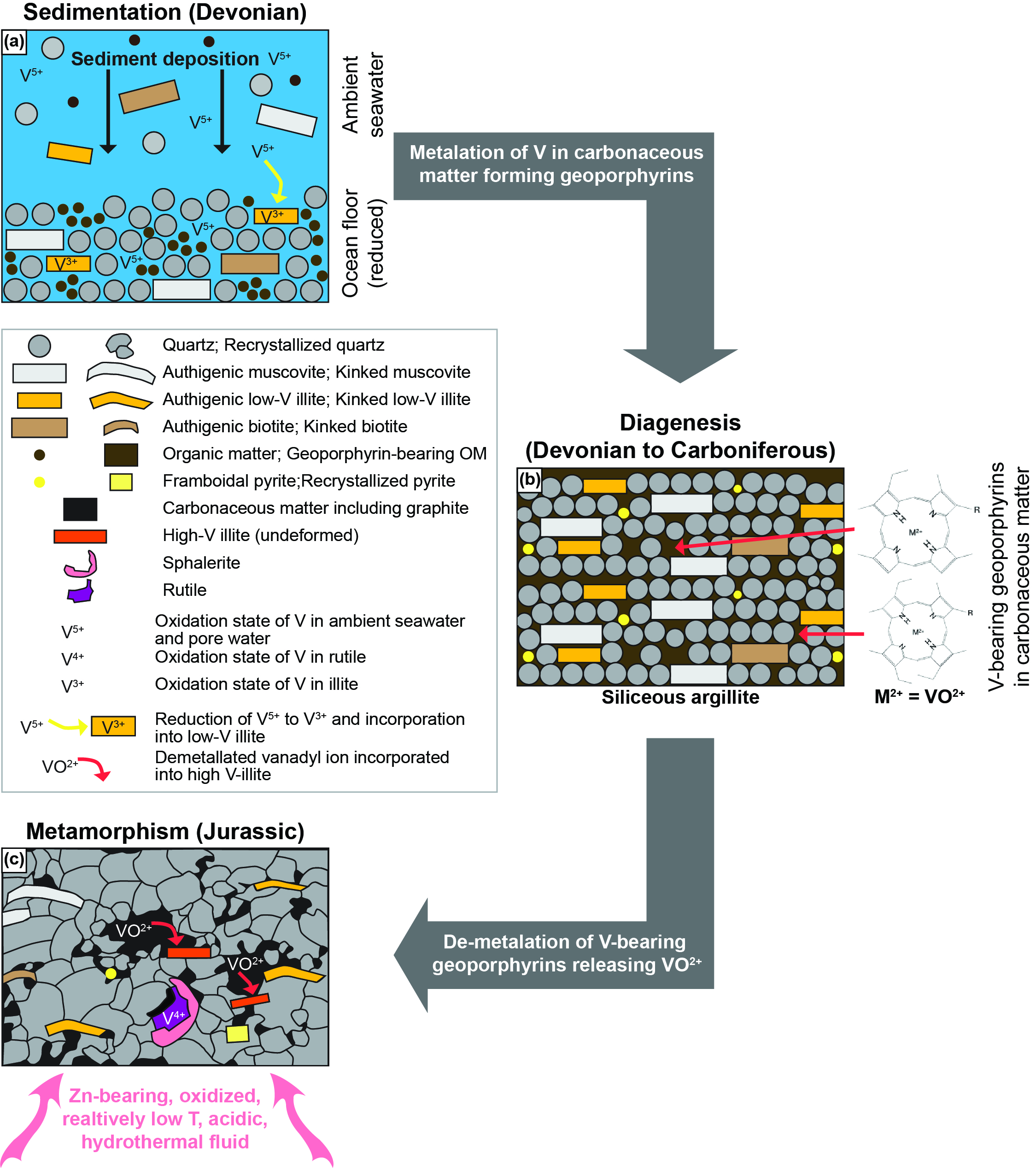
This study investigated the enrichment of V at the Van Property, Northwest Territories, using various methods. The results show that (1) V enrichment is not restricted to shale; (2) illite, rutile, and assumingly carbonaceous matter are the predominant V hosts; and (3) the genesis is a complex interplay of syngenetic (e.g., V scavenging from seawater), diagenetic (e.g., metalation of V forming organo-complexes), and metamorphic (e.g., release of V due to de-metalation; hydrothermal fluid interaction) processes. These results have implications for the role of metamorphism regarding V enrichment and exploration for shale-hosted V deposits.
Groundmass pyroxene crystal habits (trachts) record syneruptive magma dynamics in glassy pyroclasts
https://doi.org/10.2138/am-2023-9166
Textural variations in pyroclasts from explosive eruptions are known to record the complex magma dynamics during syneruptive ascent in conduits; however, it has not been possible to use textures to quantitatively evaluate transport mechanics of glassy pyroclasts containing few groundmass crystals. In this context, Okumura et al. advance the understanding of magma ascent dynamics by showing that pyroxene tracht analyses apply even to glassy pyroclasts. Tracht analyses also provide a glimpse of the processes controlling magma temperature via estimating the degree of effective undercooling. These findings should appeal to volcanologists, igneous petrologists, and mineralogists.
Transcrustal magmatic system in lamprophyre dike constructed by multiple magma reservoirs
https://doi.org/10.2138/am-2023-9271
Three different mineral assemblages with distinct textural and compositional characteristics are observed in lamprophyre dikes of western Tianshan. The magmatic system features early-formed recycled crystals, multiple magma replenishment events, peritectic reactions, and crystal fractionation. A petrogenetic model involving three levels of magma storage is proposed to interpret the lamprophyre transcrustal magmatic system.
Magma oxygen fugacity and volatile components control the Miocene high-Sr/Y granitoids forming either Cu or W mineralization in the Gangdese metallogenic region, Xizang, China
https://doi.org/10.2138/am-2023-9023
High-Sr/Y intrusions are generally responsible for porphyry Cu deposits. However, this study found that the Miocene high-Sr/Y granitoids in the Gangdese metallogenic region in southern Tibet can form porphyry Cu and wolframite deposits. Wang et al. conducted in situ chemical composition studies on magmatic biotite, apatite, and zircon from the W-related high-Sr/Y granites. The authors highlight the key roles of magma oxygen fugacity and volatile contents (H2O, Cl, and S) in controlling metal variations (Cu or W) in high-Sr/Y granitoids. Wang et al. also propose combined mineral chemical fertility proxies for W-mineralization-related high-Sr/Y granites as a cost-effective screening tool to identify their potential for W mineralization.
Structural variations along the apatite F-OH join: II. The role of hydrogen bonding in fluoridated teeth
https://doi.org/10.2138/am-2024-9393
Fluoride is one of the most consumed pharmaceuticals in the world, and its facility in preventing dental caries is recognized as one of the top 10 public health achievements of the 20th century. Although hydroxylapatite is often used as an analog of dental enamel, the details of the substitution of F for OH in the apatite anion column are not well known. Using new synthesis techniques, this work extends the structure work on P63/m apatites along the middle portion of the F-OH apatite join to compositions near the composition of fluoridated human teeth.
Phase transformation of ferric-iron-rich silicate in Earth's mid-mantle
https://doi.org/10.2138/am-2024-9410
The oxidation state of the mantle varies regionally and with depth, but the chemical behavior of Fe3+ in the deep Earth is less understood. This work examines the stability and physical properties of oxidized-iron-rich silicates in the mantle transition zone and lower mantle. Lv et al. find an easy transition path between two Fe3+-rich silicate structures, LiNbO3 and perovskite. Fe3+-rich silicate perovskite may form in the transition zone and is important to seismic wave speeds and mantle dynamics.
Insights into the structure of disordered layered lead oxychlorides: Twinning and short-range order in janchevite, Pb9VO10.25□0.75Cl2.5
https://doi.org/10.2138/am-2024-9414
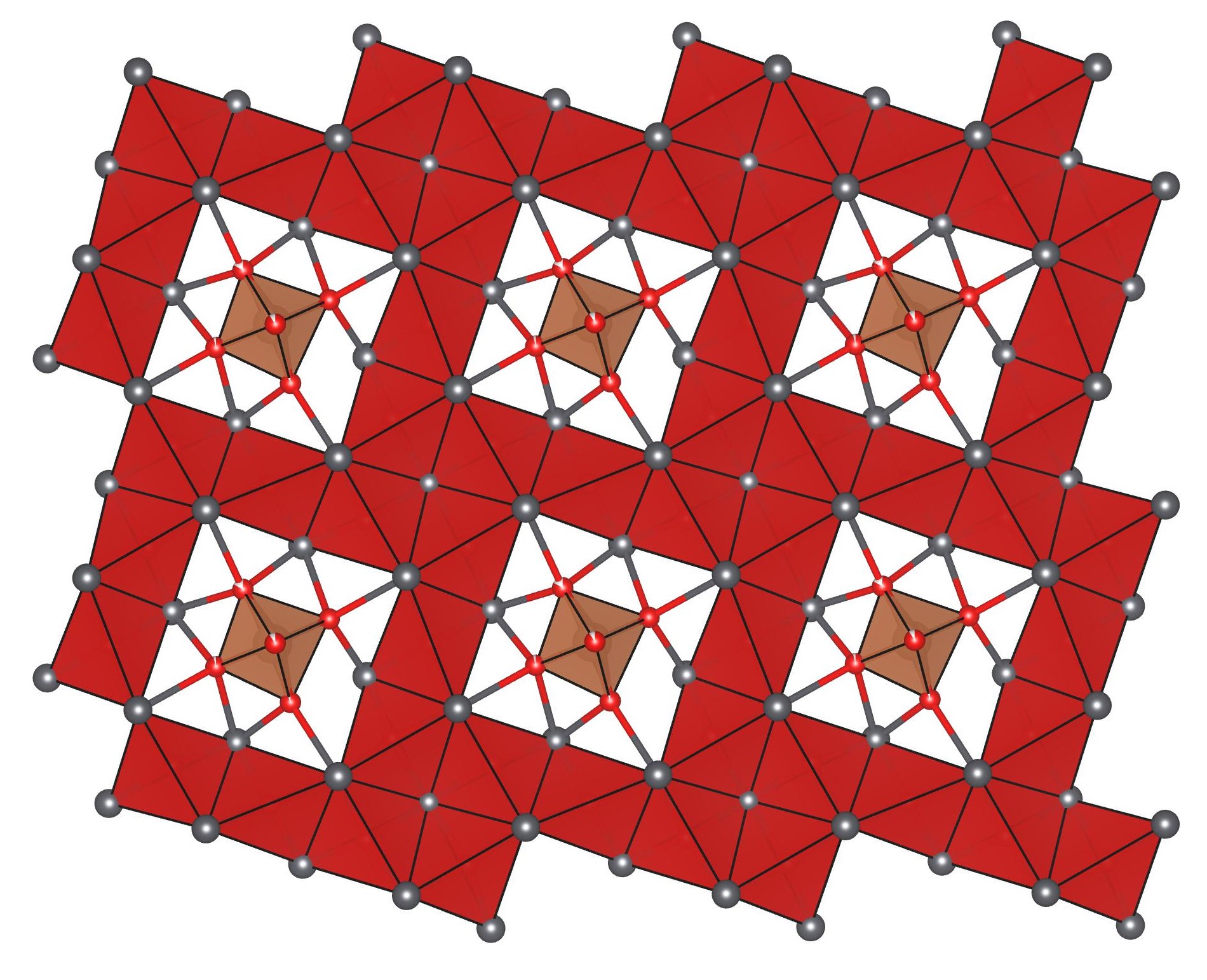
This investigation on the crystal structure of janchevite offers the opportunity to better understand the relationship between short- and long-range order in layered lead oxychlorides. It indeed provides insights into the relationship between atomic structure and physical and chemical properties, which are crucial for tailoring materials with specific functionalities. In this light, the investigation of short-range ordering phenomena is even more important since they are often reported to have a strong impact on several properties of functional materials.
Coexisting hematite induces and accelerates the transformation of ferrihydrite: Pathway and underlying mechanisms
https://doi.org/10.2138/am-2023-9281
Coexisting hematite nanoplates can significantly affect transformation rates, pathways, and products of ferrihydrite. Hematite surfaces can induce the heterogeneous crystallization of dissolved Fe3+ from ferrihydrite to hematite/goethite at preexisting hematite surfaces and further accelerate the transformation process. The recrystallization of Fe3+ at hematite surfaces, including crystallization products and growth modes, is highly facet specific.
Interfacial structure and acidity of the orthoclase (001) surface: Understanding the effect of the surface metal cation
https://doi.org/10.2138/am-2023-9207
Surface acidity is central to understanding the interfacial properties of orthoclase, but research is still lacking. Using first-principles molecular dynamics (FPMD) techniques, Zhang et al. investigate interfacial structures and acid constants of orthoclase (001) with surficial Na+ and K+ cations. They found that Na+ significantly enhances surface acid reactivity and thus may alter the complexation mechanism of foreign metal cations. The results in this study form a quantitative basis for investigating the properties and processes at orthoclase interfaces.
Mineralogical fingerprints of crustal silica contamination in the Bayan Obo carbonatite
https://doi.org/10.2138/am-2023-9297
For the first time, britholite and humite group minerals are identified in the No.1 carbonatite dike at the Bayan Obo REE-Nb-Fe deposit. They are rare and poorly understood silicates in the context of carbonatites. This study presents detailed petrographic observations (SEM, TIMA), EPMA, and LA-ICP-MS analysis of these minerals to constrain their crystallization environment and relation to the fenitization process.
The effect of the ANa-AK ratio on chlorine incorporation into hastingsitic amphiboles
https://doi.org/10.2138/am-2023-9083
The Cl content of amphiboles can be used to determine the Cl concentration of paleofluids, given a sufficient understanding of how Cl is incorporated into amphiboles. This study explores the effect of changes in amphibole composition and brine chlorinity on the amphibole’s ability to take up Cl. The authors determined that Na- and K-rich calcium amphiboles incorporate Cl comparably. These findings indicate that the Cl concentration of the fluid is the main variable controlling amphibole Cl content in Mg-free calcium amphiboles.
Paulišite, Ca2Zn(CO3)3·2H2O, a new mineral with a novel crystal structure
https://doi.org/10.2138/am-2024-9418
Sejkora et al. describe the properties of new mineral paulišite from Kaňk near Kutná Hora, Czech Republic (accepted by IMA 2023-031). The results of physical, optical, chemical, and X-ray analysis yielded single-crystal data appropriate for defining this new mineral species. The article considers the implications of the mineral’s formation from the weathering of sulfide ores.
« ‹ 1 … 7 8 9 10 11 … 85 › »ADDITIONAL RESOURCES